




Вы здесь
Mausoleum of Abdullah ibn Bureida.
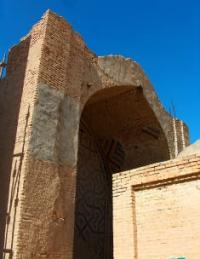
our of Mausoleum of Abdullah ibn Bureida.
"Kitab al-Ansab" also contains valuable information on the history of Central Asian administration. Thus, among the first governors of Khorasan, as-Sam'ani mentions al-Hakam ibn 'Amr al-Ghifari (d. 50-670), who was a companion of the Prophet Muhammad. Due to disagreements with Ziyad, the son of the Caliph Yazid ibn Mu'awiya, al-Hakam was deposed, imprisoned, and died in chains (14, v. 9, pp. 165-166). Ibn al-Athir specifies that al-Ghifari was removed from power by Caliph Mu'awiya (ruled 35-60 – 656-680) for refusing to divide the gold and silver plundered in Khorasan between the Caliph's men and his son Ziyad (112, vol. 3, p. 237). According to al-Sam'ani, before his death, al-Ghifari bequeathed that his body be buried in chains, which was fulfilled. His grave in the Tannurgaran cemetery was known and revered by people even in the 12th century (14, vol. 9, p. 166). Its remains survive to this day in the southern part of the Sultan-kala settlement, 15 meters from the grave of another companion of Muhammad, Buraydah ibn al-Husayb al-Aslami (d. 61-680-681). In the 15th century, monumental mausoleums were erected over their graves, which still survive (205, pp. 400-402).
"Kitab al-ansab" by Abu Sa'd 'Abd al-Karim ibn Muhammad al-Sam'ani. 6th century AH - XIIth century CE.
Architectural features of Mausoleum of Abdullah ibn Bureida.
Mausoleum of Abdullah ibn Buraydah, located at an altitude of 234 m. a. s. l. m., is located 10 meters east of Al-Hakim ibn Amr Al-Ghifari Mausoleum, 1.4 kilometers southeast of Sanjar Mausoleum, 2.6 kilometers southwest of Erk-Kala Fortress, 29.2 kilometers east and slightly north of city of Mary, within Ancient Merv State Historical and Cultural Reserve, in Bayramaly Etrap of Mary Province.
The Mausoleum of Abdullah ibn Bureida is located at the intersection of early Islamic history, medieval Merv, and the folk spiritual traditions of Turkmenistan.
Mausoleum of Abdullah ibn Bureida is a sacred site in ancient Merv.
Amid the vast desert expanses of Turkmenistan, in the famous Merv Oasis, lies one of the most revered Muslim shrines in Central Asia - the Mausoleum of Abdullah ibn Bureida. For centuries, this site has attracted pilgrims, historians, and travelers, recalling the early centuries of the spread of Islam in the lands of ancient Khorasan.
The shrine is located in the historic city of Merv, one of the largest cities of the medieval East, which was called the "Pearl of Khorasan" and the "Mother of the World" at various times.
Geographical location of Mausoleum of Abdullah ibn Bureida.
The mausoleum is located within the ancient Merv Oasis, located in the Murghab River valley, in what is now Turkmenistan. The oasis was formed by the extensive system of branches and canals of the Murghab River, which, descending from the mountains of Afghanistan, disappears into the sands of the Karakum Desert.
Since ancient times, this territory has served as a bridge between Iran, Central Asia, India, and the Eurasian steppes.
Natural Environment of Merv Oasis.
To understand the significance of the mausoleum, it is necessary to imagine the natural environment in which it arose. Merv is surrounded to the west and north by the sands of the Karakum Desert, one of the world's largest deserts. However, thanks to the waters of the Murghab River, a unique green island has emerged here amidst the arid landscape.
The region is characterized by a sharply continental climate, hot, long summers, mild winters with little snow, extremely low precipitation, and high evaporation. Summer temperatures often exceed 40°C. It was the presence of water that made Merv one of the most important centers of civilization in Central Asia.
History of Mausoleum of Abdullah ibn Bureida.
Mausoleum of Abdullah ibn Burayda, a centric mausoleum (mazar), was built in the 1070s-1080s. This classical chortak mausoleum was erected by the master Abu Bakr over the grave of Abdullah ibn Burayda, the son of one of the companions of the Prophet Muhammad, a Sahaba who died in 681 and was buried in Merv.
It was built by order of a certain Abu Bakr and Muhammad, the son of Abdullah. The Merv region, where it was built, was a highly cultured metropolitan area of Margiana from the IXth to the XIIth centuries. According to S. G. Khmelnitsky, renovations were carried out in the early 1930s (by whom is not specified), which the scholar assesses as "possibly the only distortion of the original appearance of the structure, in which even the dome - one of the most vulnerable parts of ancient buildings - seemed to have been unmolded."
As a result, the cubic volume was crowned with a profiled cornice of modern brick. The monument was discovered and first studied by researchers in 1958. In the Xth-XIth centuries, small buildings with domes were erected over the tombs. The mausoleums, which reached a height of 12 meters, were not built until the XVth century, when Merv became part of the Timurid Empire.
Merv was soon abandoned, and the mausoleums began to decline, although believers continued to make pilgrimages there. In the late 19th century, when Russian travelers began to explore the ruins of Merv, the Askhab mausoleums had significantly deteriorated.
In 1914, a restoration was completed, restoring its original appearance, and in 2013, a second restoration was carried out by Turkish craftsmen. During the construction of the mausoleums in the 15th century, black marble tombstones were created.
They were decorated with beautiful carvings inscribed with the names of the Companions and floral motifs. Aywans were built behind them, adorned with blue and turquoise tiles, almost none of which survive today. On the back wall of the hall, the word "Allah" is inscribed in large Kufic script.
Who is Abdullah ibn Bureydah?
Abdullah ibn Bureydah is considered one of the most famous figures of the early Islamic world. He was the son of Buraydah ibn al-Husayb, a companion of the Prophet Muhammad. According to Islamic tradition, Abdullah was renowned for his scholarship, piety, and profound knowledge of religious sciences.
He lived in the VIIth-VIIIth centuries and belonged to the generation of Tabi'een - Muslims who lived during the time of the Prophet's companions but did not meet the Prophet Muhammad himself. Historical sources report that Abdullah ibn Burayda spent a significant part of his life in Khorasan, where he spread Islamic knowledge.
According to Muslim tradition, Hakam and Burayda arrived in Merv in the VIIth century as part of the first Arab contingents that brought Islam to the east. However, unlike simple warriors, they were missionaries, bringing not only a new word but also the principles of justice and faith.
Their sermons were gentle and persuasive, and their righteous lives were modest and impeccable. They carried a message of peace and unity, not conquest, and earned the deep respect of the locals. After their deaths, they were buried in the Merv region, which at the time was one of the largest cities in the nearby Islamic world, and this proximity became an eternal symbol of spiritual brotherhood in the name of truth.
Ancient Merv - a city of great civilizations.
The mausoleum cannot be considered separately from the history of Merv itself. For over two millennia, successive cities existed here. Merv was part of the Achaemenid Empire, the kingdom of Alexander the Great, the Parthian Empire, the Sassanid Empire, the Arab Caliphate, and the Seljuk Empire.
In the XIth and XIIth centuries, the city was one of the largest metropolises in the world. Important branches of the Silk Road passed through it. Merv was famous for its libraries, madrassas, caravanserais, and gardens.
Architecture of Mausoleum of Abdullah ibn Bureida.
The modern mausoleum is a relatively small religious building, repeatedly rebuilt over the centuries. Its architecture is characterized by: a traditional Central Asian dome, brickwork, laconic exterior decoration, emphasized austerity of form. The main value of the monument lies not so much in its architectural expressiveness, but in its spiritual significance and historical memory associated with the name of Abdullah ibn Bureida.
The architectural appearance of the two mausoleums reflects the spirit of the early Islamic era, where simplicity, peace, and a sense of eternity reigned supreme. The brickwork, darkened by time, is striking in its craftsmanship. There are no mosaics, carvings, or elaborate paintings here - only pure, austere lines and the interplay of light and shadow, creating a unique poetic quality to the space.
This laconic architecture reveals the essence of an era when faith was expressed not through decoration, but through actions, steadfastness, and profound memory. The mausoleums leave a profound impression with their simplicity: their austere forms convey eternity, and their silence reveals centuries of history.
This architectural restraint recalls early mosques, where functionality and spirituality, rather than opulence, played a central role. The absence of lavish decoration forces one to focus on what is most important—the memory of those buried here.
Over time, as Islamic architecture became more decorative, these mausoleums remained models of their original simplicity and purity. In the XVth century, the new rulers of Merv built two deep, vaulted iwans (above-the-ground vaults) over the brick tombs, positioned strictly along the axes of the tombs.
The architecture of the iwans is a unique echo of the capital architecture of the Timurid Empire, which flourished in Central Asia and was intended not only to exalt rulers but also to preach Islam - the ideology that underpinned the spiritual and secular authority of Timur and his successors.
Between the mausoleums and the iwans is a paved courtyard where pilgrims and travelers could find refuge from the scorching heat. A short distance from the mausoleums, an ancient sardoba (a subterranean water reservoir) remains - it once served as a source of life for all who visited the site.
Its presence indicates that the area around the mausoleums was not simply a burial site, but also an important stop along caravan and pilgrimage routes. The building is oriented with its corners facing the cardinal directions, a rarity for Central Asian mausoleums.
The small building, with external dimensions of 3.8x3.8 meters and internal dimensions of 2.6x2.6 meters, is constructed of baked brick. Oriented with its corners facing the cardinal directions (a rarity for mausoleums), it opens on four sides with axial arched openings that appear wider from the outside due to wide niche frames of the same arched shape, with arches of an unusual three-layered construction.
The sparse decoration of the facades is limited by horizontal panels with inscriptions in Kufic script, located at the top of the walls and slightly short of the corners. The relief letters of the inscriptions are composed of hewn bricks of the same size and quality as those used in the building's masonry.
The narrow spaces between the corners and edges of the panel are decorated with diamond-shaped carved bricks, set one above the other along the axis of these spaces - the only other element of relief decoration, aside from the inscriptions, and a very modest one.
The facades, as is customary in a chortak, are identical, but the southeastern facade was apparently chosen as the main one: here, beneath the panel with the brick inscription, there is another, narrow (20 cm high) panel, densely filled with a Kufic inscription carved into the ganch (the names of the mausoleum's founders are inscribed).
Authority:
Yazgul Tirkishova.
Chief Curator of the Ancient Merv State Historical and Cultural Reserve.
https://www.infoabad.com/5872-mavzolei-ashabov-v-merve-drevnie-islamskie-svjatyni.html
Legends and folk tales about mausoleum of Abdullah ibn Bureida.
Like many holy sites in Central Asia, mausoleum is surrounded by numerous legends.
Legend of the blessing of oasis is associated with mausoleum of Abdullah ibn Bureida.
According to legend, during a severe drought, the residents of Merv turned to Abdullah ibn Bureida for help. The righteous man prayed, after which the waters of the Murghab River once again filled the oasis canals. According to local legend, the water from this sardoba possessed miraculous powers.
Legend has it that during a severe drought, when the wells dried up and people suffered from thirst, an elder came to the sardoba and, bowing his head, asked the Companions for a blessing. Before he could finish his prayer, a spring gushed from the ground, filling the sardoba to the brim.
This miracle saved the local residents and strengthened their faith. Since then, people have come here in hopes of a miracle, believing in the power of spiritual intercession. Since then, locals have considered him the patron of fertility and prosperity.
A legend about a traveler in desert is associated with mausoleum of Abdullah ibn Burayda.
According to another legend, a caravan once got lost in the sands of the Karakum Desert. The travelers had already given up hope of finding water when a gray-haired old man appeared to them and showed them the way to a saving spring. Upon reaching the oasis, the people recognized him as Abdullah ibn Burayda.
Therefore, pilgrims have long prayed to the saint for a safe journey.
A legend about an ever-burning light is associated with mausoleum of Abdullah ibn Burayda.
The right tomb contains the remains of Buraydah ibn Husayb, who came from the Aslam tribe. He met the Prophet during the Hijra, when Muhammad migrated from Mecca to Medina. Burayda, like other warriors, tried to capture the Prophet, but after they met and talked, he changed his mind, converted to Islam, and began guarding the Messenger of God.
Traditions say that Burayda told the Prophet that Medina should not be entered without a standard, removed the headband from his head, and attached it to a spear. Thus, he became Muhammad's standard-bearer. Burayda subsequently participated in many military campaigns, spreading Islam, the last of which was the capture of Khorasan, whose capital was Merv.
After his death, a hundred years later, during the Seljuk Empire, the southern gate of the Sultan-kala was named Alamberdar, which translates as "standard-bearer."
Spiritual significance of the shrine – mausoleum of Abdullah ibn Burayda.
For centuries, the mausoleum was one of the pilgrimage centers of Khorasan. Merv residents and pilgrims from distant cities and towns in Turkmenistan, believers from Iran, and residents of Afghanistan and Uzbekistan come here. During a tour of Merv, it is recommended to visit the graves of the Prophet's companions, people who lived during the birth of Islam.
A visit to the mausoleum was traditionally combined with visits to other holy sites in ancient Merv. Today, the site of ancient Merv is a UNESCO World Heritage Site. The Ancient Merv Historical and Cultural Park is considered one of the most significant archaeological complexes in Central Asia.
Preserved here are ancient settlements, mausoleums, fortresses, palace remains, and religious buildings from various eras. The Mausoleum of Abdullah ibn Bureida is an important part of this unique historical landscape.
Tourist information for visiting Mausoleum of Abdullah ibn Bureida.
Best time to visit:
March to May; September to November.
During these months, the climate is most favorable for excursions to ancient Merv.
The nearest large city is Mary, from where trips to the archaeological complex are organized. During a visit, it is recommended to see: the Mausoleum of Sultan Sanjar, Greater Kyz-Kala; Lesser Kyz-Kala, Gyaur-Kala, and Erk-Kala.
Conclusion about Mausoleum of Abdullah ibn Bureida.
The Mausoleum of Abdullah ibn Bureida is more than just the burial place of a revered Islamic saint. It is part of the centuries-old history of Merv – a city that for centuries connected the civilizations of the East and West. Set against the backdrop of a green oasis amid the sands of the Karakum Desert, the shrine recalls the early centuries of the spread of Islam in Central Asia, the outstanding theologians of the past, and the inextricable connection between spiritual culture and the history and nature of ancient Khorasan.
For the pilgrim, it is a place of prayer and remembrance, for the historian, a testimony to a great era, and for the traveler, an opportunity to experience one of the most ancient cultural landscapes of Eurasia.
Geographical coordinates of Abdullah ibn Bureida Mausoleum: N37°39'11 E62°10'17
Authority:
https://ru.wikipedia.org/wiki/%D0%9C%D0%B0%D0%B2%D0
Yazgul Tirkishova.
Chief Curator of the Ancient Merv State Historical and Cultural Reserve.
https://www.infoabad.com/5872-mavzolei-ashabov-v-merve-drevnie-islamskie-svjatyni.html
Alexander Petrov.
Photos by:
Alexander Petrov.