




Вы здесь
Mount Kazygurt.
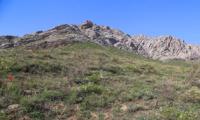
Excursion to Mount Kazygurt.
"About 50 versts from Tashkent stands a mountain called Kazygurt-Ata - that is, 'Father of Mountains.' It is said that Noah's Ark came to rest there, and that a massive petrified plank lies upon the mountain to this day."
Lieutenant Karl Miller and Surveyor A. Kushelev. "Trade Mission to Tashkent," 1738-1739.
"...the twin-peaked summit of Kazygurt, notable not so much for its height (about 5,000 feet) as for its renown among the region's Muslim population as the burial place of the saint Kazy-kurt and the resting place of Noah's Ark after the Flood. A host of legends and tales surrounds this 'Turkestan Ararat,' and Kyrgyz (Kazakh - Author) bards, playing the kobyz and dombra, still recount in their songs the animals that were saved in the Ark atop Kazygurt."
Encyclopedic Publication of Russia*, 1913, p. 606.
Sacred sites of Mount Kazygurt.
Mount Kazygurt, elevation 1,769 m. a. s. l. It is situated in the eastern part of the mountain range of the same name - which forms the western spurs of the Karzhantau Range within the Western Tian Shan system - 14 km southwest of the village of Birinshi Mamyr, 17.6 km east of the village of Rabat, and 30 km south (and slightly east) of the city of Shymkent, at the junction of the Tole Bi and Kazygurt districts of the Turkistan Region.
Mount Kazygurt (also known as Kazkurt-Ata or Kozyurt) is a sacred mountain. It acquired this status through local folklore; a legend prevalent among local residents holds that, following the Great Flood, the Ark of Nuh-Paygambar (Prophet Noah) came to rest at the summit of Kazygurt.
The mountain’s significance was also noted in a Russian encyclopedia from the early XXth century:
"...the twin-peaked summit of Kazykurt, remarkable not so much for its height (about 5,000 feet) as for its widespread renown among the region's Muslim population as the burial place of the saint Kazy-kurt and the resting place of Noah's Ark after the Flood.
A number of legends and tales have been woven around this Turkestan Ararat, and Kyrgyz (Kazakh - Author) singers, playing the kobyz and dombra, still recount in their songs the animals that were saved aboard the Ark at the summit of Kazygurt.
The place name Kazykurt is first recorded as the settlement “Gazkerd”
- located on the route from Shash (Tashkent) to Ispijab (Sayram) - in the writings of the IXth-century Arab geographer Ibn Khordadbeh; he is believed to have relied on sources dating back to the mid- or late VIIIth century.
Shortly thereafter, the name appears in Qudama ibn Ja'far's description of the route from the city of Shash to Ispijab:
"From the city of Shash to the military camp within the wall is 2 farsakhs; from there to Gazkerd is 5 farsakhs. From Gazkerd across the desert to Ispijab is 4 farsakhs."
(Depending on the terrain, one farsakh ranges from 6 to 8 km.) In the Xth century, the Arab geographers al-Istakhri and al-Muqaddasi wrote about Gazkerd as a settlement. It is hypothesized that the name Gazkerd originated from the name of the mountain at whose foot the settlement lay.
The distance of 4 farsakhs (approximately 32 km) roughly corresponds to the location of Mount Kazykurt relative to Ispijab (modern-day Sayram). The settlement is also mentioned as Kazgirt or Kadgirt in a Turkic-language manuscript dating to the mid-XIVth century.
It should be noted that these sources contain no information identifying Mount Kazykurt as the resting place of the famous ark. The etymology remains unclear. Most researchers believe the oronym consists of two parts. Some authors link it to the names of ancient Turkic tribes, specifically the paired combination Kaz and Kurt.
Others derive it from the word ker, meaning "dragon"; based on this interpretation, some translate the oronym as "Dragon (Mountain)." According to B. Baitanaev, the mountain was perceived as a holy, sacred site by Christians and was reinterpreted in terms such as "encampment on the mountain," "mountain settlement," or "mountain haven."
However, this theory is contradicted by the existence of two other mountains in Kazakhstan bearing the name Kazygurt. It should be noted that the Kazakh-Central Asian legend regarding the stopping of Noah's Ark during the Great Flood applies only to the Kazygurt mountain in the Turkistan region.
The existence of at least three mountains with the same name suggests that... Kazygurt is most likely an archaic geographical term that served to designate some feature of the mountain. As a mountain, the Turkestan Kazygurt was first mentioned in the book of Vain ad-Din Vasifi “Amazing Events”, in the description of the campaign of Ubaydullah Khan.
The author notes that the khan stopped on June 10, 1537 at the foot of Mount Kazykurt, where:
“he offered up his prayer to the palace that listened to the prayers.”
Judging by the fact that when describing the subsequent route of the Khan’s campaign, during which mountains were repeatedly encountered, there is no information about the performance of any ritual actions near other mountains, it can be assumed that Ubaydullah Khan and his entourage were familiar with the legends about the sacredness of Mount Kazykurt.
Therefore, the mention of a XVIth-century author can be considered the first documentary evidence of the veneration of this mountain.
In Russian sources, the Turkestan mountain is first found in the materials of the trip of Lieutenant Karl Miller and surveyor A. Kushelev in 1738-1739. to Tashkent:
“From Tashkent, about 50 versts away, there is a mountain called Kazgurt-ata, i.e. Father to the mountains. They say about it that Noah’s Ark stood on it, and now a great petrified board lies on that mountain.” This message by K. Miller serves as evidence of the existence of Turkestan legends about the global flood during the late Middle Ages, in which Kazygurt occupied the top step in the hierarchy of mountains (“the father of mountains”) and was the stopping place of Noah’s Ark, from which “a great fossilized board has been preserved on that mountain.”
Somewhat later, “Mr. Kazgurt-ata,” most likely based on data from K. Miller’s expedition, appeared on the map of the Russian cartographer I. Islenyev, compiled in 1777. After 70 years, the local legend is celebrated by Philip Nazarov. The toponym Kazygurt in the form Kozygurt is noted in his book about his travel to Kokand in 1813.
When describing the route of the caravan from Shymkent in the direction of Tashkent, we find the following lines:
“The next day we reached the highest mountain Kozygurt, at the height of which, the Asians claim, that the bottom of Noah’s Ark is located. Since this mountain has many ridges and gorges in which predators hide, I could not be on it.”
It is interesting that Mount Kozyurt is marked on the map of the German naturalist, geographer and traveler A. Humboldt (1769-1859). The long grave of Kazygurt-ata is made of stone on the mountain.
The first description of the holy place belongs to the geologist and geographer I.V. Mushketov, who visited the top of the mountain in 1874:
“...on it there is the grave of Saint Kazygurt with, of course, a sacred tree, it seems, the only one in all of Kazygurt, hung with multi-colored rags - a symbol of the respect of the faithful for the grave of the saint. For my audacity to climb to the top of the Kyrgyz Ararat, I paid with illness and therefore could not complete the crossing of Kazykurt at the western end.”
Pilgrims usually place pebbles on the grave of Kazykurt-ata. It is believed that no matter how many pebbles are placed on a holy place, the volume of the grave mound does not increase. Most likely, the stones and strips of material are offerings from pilgrims to the saint.
Climbing the mountain at least once a year is considered a pious and godly deed among Muslims. To this day, local residents have retained the idea that climbing the mountain eliminates sins. On the western side of the peak, between blocks of stones, there is a depression with a flat bottom.
According to legend, this is “Keme Kalgan” - “the place where the ship stood.”
According to a recording from the late XIXth century, the legend was also sung in poetic form:
"A ship stopped at the top of Kazykurt,
If he were not great, holy, then why would he stop?
At the top of Kazykurt, an orphan camel escaped; his patron was Uvays-il-Kara!”
It is noteworthy that the legend focuses most of its attention on saving livestock; almost all the patrons of livestock are named - Oysylkara, Zhylky-ata, Zengi-baba, Chopan-ata. The earliest archaeological monuments on Mount Kazygurt are the burial mounds of ancient nomads.
Noteworthy is a chain of three mounds with stone embankments with a diameter of four to six meters, located on a ridge adjacent almost perpendicular to the southern slope in the middle of the Kazykurt saddle. Similar burial structures, explored in close proximity to Kazygurt, are attributed to the period of early nomads and date back to the Vth-IIIrd centuries. BC e.
A large mound with a diameter of 60 m and a height of 3.5 m was noted by A.I. Bernshtam in 1948 near the village of Rabat. Most likely, the cult of Mount Kazykurt initially formed among early nomadic herders, who, judging by archaeological monuments, were the first to develop this territory.
“Beautiful pastures, fresh spring water and cool air attract "Kazykurt teems with nomads and their herds; even in June, when I visited the summits of Kazykurt, its ridge and all the broad meadow valleys sloping to the south and north were already occupied by numerous auls (encampments) of the Kyrgyz (Kazakhs - Author), while the well-fed livestock - especially the stout camels - bore witness to the beneficial influence of the Kazykurt pastures,"
- wrote I. V. Mushketov.
An interesting structure was discovered near the burial mounds: a cross laid out in stone, measuring 4 meters in width and 32 meters in length. Various theories regarding the cross's origin have circulated; one version suggests it was a ritual structure built by followers of the prophet Zarathustra.
However, new evidence has since emerged refuting the theory of the cross's ancient origin, revealing instead that it was constructed in the 1930s. A spring and the tomb of Akbura-ata are located at the mountain's southwestern foot. Childless women, or those who have frequently lost children, come here to visit.
They perform rites of veneration at the holy site, offer livestock as sacrifices, spend the night, and pray for offspring. Near the village of Akbastau lies a cave - the abode of the saint Kozdi-ata. Inside the cave rests a stone marking the spot where Kozdi-ata used to offer his prayers.
A spring flows near the cave, alongside the saint's tomb. The site is believed to aid the blind. Shilter-ata is a sacred place where, according to legend, forty saints - known as Ghayyp Erten Kyryk Shilten - stopped for the night before mysteriously vanishing without a trace.
This legend echoes Sufi concepts regarding Muslim saints known as ghayb (Arabic for "absent," "vanished," or "hidden"). Three springs, considered to have healing properties, well up from the ground at the holy site. Nearby grows a mulberry tree where pilgrims offer prayers.
Higher up stands a rock formation nearly ten meters high, where pilgrims often spend the night. The rock is split in two: one part is called Ata (Father) and the other Ana (Mother). Pilgrims make their way through the narrow fissure between them.
It is believed that sinners get stuck in the crevice, or that the saint’s snake - which dwells within - bars the way to the sinful.
A publication by ethnographer and folklorist A. Divaev featuring legend of Kazykurt Ark:
Upon the peak of Kazykurt, the ship came to rest;
Had it not been great and holy, why would it have stopped?
Upon the peak of Kazykurt, an orphaned camel calf was saved;
Its protector was Uways al-Qarani!
Upon the peak of Kazykurt, the ship came to rest;
Had it not been great and holy, why would it have stopped?
Upon the peak of Kazykurt, a mangy foal was saved;
Its protector was Zhylky-Ata!
|Upon the peak of Kazykurt, the ship came to rest;
Had it not been great and holy, why would it have stopped?
Upon the peak of Kazykurt, a heifer suffering from diarrhea was saved;
Its protector was Zangi-Baba!
Upon the peak of Kazykurt, the ship came to rest;
Had it not been great and holy, why would it have stopped?
A year-old lamb, covered in scabs, found salvation on the summit of Kazykurt;
Chopan-Ata was its protector!
A. A. Divaev. "Legend of Kazykurt Ark." *Collection of Materials for Statistics of Syr Darya Region*. Vol. 5. Tashkent, 1896. pp. 1–11.
Geographic coordinates of Mount Kazykurt: N42°03'54 E69°43'29
References:
Baitanaev B.A. *Ancient Ispijab*. Shymkent–Almaty, 2003; Volin S.L. "Information from Arab sources of the IXth–XVIth centuries regarding the Talas River valley and adjacent regions." *Proceedings of the Institute of History, Archaeology, and Ethnography*. Vol. VIII. Alma-Ata, 1960.
IKRI-6. Travel diaries and official memoranda on journeys through the southern steppes (XVIIIth–XIXth centuries). History of Kazakhstan in Russian sources (XVIth–XXth centuries). Vol. 6. Almaty, 2007;
Islamization and Sacred Genealogies in Central Asia*. Vol. 1. Almaty–Bloomington, 2013;
Kerimbaev E.The Mystery of Place Names (Ataular syry). Almaty, 1984;
Koichubaev, 1974. Koichubaev E. Brief Explanatory Dictionary of Place Names of Kazakhstan. Alma-Ata: "Nauka" of the Kazakh SSR, 1974; MIKH, 1969. *Materials on the History of the Kazakh Khanates (XVth–XVIIIth centuries* (Excerpts from Persian and Turkic writings). A-A., 1969
Nazarov F. Notes on some peoples and lands of central Asia. M., 1968
Russia. A complete geographical description of our fatherland. St. Petersburg, 1913
P. 606; Omiraliev, 1967 Omiraliev K. “Kazykurt” zhane ogan katysy bar toponymder zhaily (ethnolinguistic essay). Kazakhstan mektebi, No. 4. 1967, 78-84 bet;
Toponymy of Kazakhstan, 2010 Toponymy of Kazakhstan. Encyclopedic reference book. A. “Aruna”, 2010
Authority:
Mukhtar Bakhadyruly Kozha (Khojaev) is a famous Kazakh archaeologist, Doctor of Historical Sciences and professor at the International Kazakh-Turkish University. HA. Yasawi. "Turkestan is the cradle of spirituality." Linguistic and local history encyclopedia. Nur-Sultan. 2019