




Вы здесь
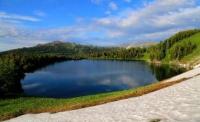
Beloubinsky lakes on Kazakhstan Altai.
Tours to Beloubinsky lakes.
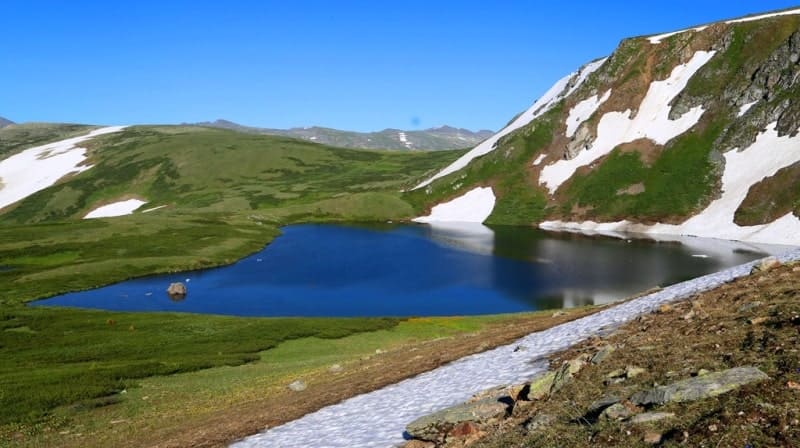
«A traveler ascending the northern slopes of the eastern Ivanovo Range would hardly expect to encounter six high-mountain lakes in just two kilometers. Each differs in size, shoreline shape, and the character of the surrounding landscape. However, they all share a common origin. Their formation is the result of the work of an ancient glacier, which many thousands of years ago formed one of the most picturesque high-mountain corners of Western Altai.»
Beloubinsky lakes in West-Altai Natural Reserve.
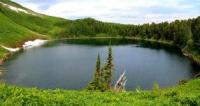
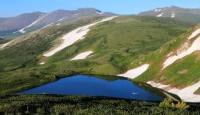
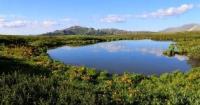
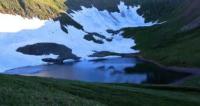
Beloubinsky Lakes are a high-mountain lake complex in Western Altai.
The Beloubinsky Lakes group is a unique complex of freshwater bodies of glacial origin located in the eastern spurs of the Ivanovo Range, west of the Koksuysky Range, within the West Altai State Nature Reserve within the Ridder City Administration of the East Kazakhstan Region.
All the lakes occupy high-altitude intermontane basins formed by ancient glaciers and lie at altitudes ranging from approximately 2,060 to 1,793 m. a. s. l. Despite their relatively small size, they form a unified natural system reflecting the various stages of glacial relief development in the eastern Ivanovsky Range.
The Beloubinsky group includes the First, Second, Third, and Fourth Beloubinsky Lakes, as well as Lake Kedrovoe and Lake Shcherbakov (known as Listvyazhnoe until 2002), located further north. All these bodies of water are united by a common origin, similar natural conditions, and their belonging to the same high-altitude landscape complex.
The main chain of Beloubinsky Lakes extends along the northern slope of the eastern Ivanovo Range for almost two kilometers, oriented from southwest to northeast. This arrangement reflects the direction of movement of the ancient glacier that formed the system of cirques and moraine-dammed basins.
The lakes form a unique cascade, located at various elevations, highlighting the gradual change in relief with distance from the main watershed ridge. The highest absolute elevation is occupied by Lake Vtoroy Beloubinskoye (2062 m above sea level), located at the upper part of the glacial complex.
Further down the slope, the remaining Beloubinskoye lakes are successively located, with Lake Shcherbakov, located in a deep moraine-dammed basin, occupying the lowest position. Lake Kedrovoe (Kedrovoe) occupies an intermediate position and serves as a link between the Beloubinsky cascade and the northern part of the lake group.
A distinctive feature of the Beloubinsky lake complex is that each body of water has its own morphological and hydrological characteristics, yet they are all part of a single glacial system formed tens of thousands of years ago. Therefore, examining each lake in isolation would be inappropriate: only together can we trace the formation of the modern high-mountain topography of Western Altai.
After the formation of glacial basins and the end of the last stage of glaciation, all the lakes gradually filled with meltwater and precipitation. Despite the relatively short distances between them, each body of water acquired its own natural characteristics, differing in elevation, depth, shoreline structure, feeding patterns, and surrounding landscapes.
The Beloubinsky lakes, First, Second, Third, Fourth, Kedrovoe, and Shcherbakov, are classic moraine reservoirs occupying ancient glacial basins along the northern slope of the eastern Ivanovsky Range. They are linked by a common origin and form a unique high-mountain cascade, reflecting the successive stages of the retreat of an ancient glacier.
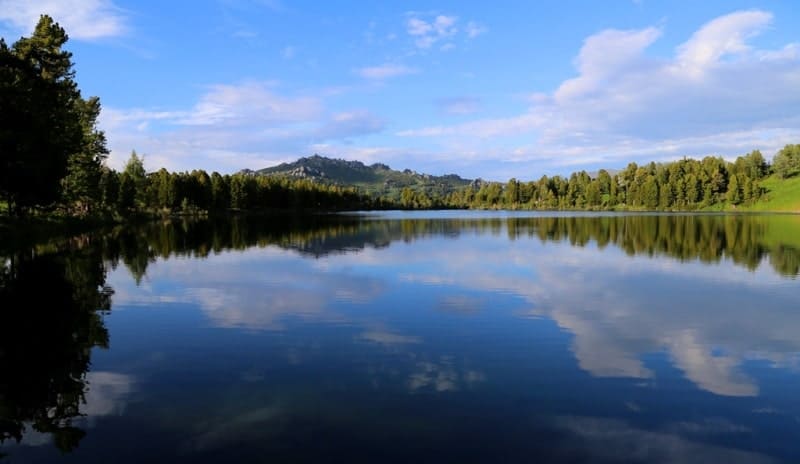
Kedrovoe Lake occupies a special place in this group. Unlike the other Belouba lakes, it is surrounded by dense cedar forests, giving it a unique appearance. The combination of dark Siberian taiga, mirror-like water, snowfields, and granite peaks makes it one of the most picturesque lakes in the West Altai State Nature Reserve.
The most unique body of water in the group is Shcherbakova Lake, formerly known as Listvyaznoye Lake. It is located in a deep moraine-dammed basin and is distinguished by its considerable depth, reaching 42 meters. The lake has no surface runoff, and its.
The exceptionally clear water takes on a rich turquoise hue, characteristic of many glacial lakes in Altai. All the Belooubinsky lakes are located within a single natural system, where altitudinal zonation is clearly evident. The lower slopes are covered with dense coniferous forests, dominated by Siberian cedar, larch, and spruce.
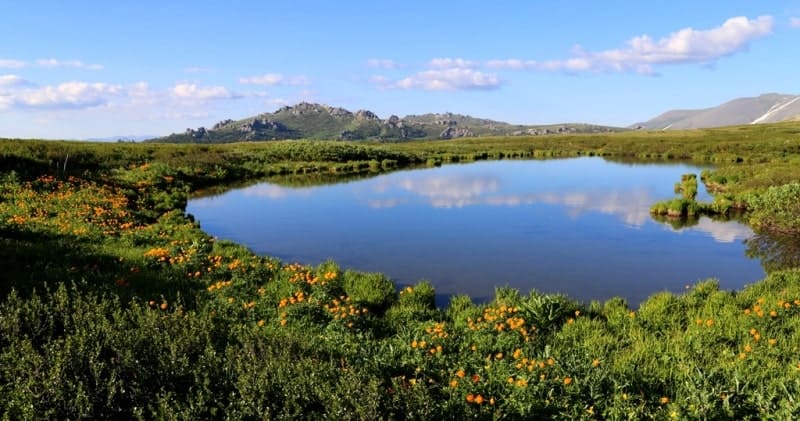
Higher up, these give way to subalpine meadows, thickets of dwarf birch, and shrubs, while near the watershed ridges, rock scree, snowfields, and patches of alpine tundra predominate. This diversity of natural complexes gives the region an exceptionally expressive landscape.
The hydrological regime of the lakes is determined primarily by seasonal melting of snowfields, precipitation, and the characteristics of the glacial topography. Most of the lakes are characterized by high water clarity, low mineralization, and stable temperatures.
Due to the lack of economic activity and their location within a specially protected natural area, the waters of the Beloubinsky Lakes retain a virtually natural quality. The Beloubinsky Lake Complex is of particular scientific value as a clear example of the formation of high-mountain reservoirs as a result of ancient glaciation.
Morainic ridges, cirque basins, dammed formations, snowfields, and modern weathering processes allow us to trace the main stages of the Ivanovsky Range's relief development after the retreat of the glaciers.
A physical and geographical overview and guide to the Beloubinsky Lakes Cascade.
The Beloubinsky Lakes Cascade is one of the most impressive and secluded high-mountain hydrological complexes in the Rudny Altai. Located in the remote core of the West Altai State Nature Reserve (East Kazakhstan Region), these lakes represent a unique example of wilderness, where alpine landscapes blend with the harsh history of ancient glaciation.
Physical and geographical characteristics of the Beloubinsky Lakes.
The Beloubinsky Lakes, a group of freshwater, moraine lakes, are located at elevations ranging from 2062 to 1793 meters above sea level. They are located in the eastern spurs of the Ivanovsky Range and west of the Koksuysky Range, within the territory of the West Altai Nature Reserve, the Ridder City Administration, and the East Kazakhstan Region.
The Beloubinsky Lakes include the following lakes: First, Second, Third, Fourth, Kedrovoe, and Shcherbakov (Listvyazhnoe). Lake Third is the highest lake in elevation, located at 2,062 m. a. s. l., while Lake Shcherbakov is located at 1,790 m. a. s. l.
Lakes First through Foure are located along the southern part of the main ridge of the Ivanovsky Range, stretching from west to northeast. Lake Shcherbakov is the farthest from the main ridge of the Ivanovsky Range, while Lake Kedrovoe is located in the middle part of the group of lakes.
Genesis and morphometry of Beloubinsky Lakes.
High among the eastern spurs of the Ivanovsky Range, within the West Altai State Nature Reserve, lies a small group of high-mountain lakes, whose origins are inextricably linked with the ancient history of glaciation in the Altai Mountains. Today, these six bodies of water are collectively known as the Beloubinsky Lakes.
Despite their relatively small size, they represent a single natural complex, allowing us to trace the formation of modern mountainous terrain, the origins of the Belaya Uba River, and the development of high-mountain ecosystems. The cascade includes six main bodies of water (First, Second, Third, Fourth, Kedrovoe, and Shcherbakov Lakes), located in steps at elevations ranging from 2062 to 1793 m. a. s. l.
Origin of the Beloubinsky Lakes.
The lakes have a pronounced cirque-moraine (glacial) genesis. They were formed as a result of the retreat of Pleistocene glaciers. The ancient glacier formed deep niches (corries) in the granite massif, and the retreating moraine ridges created natural dams that retain meltwater.
Hydrology of the Beloubinsky Lakes.
The lakes are connected by short channels with cascading waterfalls and rapids. The cascade serves as the main source of the Belaya Uba River (the left branch of the Uba River, a major tributary of the The lakes are fed by snow and glaciers and atmospheric precipitation.
The water is extremely clear (up to 6-8 meters), ultra-fresh, low in mineralization, and oxygenated.
Thermal Regime of the Beloubinsky Lakes.
Even in the height of summer (July-August), the surface water temperature rarely exceeds 10 degrees Celsius. Ice on the Upper Lakes cascade can persist until the end of June, and the first winter phenomena are observed as early as September.
Geology and Topography of the Beloubinsky Lakes.
The lake cirque is sandwiched between the snow-capped peaks of the Ivanovsky and Koksuysky Ranges. The geological structure is dominated by metamorphic schists, sandstones, and massive granitoid intrusions. The surrounding slopes feature steep ridges, kurumniks (large-block rock falls), and rock walls with traces of exaration (glacial gouging).
Flora and Fauna of the Beloubinsky Lakes.
The vertical zonation around the lakes is extremely pronounced. Lower tier: Dark coniferous taiga dominated by Siberian pine (Pinus sibirica) and fir. Subalpine and Alpine tiers: Subalpine tall grasses give way to alpine carpets, home to rare and endemic species such as Altai columbine, spring violet, and medicinal plants such as golden root (Rhodiola rosea) and maral root (Leuzea carthamoides).
Fauna of the Beloubinsky Lakes.
Wildlife visiting the lakes is common. Brown bears, wolverines, lynxes, and Altai snowcocks inhabit the surrounding area, while Siberian ibex (tau-teke) roam the mountainous areas. Due to the low temperatures and the isolation of the cascade by waterfalls, native fish fauna is virtually absent in the lakes themselves.
Legend of Belaya Uba and Lake Bowls of Beloubinsky Lakes
In ancient times, when the Altai Mountains were just gaining their colossal power, the mighty Uba Batyr lived in these lands. He had a daughter, the beautiful Belovodye Kyzy, whose voice gurgled like a mountain spring and whose eyes were a stunning deep glaucous blue.
When the ice giant Muzdykhan attacked the Altai lands, bringing with him eternal cold and death, Uba Batyr engaged him in mortal combat. The battle lasted three days and three nights. Uba batyr defeated the giant, but Muzdykhan himself fell exhausted onto a mountain ridge, turning into a granite rock.
Seeing her father, Belovodye kyzy wept bitterly. Her first tears fell on the highest cliff and formed the Upper Lake – cold and clear, like her sorrow. The second tears rolled down, filling the Middle Bowl – deep, like her love for her native land. And when the tears ran out, a swift and turbulent river burst forth from the Third, Lower Lake, rushing down the valley.
Mountain lovers call it the White Slaughter – in memory of the daughter and her father, who guard the peace of Altai.
The Legend of the Belovodye Lakes.
A beautiful legend exists among the people of Altai explaining the origin of these lakes. They say that in ancient times, the peaks of the Ivanovsky Range were the domain of a great mountain spirit. He decided to preserve the beauty of the sky in these places and created six mirrors from the purest glacial water.
Each mirror was meant to reflect its own part of the mountain world: the first - snowy peaks, the second -the rising sun, the third - swimming clouds, the fourth - rocky ridges, Kedrovoe - the age-old taiga, and the farthest, Shcherbakova - the bottomless depths of the sky.
Since then, old-timers say, each lake has had its own character. Some greet travelers with open shores, others are hidden among the cedar forest, and still others amaze with their depth and silent severity. But all remain part of one great world, created by the mountains and time.
Of course, this is just a beautiful legend, but it remarkably accurately conveys the impression the Beloubinskaya group of lakes leaves on everyone who has visited.
Tourist and local history information when visiting the Beloubinsky lakes.
Special legal regime.
The Beloubinsky Lakes are located within the West Altai State Nature Reserve. Independent and unregulated tourism is prohibited. Visits are permitted only in organized groups along approved ecological trails and accompanied by reserve rangers.
A permit must be obtained in advance from the tourism department of the West Altai State Nature Reserve (office located in Ridder). Due to the proximity to the state border of the Republic of Kazakhstan, an ID card or passport is required.
Logistics and route.
Starting point: Ridder (East Kazakhstan Region).
Transportation:
Regular transportation (grade road) is required to reach the reserve's border, where the Koksinsky cordon is located.
Hiking:
From the end of the vehicle route, a hiking (or horseback riding, where permitted) trek of first and, in some places, second category difficulty begins. The route passes through taiga, marshy areas, and traverses kurums (rock falls) and requires good physical fitness.
Season and Equipment
Best Time: mid-June to late August. In June, there is still some snow on the passes, while in September, there is a high risk of frost and snowfall.
Equipment:
Trekking shoes with a rigid sole and fixed ankle (for walking on kurums), but rubber boots are best, as the ground is often marshy, making boots much more comfortable. Storm clothing (membrane) to protect against strong high-altitude winds and sudden precipitation. Insulated sleeping bag.
Tick repellent, mosquito repellent (in the taiga zone), and repellents.
Environmental Etiquette ("Leave only your bootprints")
The reserve territory requires maximum responsibility: Campfires are permitted only in designated areas (or camp stoves may be used). All non-organic waste must be removed from the area without question. Collecting plants, cutting down trees, and disturbing wild animals are punishable by large administrative and criminal fines.
Geographic coordinates of Lake Pervoye Beloubinskoe: N50°17'16 E84°08'08
Geographical coordinates of Lake Vtoroye Beloubinskoe: N50°17'13 E84°08'53
Geographical coordinates of Lake Tverdy Beloubinskoe: N50°17'24 E84°09'31
Geographical coordinates of Lake Vtoroye Beloubinskoe: N50°17'30 E84°09'47
Geographical coordinates of Lake Kedrovoe: N50°17'50 E84°08'52
Geographical coordinates of Lake Shcherbakova: N50°18'08 E84°08'05



Authority and photos by:
Alexander Petrov.