




Вы здесь
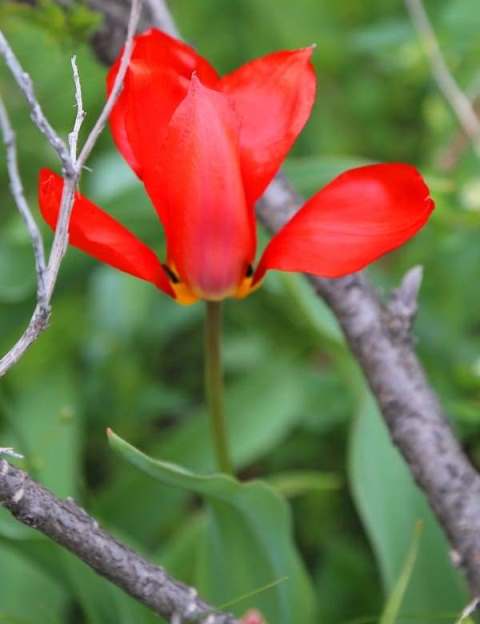
Tulipa ivasczenkoae Epikt. et Belyalov.
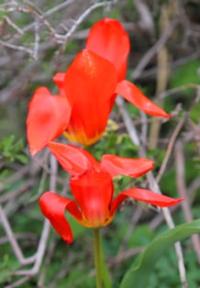
Tulips in Sholak Mountains.
"Wherever the tulip glows red and the rose blooms,
There the earth once sank into the blood of kings,
And wherever a violet grew on earth,
Know - it was the beauty's birthmark."
Omar Khayyam, Persian poet. 1048-1131.
Sightseeing tours in Sholak Mountains.
Historical information about Tulipa ivasczenkoae Epikt. et Belyalov.
Tulipa ivasczenkoae Epikt. et Belyalov – (family Liliaceae). A local endemic of the Chulak Mountains, described by V.G. Epiktetov and O.V. Belyalov (2013) from collections from the Aiyrkezen tract in the southwestern spurs of the Dzungarian Alatau.
We surveyed the only known population of this species on May 22, 2013.The new species was discovered in the lowlands of the Chulak Mountains (southwestern spurs of the Dzungarian Alatau). We had been monitoring this small population since 2009, including specimens planted in the introduction site.
However, flowering specimens had not yet been found. It was only on April 26, 2013, that we finally encountered seven flowering specimens in the wild population. The species is named after the Kazakh florist Anna Andreyevna Ivaschenko, who has been studying wild bulbous plants in Kazakhstan, including tulips, since 1963.
Brief description of Tulipa ivasczenkoae Epikt. et Belyalov
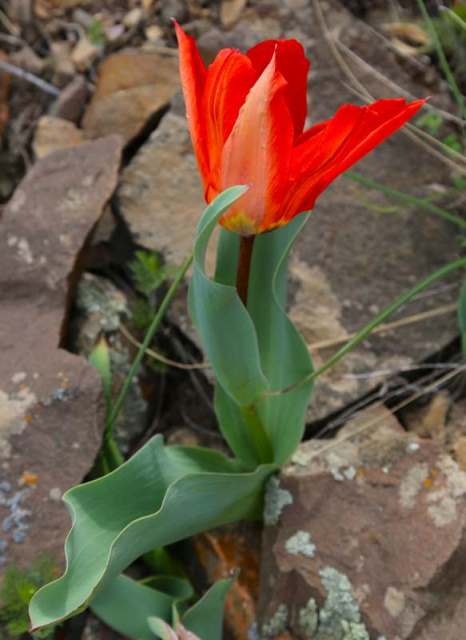
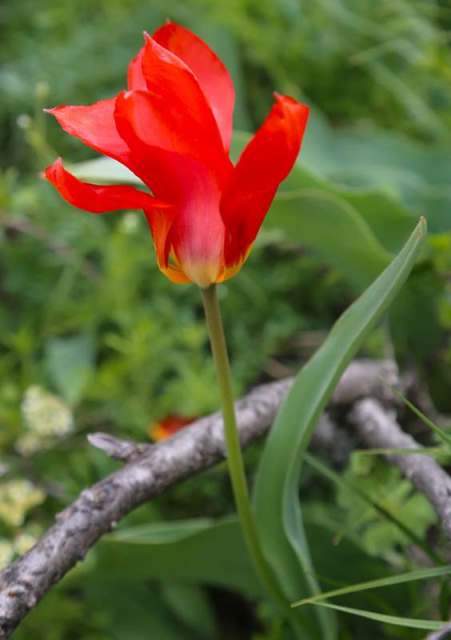
The bulb of the Tulipa ivasczenkoae Epikt. et Belyalov is ovoid, 3-3.5 cm wide, with leathery, dark brown scales and a long, woolly pubescence on the inside. The pubescence is more dense at the base and top. The stem is straight, green, 35-40 cm tall (from the soil surface, together with the flower), pubescent.
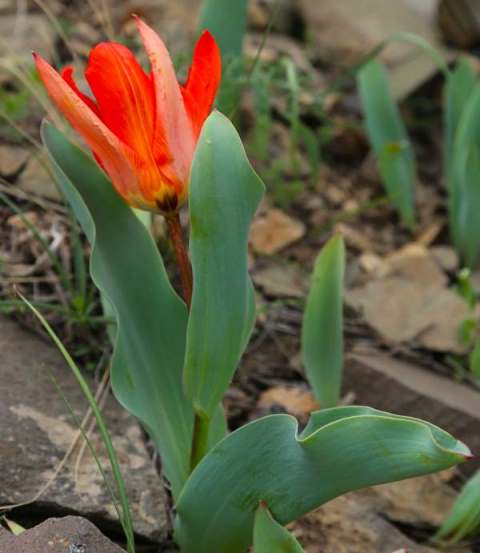
There are 3 leaves, directed upwards, deflected, spaced 5-6.3 cm apart; the lower one rises above the soil surface by the same distance. All leaves are large, shiny, pubescent on the upper side, with a whitish-reddish border along the edge, keeled, gradually decreasing in size towards the top, not exceeding the flower.
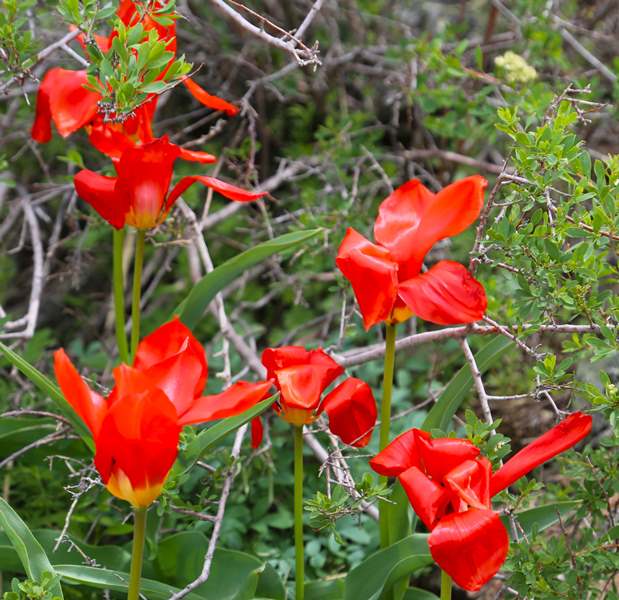
The lower leaf sometimes has a finely curly edge, the upper one has two keels. The length of the lower leaf is 22-22.5 cm, the width is 5-9.5 cm, the upper one is 13-14 and 2.4-2.8 cm, respectively. The flower is solitary, the tepals are red, with a yellow three-apexed spot at the base, almost equal to each other, 4.8-5.1 cm long and 2.5-2.8 cm wide, oboval, widened in the upper third, the inner ones are obtuse at the apex, the outer ones have a slightly pointed tip.
The stamens are 2.5-3 times shorter than the perianth; their filaments are naked, with a triangular base, evenly narrowing towards the top, 7-9 mm long, yellow; anthers are noticeably longer than the filaments, 13-14 mm long, blackish or dark purple; the ovary is shorter than the stamens, 15-17 mm long and 3-4 mm wide, with a sessile stigma.
The fruit is round-cylindrical, with a well-defined peduncle and an elongated beak. In its immature state (May 22, 2013), its length was 4.5 cm, its width 2.2 cm. The species is close to the Pamir-Alai endemics Tulipa fosteriana Irw. and T. carinata Vved.
It is clearly distinguished from the former by its keeled leaves, and from the latter by its obtuse or shortly pointed, rather than long, tepals, and larger, wider leaves that noticeably shorten toward the top, rather than being nearly equal in length. (Type: "Southwestern part of the Dzungarian Alatau, Chulak Mountains, Aiyrkezen tract, upper third of the rocky northern slope (1100 m above sea level), among shrubs, 26 April 2013, V.G. Epiktetov, O.V. Belyalov" (ALTB, iso – LE).
The Tulipa ivasczenkoae Epikt. et Belyalov population is part of a shrub community with an almost uniform participation of Atraphaxis spinosa, Spiraea hypericifolia, and Rosa platyacantha; Cerasus tianschanica and Ephedra equisetina are found in slightly less abundance, and outside the described area, Ephedra intermedia is also found.
The density of the shrub layer fluctuates in some areas from 0.2-0.4 to 0.8. General The floristic composition of this site includes 46 species from 20 families, including 23 annual herbs and 12 ephemeroids. In terms of habitat type, only about 20% are widespread (Holarctic and Palearctic), most of which are weeds (Asperugo procumbens, Descurainia sophia, Polygonum aviculare, Chenopodium album), occurring in low abundance.
This indicates recent grazing and fires, traces of which are visible on many surviving bushes. Most other representatives of the community belong to mountain-Central Asian and Dzungarian-Central Asian floristic elements. Two more species, besides Ivaschenko's tulip, are endemic (Tulipa brachystemon, Saussurea ninae), and one (Leymus petraeus) is a Dzungarian-Tarbagatai endemic.
The Tulipa ivasczenkoae Epikt. et Belyalov population is divided into three small, isolated fragments. Its total population is unlikely to exceed 100 individuals, of which only 5 to 9 bloomed in different years. A rough preliminary estimate suggests that the proportion of virginal individuals with large leaves (27-31 x 5-7.5 cm) is approximately 15%; the remainder are immature (leaf blade 12-15 x 3-4.5 cm) and juveniles.
Thus, based on its population structure (a significant predominance of juveniles over adults), Ivaschenko tulip belongs to the group that includes Tulipa kaufmanniana (Tulipa berkariensis) .and T. kolpakowskiana, for which we previously identified this population type (Belousova and Ivaschenko, 1992).
Phenology of Tulipa ivasczenkoae Epikt. et Belyalov.
Mid-April.
Ecology of Tulipa ivasczenkoae Epikt. et Belyalov.
The tulip grows in a small area, approximately 150-200 square meters, in the upper third of the dry northern slope of a low rocky ridge. The slope is approximately 35-400 degrees, with the soil surface being gravelly in places reaching 80%, and occasional large rock outcrops and rocky areas.
Distribution of Tulipa ivasczenkoae Epikt. et Belyalov in Kazakhstan.
Southwestern part of the Dzungarian Alatau, Chulak Mountains, Aiyrkezen tract, upper third of the rocky northern slope (1100 m. a. s. l.), among shrubs.
Cultivation of Tulipa ivasczenkoae Epikt. et Belyalov.
Practical significance of Tulipa ivasczenkoae Epikt. et Belyalov.
Protection of Tulipa ivasczenkoae Epikt. et Belyalov in Kazakhstan.
This endemic species requires further study, regular monitoring of its population, and inclusion in the Red Data Book of Kazakhstan.
Authority:
"On Some Rare Plants of the Altyn-Emel National Park and Adjacent Territories." A.A. Ivaschenko. Transactions of the Ile-Alatau State National Park. 2016.
1. Address of the private introduction nursery: Kyrgauldy, Klochkova St., 169-21; 050057, Almaty, Kazakhstan; e-mail: v.epiktetov@gmail.com
Acknowledgments:
The authors are grateful to D.A. German for assistance in translating the description into English and to A.L. Ebel for assistance in preparing the article.
References:
Vvedensky A.I. Genus Tulipa L. – Tulip. Flora of the USSR. – Moscow-Leningrad, 1935. – Vol. 4. – Pp. 320–364. Vvedensky A.I., Kovalevskaya S.S. Genus Tulipa L. "Key to plants of Central Asia". Tashkent, 1971. - V. 2. - P. 94 -109.
Photos by:
Alexander Petrov.