





Вы здесь
Tulipa berkariensis. Janis Rukšans.

Discovery of Berkara Tulipa berkariensis by Janis Rukšans.
"From the words of the sage, the ruler's heart
bloomed like a tulip in early spring."
Rashid ad-Din. Collection of chronicles "Jami at-Tawarikh." (Narrative A 188a, S 436). About Hulage Khan, son of Tului Khan, son of Genghis Khan, and it is in three parts.
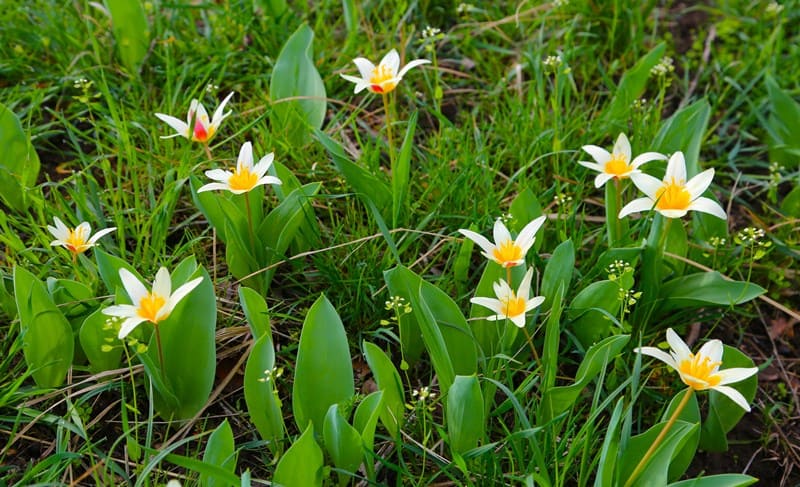
Tulips in Berkara Gorge.
Some geophytes from Berkara Gorge in Karatau Mountain Ridge (Kazakhstan) and Tulipa berkariensis Rukšāns species nova – an “old” new species of Tulipa (Liliaceae).
My first expedition to the Central Asian mountains took place in 1975.
I think it would be more appropriate to call that undertaking an “excursion” – I was so inexperienced then and had so little knowledge of the taxonomy of bulbous plants that the use of the word “expedition” seems to be rather exaggerated. Although before that I had worked in the laboratory of plant taxonomy and seed exchange of the National Botanic Garden, where we explored the dendroflora of the Baltic States (then republics, which actually were colonies of the USSR), in that job I had no link with bulbs.
But I learned there the art of herbarium mounting, how to search for data in literature and a great number of other technicalities needed in plant taxonomy, botanical researches and publications. As to bulbs – at that time I already was a quite experienced grower and had a very good collection of mostly cultivars and a very few wild species, although even in those early years I was particularly interested in the latter.
You can read about all this in my book “Buried Treasures” (Timber Press, 2007). I had never been to the mountains before, so I knew nothing about them. I had no idea what to wear and really I went there with a briefcase containing the traditional presents for people who I could possibly meet on the way.
I had a suit on (fortunately, not my best one), city shoes, etc. Luckily a sweater and a small empty rucksack had also somehow found a place in my bag. While there, I met my long-time correspondent Vladimir Sudorzenko, a bulb enthusiast from Bishkek (then Frunze) in Kyrgyzstan, who sent me corms of my first wild crocus – Crocus alatavicus. He showed me how to collect bulbs in the wild, what kind of tools to use and a lot of other things that proved very useful in my later trips.
He brought me to several localities, where I saw a lot of fantastic bulbs for the first time – alliums, corydalis, tulips, etc. Some of them I collected, but they were not sorted out for I hoped to do that at home.
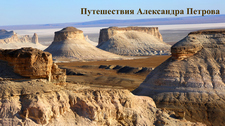
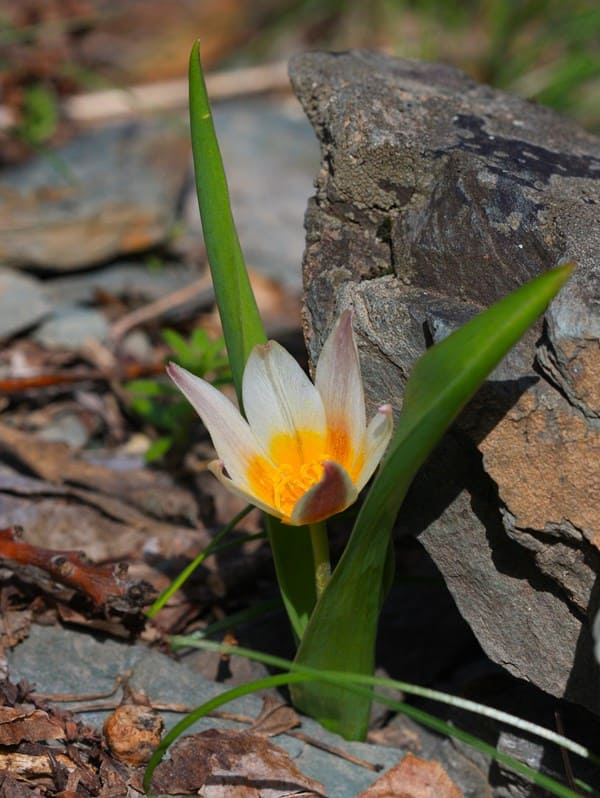
Black shale stone-slide in Berkara Gorge.
The last place where he accompanied me was Syrdarya Karatau Mountain Ridge in Kazakhstan (there are several Karatau ridges in Central Asia, “kara” means black, “tau” – mountains and this name can be applied to any mountain where the primary rocks are black coloured).
We went by bus and stopped somewhere in the middle of a black rocky steppe. There a walk started about 6 km long into the mountains that loomed in front of us over an absolutely flat though slightly ascending sun-baked steppe with a few very spiny low shrubs and dry ephemeral grasses.
There we came to Berkara Gorge – something like a milestone in my career because just there I found my first new species. “Ber” means „stream‟ and everything there is greyish black. The mountains there consist of greyish black shale-type rock, the natural slate.
Although the stream was brim full with the purest water it looked dark because of the black rocks on its bottom. It rushed from a narrow valley, but very soon disappeared into the dry steppe.
Vladimir brought me there to see Tulipa greigii.
In Berkara Gorge their variability reached the extremes from very pale creamy yellow, even almost white, to the deepest golden yellow with various shades of orange to almost brownish in between. Red specimens there were rare. Very few had naturally increased vegetatively and had formed groups of two to three stems with identical blooms.
I collected a few of them and from one such clump came one of my best T. greigii varieties „Sunset‟. It has very large, brightest yellow flowers and multiplies well by bulb splitting. Another Tulipa species growing there amongst stones was one of the most beautiful representatives of Section Eriostemones – T. orthopoda. It is a close relative of the well-known T. turkestanica, but with a very compact habit.
The flower stem is short and up to five white flowers with a very large yellow base (up to two thirds of the petal length) form an exquisite, compact inflorescence. The inner petals are exceptionally wide, almost twice as broad as the outer petals, which makes the flowers look perfectly round.
This unusual beauty, which grows freely in the open in Latvia, is so far almost unknown in gardens. Near the entry into the gorge, deep within the shrubs one other small tulip bloomed with widely open yellowish flowers, which my guide V. Sudorzenko identified as T. kaufmanniana.
The last place visited by me (and this time I went there by myself) was Chimgan, not very far from Tashkent, where I collected a few tulips, a Juno iris that was published by me later as Iris pseudocapnoides, Gymnospermium albertii, Colchicum luteum, Crocus alatavicus and several other bulbous plants.
After returning home I tried to identify the collected plants consulting the Flora of the USSR and immediately encountered some difficulties. The so-called Tulipa kaufmanniana from Berkara, although similar to the true T. kaufmanniana, had some distinct features, such as the shape of the bulb and the number of leaves, which set it apart.
But the most outstanding trait was the formation of very long, sideways growing stolons, which in a typical T. kaufmanniana grow downwards deeper into the ground. The Juno from Chimgan, although listed in the local floras as Iris orchioides, also differed from the descriptions in the botanical literature and other Floras.
These issues demanded solutions, so a new trip to those localities was needed and two years later I returned to Berkara Gorge and Chimgan together with two colleagues who were very interested in tulip breeding and were intrigued by my stories about the variability of T. greigii. Now I was much readier for real botanical collections.
We went there for a few days. On 26 April 1977 I stayed in the camp to guard our belongings and spent the time with my diary. Having nothing else to do I walked somewhat higher up the mountains where deep in a very spiny shrub of a dwarf rose I noticed leaves of a Corydalis sp.
It was not easy to get to the tubers: the branches were extremely thorny and the day before we had found a few scorpions under the stones and the peaty soil inside the shrub was a good place for them to hide from the hot sun. Corydalis stems are fairly brittle, the tubers in the wild are usually tiny, black and almost invisible in the soil, therefore I had to remove the humus-like soil slowly not to lose this treasure – the first Corydalis found there. In total I collected eight small tubers.
The next spring they bloomed in my garden with incredibly beautiful tricolored flowers – the spur was bright light pink, the front half of the petals was yellow, but the inner petals were tipped dark chocolate-purple, which made a striking contrast.
All my attempts to classify the plant using the available floras were fruitless, so there was only one option left – it was a new species. I named it Corydalis ainae after my secretary of that time and sent some bulbs to Michael Hoog who distributed it further.
In 1988 Magnus Lidén and Henrik Zetterlund in the Bulletin of the Alpine Garden Society (vol. 56, No. 2, p. 153) wrote about this plant: “you can never forget it if you ever get a chance to see it”. Later Magnus Lidén published it as Corydalis schanginii subsp. ainae Rukšāns ex Lidén, retaining the name given by me.
Thus it became the first species discovered by me and officially recognised. Very recently Lazkov & Sennikov (2017) raised its status to the species level. According to their researches, Corydalis ainae is widely distributed in the lower mountains of Kazakhstan, slightly extending into Kyrgyzstan and Uzbekistan.
It is very likely that there are other localities because this species had been much neglected in the past. The distribution of C. ainae does not overlap with that of C. schanginii sensu stricto, contrary to the statement of Lidén & Zetterlund (1997).
The species status of this taxon is justified. So now the correct name is C. ainae (Rukšāns ex Lidén) Lazkov & Sennikov. The attached map clearly shows that C. schanginii is distributed in eastern part of common area, but Corydalis ainae replaces it in a westerly direction.
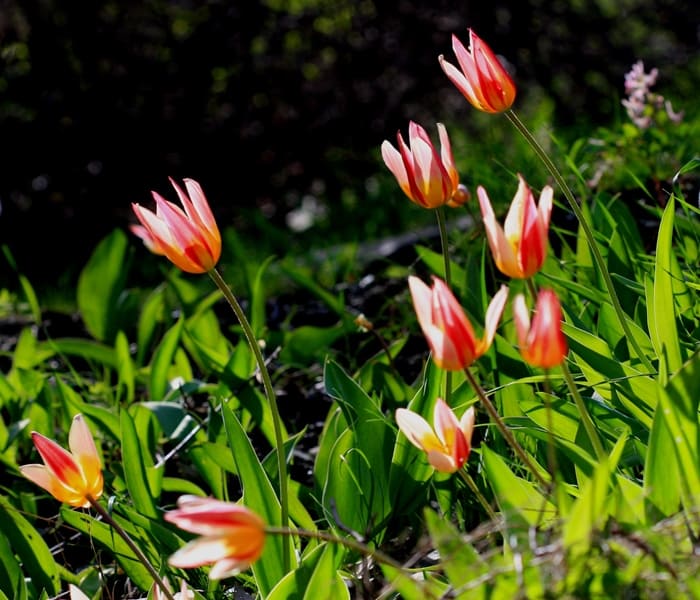
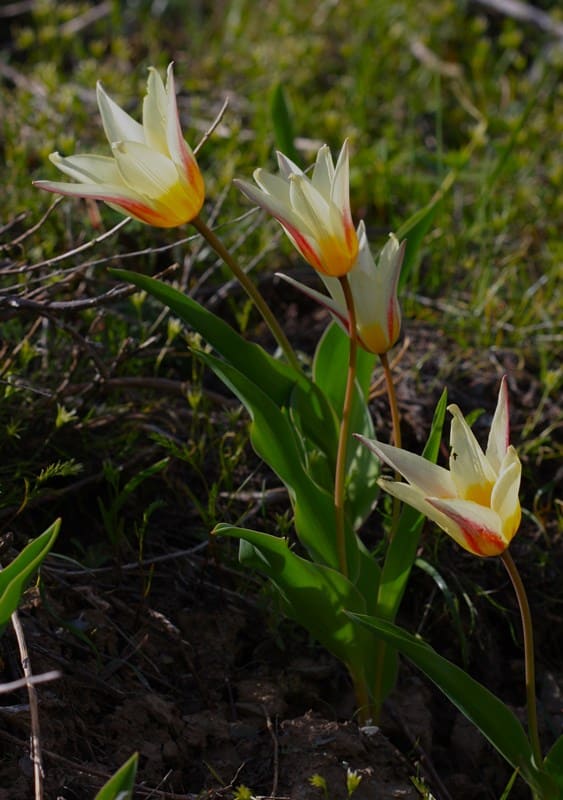
During this trip I paid more attention to tulips and this small “kaufmanniana-like” tulip was growing only within shrubs at the bottom of the gorge. There it had formed groups of identical plants that had multiplied vegetatively. As a rule, in the spots where a flowering bulb of this tulip had grown no replacement bulbs remained, but all the energy had been used to form 1-2 long stolons with a nice very round bulb at their ends.
The longest stolons were 37 cm long. The plants resembled a minor Tulipa kaufmanniana by flower and as it is characteristic of this species the anthers opened gradually. The unique very round shape of the bulbs made me think that it was a new not yet described species, which I named a few years later as T. berkariense (which correctly should be T. berkariensis) after the gorge where it was found.
There were a few samples collected from different groups and two clones were later named. One got the name „Morning Star‟; the other was named „Little Ilze‟ after my youngest daughter. The latter has intensely undulate deep purple leaves with a few narrow green veins and brownish red backs of the white petals.
I do not think that the purple in the leaves is the result of hybridization with T. greigii which does grow in the vicinity, but at much higher altitudes and only in open places in grass. Purple leaves sometimes occur in other species too, for example, T. dubia, and probably it is some kind of protection against the intense solar radiation, although possible hybridization cannot be excluded, because one of the samples checked by Zonneveld (2008) was triploid.
Together with T. greigii there grew another kaufmanniana-like tulip that was much larger and with very long downward-growing stolons. Although a few were collected, none survived in cultivation and were lost within a few years, so now I cannot judge about its taxonomy as no notes on its morphology were made, I only listed it in my diary as typical T. kaufmanniana.
I used the two named clones of T. berkariensis in crossings with T. vvedenskyi. Many of the hybrids inherited the habit of very long stolons, but now they grew downwards with a slight sideways angle. So it is possible that those kaufmanniana-like tulips that grew alongside T. greigii were hybrids between greigii and berkariensis.
When I shared this information with the botanists from Tashkent Botanical Garden, the comments were that an “amateur” knew nothing about the taxonomy of tulips and that dissimilar clones should not be treated as a “new” species. Such an attitude did not affect my belief that I had discovered a new species, although the finding of 3 new taxa (Corydalis, Iris and Tulipa) by a then actual amateur during his first visit to the mountains really sounded somewhat incredible.
I continued to offer this tulip in my commercial catalogues under the name of T. berkariense and there it was spotted by B.J. Zonneveld, who asked for leaf samples to check its genome. His research confirmed that the tulip from Berkara Gorge belonged to a new, unpublished species that was genetically significantly different from T. kaufmanniana (Zonneveld, 2009).
It also showed that this tulip had much wider distribution. Several samples from Aksu-Zhabagli, Ulken Kaindy and Kshi Kaindy turned out to be identical with the plants from Berkara. Diana Everett (2013) included this species in her monograph “The Genus Tulipa. Tulips of the World” under the name used by me as Tulipa berkariensis, but as it was not yet officially published, marked this name as a synonym of T. kaufmanniana.
It was included in the book “Tulips of Kazakhstan” (Valdshmit, 2010) under the name of T. kaufmanniana, but with a note that the true T. kaufmanniana was distributed in Uzbekistan, whereas Kazakh plants belonged to another species named by Rukšāns as T. berkariensis, after the place where it was for the first time discovered, though it would have been better to use the name “T. kazakhstanica” as it had much wider distribution than was supposed earlier.
But I decided to keep the original name by which it had been distributed and is already well known to botanists and gardeners.
Tulipa berkariensis Rukšāns species nova.
Type: Kazakhstan, Karatau Mountain Ridge, Berkara Gorge, among shrubs. 42° 55.420‟ N, 70° 38.439‟ E, at altitude 630 m. Leg. J. Rukšāns 26 April, 1977. Ex culturae in horto Jānis Rukšāns, 18- 04-2012. Holotype: GB (Gothenburg).
Habitat and distribution Tulipa berkariensis.
among bushes in partly shaded areas, distributed in Kazakhstan: Karatau Mountain Ridge, Aksu-Zhabagly Reserve in the Tian-Shan Mts, ?western part of the Kyrgyz Ala-Too (Alatau)? (according to Valdshmit. 2010).
Flowering time Tulipa berkariensis.
April-May.
Description Tulipa berkariensis.
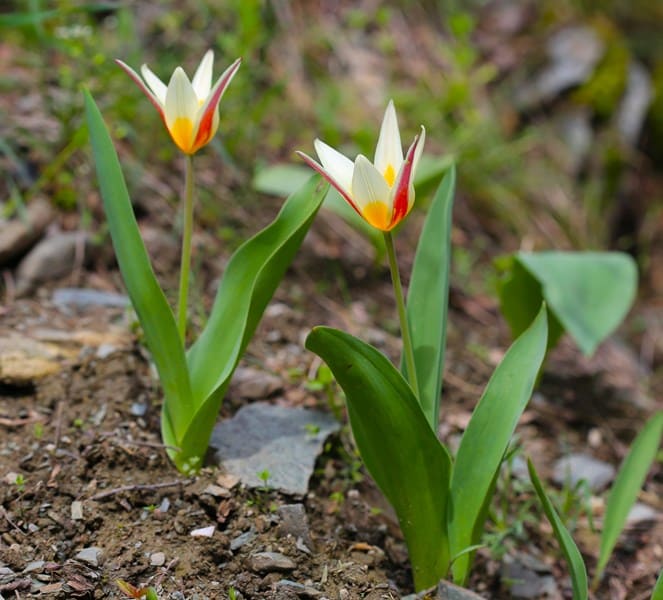
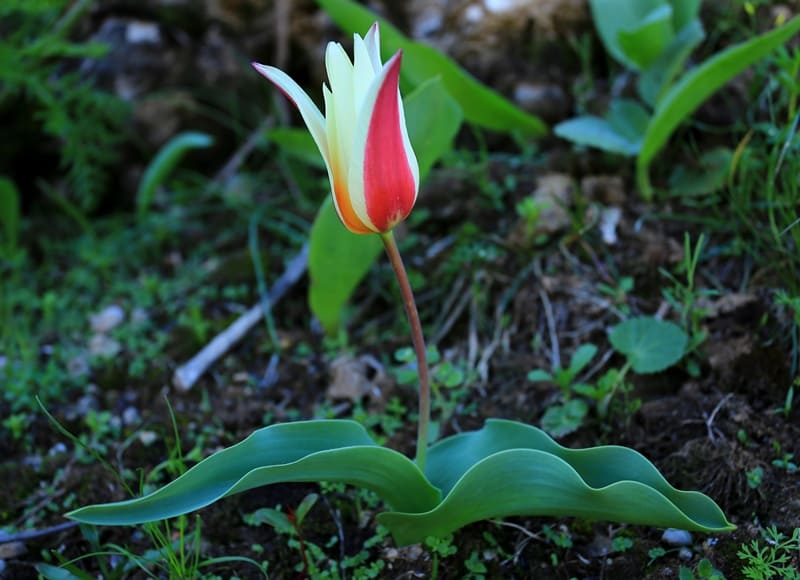
Bulbs globular, up to 2 cm in diameter, usually producing 1-2 up to 37 cm long sideward-growing stolons. Bulb tunics dark brown, thin, hard, lined with adpressed hairs, denser towards the apex and the basal plate. Leaves usually 2, rarely 3 (-4 – Clement, 2013), canaliculated, produced at ground level, glaucous green (occasionally purple with glaucous green veins), spreading, the lower leaf 16 x 5 cm, the upper leaf 12 x 3.5 cm and more erect.
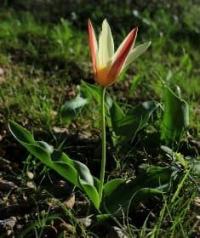
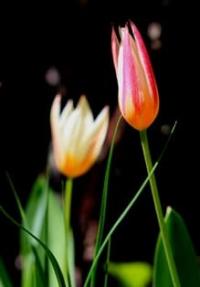
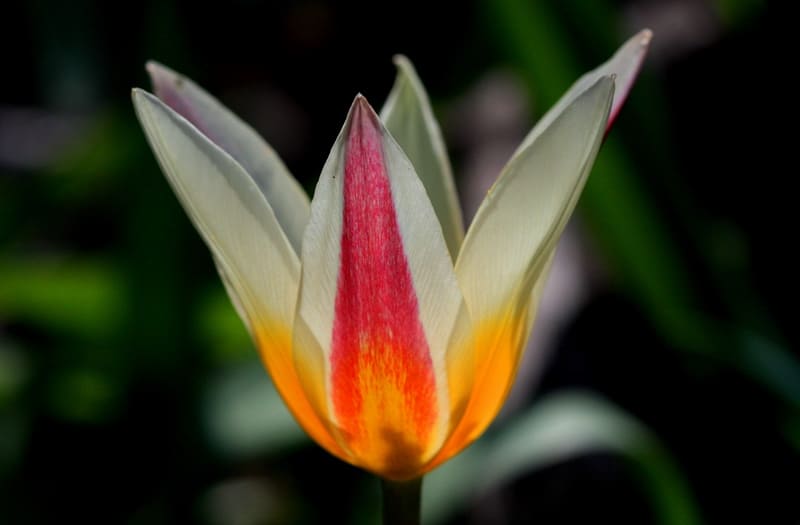
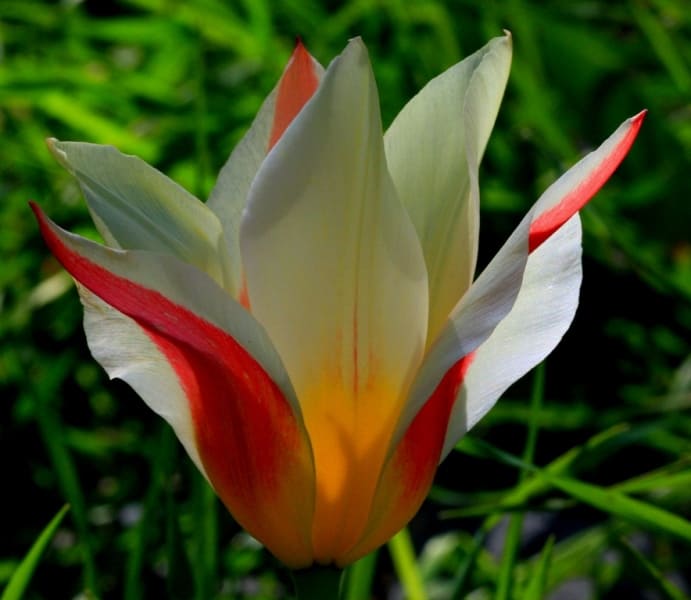
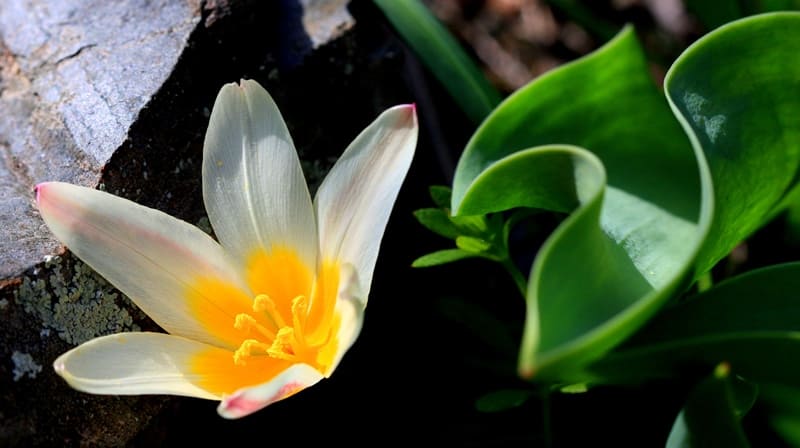
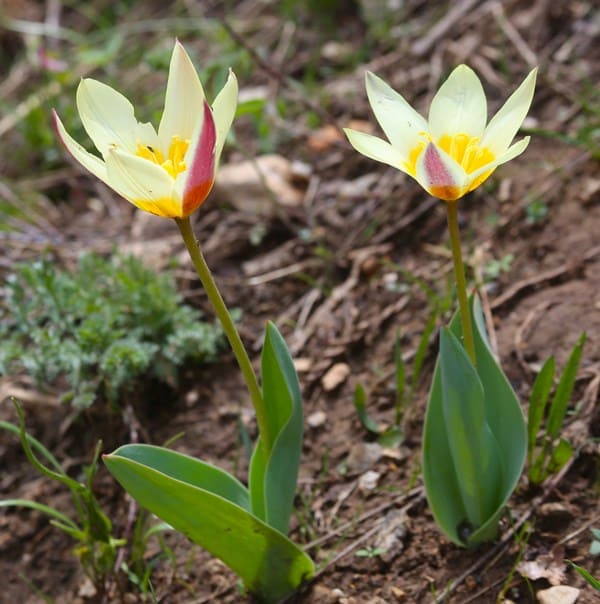
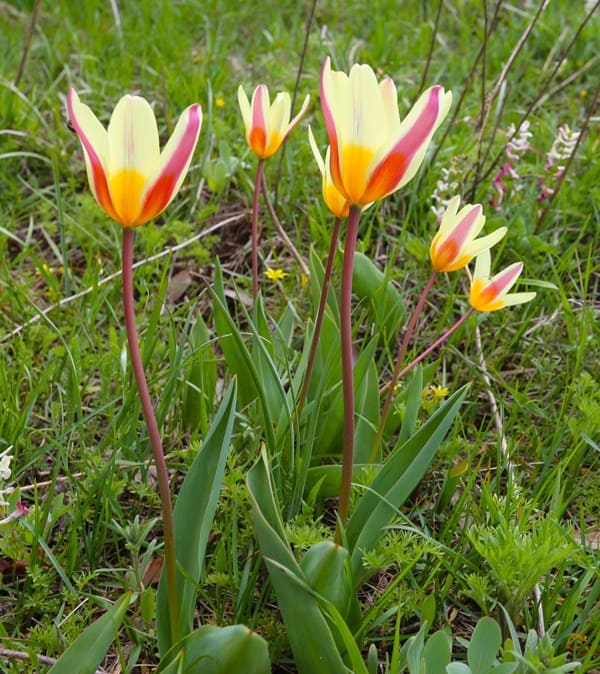
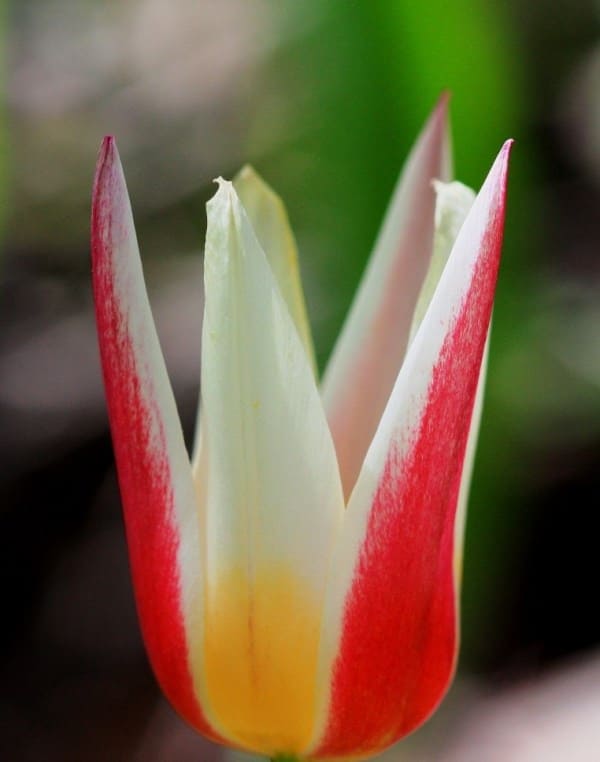
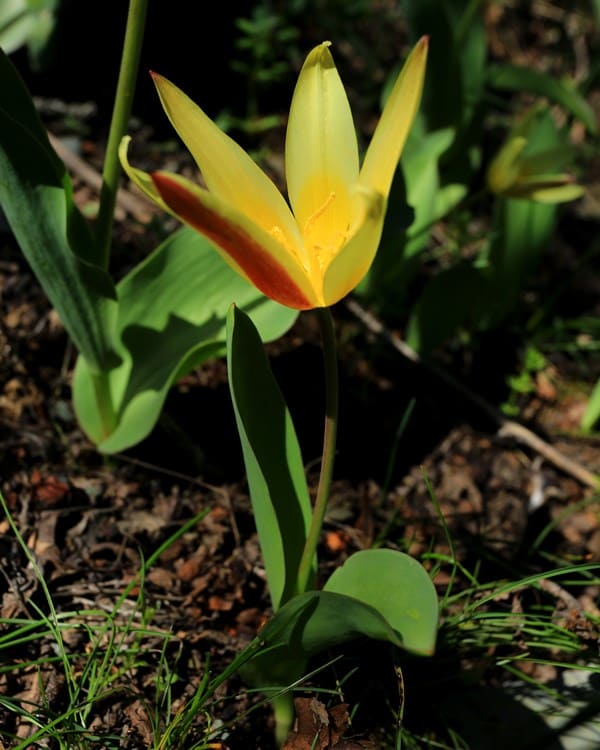
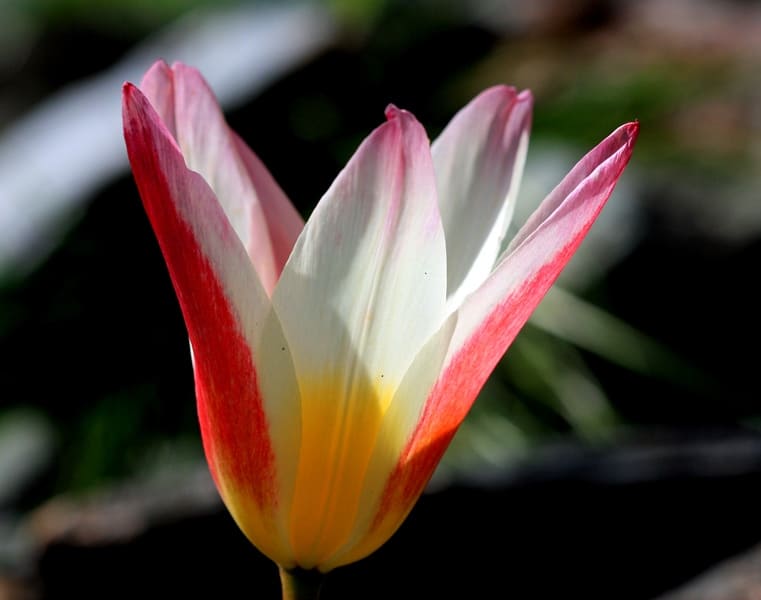
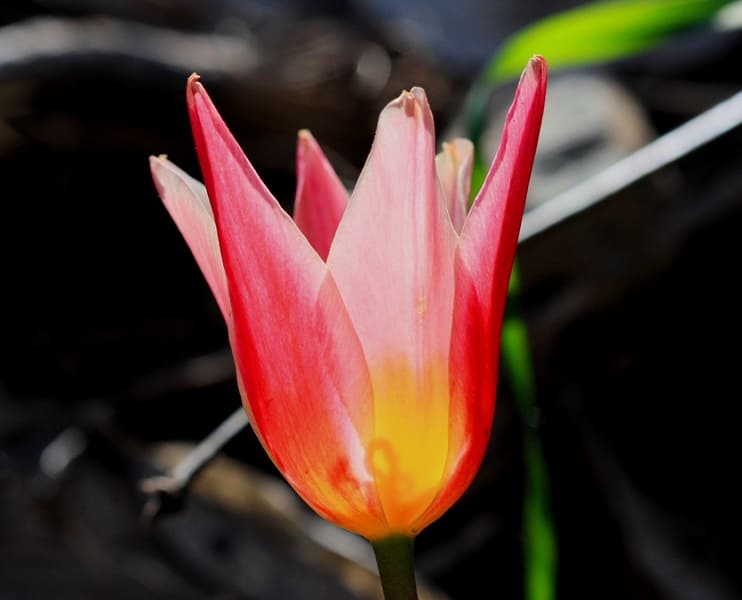
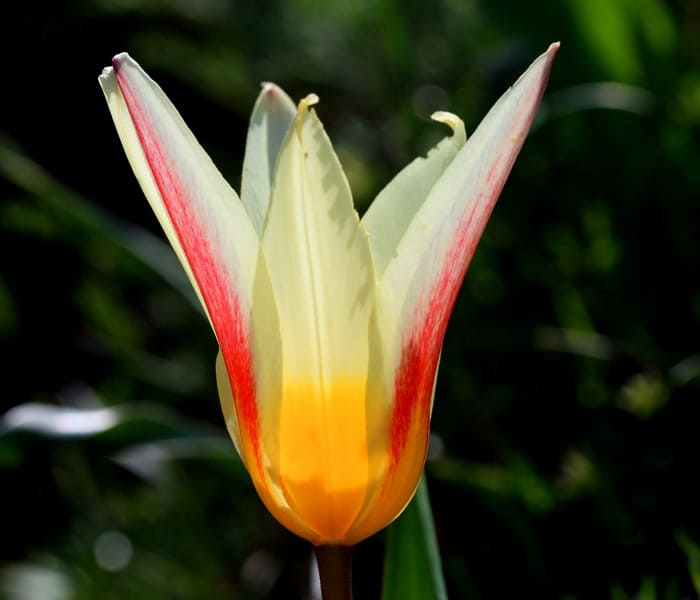
Stem up to 20 cm long ending with a single starry flower. Flowers usually creamy or slightly greenish white to white with a large (up to 1/3-1/2 of the segment length) yellow basal blotch on the inside, sometimes at the tip of the inner blotch there are red marks.
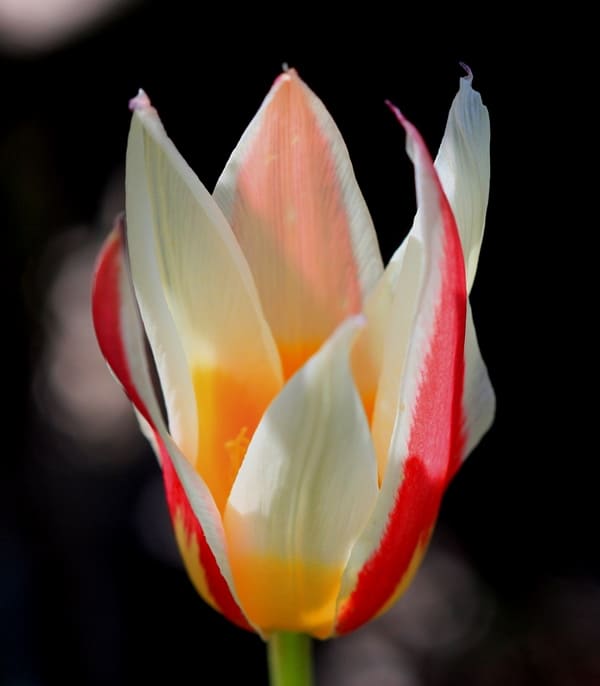
The outside of the outer segments (48-55-60 mm long and 20-22-26 mm wide; n=10) mostly stained red with a creamy edge and with a large triangular light blotch at the base, sometimes greenish with a creamy edge. Inner segments slightly smaller (45-53-58 mm long and 15- 21-26 mm wide; n=10), of the same colour as the outer segments, but without the coloured middle zone on the outside and a smaller red blotch (if present) at the tip of the inner yellow basal blotch.
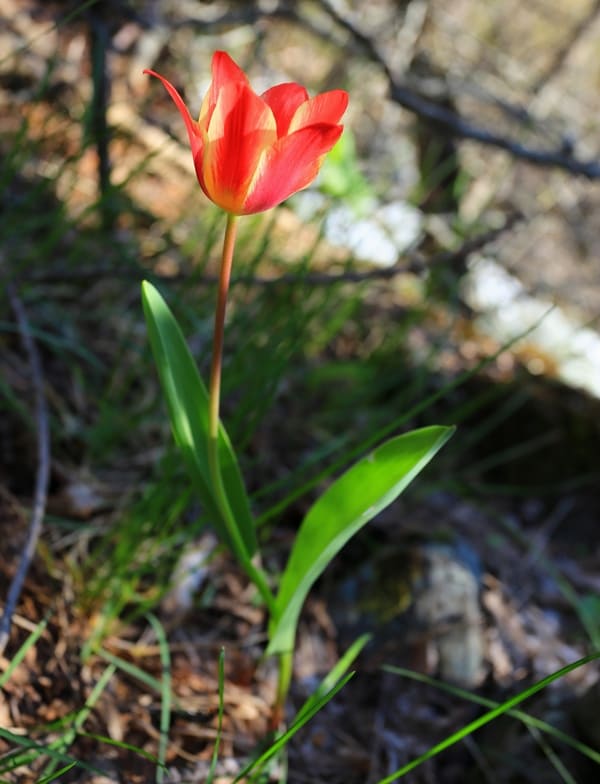
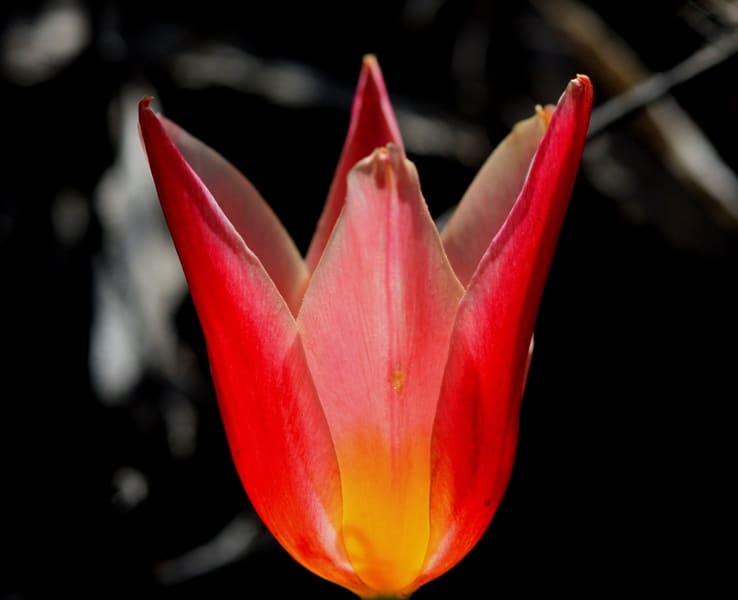
According to Clement (2013), pure red forms are not rare, but have never been observed by the author.
Filaments yellow, 9-11-15 mm long, anthers distinctly longer than the filaments, twisting as they dehisce (Section Spiranthera Vved ex Zonn. & Veldk.). Pollen grains yellow. Ovary greenish or yellowish, sometimes with reddish tinted ribs, shorter than the stamens (mostly ending around the middle of unopened anthers).
Capsule up to 6 cm long, with ribs stained maroon, with a prominent beak and an overlapping stigma, triangular in section.
Chromosome number Tulipa berkariensis.
Diploid.
The main characters separating Tulipa berkariensis from the closely related T. kaufmanniana are the globular shape of the bulbs and the habit of producing long horizontal stolons; less important is the number of leaves, although in T. berkariensis there are mostly only 2 leaves, whereas in T. kaufmanniana there are at least three, only rarely two.
When I shared this information with the botanists from Tashkent Botanical Garden, the comments were that an “amateur” knew nothing about the taxonomy of tulips and that dissimilar clones should not be treated as a “new” species. Such an attitude did not affect my belief that I had discovered a new species, although the finding of 3 new taxa (Corydalis, Iris and Tulipa) by a then actual amateur during his first visit to the mountains really sounded somewhat incredible.
I continued to offer this tulip in my commercial catalogues under the name of T. berkariense and there it was spotted by B.J. Zonneveld, who asked for leaf samples to check its genome.
His research confirmed that the tulip from Berkara Gorge belonged to a new, unpublished species that was genetically significantly different from T. kaufmanniana (Zonneveld, 2009). It also showed that this tulip had much wider distribution. Several samples from Aksu-Zhabagli, Ulken Kaindy and Kshi Kaindy turned out to be identical with the plants from Berkara.
Diana Everett (2013) included this species in her monograph “The Genus Tulipa. Tulips of the World” under the name used by me as Tulipa berkariensis, but as it was not yet officially published, marked this name as a synonym of T. kaufmanniana.
It was included in the book “Tulips of Kazakhstan” (Valdshmit, 2010) under the name of T. kaufmanniana, but with a note that the true T. kaufmanniana was distributed in Uzbekistan, whereas Kazakh plants belonged to another species named by Rukšāns as T. berkariensis, after the place where it was for the first time discovered, though it would have been better to use the name “T. kazakhstanica” as it had much wider distribution than was supposed earlier.
But I decided to keep the original name by which it had been distributed and is already well known to botanists and gardeners.
Tulipa berkariensis Rukšāns species nova Type: Kazakhstan, Karatau Mountain Ridge, Berkara Gorge, among shrubs. 42° 55.420‟ N, 70° 38.439‟ E, at altitude 630 m. Leg. J. Rukšāns 26 April, 1977. Ex culturae in horto Jānis Rukšāns, 18- 04-2012. Holotype: GB (Gothenburg).
Habitat and distribution: among bushes in partly shaded areas, distributed in Kazakhstan: Karatau Mountain Ridge, Aksu-Zhabagly Reserve in the Tian-Shan Mts, ?western part of the Kyrgyz Ala-Too (Alatau)? (according to Valdshmit. 2010). Flowering time: April-May.
Description: Bulbs globular, up to 2 cm in diameter, usually producing 1-2 up to 37 cm long sideward-growing stolons. Bulb tunics dark brown, thin, hard, lined with adpressed hairs, denser towards the apex and the basal plate. Leaves usually 2, rarely 3 (-4 – Clement, 2013), canaliculated, produced at ground level, glaucous green (occasionally purple with glaucous green veins), spreading, the lower leaf 16 x 5 cm, the upper leaf 12 x 3.5 cm and more erect.
Stem up to 20 cm long ending with a single starry flower. Flowers usually creamy or slightly greenish white to white with a large (up to 1/3-1/2 of the segment length) yellow basal blotch on the inside, sometimes at the tip of the inner blotch there are red marks.
The outside of the outer segments (48-55-60 mm long and 20-22-26 mm wide; n=10) mostly stained red with a creamy edge and with a large triangular light blotch at the base, sometimes greenish with a creamy edge. Inner segments slightly smaller (45-53-58 mm long and 15- 21-26 mm wide; n=10), of the same colour as the outer segments, but without the coloured middle zone on the outside and a smaller red blotch (if present) at the tip of the inner yellow basal blotch. According to Clement (2013), pure red forms are not rare, but have never been observed by the author.
Filaments yellow, 9-11-15 mm long, anthers distinctly longer than the filaments, twisting as they dehisce (Section Spiranthera Vved ex Zonn. & Veldk.). Pollen grains yellow. Ovary greenish or yellowish, sometimes with reddish tinted ribs, shorter than the stamens (mostly ending around the middle of unopened anthers).
Capsule up to 6 cm long, with ribs stained maroon, with a prominent beak and an overlapping stigma, triangular in section. Chromosome number: diploid.
Cultivation notes Tulipa berkariensis.
This species is not very difficult in cultivation, but in the outside garden it should only be planted in well-drained places where it can spread by its long stolons and where some aridity during the summer rest can be ensured. When everything is taken into account, Tulipa berkariensis can grow without lifting for several years.
An ideal place for the species is a rock garden. If planted in pots, they must be well fertilized and watered until the end of blooming to guarantee an optimal size of the replacement bulbs, thus securing good blooming the following season. Later in the growing season the watering must be gradually stopped.
The species requires annual repotting because the position of the new replacement bulbs in the pot is very unpredictable – sometimes the long stolons after the circling the pot even push the new bulb out of it. Because of the compact habit and large flowers, it is an excellent show plant.
More challenging is its cultivation on a large scale, again just because of its stoloniferous habit. I recommend commercial growers to use containers to prevent the new bulbs from “escaping” from where T. berkariensis had been planted.
Acknowledgments Tulipa berkariensis.
Firstly I want to express my greatest thanks to my then travel partners to the Central Asian mountains V. Sudorzenko (Kyrghyzstan), A. Krūmiņš and L. Sidrevics (both Latvia), and V. Vinogradov (Uzbekistan) who are sadly not among us anymore; to Diane Everett (UK), Henrik Zetterlund (Gothenburg Botanical Garden, Sweden), Arnis Seisums (National Botanic Garden, Latvia), Tony Hall (Kew) for their help in my researches and getting hold of the required literature, to Vladimir Kolbintzev, Alexander Naumenko and Alexander Sennikov for permission to use their pictures and distribution map; and all the others who assisted and supported me in my work.
Of course, my thanks also go to my regular language corrector Mārtiņš Erminass. And I am especially thankful to my family and my wife Guna in particular for their hard work at the nursery during my absence while in the mountains.
Authority:
Jānis Rukšāns, Dr. biol. h.c. e-mail: janis.bulb@hawk.lv
Summary: A validly published name for a long-standing new Tulipa species from Kazakhstan – Tulipa berkariensis.
Key words: Kazakhstan, Tulipa kaufmanniana, Tulipa berkariensis.
Bibliography:
Everett D. 2013. The genus Tulipa. Tulips of the World. RBG Kew. 380 p.
Lazkov G.A., Sennikov A.N. 2017. Taxonomic corrections and new records in vascular plants of Kyrgyzstan, 5. Memoranda Soc. Fauna Flora Fennica 93: 79-100.
Lidén, M., Zetterlund H. 1988. Notes on the Genus Corydalis. Quarterly Bulletin of the Alpine Garden Society. 232: 146-169.
Lidén, M., Zetterlund H. 1997. Corydalis. A gardener‟s guide and a monograph of the tuberous species. AGS Publications Limited, Gr. Brit. 144 p.
Rukšāns J. 2007. Buried Treasures. Portland, Oregon: Timber Press. 384 p.
Valdshmit L.I. 2010. Tulips of Kazakhstan. Almatykitap Baspasy (in Kazakh, Russian & English). 272 p.
Zonneveld B.J.M. 2009. The systematic value of nuclear genome size for “all” species of Tulipa L. (Liliaceae). Pl. Syst. Evol. 281: 217-245.
Photos by:
Alexander Petrov.