




Вы здесь
Сity of Sergiopol.
Settlements of Abay Region.
"Ayaguz (Sergiopol) is a small stanitsa (council), home to the district administration. Of all the stanitsas of the Kyrgyz steppe, Ayaguz is the most unprepossessing in appearance, though they say Kokpekty is no better. It's a small fortress, a suburb, with a few wooden houses, a mosque in the Tatar settlement, and dugouts. Under the new regulations, with the founding of the Semipalatinsk region, it is called a city."
Valikhanov Ch. Ch. Collected Works, Vol. 1, p. 229. 1856.
"What kind of fantasy did Gasfort (Governor-General of Western Siberia) have to rename the vile villages of Kokpekty and Ayaguz into cities... Sergiopol is a former Cossack village... A Cossack village still resembles a poor village, but a city, or so-called Tatar settlement, is beneath all criticism. A few fenced courtyards, in the middle of which are old, sooty yurts; a few mud huts, several significant piles of dirt and manure; a few ragged and dirty residents – that's all the settlement..."
Gaines, A.K. Collected Literary Works, St. Petersburg, 1897, Vol. 1, p. 64.
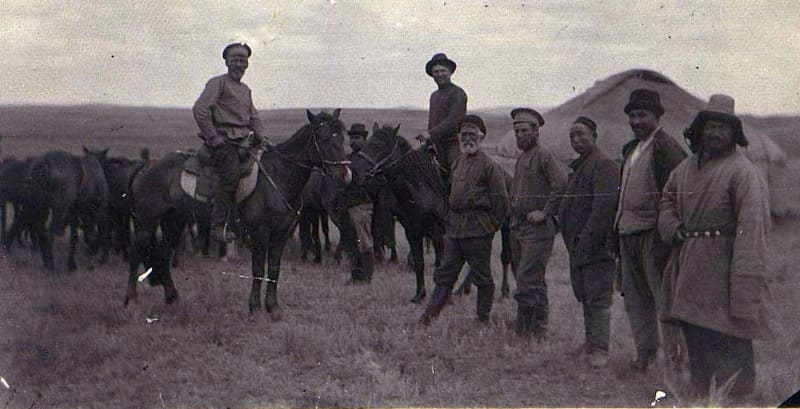
"The Sergiopol stanitsa (the residence of the district police officer) is located on the right bank of the Ayaguz River; to the north and northwest, it is surrounded by a low spur of the Chingiz Range. Externally, it is the most inhospitable point in Semirechye due to the almost complete absence of gardens and any woody vegetation. The dusty streets are lined with low huts made of crooked timber or clay, and there are barely a dozen decent houses in the entire stanitsa. Several barrack-type buildings line the single church, and in the center of the stanitsa is a bazaar with rows of wooden shops, owned primarily by Tatars. The predominant crowd on the streets and at the bazaar are Kirghiz; their saddled horses and oxen with a rope threaded through their nostrils add variety to the scene. The monotonous picture of the village. The main occupation of the Cossack population is agriculture, but even in this regard, the village is quite unfavorable, as suitable areas with arable land and meadows are several miles away. Timber has to be obtained from 70-80 miles away. The village was founded for strategic reasons, through the forced resettlement of Cossacks primarily from the Biysk district, and now that the need has passed, Sergiopol remains as something of a misunderstanding; it's no wonder its population is only 1,387, including the Kyrgyz.
V.V. Sapozhnikov. "Essays on Semirechye." 1904.
"The ancestors of the Semirechye people - Siberian Cossacks - began serving permanently in the northeastern reaches of what is now the Semirechye region with the founding of the Ayaguz Outer District, i.e., in 1831. The first act in the history of the colonization of Semirechye was the permission granted by Governor-General of Western Siberia Velyaminov on January 21, 1832, to the Omsk regional governor to settle up to 100 Cossack families in the outer Ayaguz District, granting them a two-year exemption from military service."
Esaul Nikolai Vasilyevich Ledenev. Prominent Semirechye historian and Cossack officer. "History of the Semirechye Cossack Host." 1908.
P. Galitsky on Sergiopol.
From Semipalatinsk to Sergiopol, you won't encounter a single settlement other than pickets. A picket is a long house divided into two halves, one containing a room, or rather a barracks, where travelers can rest, while the other is occupied by the Cossacks - the guardians of peace in this land.
It's remarkable that from Semipalatinsk to Sergiopol, a distance of 270 versts, you won't encounter a single bridge or a single tree: the impenetrable steppe, covered with fine, parched grass, is in all its glory! Occasionally, herds of two-humped camels appear along the road, eyeing you with a sheepish, unconscious curiosity; and once you've passed, they return to their meager food.
Their hummocks, either erect or swaying, reveal the toils of this useful animal. As you approach Sergiopol, the terrain begins to rise, and after descending unnoticed from Across the plateau, you enter the city of Ayaguz, now Sergiopol. Sergiopol, by its appearance, cannot be called a city in the strict sense of the word, but it fulfills this function as a necessary administrative point in the vast steppe stretching from Semipalatinsk to Kapal.
The city consists of a fortress surrounded by a turf rampart. The fortress houses barracks, an infirmary, a guardhouse, and other government buildings, all neatly maintained, as well as a stone church, very poorly decorated. The city proper consists of two or three streets.
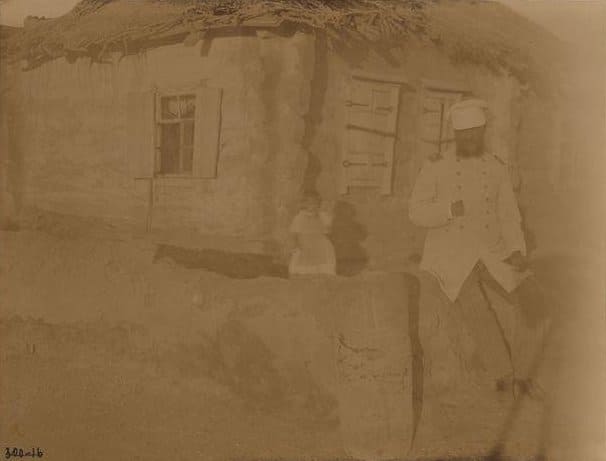
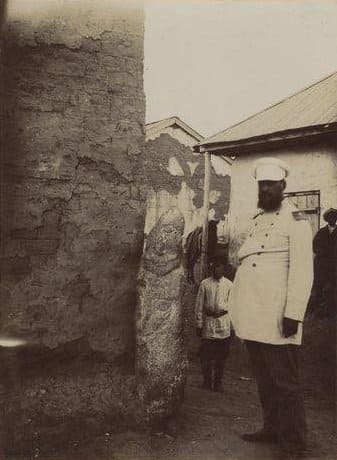
The houses are mostly clay or wooden with thatched roofs, while the merchant class flaunts their plank houses, hanging a red rag on a pole - a sign of door-to-door trade. Such a structure is no disgrace to the people of Sergiopol, for they live in an area where obtaining building materials is extremely difficult.
Timber is brought here from Semipalatinsk, a distance of 270 miles. Fuel is delivered from 80 miles away, and therefore most residents, especially the poor, warm themselves with karagai wood or pay 4 rubles per fathom for single-leaved aspen firewood.
Near the town, there is a small grove that, with proper care and given the lack of forests, could be a pleasant stroll for residents. However, it is so neglected that only signs of the care it once received are visible.
P. Galitsky. "From Semipalatinsk to the Verny Fortress." Sankt-Peterburgskie Vedomosti. 1868, Nos. 150, 151.
A.M. Nikolsky on Sergiopol.
"Having stocked up in Omsk and Semipalatinsk with everything I could possibly count on, I arrived at the Sergiopol stanitsa on March 18th, where I was to make final preparations for the journey. Ahead lay a desert, devoid of a single Russian settlement, save for postal pickets along the route, so it was necessary to stock up on provisions for several months.
Thanks to the kindness of the military commander, rusks were quickly prepared, and on March 23rd, we were ready to move on. The road runs near the Ayaguz, which here consists of a series of pools. In places, this river is forded dry-shod at the end of summer, jumping from stone to stone. In the spring, Cossacks catch marinka and osmans in it.
The river valley near Sergiopol is covered with small, heavily felled willows, and only after the third station do groves of large poplar and aspen trees appear. On the third stretch, the road descends from the mountains into the steppe. Severe snowstorms, coupled with the heavy snowfall of the previous winter, had heavily snowed the road, making it possible to travel only in pairs.
The station houses, even their roofs, were buried in snow, and only through corridors dug opposite the windows and doors could one see the human dwellings beneath. The unusually harsh, snowy, and prolonged winter had caused terrible hardship for the local Kirghiz.
Their horses and sheep, which lived year-round on pasture, perished in large numbers from lack of food. To somehow sustain the livestock until spring, they fed them manure collected near the stations, willow and poplar bark, thorns, and anything that could even remotely serve as a substitute for hay.
A.M. Nikolsky, Curator of the Zoological Museum of St. Petersburg University. "Journey to Lake Balkhash and the Semirechye Region." 1885
A. I. Geibovich about Sergiopol.
"Our kindest and unforgettable friend," wrote Dostoevsky, "most noble Artemy Ivanovich, I will not try to justify myself to you in a long silence, but if I have been at fault before you, then, I swear, I am innocent! My wife and I, we, and your entire dear family, not only have not forgotten you, but it seems that not a day has passed without our remembering you and remembering you with warm hearts. <...>"
Returning to St. Petersburg after three years in Semipalatinsk, Dostoevsky left Geibovich and his family most of his library, his archaeological collection, his photographic portrait, personal belongings, and furnishings. Artemy Ivanovich was soon transferred to Sergiopol, where he dedicated one of the rooms in his modest house to a makeshift Dostoevsky museum, "so that not only I and my household could see and remember you every hour, but so that my guests, to whom I proudly told who I received it from," Geibovich informed Dostoevsky.
Dostoevsky's orderly also transferred to serve Geibovich. In turn, Fyodor Mikhailovich sought to facilitate the relocation of his commander's family to European Russia, but due to lack of funds and old age, Dostoevsky never decided to do so, dying in Sergiopol in 1865.
Thus, the first Dostoevsky museum in Russia existed during his lifetime, in that very same city. in the remote desert of the Semipalatinsk region. Ten years later, the last letter from Kazakhstan arrives in St. Petersburg:
"Dear Fyodor Mikhailovich!
You will be very surprised to receive this letter; after such a long time, you have probably forgotten your former Siberian friends. And how could you not? 15 years have passed since we parted. But no matter how long ago that was, you will probably remember Artemy Ivanovich Geybovich and his entire family.
I, who am writing you this letter, am his daughter, Zinaida. Our entire family has dispersed. My father died in 1865 in Sergiopol; both sisters have long since married and live - one in Semipalatinsk, the other in Karakol. After my father's death, my mother and I left for Omsk, but we did not live together for long; my mother died in 1871.
Before her death, she asked me to find your address and give it to you. I bid you my last farewell and wish you happiness and all that the most sincere and kind friend could wish for. We thought of you often, very often. Mama told us of all the good times she spent with you.
And now, when our entire family has dispersed: my father and mother have died, and all three of us are married. But I am sure that in each of our three families, memories of you will forever remain. Forgive me, dear Fyodor Mikhailovich, for writing to you.
Perhaps you have no time to read my illiterate letter, but I know you are kind and will forgive me upon learning that I am writing to fulfill the last request of my dying mother. Forgive me again. I dare not ask you to write to me; I know well you don't have the time to engage in completely unnecessary correspondence.
I will also be happy if, when you read my letter, you remember your always deeply respected
inaida Sytin.
September 24, 1875
Lepsinskaya village, Semirechye region.
P.S. While living in Omsk, we heard that our kind, respected Maria Dmitrievna had died, but God grant that this was a false rumor.
Artemy Ivanovich Geybovich – company commander of the 7th Siberian Line Battalion in Semipalatinsk, Dostoevsky's immediate superior during his time as a soldier. Dostoevsky and Geybovich had a friendly relationship.
https://vykhochetepesen.livejournal.com/99467.html
G.N. Potanin on Sergiopol.
"Nothing can be imagined more pitiful and desolate than the steppe that separates Sergiopol from Semipalatinsk. After crossing the Irtysh, the steppe begins, where lifelessness reigns in all its force. Not a bush, not a blade of grass, not a tree - nothing is visible for almost 300 miles.
Even the pickets seem aware of their isolated position and look somehow sad and dismal. In general, the Semipalatinsk-Sergiopol steppe makes a heavy, oppressive impression. You involuntarily ask yourself: who needs it, and what can be done here?
Apart from the Kyrgyz, and even those who live 100 miles from the road, there is no one here; the pickets themselves are haphazardly arranged, you can barely find the bare necessities in them. The first city of the Turkestan District, Sergiopol, appears before your eyes somehow quickly and unexpectedly, as if it suddenly grew out of the ground.
Sergiopol doesn't look like a city at all; many villages along the Russian highway are much better and larger than it. It also has almost no administrative significance; the entire district administration abandoned it long ago and moved to Lepsa as a more central and much more promising point than Sergiopol; so now Sergiopol has absolutely no significance. Its inhabitants - Cossacks - indulge in their laziness to the fullest and in winter they are covered with snow, along with their houses.
If Sergiopol is remarkable for anything, it is its snowstorms; they are sometimes such that houses and their roofs are completely covered with snow. There have been cases of people being snowed in the middle of the city. During a snowstorm, nothing can be seen on the street, and the snowstorms themselves arise suddenly, out of the blue - and woe to anyone who does not immediately rush to hide in the first house they come across.
There is, of course, no public life in Sergiopol; everyone lives their own special and separate "People with fresh and healthy outlooks on life who find themselves in Sergiopol are doomed, in my opinion, to a very sad fate, since 'wine and cards' is the general motto of Sergiopol."
G.N. Potanin. Newspaper "Siberia", Irkutsk, 1878, No. 41 (November 12).
https://russiainphoto.ru/photos/349276/
In 1838, Semipalatinsk and Ust-Kamenogorsk were included in the Biysk district of the Tomsk province with settlements along the Irtysh line. The first stanitsa of Ayaguz was formed on the site of the Ayaguz order with 50 families in 1831, with the settlement of Cossacks of the 10th Cavalry Cossack Regiment (3 officers and 106 lower ranks).
Later, in 1836, the stanitsa of Kokpekty was formed - 2 officers and 96 lower ranks. In 1841 - the stanitsa of Kopalskaya from 3 hundreds of the 9th regiment of the Biysk line of the SKV. By the Imperial Command of February 8, 1854, the 10th regimental district was formed with the placement of the 1st-3 hundreds in the stanitsa of Kopalskaya, 4 hundreds in the stanitsa of Ayaguzskaya and the 5-6 hundreds in the stanitsa of Kokpekty.
At the same time, the Tomsk Diocese permitted clergy from Semipalatinsk to conduct mobile services in Ayaguz, and those from the Ust-Kamenogorsk parish to conduct services in Kokpekty. Sergiopolskaya stanitsa (initially Ayaguzskaya from 1847 to 1860) is the northernmost Cossack settlement in the Semirechye region.
It existed since 1831 as the Ayaguz fortification, the center of the outer district of the same name. It then became the center of the district capital of the Semipalatinsk region from 1854. From 1867 to 1880, it was a district capital of the Semirechye region.
After the district offices were moved to Lepsinsk in the early 1880s, it became a provincial town. Sergiopol, like all large Semirechye settlements, was divided into the town proper with a Tatar settlement, a fortress, and a Cossack stanitsa. In 1860, the town of Ayaguz was renamed Sergiopol in honor of Grand Duke Sergei Alexandrovich.
The town consisted of the town proper and the Sergiopolskaya stanitsa. In 1857, the brick Church of St. Sergius (with the altar of St. Sergius of Radonezh) was built; it still stands, but is inactive.The town had two forges, two watermills, and one windmill. Six miles from the city, limestone was quarried, and a kiln was also located there.
Three miles away stood a brick factory producing baked bricks. The output from the kiln and the factory was used to build the church, government buildings, and furnaces. The intelligentsia of the city consisted of ten to twelve officers and officials, two or three assessors of the district parish, one semi-literate teacher, a mullah, and a priest with a deacon...
During the civil war, from 1918 to the spring of 1920, Sergiopol served as the temporary capital of the Semirechensk Cossack army, where the military government and the military ataman were located, and a newspaper was also published: "Semirechensk Regional News.
The village of Sergiopol was located midway between Semipalatinsk and the town of Verny. Shokan Valikhanov, P.P. Semenov Tyan-shansky, and many other travelers and explorers of the Semirechye region stopped here overnight. Later, after Kazakhstan gained independence, the village of Sergiopol was renamed Mamyrsu on July 17, 2007.
Now Mamyrsu, a village in the Ayagoz District of the Abay Region, is the administrative center of the Mamyrsu Rural Okrug.
Authority:
Archive of Alexander Yuryevich Ushakov https://russiainphoto.ru/photos/330941/
Nikolai Petrovich Ivlev. "And Biographies Come to Life. Notes of a Local Historian." 1983 Sergiopol Enthusiast, pp. 173-174.
(TsGA RUz, I-961). WITH.