




Вы здесь
Burial mounds Besshatyr.
Sights of Kazakhstan national parks.
"And he left on the steppe floor
Between the mugwort and the chokeberry
The charred ribs of bulls
And the stones of crude altars"
Maximilian Voloshin. Koktebel. November 19, 1919.
Trip to Burial mounds Besshatyr.
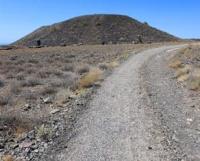
Besshatyr burial mounds are located at an altitude of 674 m. a. s. l. in the southwestern part of Sholak foothills, 4.1 kilometers from right bank of Ili River delta, 27.8 kilometers east and slightly north of Cordon No. 1, 50.5 kilometers southwest of village of Basshy, 4 kilometers north and slightly east of entrance to Shylbyr Gorge, within Altyn-Emel Nature Park, in Kerbulak District of Zhetysu Region.
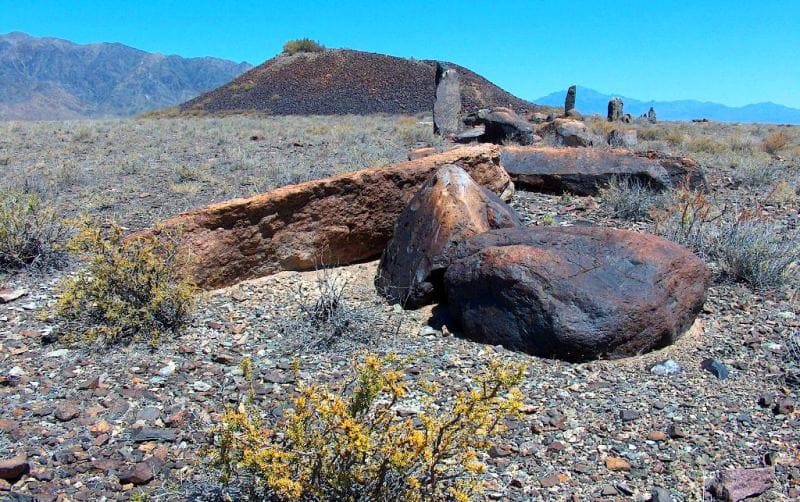
Besshatyr (Five Tents) burial mounds, located in the Altyn-Emel National Park, date back to the Early Iron Age (VIIth-VIth centuries BC) and are the largest Saka burial sites. Besshatyr (Five Tents) necropolis is considered the spiritual mecca of the ancient Sakas, who lived in the first millennium BC in what is now Kazakhstan.
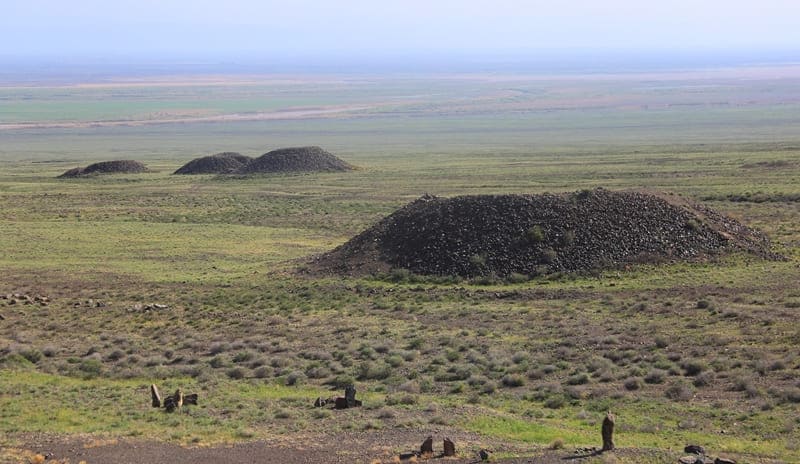
The largest burial mound, known as the "Semirechye pyramid," measured 105 meters in diameter and 17 meters high. The wooden tombs of these mounds were constructed from Tien-Shan spruce logs, which have remained perfectly preserved for over 2,000 years.
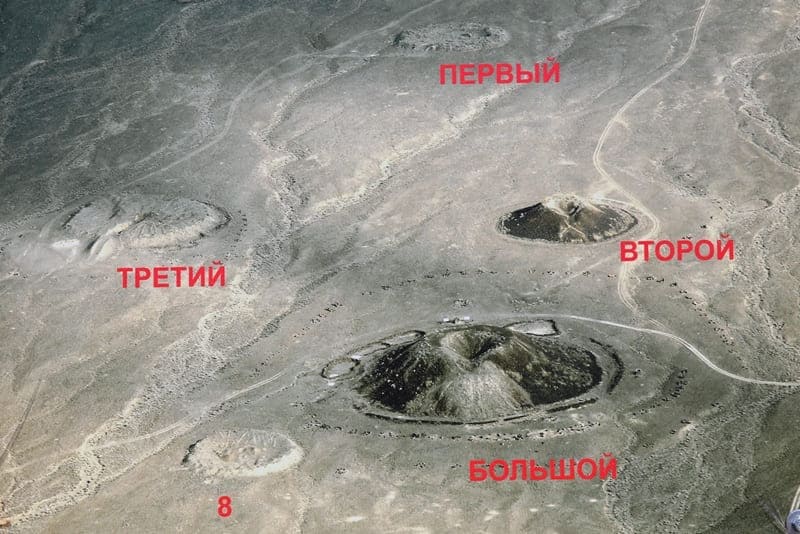
A distinctive feature of the Besshatyr burial mounds is their underground catacombs with a labyrinth, one of whose passages led to the tomb. The Besshatyr burial ground consists of 31 burial mounds, extending 2 kilometers from north to south and 1 kilometer from west to east.
Of these, 21 are stone-covered and 18 are filled with rubble and earth. The burial mounds are divided into large, small, and medium. The large mounds range in diameter from 45 to 105 meters and are 6 to 17 meters high. The nine medium mounds range from 25 to 38 meters and 5 to 6 meters, respectively.
The small mounds range from 6 to 18 meters and are 0.8 to 2 meters high. The large mounds are the graves of tribal leaders and military commanders. The medium mounds are the graves of noble and renowned warriors, and the small mounds are the graves of brave common soldiers.
History of archaeological excavations at Besshatyr burial mounds.
Excavations of the royal burial mounds were conducted in the late 1950s and early 1960s by the Semirechye archaeological expedition led by Professor K.A. Akishev. Beneath the stones of the mound, archaeologists discovered complex above-ground burial vaults constructed from Tien-Shan spruce logs.
These were wooden "houses" measuring 20 square meters and 3 meters high, with a thick, multi-layered wooden deck capable of withstanding a multi-ton pile of stones from above. The burial vault had an entrance corridor 5 meters long and 1.5 meters wide, along with a doorway through which the deceased was carried.
A mysterious architectural detail of the royal tombs is the underground passages dug deep into the bedrock. This detail resembles the design of the Saka tombs with the Egyptian pyramids. Over the course of four years, from 1957 to 1961, 18 burial mounds were excavated.
The bones of individual male skeletons have been discovered in the royal tombs. In some, male and female skeletons were found together, along with clay vessels of various shapes, horse, sheep, and goat bones, felt mats, reed mats, short iron daggers, akinakes, and quivers with bronze arrowheads.
History of Besshatyr burial mounds.
Probably due to their impressive size, the mounds were called "royal." During excavations, archaeologists have uncovered beautiful works of art from the Saka culture at its peak in these burials. The Besshatyr burial ground, the tomb of the Saka kings – Tigra Hauda.
The name of this people has come down to us from the depths of time thanks to ancient Persian and classical written sources. Many pages of their heroic history are also recorded in ancient Chinese dynastic chronicles. The Sakas were contemporaries of the legendary Scythians, who lived around 1000 BC.
In the south of the Russian Plain, the Sauromato-Sarmatians, warlike tribes who inhabited the junction of Europe and Asia - the Lower Volga region, the Southern Urals, and Western Kazakhstan. This warlike people defended the southern borders of their homeland during the conquests of the ancient Persian kings Cyrus, Darius, and Xerxes, and preserved the country's independence in wars with Alexander the Great's powerful standing army.
Written tradition has preserved the names of the great Saka kings and leaders: Tomyris, Zarina, Idanfirsos, and Spargatis. Large royal necropolises are scattered from southern Kazakhstan to northern Kyrgyzstan. And the most significant in terms of monumentality and compositional complexity is undoubtedly Besshatyr.
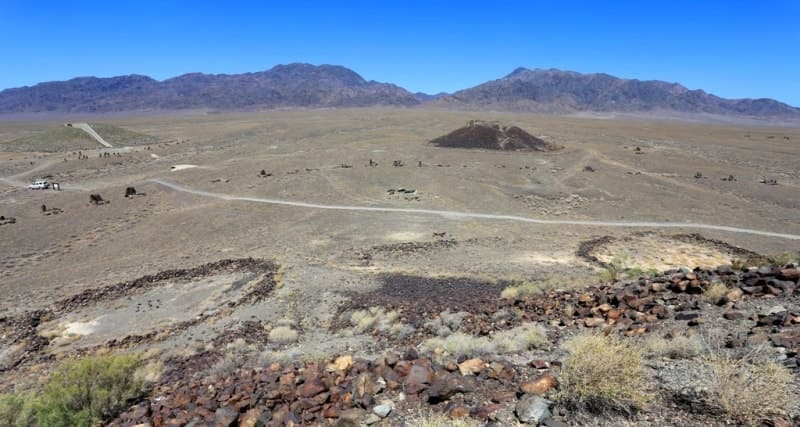
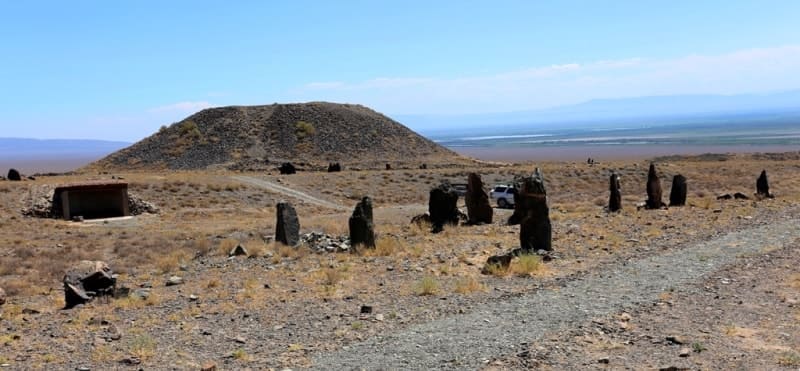
Nowhere else in Eurasia can one find such a concentration of royal burial mounds. Eighteen royal burial mounds are concentrated within an area of 2 square kilometers. The grandeur of the royal tombs is emphasized by the rugged appearance of the surrounding landscape.
The backdrop is a mountain range, limiting the habitat of the great kings and separating the world of the living from the world of the dead. Perhaps this is the place Herodotus had in mind when he described the nomadic tradition of burying kings in sacred Gerrhae, the location of which was kept secret.
Indeed, the site chosen for this royal cemetery was in a remote, secluded area of the Ili Valley.
Characteristics of Besshatyr burial mounds.
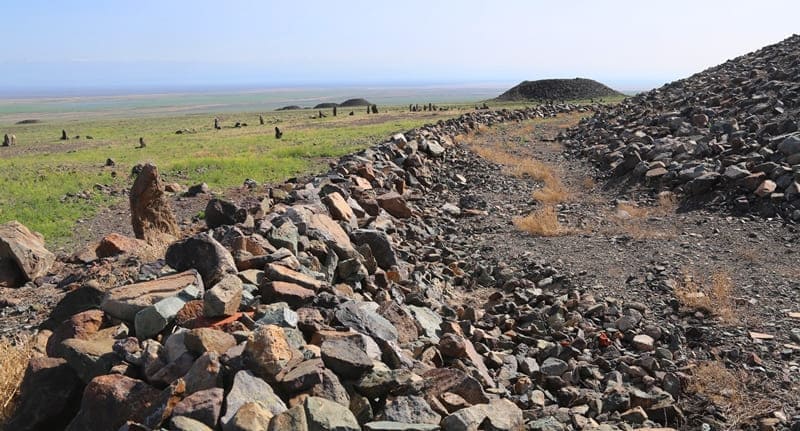
Burial stones were usually brought from the surrounding mountains. Archaeologists excavated seven mounds from the entire group of mounds. Beneath them were found tombs in the form of rooms with a corridor leading into them, constructed from Tien-Shan spruce logs, carefully hewn with bronze axes.
Nothing valuable was found in the mounds except fragments of scattered human and domestic animal skeletons, shovel handles, and shovel shovel handles. Five large mounds are located among smaller ones lined with the same material. Burial stones were usually brought from the surrounding mountains, approximately four kilometers from the nearest Chelbyr gorge.
The mound closest to the river is made of fine crushed stone and coarse gravel. Only five large mounds are visible from a distance. The rest seem hidden from view. That's why they're called "Besshatyr," meaning "Five Tents." A small mound, built of stones and located south of the large mound, adjoins the circular enclosure system.
Similar ditches and enclosures are built at the second, adjacent mound. The third large mound has a slightly different ornamental pattern. Here, enclosures are located only on the eastern side, forming two successive semicircles. Finally, the mound closest to the river is seemingly fortified by a fence in a straight line on the western side; the high front stones of this line, however, face east.
The mound closest to the river was excavated, and a now-collapsed tunnel led from its western side to its foundation. Undoubtedly, only the most valuable items were taken from the tomb. Besshatyr, whose significance and uniqueness merit careful management and preservation for future generations, is currently located within the Altyn-Emel National Park.
Geographic coordinates of Besshatyr burial mounds are: N43°55'24 E78°12'33
Authority:
"Commandments of Singing Dune." 1996. P.I. Marikovsky.
Photos by:
Alexander Petrov.