




Вы здесь
Vyatkin on Tillya-Kari Madrasah.
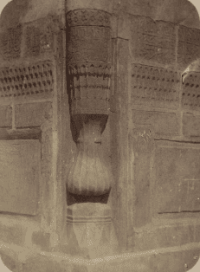
Guided tour of Tillya-Kari Madrasah.
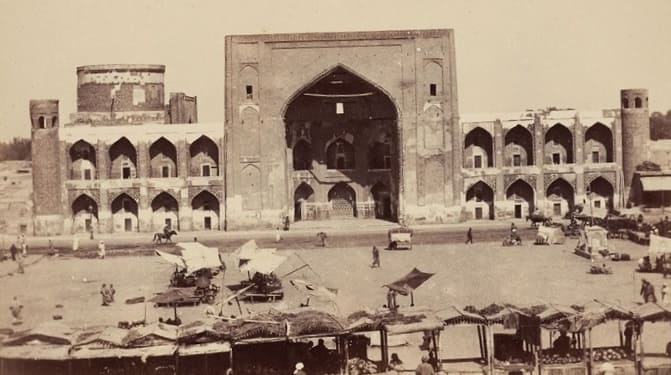
"The Registan has long been lined with shops; it was Samarkand's main marketplace. Until recently, it housed food stalls. Here, beneath the majestic portal of the Mirza Ulugh Bek Madrasah, a maddah (narrator) would loudly recount the exploits of saints and heroes, surrounded by a crowd seated on the floor slabs beneath the portal and on the stone pavement. He was excited, and with his voice and gestures, full of tragedy, he sought to express the suffering, rapturous love, and heroism of celebrated figures from bygone centuries.Today, the Registan serves as a venue for rallies and parades."
V. L. Vyatkin "Antiquities of Samarkand." 1930.
Architectural highlights of Tillya-Kari Madrasah.
The Tillya-Kari madrasa, bordering Registan Square on the northern side, was also built by Yalangtush Bahadur and is only 12 years younger than the Shir-Dor. Its façade features a tall portal with a pointed arch, a favorite feature of Central Asian madrasa architecture, flanked by two-story khudjras with arches and niches, opening onto the square.
These arches, covered with tiles and mosaics, lend the façade a more lively atmosphere than the solid walls of neighboring madrasas, albeit dissected by false arches. The Tillya-Kari façade, thanks to its ajas, is unique and beautiful. Small minarets stand at the corners of the façade, their lantern-like tops rising slightly above the second floor.
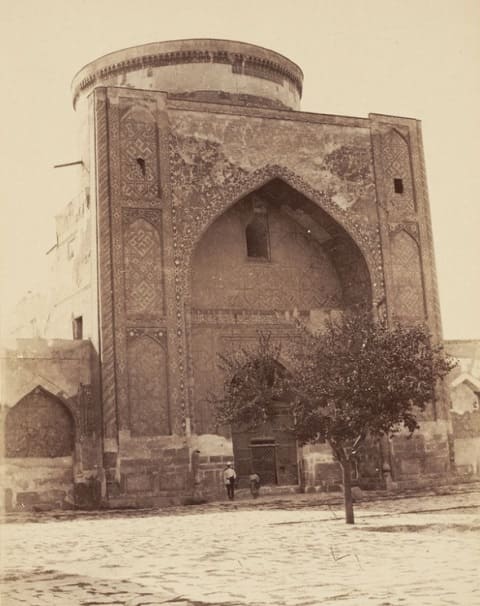
Too much of the tiled decoration on the portal has been lost, as its upper portion, above the vault's pedestal, was completely rebuilt after a collapse in ancient times, and was partially left uncovered or covered with random tiles. Reconstructing the composition of the portal's upper portion is therefore impossible.
But even the surviving ornamental tiled decorations characterize the incipient decline in art. Here, the coarseness of the ornamentation, its garishness, and its variegation are even greater than in Shir-Dor. The vast courtyard of the madrasa is occupied on three sides by single-story cells and the western cathedral mosque, with a high portal and beyond it a towering, vast drum, long since deprived of its crowning dome.
In this madrasa, the main and most important part is the mosque, flanked by spacious chambers, the vaults of which are supported by rows of columns. In this colonnade, the small domes create an excessive number of supporting structures in the form of multifaceted brick columns, which are generally very rare in local architecture.
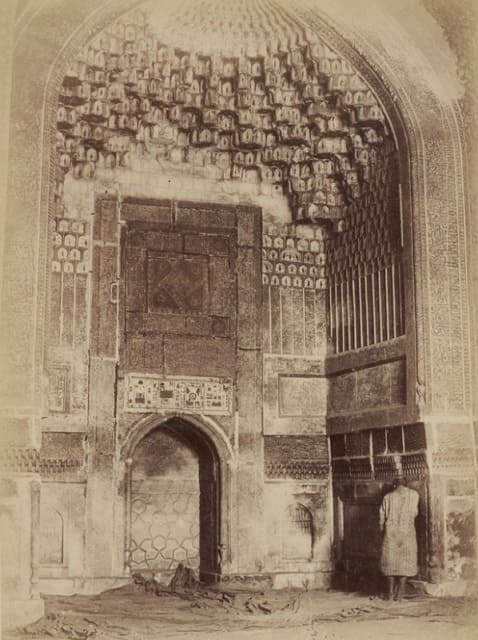
The interior of the spacious mosque is gloomy, obscuring the beautiful paintings on its alabaster plaster. Upon closer inspection, you see that the paintings are still strong, multicolored, and varied, with in places fine floral and geometric designs. It's a shame that light can't be allowed to bring the colors to life.
The deep niche in the western wall (mihrab) is finished in stone, and the stone slabs were gilded. In some places, the gilding remains on the convex parts, in others on the recessed ones. Apparently, the stone was completely covered in gold. The minbar (pulpit) of black marble with a row of steps harmonizes with the overall tone.
The outer walls of the courtyard within the tympanums are often decorated with broadleaf ornamentation on spiral stems, circles, and geometric figures. While Shir-Dor may have inspired a high opinion of its builder for its time, Tillya-Kari is only a weak imitation.
Authority:
V. L. Vyatkin. "Antiquities of Samarkand." 1930.