




You are here
V. Vyatkin on Shir-Dor Madrasah.
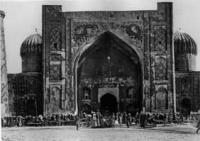
Tour of Sherdor Madrasah.
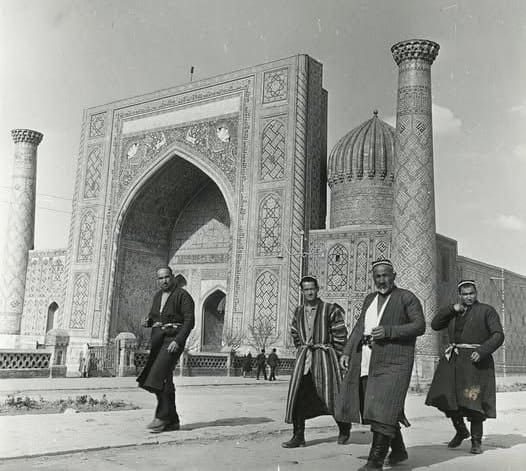
"The majestic and colorful buildings of the Registan are memorable to anyone who has ever visited Samarkand. Situated in an elevated part of the city, they attract attention even from afar with the uniqueness of their architectural forms: the grand pointed arches of their portals, the ribbed colorful domes, and the slender, slender minarets. From a distance, the building's architectural masses seem to be fancifully piled upon one another, forming a picturesque group of colorful blocks."
B. Veyrman. "Registan in Samarkand." 1946.
Architectural highlights of Sherdor Madrasah.
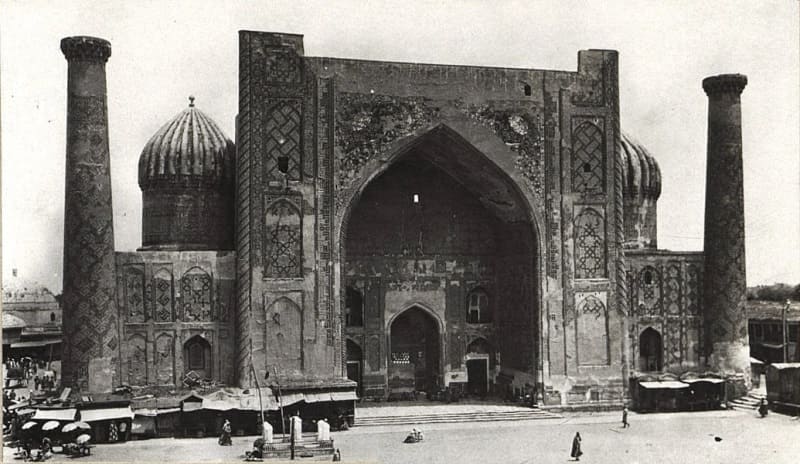
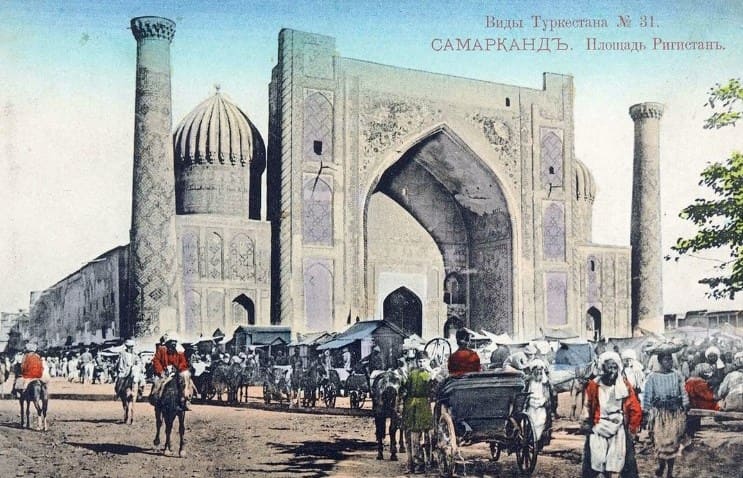
Directly opposite the façade of the Mirza Ulugh Beg Madrasah rises the majestic portal of the Shir-Dor Madrasah, with ribbed domes on tall drums on either side and slender minarets at the corners. The plan of both madrasahs is essentially the same. Perhaps the builder of the Shir-Dor was driven to imitate it by a sense of symmetry inherent in the Central Asian East, rather than a lack of his own imagination or boldness.
The Shir-Dor Madrasah was built two centuries later (1618) than the Mirza Ulugh Beg Madrasah by Yalangtush-biy-Bahadur, an Uzbek of the Alchin clan and a dignitary of Emir Imamkuli Khan, on the site of the khanaka of Mirza Ulugh Beg, which had already collapsed.
It is remarkable that the dying antiquity has once again gathered its strength, once again exerting itself to leave posterity a series of beautiful monuments in Bukhara and Samarkand, the finest of which is Shir-Dor. In its inherent technical qualities, it is far inferior to the Timurid style, but for its time, it is a high standard.
In its ornamentation, we find echoes of distant antiquity, elements of artistic wealth accumulated over centuries, the results of research and craftsmanship, but this is only a flash, soon extinguished. Shir-Dor is rougher and more ponderous than its model; the compositions here have lost their freedom and lightness, the technical execution of the tiled covering has deteriorated, and above all, the viewer's attention is drawn to the power of the whole.
It has been better preserved than Miraz Ulugh Beg and helps restore some of what he lost. The facade of the Shir Dor madrasah, enclosed between two slightly inclined, slender minarets, presents a high portal with a wide pointed arch and lower wings along the minarets have lost their crowning caps, which were preserved on the Bukhara minarets.
Ribbed domes, missing from Mirza Ulugh Beg's minarets, remain above the wings on tall drums. The base is paneled with gray marble slabs with the same ornamental band of horizontally arranged rows of arches and a band of marble slabs with polished relief inscriptions.
In the division of the portal's sections, the builder, Shir-Dora, whose name is inscribed in white lettering on a medallion with a black background above the inner arch of the portal -
"This building was erected by the art of Abdul-Jabbar the architect"
- imitated his model, but employed a different ornamental composition.
The portal's tympanums depict a lion (tiger) pursuing a chamois, and behind the lions, a rising sun in its rays - an unusually rare animal motif, as Muslims took one text of the Koran literally:
"Thou shalt not make for thyself any graven image..."
and animal ornamentation was not permitted.
The lions' coloring is partly natural - yellow with a light underside - but the chamois are depicted white with black spots, like the sun. Generally speaking, the choice of colors is arbitrary. The Shir-Dor portal contains a significant number of ornamental motifs, but, with the exception of the tympanums, the predominant motif is geometric ornamentation of small tiles.
Only the inner arch, distinguished by its fresh colors, is almost entirely mosaic, with a predominance of yellow and blue tones. Its theme and colors are similar to the exterior decorations of the madrasa courtyard. Yet even the façade displays vibrant colors, enlivening the lines of the relief frames and trusses with shadows in the recesses, and sunlight streaks across the facing of the minarets and portal.
The vast expanses of the madrasa's outer walls, with the exception of the portal, are flat, without cornices, and would be extremely dull and monotonous if they weren't decorated entirely with ornamentation of tiled bricks of a type favored for such surfaces - a geometric grid of blue tones, with rectangular Kufic script in light blue.
Small windows in the wall seem like holes. The madrasa courtyard, surrounded on all sides by walls with two tiers of arches and in the center, with high portals, higher than the roof, with pointed arches and deep blind niches, is impressive in the totality of all its parts.
Here, the yellow tone stands out sharply, less pleasing than in Timurid buildings; combined with blue, it deprives the coloring of its softness. The most exquisite ornamentation is found in the arch portals and the deep niches within them, divided at the edges of the northern and eastern arches.
The semi-domed vault of the niches is composed of sectors, thus providing a series of surfaces for ornamentation. One of the most important ornamental motifs, a legacy from previous centuries, is the stylized floral spiral design. The main motif consists of successive spirals, from which symmetrical branches emerge with small three-petaled leaflets and burdock-like buds.
Another key element of the decorative style is a wide, sometimes stylized, grape leaf, sometimes unnaturally elongated. Both of these motifs reign supreme in the Shir-Dor courtyard, along with blue horizontal and vertical bands with white inscriptions, the style of which is also linked to the decorative embellishment.
Beautiful mosaic vases with stylized flower bouquets are quite striking in the niche of the western portal, on the gable wall and cheeks. The vases have longitudinal stripes along the neck and a base in the form of curved leaves. Above, on a blue background, is a white historical inscription in Persian, which I reproduce below in translation.
Muslim authors who described architectural structures placed particular emphasis on monumentality. Colossal scale, visual impact, and then artistic refinement were essential. Grandiosity, bombast, extreme exaggeration, and astonishing metaphors are characteristic of these authors.
Thus, the aforementioned poem about the construction of the madrasa is as follows:
"Military leader, commander, just Yalangtush! If an arrow flew in praising his perfection, this elegant tongue, full of pearls. He built such a madrasa that he brought the earth to the zenith of the sky, this banner of their mutual adornment. For years, the eagle of the mind will not reach the lofty summit of its portal with the power and zeal of its skillful wings.
For centuries, the skilled acrobat of thought will not reach the summit of its forbidden minarets on the tightrope of fantasy. When the architect of precise precision erected the curve of the portal's arch, the heavens, mistaking it for a new moon, bit their finger in amazement.
Since Yalangtush Bahadur was its founder, the year of its construction (Israel) is calculated as Yalangtush Bahadur.
If we add the digits that replace the letters in the words Yalangtush Bahadur, we arrive at the founding year of the Shir-Dor madrasah, 1028, corresponding to the Christian year 1618. The Shir-Dor madrasah contains a series of residential spaces on both floors, two auditoriums in the corners of the eastern wall, and two spacious rooms. halls under the domes of the facade - one houses a mosque with paintings on the walls and the other contains the tomb of one of the imams, a descendant of Imam Ja'afar.
The top of the portal from the courtyard side Unfaced, reinforced at the rear by a series of supporting arches or trusses. In Shir-Dor, the architectural and artistic elements, despite all their shortcomings, are well-maintained and form a complete whole.
Authority:
V. L. Vyatkin. "Antiquities of Samarkand." 1930.
Uzbek Committee for Cultural Monuments. Khamkomstaris. Third edition.