




Вы здесь
Vyatkin on Ak-Saray in Samarkand.
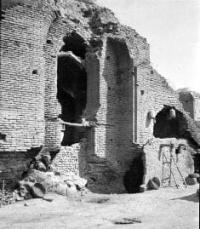
Tour of Ak-Saray Mausoleum in Samarkand.
"On the outside, it is merely a severe, unclad brick skeleton, but inside is a dazzling, gold-woven carpet."
"Architecture of Central Asia. XVth Century." G. A. Pugachenkova, 1976.
Architectural Features of Ak-Saray Mausoleum.
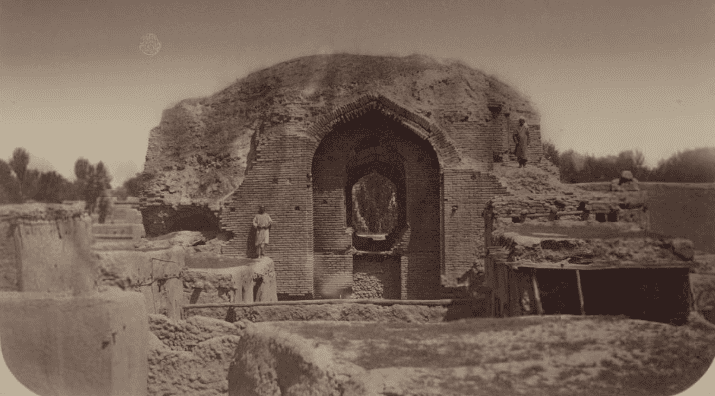
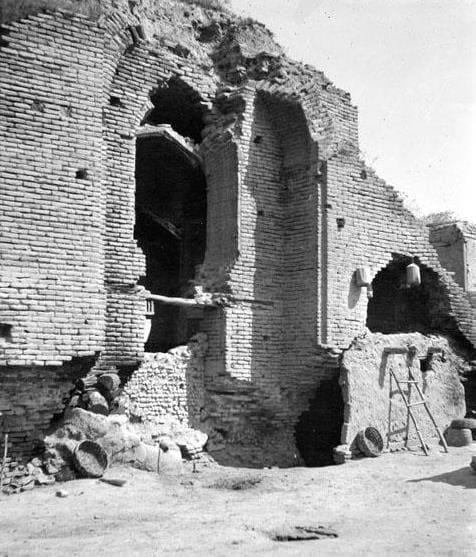
A little further east of Guri-Emir lies a pitiful ruin, lost among the small houses, devoid of the outward attributes of ancient Samarkand monuments - a faban, a dome, and tiled decorations. Popularly known as Ak-Saray, it shares the name with Timur's marvelous palace in Shikhrisyabz.
This structure, by all accounts, dates back to the time of Timur or the Timurid Empire and is undoubtedly a mausoleum. However, a certain ambiguity and paucity of historical data make it mysterious, and even the idea that Timur and his grandson Muhammad Sultan were originally buried here is now questioned.
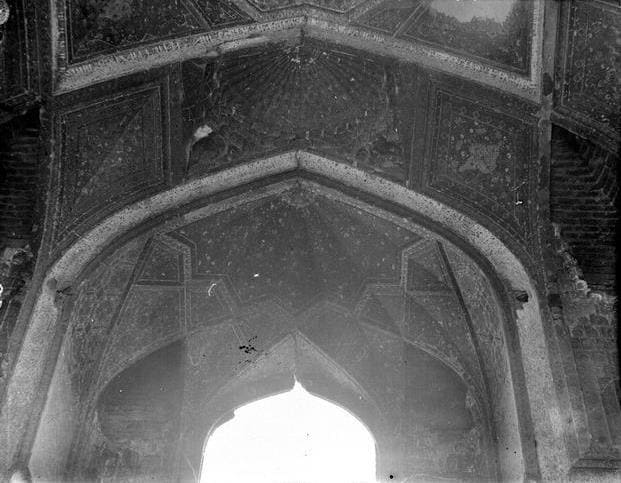
There are no traces of tile decoration on the building's exterior, and excavations of its walls have not revealed any. This monument deserves attention for its marvelous interior decoration. One panel, of which only fragments remain, allowing for restoration, was mosaic, with vases and bouquets, but was apparently unfinished.
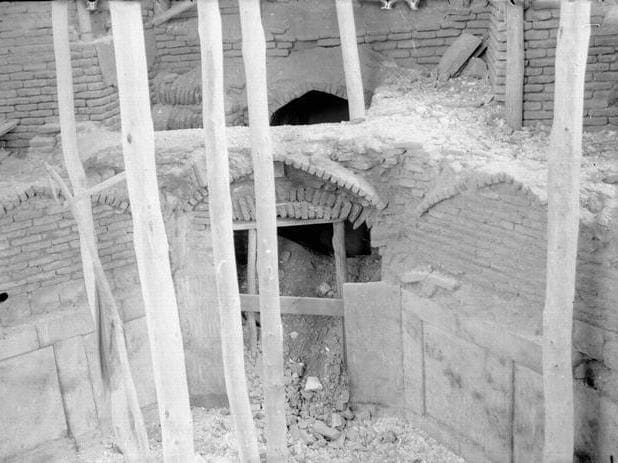
The vibrant colors and combination of yellow and blue in the mosaic make it exceptionally beautiful. The visible vault, the transitions between the walls, the arched niches, and the pendentive arches are composed of solid alabaster plaster of varying thickness, supported by the main masonry or suspended from it only in places.
The curvature of the main masonry does not coincide with the plaster, sometimes leaving a significant void between them. Therefore, the architect's attention is focused not on the design of the building's brick foundation, covered with plaster and separated from it by a void, which remains unfinished, but only on the plaster itself, carefully processed by Ak-Saray.
The vault appears to be composed of individual panels of geometric shape, most often in the form of elongated parallelepipeds, set at an angle to one another, sometimes with a break in the middle, creating a concavity and dividing the panel into two fields.
The edges of the panels resemble relief frames, while the edges of the corners and arches are accentuated on both sides by wide ornamental frames with raised longitudinal ridges.
Authority:
V. L. Vyatkin. "Antique Monuments of Samarkand." 1930.