




You are here
Vasily Vyatkin on Gur-Emir.
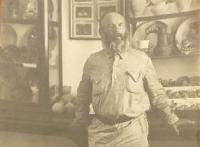
Manuscripts of Vasily Lavrentyevich Vyatkin.
"There was no doubt that the old man's gift was directly related to Timur's tombstone. It is a fragment from the lower part of the southwest corner of the slab (Fig. 1). On the inside, it has two sockets for small iron pins, which were used to secure it to the adjacent surfaces of the large slab at the foot of the burial. On one of the two outer surfaces of the piece, with an area of approximately 140 square centimeters in the surviving portion, several words have been preserved, both in whole and in part, continuing the four lower lines of the Arabic inscription located on the end of Timur's tombstone."
M.E. Masson. "Third Piece of Timur's Jade Tombstone. 1948."
Wall paintings in Gur-Emir mausoleum.
The history of Central Asia reveals no evidence that the religious sentiment of the population motivated the construction of capital public structures. The material resources for their construction were provided not by the people, nor even by capitalists, but by rulers and dignitaries, even in cases dictated by the needs of faith.
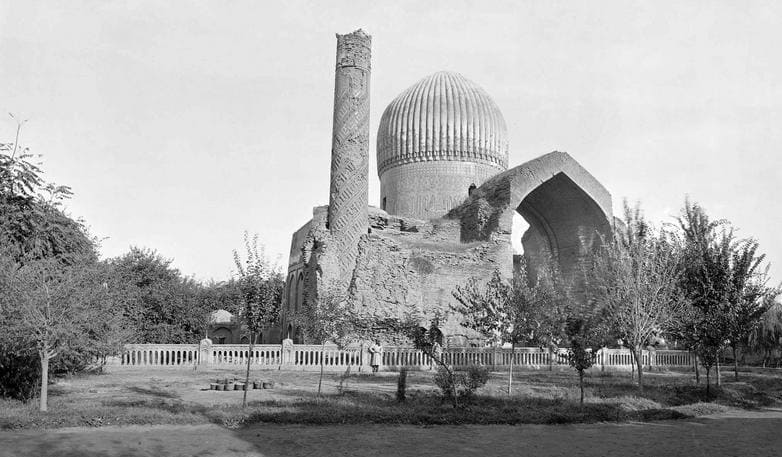
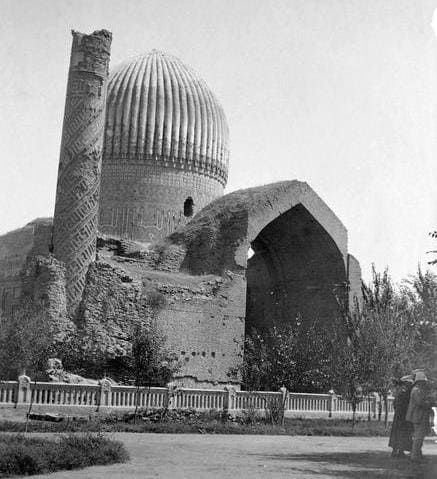
The building in which Tamerlane was subsequently buried, a tomb worthy of his power, was founded by him personally (from 805 to 1404), but completed somewhat later, most likely by Mirza Ulugh Beg. The Guri-Emir Mausoleum is enclosed by annexes on all sides, which have transformed its appearance.
The lower part of the building is obscured by them. Originally, it was built exclusively upward. The majestic dome of the mausoleum, soft in contour, even now, with its appearance marred by buildings, reveals an irresistible striving upward. The building's base is a quadrangular prism with slightly truncated corners.
Atop it rests a polygon, supporting a tall drum crowned with a vertically ribbed dome. Two minarets rose at the edges of the northern ceremonial façade. The purity and lightness of its forms were intended to convey a graceful air, despite its large size, suggesting a sense of upward mobility, as if detached from the mundane.
Essentially, the main structural elements of the Guri-Emir Mausoleum are four massive abutments at the corners of the building, designed to support the thrust and pressure of almost the entire building's upper portion, the drum, and two domes - an outer and an inner one.
The space between the abutments is occupied by deep niches with vaulted ceilings and thin enclosing walls, placed along the outer line of the abutments. Above the arched niches, the walls are uniform in thickness throughout, and the interior plan becomes square.
At the corners of the square are small arches, replacing pendentives, and above them a multifaceted ring, from which an easy transition is made into the circumference of the inner dome. The lower surface of the walls was completely covered with slabs of greenish, smoothly polished fine-grained marble, worked in wide frames on each wall plane into large hexagonal checkers with strips of dark serpentine interlining the edges.
Then, higher up, a band of marble slabs, resembling a cornice, with recessed arches painted in several colors, and above this, another band of marble with large relief lettering. The interior continuous wall painting on alabaster plaster represents meager remnants of its former splendor, and only a careful examination can evoke an opinion of the master's good taste.
The murals are dominated by greenish paints, matching the paneling. The vault and the arches in the corners beneath it were completely lined with embossed palmettes and rosettes of silk cloth, painted gold and other colors. The tops of the niches where the vault meets the gable wall are filled with stalactites, shaped like...
Behind the marvelously crafted marble latticework, with its varied ornamental motifs on the frame and columns, delightful in the flexibility of the chisel and the breadth of imagination, are the tombstones and daises of Timur himself, his two sons, two grandsons, and his spiritual mentor.
And here, near the black, mournful jade, smoothly polished tombstone with its distinct inscription of Timur's genealogy, one is reminded of all the terrible and tragic things the man lying beneath brought into the world. Daylight faintly penetrates the mausoleum from above, through two rows of latticed windows in each wall, one above the other. It's dim, quiet, and peaceful here.
An inconspicuous staircase, descending beneath the floor, leads to the crypt. The crypt is gloomy and damp. The vault is built boldly, almost horizontally. The white joints of the masonry, protruding against the brown background of ground bricks, form a veritable web.
The corners of the crypt's base unfurl like pendentives. Tombstones covered with inscriptions lie on the floor of large stone slabs. Only a small arched portal, the remains of whose pilasters remain, and two minarets on the sides of the building, now lost, accentuated its façade. In Central Asian In architectural design, the portals were especially carefully and beautifully ornamented.
The Guri-Emir Mausoleum deviated from this tradition - it was neither artistic nor majestic. Another distinctive feature of the mausoleum is the complete absence of mosaics and floral ornamentation in the exterior decoration. As is well known, the building's body and its tiled cladding are not a single unit - the latter is applied with alabaster mortar to the finished masonry of the walls and other parts of the building.
At close range, the ornamentation of the main building, predominantly large, stands out clearly, but further away it merges to form a delicate blue hue. Each side of the prism-shaped base, enclosed in a frame, is divided diagonally by blue bricks into a geometric grid, the cells of which alternate and enclose words of rectangular blue letters, also elongated diagonally.
The design was laid out using a square as a starting point, giving the impression of cross-stitch embroidery. The shape and arrangement of the texts are such that they appear ornamental. The tall drum, also decorated with a pattern of square bricks, with a blue-and-white band encircling it just below the dome, with brown bricks predominating below, has a pattern of white bricks framed in blue, extending vertically across almost its entire width, visible from afar. The austere and sparse wall ornamentation here on the drum is somewhat lively and varied.
The vertically ribbed dome, once clad in blue and light blue majolica tiles, gently overhangs the drum, decorated with stalactites along the overhang. The entrance to the mausoleum courtyard on the north side is not impressive in size. The entrance portal is completely independent of the main building and stands alone, as it is the only surviving element of the courtyard fence.
However, its tiled cladding is superb in its strength, richness, freshness, and purity. Luxuriously and exquisitely decorated with graceful, varied ornamentation and calligraphic inscriptions made from vibrant blue mosaic and majolica tiles, this portal contrasts with the austere ornamentation of the main building.
Here, such sharp colors as white, green, blue, light blue, yellow, black, and gold are fused into the overall color scheme. The colors are enhanced by the contouring of individual motifs. As a rule, each individual ornamental motif is framed, sharply emphasizing its content.
In the arch of this portal, the vault of which has not survived, cracks remain, and superbly crafted tiled stalactite decorations hang overhead. Above the entrance arch, a medallion on a blue background bears the inscription in white letters that this is "the work of the weak slave of the architect Muhammad son of Mahmud from Isfahan*1."

Authority:
Vasily Lavrentyevich Vyatkin. "Antiquities of Samarkand." Third edition. 1927.
Photographs by:
Paul Nadar. 1890.