



Вы здесь
Nikolai Yakovlevich Konshin.
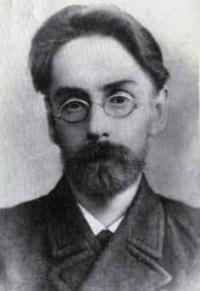
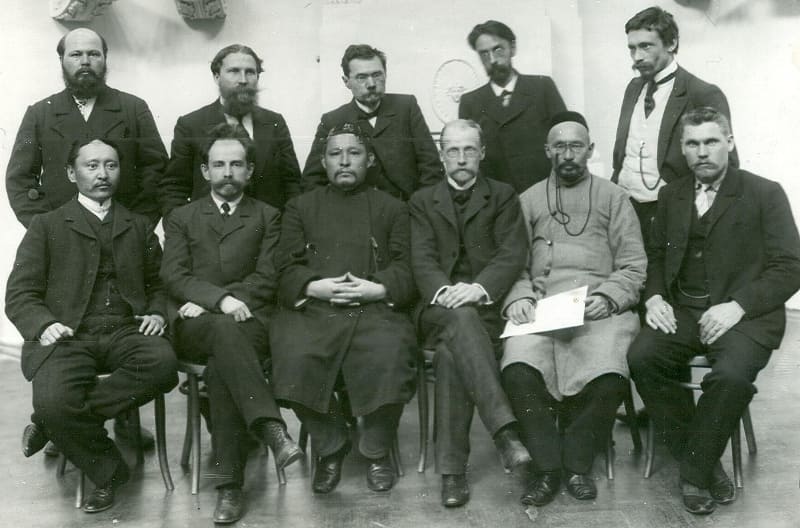
Researchers of Semipalatinsk Region.
"Interesting people members of the progressive intelligentsia often gathered at our home. Among our guests were the renowned Siberian researcher and scholar G. N. Potanin; local historians and active members of the Geographical Society such as B. G. Gerasimov, A. N. Beloslyudov, A. N. Chekalinsky, and P. A. Solomin; as well as Professor P. N. Nekhoroshev. My father shared a long-standing friendship and common interests with them. He would often tease Boris Georgiyevich Gerasimov, asking, 'How can you be both a priest and a biologist? How do you reconcile the two?' Boris Georgiyevich never took offense, as his true calling was scientific work. My father also maintained a correspondence with political exiles, including N. I. Dolgopolov, A. L. Bleck, and many others. According to my mother, my father was friends with Abai Kunanbayev who visited him quite often as well as with Mukhtar Auezov..."
Ekaterina Nikolayevna Konshina. S. Chernykh, "A Friend of Abai," “Prostor” magazine, No. 6, 1979.
Researchers of history of Kazakh clans.
Nikolai Yakovlevich Konshin (1864-1937) was a Russian journalist and ethnographer who served as a deputy to the State Duma of the Russian Empire (during its first and second convocations), representing the Semipalatinsk Region. Nikolai Yakovlevich Konshin served as secretary of the Statistical Committee and was one of the initiators behind the establishment of a local branch of the West Siberian Geographical Society.
As one of the most prominent political exiles, he made a significant contribution to the development of local historical and ethnographic studies. Nikolai Konshin was born in Tver in 1864 into a noble family. After graduating from the Tver Gymnasium for Boys, he enrolled in the Faculty of Medicine at Moscow University.
In 1884, he was sent back to his hometown of Tver for his participation in student unrest. In 1885, he entered the Demidov Law Lyceum in Yaroslavl, where he became a member of a revolutionary student circle closely linked to the “Narodnaya Volya” ("People's Will") organization.
In 1886, he enrolled at the Demidov Law Lyceum in Yaroslavl. That same year, he was arrested and convicted, subsequently serving time in prisons in Yaroslavl, Moscow, and Pavlodar. Following his imprisonment, he was exiled for three years and six months to the town of Zaysan in the Semipalatinsk Oblast.
There, he worked as a private legal counsel for the Semipalatinsk District Court, edited the newspaper “Semipalatinsky Listok” ("Semipalatinsk Leaflet"), and served as the administrator for the Semipalatinsk branch of the Russian Geographical Society.
Due to his involvement with the (Narodnik) (populist) movement, he was exiled to Western Siberia. In 1890, he was relocated to Semipalatinsk, where he spent the remainder of his life. It was during his time in Semipalatinsk that Konshin’s talent as a researcher truly emerged a process aided by his appointment in 1898 as secretary of the Statistical Committee.
His duties included not only reporting on the socio-economic conditions of the Semipalatinsk Oblast but also conducting research into its natural resources, history, archaeology, ethnography, and geography. He also worked on the study of local archives and served as the first director of the provincial archival collection.
He collected, processed, and published extensive and valuable material on the history of the Steppe Region, the history of administrative and political exile, and the historical monuments of the Semipalatinsk territory. He also authored significant research on the history of Kazakh clans.
Konshin’s body of work includes several articles based on archival research, such as "The History of a Kyrgyz livestock famine," "On the Political Unreliability of Semipalatinsk Officials," and others. In 1890, Konshin met Abai Kunanbay and maintained a close relationship with him.
His published works include "Notes on the Kazakh Famine," "A Trip to Shugyshak," "The Zemstvo and the Kazakhs," "A New Proposal for Kazakh Land Tenure," and "Dangers Facing Settlers in the Steppe Region," among others. N. Y. Konshin was the driving force behind the establishment of the Semipalatinsk branch of the Russian Geographical Society, having proposed its creation in the pages of the Semipalatinsk Regional Gazette (Semipalatinskiye Oblastnye Vedomosti).
In 1901, he published "An Outline of the Economic Life of the Kyrgyz in the Semipalatinsk Region," based on data from an 1899 expedition conducted to gather information on the way of life of Kazakhs residing on Cossack lands. The study describes the settlement and development of the Irtysh Valley by Russians and Kazakhs, illustrating the process of rapprochement between the two peoples and the mutual influence of their respective cultures and customs.
In 1905, N. Y. Konshin became the editor of the newspaper "Semipalatinsky Listok". In 1907, he was elected as a deputy to the State Duma; in 1914, he became a member (glasny) of the Semipalatinsk City Duma; in 1919, he was appointed Mayor of Semipalatinsk; and following the restoration of Soviet power, he served as the head of the Gubernia Archives Bureau.
In 1911, Konshin served as the editor of the newspaper Semipalatinsk Region and also compiled an archaeological map of the Semipalatinsk Oblast. N. Ya. Konshin created a comprehensive genealogy of the Kyrgyz (Kazakh) khans and sultans, which included a highly detailed lineage of all the descendants of Bukey Khan; he also took an interest in the history of the uprising led by Kenesary Kasymov.
Konshin contributed articles to newspapers in Omsk, Tobolsk, and other Russian publications. He compiled a catalog of archival materials that contained a wealth of information regarding the ethnic composition of the population in the Irtysh region, the history of the area, and its raw material resources.
The Semipalatinsk branch of the Russian Geographical Society (RGS) was established in 1902, and by 1904, Nikolai Konshin had been awarded a silver medal by the Imperial Russian Geographical Society. During his period of exile, he studied the history of the Kazakh people.
In July and August of 1898, he traveled through the Ust-Kamenogorsk Uyezd with the objective of "examining the situation of the settlers' villages firsthand" and "studying the way of life of the *zhataks* [impoverished, landless Kazakhs]" in a section of the "Cossack ten-verst strip."
Based on the data gathered during his survey of the settlements of Georgiyevsky, Aleksandrovsky, Mariinsky, Nikolayevsky, Mikhailo-Arkhangelsky, Karashsky, and Chubar-Kain, he published two essays in 1899: "Settlers' Villages in the Ust-Kamenogorsk Uyezd" and "Across the Ust-Kamenogorsk Uyezd."
After his exile ended, he remained in Semipalatinsk. For several years, Konshin served as the editor of the "Yearbooks of the Semipalatinsk Region," secretary of the regional statistical committee, and administrator for the Semipalatinsk branch of the Geographical Society.
From 1902 to 1905, he managed the city museum and library in Semipalatinsk. He also authored essays on the life of F. M. Dostoevsky in Semipalatinsk, as well as articles such as "On Historical Monuments of the Semipalatinsk Region," "Administrative Investigations into Individuals in Ust-Kamenogorsk," and "Materials for the History of Political and Administrative Exile to the Steppe Region," among others.
For his work on the history of the Steppe Region and his role in establishing the Semipalatinsk branch of the Geographical Society, Nikolai Konshin was awarded a silver medal by the Imperial Russian Geographical Society. In June 1906, Nikolai Konshin was elected as a deputy to the First State Duma of the Russian Empire, representing the urban and peasant populations of the Semipalatinsk region; however, he did not have the opportunity to serve, as the Duma was dissolved on July 8, 1906. He supported the Constitutional Democratic Party.
In the spring of 1907, he was re-elected as a deputy to the Second State Duma of the Russian Empire, where he identified himself as a "left-leaning, non-partisan progressive." During his tenure, Konshin signed a statement addressed to the Chairman of the State Duma advocating for a balanced approach to the government's resettlement policy.
In March 1907, he joined the Siberian Parliamentary Group. Following the establishment of Soviet power, he participated in the organization of the Semipalatinsk Provincial Archive. For his work on the history of the Steppe Region and his role in establishing the Semipalatinsk branch of the Geographical Society, N. Ya. Konshin was awarded a silver medal by the Central Geographical Society.
N. Ya. Konshin passed away on August 1, 1867, at the age of 73.
Bibliography:
*Archives: Memory of the Past* / Center for Documentation of Modern History of the East Kazakhstan Region. Semipalatinsk, 2000.
Gulyaeva, E. "A Repository of the Nation." Spektr, April 7, 2010, p. 3.
Durdybaeva, G. "Chronicler of the Steppe Region." 7 Dney, March 12, 2009, p. 5.
"An Explorer of the Steppe Region" (compiled by G. Nugumanova). Vesti Semey, August 5, 2014, p. 3.
Kozhakhmetova, G. "It All Began with Geography." Nashe Delo, October 14, 1999, p. 7.
Ramazanova, F. S., and R. T. Daukonova. "Scientific Description of the Region in the Materials of Members of the Semipalatinsk Sub-branch of the West Siberian Department of the Russian Geographical Society." Bulletin of the Shakarim State University of Semey, 2016, No. 3, pp. 273–277.
Titova, S. "Chronicles of the Steppe Region: On the 145th Anniversary of the Birth of N. Konshin." Vesti Semey, August 6, 2009, p. 4.
Tusunbaeva, T. U. "They Were the First." Arna, March 29, 2002. p. 8
Tusunbayeva T. At the Crossroads of Eras / T. Tusunbayeva, I. Khadzhi-Murat; compiled by O. Babchenko. Nashe Delo. March 5, 2009. p. 8
Urymbayeva Zh. Invaluable Works by Researchers. Vesti Semey. September 30, 2014. p. 5
11. Urymbayeva Zh. Nikolai Konshin: A Researcher of History and Ethnography. Vesti Semey. September 4, 2012. p. 3
Authority:
https://semeylib.kz/?page_id=12980&lang=ru