




You are here
Uilskoye Fortification.
A trip from settlement of Uil to Aktobe.
“Uilskoye Fortification (settlement) - Ural Region, Temirskoye in the Kyrgyz Steppe, near the Ulu-Uil River. Nearby, Russian settlers founded the village of Uilsky (Shipovsky), which currently forms part of the fortification. From Uilskoye, there is a temporary road to the Iletsk defense, open four times a year for the duration of the local village fairs. From here, roads diverge to Temir, Guryev, Kalmykov, and Uralsk. The military commander's office, garrison, Cossack detachment, infirmary, church, school, rural and veterinary doctors, and two fairs, the turnover of which in 1898 amounted to 2 million rubles. The main place for purchasing Kyrgyz cattle.”
N. B-n. Brockhaus and Efron Encyclopedic Dictionary.
"...Here is Uil-the former Uil fortification. In the center stands a small, brand-new stone church (a mosque, author's note); to the right is a large peasant settlement with regularly spaced houses, roofed with either planks or iron, or thatched; further to the right is an old fort, surrounded by a rampart, where a small Cossack detachment still stands. To the left is a vast fairground, and in the center is a large stone building housing the fair's administration and the numerous officials (the fair committee, author's note) who flock to the fair."
A. A. Kaufman. "In Central Asian Steppes" (from summer impressions), "World of God" magazine, 1904.
Historical landmarks of Uilsky District.
Uil Fortification was located on site of present-day settlement of Uil, administrative center of district of same name, at an altitude of 88 m. a. s. l., 2.3 kilometers from right bank of Uil River, 228 kilometers northwest of Emba Fortification in Uil District in western Aktobe Region.
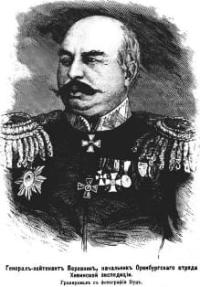
The Uil Fortification Since 1899; formerly part of the Kalmykovsky district was founded by order of Major General Nikolai Aleksandrovich Verevkin (August 3, 1820 – July 10, 1878, St. Petersburg) in the Kokzhar tract on July 6, 1869, as the Uil Fortification, in the Kyrgyz steppe, near the Ulu-Uil River.
Near the fortification, Russian settlers founded the peasant settlement of Uilsky (Shipovsky), which by 1902 had become one with the fortification. A temporary road to the Iletsk defenses ran from the Uilskoye fortification, opening four times a year for the duration of the local village fairs.
From there, roads diverged to Temir, Guryev, Kalmykov, and Uralsk. Two fairs were held in the settlement, with turnover in 1898 reaching up to 2,000,000 rubles. It was also the main place for purchasing Kyrgyz cattle. 1880. The Kazan-Our Lady Church was built in the Uilskoye fortification.
(Orenburg Diocesan Gazette No. 2, January 15, 1881; Memorial Book and Address-Calendar of the Ural Region for 1911, p. 92.) Until 1899, part of the Uilskaya volost of the Kalmykovsky district; afterward, part of the Temirsky district of the Ural region.
In 1902, the Uilskoye fortification housed the Military Commander's Office, a garrison, a Cossack detachment, a hospital, a church, a school, and rural and veterinary doctors.
Authority:
https://ru.wikipedia.org/wiki/%D0%A3%D0%B8%D0%BB_(%D1%81%D0%B5%D0%BB%D0%BE)
Machulin's description of expedition to Emba in 1871 (Machulin). 1872.
"The Uilskoye fortification was founded in June 1869 and completed in September 1870. The terrain on which the fortification was built is elevated, almost on a mountain, but level and open on all sides. Winds and snowstorms constantly harass the garrison, especially in winter; from large
The fortification suffers from snowdrifts, and in summer, the easterly winds are always long and so dry that they completely scorch all the vegetation. Beneath the mountain, the Uil River flows, sparkling in the sun, and twists like a snake. One end of this river, to the left, rests against a cliff, and, making a sharp angle, is completely hidden from view, as if cut off or swallowed by the rock.
The right end, on the contrary, disappears somewhere very far into the steppe. Beyond the river, there is steppe again, a vast yellow plain in summer. The location was quite well chosen: there are good meadows for haymaking, plenty of reeds for fuel along the river banks, and fairly tolerable land for about two miles below the mountain.
Thanks to the efforts of the fortification commander, large vegetable gardens, melon and watermelon patches, and arable land have been planted. This year, 35 dessiatines of oats, 25 dessiatines of rye, and 20 dessiatines of millet were sown as a trial.
But what a tremendous amount of labor it took to bring it all to its present state! Perhaps in time, something more will emerge. But there's not a single tree or bush anywhere. Last fall, the commandant planted acacias brought from Iletsk-Zashchita; but they didn't take root and almost all withered.
There's plenty of fish caught in Uila: carp, pike-perch, bream, crucian carp, catfish; occasionally, small sturgeon are caught. The Ural Cossacks are great fish hunters; I think they prefer it to meat. Fish is everything to a Ural Cossack; you should see how they revere their Ural Mountains! It's their breadwinner - and, frankly, sometimes a successful catch means a Ural Cossack's entire fortune.
The construction of the Uilsky fortification in 1869 was proceeding very slowly; bricks had to be made first. This was primarily done by Kyrgyz from nearby villages. Up to two hundred of their tents moved to the newly founded fortification; they (both women and men) hired themselves out by the day and by the lesson, ranging from 60 kopecks to 1 ruble 20 per day - and were very sorry when the work ceased.
The fortification is laid out somewhat irregularly; small one-story outbuildings are sometimes crowded together, sometimes spaced apart, without any symmetry. To one side is a low embankment on which four guns are positioned; two barracks surround it, no sentry box, and the whole thing is surrounded by a small, dry ditch, without gates, and looks somewhat peaceful.
This fortification can't frighten the Kirghiz, though naturally as timid as a sheep, and yet it's safe and strengthens our influence in the steppe. A small barracks and a cellar for alcohol have also been built for the quartermaster's warehouse. The cellar is well-made and convenient, but the barracks are small and can't hold more than flour and grain; everything else is in disrepair.
In 1869, this new fortification suffered greatly during the winter. Only two or three outbuildings were erected, and the garrison was housed in dugouts. They fed the soldiers as best they could; there were no vegetables or cabbage, just grain and porridge.
It sometimes happened that the soldiers didn't even have warm clothes or sheepskin coats, and meanwhile the frosts were severe. Naturally, the poor, cramped, and cold conditions led to bloody diarrhea, and then malignant typhus. We arrived in May, but engineers and materials didn't begin arriving until July.
The garrison will likely have to spend the winter in dugouts again. Although the Nizhne-Embensky, or (as they're calling it) Maslinsky fortification is supposed to be built of wood, it's hardly possible to build anything, especially in such a short time during the winter, other than the bare necessities - such as kitchens, an infirmary, and a bathhouse.
Fortunately, with such an early start, the soldiers have warm clothing, otherwise further disaster would have been inevitable. The vegetable gardens on Lake Mashe have been planted, albeit with great difficulty. I bought various seeds for my team in Orenburg; but since the soil is all saline, and the gardens were planted late, I don't think the sowing will be successful.
By the time I left, some shoots had appeared here and there, but only the cucumbers had taken root. The garrison of the Uilsky fortification currently consists of the fortification commander, who is also the commandant, the adjutant, a doctor, and the quartermaster's warehouse keeper; four guns with 15 artillerymen; a local detachment from the Orenburg line battalion of 230 men; 20 non-combatants; a Ural combined company of 156 men; and, in addition, there is often a passing detachment, as the fortification contains a fairly large warehouse: alcohol, provisions, and forage, prepared and transported from Orenburg specifically for the steppe.
The fortification has three taverns, a billiards tavern, and several small shops. During the fairs—the spring fair from May 15th to June 15th and the autumn fair from September 15th to October 15th—the proportion of taverns increases, with up to 50 large shops and up to 38 small shops.
Geographic coordinates of Uilsky fortification are: N49°04'25 E54°39'50
Authority:
Expedition to Emba in 1871 (Machulin). 1872.
https://ru.wikisource.org/wiki/%D0%AD%D0%BA%D1%81%D0%BF%
Alexander Petrov.