




You are here
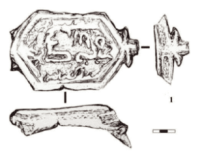
A signet ring with inscription "Muhammad" from Dzhankent.
Medieval settlement of Dzhankent.
Ibn Umar said:
"The Prophet wore a gold ring, then removed it and put on a silver ring with the inscription 'Muhammad is the Messenger of Allah,' and said: 'No one should write anything on the inscription of this ring of mine.'"
Sunan Abi Dawud, hadith 4218.
Excursion to Zhankent settlement.
A signet ring with inscription "Muhammad" from medieval settlement of Dzhankent.
This article introduces for the first time materials from the "Islamic world" obtained during archaeological work at the Dzhankent settlement. In the VIIth-IXth centuries, Central Asia and Kazakhstan fell under Arab conquest, and Muslim states with local Islamized aristocracies emerged.
Medieval historical sources mention that cities along the Silk Road were inhabited by Muslims and Turks, ruled by Turkic rulers. The Dzhankent settlement is one of the best-studied medieval sites in the eastern Aral Sea region, mentioned as the capital of the Oghuz state.
Archaeological research has uncovered materials that provide a new perspective on the relationship between the Oghuz Turks and the Arab Caliphate. Archaeological and numismatic materials indicate that trade was developing between the centers of the Arab Caliphate and the peoples living in the Eurasian steppe, a finding confirmed by finds of items bearing Islamic symbols and Kufic inscriptions in Arabic.
The ring with a Kufic inscription from Dzhankent not only reveals the economic and political position of southern Kazakhstan in the 8th-9th/10th centuries, but also reveals the historical significance of the region. but also accurately documents the changing eras, styles, culture, and tastes of the Turkic tribes during the Arab Caliphate's rule over the Eurasian continent.
Introduction.
The study of religions that took root in Central Asia and Kazakhstan primarily draws on historical sources, as well as ethnographic research, and very rarely on archaeological materials. For the period of the dominance of polytheistic religions and the diversity of cults and rituals among ancient peoples and tribes, archaeological materials complement and allow us to partially interpret the worldview of ancient people.
However, not all such examples of using archaeology can be considered accurate. One of the main problems with using early medieval archaeological materials from Central Asia and Kazakhstan during the Arab Caliphate's rule and the imposition of "Islamic culture" is that they are very difficult to explain solely in terms of the forced Islamization of the population.
It must be taken into account that the objects could have arrived through military capture, trade, or gifting. In the VIIIth century, Central Asia and Kazakhstan fell under Arab conquest, and Muslim states with local Islamized aristocracies emerged.
The Turkic-Sogdian-Arab wars led to the resettlement of Arabs, including Islamic missionaries, and the establishment of centers of Islamic culture (Ibn al-Athir 2006: 212; Bolshakov 1980: 132-136). Trade and cultural ties between the cities of Central Asia and Kazakhstan increased sharply with the emergence of trading colonies in Muslim countries:
"And trade caravans from Bukhara and Samarkand became more frequent, selling utensils and fabrics" (Materials on History 1988: 104-105).
Ibn Hawqal reports that Muslims lived in Oghuz Turkic cities: "...Muslims live in the New Village, and at the same time, it is the capital of the Oghuz state." "Nearby are Jend and Hora, both of which are inhabited by Muslims, and the Oghuz are in power" (Ibn Hawqal 1939: 184).
Sources noted that the populations of the cities of Taraz, Shalji, Mirki, Nawikat, Farunkat, and others consisted of "Muslims and Turks," while further east lay the "land of war and unbelief" (Al-Istakhri 1939: 178). The Oghuz Turks are first mentioned in Ibn Khordadbek's work "Kitab al-masalik wa-l-mamalik," where the author provides a list of tribes that includes the Pechenegs, Kimaks, Kipchaks, and Ghuzz (Ibn Khordadbek 1939: 144).
Al-Istakhri characterizes the territory of the Oghuz state as follows:
"...the borders of the country of the Ghuzz are what lies between the Khazars and Kimaks, the country of the Karluks and Bulgars, and the borders of the Muslim countries from Jurjan to Farab and Ispidzhab."...
"...all the borders of Maveranahr are the site of military operations, from Khorezm to the outskirts of Ispidzhab with the Ghuzz Turks..."
(Al-Istakhri 1939: 167, 178). Al-Idrisi writes in his work "Nuzhat al-Mushtaq":
"... the cities of the Ghuzz are numerous and they stretch one after another to the north and east" (Al-Idrisi 1939: 220).
The first mention of Dzhankent appears in Ibn Rustah's work, Kitab al-a'alak annafisa, which notes:
"... on its western shore are mountains called Siyakuh, on the eastern shore are thickets of intertwined trees; it is almost impossible to pass or drive through them except along a narrow and uneven path, along which wild boars roam, and (along the road) to the northern end of the shore, along which rides the king of the population called the New Settlement" (Ibn Rustah 1939: 150).
In all written sources, the Dzhankent settlement is designated by various names, which are all translated as "new city": Yangikent (Turkic "yangi" - new, "kent" - settlement or city); al-Qaryat al-Hadith, al-Madina al-Jadida (Arabic "qaryat" and "madinatun" mean city, and "hadithun" and "jadidun" mean new); Dih-i-nau: (Persian "dikh" means settlement, and "nau" means new) (Zilivinskaya et al. 2011: 27-37).
Research materials Dzhankent is one of the main cities of the Oghuz Empire and the most studied archaeological site of its time.The site was first visited by Lieutenant D. Gladyshev and surveyor Muravin in 1762, while en route from Orsk to Khiva.
Surveyor Muravin reports that the remains of the city of Jankent survive on an island, which "...on one side... was bypassed by the Aral Sea, on the other by the Syr Darya River, and on the third, the Karasar channel flowed from the Syr Darya into the Aral Sea... along which reeds grow, just like in a swamp..." (Khanykov, 1851: 33-34).
Descriptions of the ruins of the Djankent settlement are found in the works of topographers, military men, ambassadors, and geographers: P.I. Rychkov (Topography 1887), A.I. Levshin (Levshin 1832), A.I. Maksheev (Maksheev 1856), L.L. Meyer (Meyer 1865) and others.
The first archaeological studies of Dzhankent were conducted by staff of the Imperial Archaeological Commission (IAC) (IAC 2009; Dluzhnevskaya 2011). Thus, in 1867, at the request of the Archaeological Commission, P.I. Lerch and his assistant M.K. Priorov conducted the first archaeological excavations at the Dzhankent settlement.
Captain M.K. Priorov surveyed the area around the site. Unfortunately, the survey drawings were not published in P.I. Lerch's report. Lerch provides a more detailed description of Dzhankent than his predecessors (Lerch 1870: II).
He excavated four sites in the central and western parts of the settlement. The researcher concluded that the monument represents the remains of the Jankent settlement, mentioned in medieval written sources (Lerch 1870: I-VII). The Jankent settlement is located in the Syr Darya delta, 2 km southwest of the village of Jankent in the Kazaly district of the Kyzylorda region.
According to a 2005 topographic survey, the monument's dimensions are 375 (420) × 225 m. The monument is T-shaped-a rectangle widened in the eastern part, elongated from east to west. The citadel, 100 × 100 m in size, is located in the northwestern corner of the settlement.
It rises 8 m above the surrounding terrain and 3-4 m above the average level of the monument's area. According to S.P. Tolstov, Jankent was a settlement in the late IXth - early Xth centuries. "re-fortified according to the Khorezmian" type (Tolstov 1947: 68).
Work is currently underway at ten sites at the Dzhankent settlement. The best-studied excavation site is Excavation Site No. 1, which was started in 2005 (work is ongoing) in the northeastern part of the settlement on a large oval-shaped mound measuring 35 × 30 m (Kurmankulov et al. 2007; Zilivinskaya et al. 2011; Summary Report 2010; Sydykova Tazhekeev, 2013).
Here, a residential urban block was discovered over an area of over 3,000 square meters. The layout clearly shows streets running in latitudinal and meridional directions. The width of the streets is 2-3 m. The total number of uncovered rooms on the territory of Excavation Site No. 1 is approximately 72 units. The development of the quarter is uniform. In the upper construction period, there were houses with one- or two-room living quarters. The walls are made of adobe ricks measuring 31.5 x 21.5 x 6 cm and 20.7 x 22 x 5 cm.
In the lower construction layers, the brick sizes increased to 40-39 x 21-20 x 7-6 cm. Discussion and brief conclusions based on the results of the study of the Dzhankent settlement are published in the works of K.M. Baipakov, Zh. Kurmankulov, I.A. Arzhantseva, E.D. Zilivinskaya, Zh.T. Sydykova, A.A. Tazhekeev, R.T. Darmenov, S.U. Bilalov, and G.T. Amirgalina (Kurmankulov et al. 2007;
Baipakov 2007: 35-61; Arzhantseva, Tazhekeev 2014; Tazhekeev et al. 2020: 409-421; Bilalov et al. 2021). It was revealed that the architectural type of dwellings from the Dzhankent settlement harks back to the most traditional archaic types in Central Asian urban architecture.
An analysis of residential architecture suggests that the city possessed a single dwelling type, which can be described as traditional. In its simplest form, the basic living unit is a heated room with an iwan or antechamber. In multi-room houses, the living unit and its component parts were repeated many times; as the area and number of rooms increased, the principle of dwelling organization remained unchanged, in all cases following a single "traditional type."
The interior of the main "central" room was characterized by a large "U- or L-shaped" sufa, occupying almost the entire space, except for a small section of the floor in front of the entrance, paved with square fired bricks. In the center of this pavement, under one of the bricks, a drainage well-a large khum-was always installed, into which dirty water flowed.
This so-called "tashnau" platform. The sufa was usually 50-60 cm high, i.e., the height of one, or sometimes two, tandoors built into it. In the center of the living room were identical fireplaces: rectangular open areas, bordered on all sides by low borders made from adobe halves cut lengthwise.
The design of these fireplaces has been known in Central Asia and Khorezm since the last centuries BC. and they were widespread in the Middle Ages (Voronina 1963: 87-92; Nerazik 1966: 75). Hearths were used both for heating and for ritual purposes (Vishnevskaya, Rapoport 1979).
Ceramic hearth stands in the shape of rams' protomes (koshkar), facing in opposite directions on a flat, rectangular base, were placed on the northern side, close to the hearths (Zilivinskaya 2013: 100-107; Darmenov, Tazhekeev 2018: 109-122).
More often, a special pantry was used for storing food supplies. It was usually located in front of the wall of the living space, and the entrance could be from the level of the living space's sufa. The storage rooms typically accounted for one-quarter of the living space, and they contained large ceramic storage vessels (khums) dug into the floor (Tazhekeev et al. 2020b: 88-97).
New materials from the Dzhankent settlement allow us to reopen the question of the conversion of a group of Oghuz Turks to Islam. Archaeological excavations in the Shahristan area have yielded finds indicating Muslim presence in the city and changes in the religious beliefs of the local population.
We also document a change in the architectural layout of the living spaces at Excavation Site No. 1; the construction and renovation of the spaces occurred in the late period of Construction Horizon I. The central hearth with its altar stand featuring ram protomes disappears from the living spaces.
The excavation results of these sites have been published (Zilivinskaya et al. 2011: 27-39; Zilivinskaya 2013: 100-107; Darmenov and Tazhekeev 2018: 109-122). The most abundant material revealing the relationship of the Dzhankent population with the outside world are coins (identified by researcher E. Yu. Goncharov of the Institute of Oriental Studies of the Russian Academy of Sciences).
The earliest relations between the Oghuz and Arabs are documented by the discovery of new types of silver coins, which are designed in the style of Afrighid drachmas.
1. Obverse: full-field depiction of a male profile facing right. He wears a crown, and in front of his face, from top to bottom, is the inscription "Abd Allah ibn Tahir" in Arabic Kufi script, in one or (in one case) two lines.
2. The reverse side, in a large field, depicts a horseman on horseback, facing right and holding a staff or whip in an outstretched hand. Around the rim is the standard inscription in large, massive letters in the Khwarezmian alphabet; above the horse's croup is "Muhammad" in Arabic Kufi script (Goncharov, Nastich 2013: 82).
The coins differ in the content of the Arabic legends on both sides: the name or title "Jabuya Arslan", "N.midj? Y.midj? ...? / N.mih? Y.mih? Jabuya", "Jabuya, king of the Ghuzz, client of the Commander of the Believers", "from what Jabuya, king of the Ghuzz, client of the Commander of the Believers, commanded", "from what Jabu(ya, king) of the Ghuzz(es) commanded ...", "Bal?/Yal? Jabuya, king (of the Ghuzz), client (of the commander of the believers)" "Bal?/Yal? Jabuya" (Goncharov, Nastich 2013).
E. Yu. Goncharov and V. N. Nastich note the word ǧa-būyah (yabgu), it is invariably applied to ruling persons, who are directly called "kings of the Ghuzz" and "clients of the amir of the believers" (mawlā amir al-mu'minīn) on coins. The second name present on all discovered Arab-Oghuz coins is ‛Abd Allah ibn Tahir - the third representative of the Tahirid dynasty (213-230/828-845), governor of Khorasan from 215/830 (Ibn al-Athir 2006: 156).
According to al-Bala Zuri, “Abd Allah ibn Tahir sent his son Tahir ibn ‘Abd Allah to "A campaign against the land of the Ghuzz. He took possession of places where no one (of the Arabs) had ever been before" (al-Bala Zuri, 1987). It should be noted that this mention by al-Bala Zuri is the earliest report of the Ghuzz in historical literature.
At the same excavation site No. 1, about two dozen copper coins of the Samanid Empire were discovered in residential premises. All Samanid fels are contemporary and date back to the reign of Emir Abd al-Malik ibn Nuh Samanid. Minted in Bukhara. 343-350 AH/954-961 AH and 347-348 AH/958-960 AH (Arzhantseva et al. 2010: 49-51).
Another group of materials revealing changes in the religious and cult practices of the Dzhankent population is ceramics. Glazed ceramics made of red, highly iron-rich clay, formed on a potter's wheel using well-mixed clay, and a high-quality firing process, were discovered.
The shards are densely textured, with pink or light pink fractures. The range of glazed pieces is small. A significant portion of the finds fall into the category of tableware (bowls, pots, and jugs). There are several examples from the category of "special-purpose objects"-lamps.
They are decorated with an ornament imitating Arabic inscriptions, written in Kufic or Kufi script (Amirgalina, Bilalov 2022: 142-156). The collection of ceramics also includes one more piece with an inscription. In 2011, at the Dzhankent settlement, at Excavation No. 1, a ring was accidentally discovered on the surface-a piece of jewelry that carries not only unique artistic and aesthetic beauty but also ritual and ceremonial significance.
A signet ring bearing inscription "Muhammad."
Made of tin-lead brass. Composition: Zn - 13.4%, Pb - 12.41%, Sn - 3.44% (Ruzanova 2014: 180). A small shield and a small fragment of a shank on one side have been preserved. The flat shield is in the form of an elongated hexagon, with sloping sides.
The name "Muhammad" in Arabic is inscribed in a small narrow rim on the front surface (translated by E. Yu. Goncharov). At the junction of the shield and shank, pointed leaf-shaped protrusions are located on both sides. Despite the fact that this interesting artifact was discovered by chance, we are inclined to attribute it to the first centuries of the spread of Islam, since its metal composition matches that of toreutics from the settlement, dating to this time.
In the 8th-11th centuries, judging by archaeological materials, jewelry and ceramic items decorated with Arabic inscriptions in the style were discovered en masse. "Kufic": "Power from Allah," "I am content with Allah," "The noblest of wealth is the renunciation of desires," "(Have) patience before (expressing) an opinion," "Degree is from Allah," etc. (Nastich 1975: 97; Ilyasova et al. 2016: 396, 403).
Conversion to a new religion occurred not only by military means, but also peacefully. In 943, the Turks of Zhetysu and Southern Kazakhstan, according to O.K. Karaev, voluntarily adopted Islam, and the first Turkic Islamic dynasty, the Karakhanids, was formed there (Karaev 1983: 95).
Jamal Karshi says: "Satuk Bughra Khan al-Mujahid Abd al-Karim ibn Bazir Arslankhan ibn Tangla (Bilga) Bakhur (Nakhur) Qadr Khan from the clan of Afrasiab ibn Pushang ibn Alp ibn Risaman," "he was the first among the Turkic khakans to accept Islam within the boundaries of Kashgar and Fergana during the reign of the faithful in the state of al-Amir ar-Rashid Abd al-Malik ibn Nuh al-Samani" (History of Kazakhstan 2006: 101).
The entry of the large cities of Southern Kazakhstan and Zhetysu into the Islamic ecumene led to the formation of ethno-religious groups of Turks who converted to Islam - Turkoman, which means "similar to a Turk" (al-Biruni 1963: 19). Neophytes and the local population, imitating the Arabs and the material culture of the Islamic world, sought to acquire items bearing religious symbolism.
As Ibn Fadlan reports, Oghuz:
"I sometimes heard them say, 'There is no god but Allah, and Muhammad is the prophet of Allah.'
In this way, they seem to imitate the Muslims who pass through their midst, but there is no true faith in them....
And such is the rule of a Turk: whenever he hears a Muslim pronounce
'Glory be to Allah' and 'There is no god but Allah,' he says the same" (Ibn Fadlan 1939: 155-164).
It should also be noted that the penetration of Islam and Islamic culture among the local non-Arab population gave rise to the cultural and political movement of Shu'ubism, which rejected the Arabs' claims to a leading role in the cultural, and sometimes even political, life of Islamic countries (Barthold 1971: 359-370).
This movement had two main directions. The military involved the formation of a class of Turkic warriors, the "ghulams," led by representatives of the pre-Islamic Turkic-Sogdian dynasties of Central Asia and Kazakhstan. New spiritual and cultural centers also emerged, along with the creation of Sufi tariqas, such as the Yassaviyya, Khwajagan-Naqshbandiyya, Kubrawiyya, and Ishqiyya, whose fame spread throughout the region and subsequently throughout the Islamic world. According to As-Sam'ani, the first Sufis of Turkic origin from wealthy and aristocratic families appeared in Central Asia as early as the VIIIth century: 'Abd Allah ibn al-Mubarak al-Hanzali al-Marwazi and Nasafa Mu'az ibn Ya'qub al-Kasani an-Nasafi, who built a cathedral mosque and ribat for Sufis in Nasafa at his own expense (Kamaliddinov 1993: 184).
Sufism, as an ascetic movement within Islam, absorbed ancient Eastern, Neoplatonic, and Christian traditions as it expanded geographically to the east and west, and also experienced Indian-Buddhist influence (Schimmel 1999: 13-26). Sufi teachings among the local populations of Central Asia and Kazakhstan led to the emergence of "folk Islam," which was imbued with the cults and rituals of pre-Islamic beliefs.
In particular, this led to an increased role for mysticism, premonitions and prophecies, dreams, and symbols in daily life (Abdullaeva 2000: 6). Magical inscriptions were applied to a wide variety of objects: mirrors, jewelry, clothing, medical instruments, locks, beehives, dishes, scissors, and so on-that is, to objects that surrounded people in everyday life and were important to them (Rezvan 2001: 321-351).
Since ancient times, the signet ring has been a key attribute, a sign of identification, confirming the identity of the ruler and members of the royal house, etc. The legend on the signet ring consisted of the owner's name, title, and father's name, as well as the ruler's own name, and also included a depiction of the family coat of arms.
In Persian, the term "seal" is muhr, used in Iran and India, and in Turkish, mühür. In Safavid Iran, the muhrdar was the keeper of the seal and worked as part of the chancery (Floor 2001: 68). The widespread use of seals in the Arab Caliphate is linked to the relationship with the Byzantine Empire.
In his work, Futūḥ al-Buldān states that in 7/628, "when the Messenger of Allah was about to write to the King of the Greeks (ar-Rum), someone told him that they would not read the letter unless it was sealed." Then he made a silver ring-I can almost see its whiteness on my hand-and engraved on it, "Muhammad, Messenger of Allah" (Clark Murgotten 1924: 256).
After the conquest of Iraq in 637, the Muslim conquerors inherited from the Sassanids a complex system of government that was to serve as a useful basis for the creation of their own centralized bureaucracy. This was achieved by the first rulers, in particular Ziyad ibn Abihi, the viceroy of the Caliph Mu'awiya (661-80) from 669-673. Ziyad introduced a Sasanian-style chancery system, along with a department that used seals to register documents.
Ziyad is described as "the first Arab to introduce the divan dhimam and the seal in imitation of the Persian practice" for sealing documents (Morony 1984: 66-67). Signet rings decorated with Arabic inscriptions in Kufi script are common in Central Asia and Kazakhstan during the period of Arab expansion.
Relatively well-preserved rings date to the period after the Mongol invasion and the establishment of new dynasties, as well as the second Islamic renaissance among nomads. Information on early signet rings with inscriptions and talismans from the Muslim East, similar to the Janken ring, is contained in the British Museum catalogue "Seals and Amulets" (Porter 2017) and the Oxford Catalogue of Islamic Seals and Talismans (Kalus 1986).
The catalogues present rings made of tin-lead bronze. The rings are hexagonal in shape, with beveled sides. They are inscribed with lines of angular script with forked tips. The word "Muhammad" can be read in four different ways (Porter 2017: 45, fig. 117).
According to V. Potter, the appearance of lead-bronze signet rings is linked to the influence of the Byzantine Empire. They were primarily used in economic life in the early Islamic period, and reappeared in the Ottoman period (Porter 2017: 3-4).
E. Lane provides information on how Muslims wear signet rings in his work, "An Account of the Manners and Customs of the Modern Egyptians, Written in Egypt in 1833-1835": "On the little finger of the right hand they wear a signet ring, usually of silver, set with a carnelian or other stone, on which the owner's name is engraved.
The name is usually accompanied by the words "his slave" (meaning "servant or worshiper of God"), and often with other words, such as "of God," expressing the person's faith in God, etc. ... A seal ring is used for signing letters and other documents, and its imprint is considered more valid than a hand sign" (Lane 1978: 48).
The seal of the Prophet Muhammad (khātam), according to the hadiths of Sahih Muslim by Muslim ibn al- The Hajjaj ring is made entirely of silver, both the band and the ring itself:
"The Messenger of Allah selected a silver ring for himself, which he wore on his hand. Then Abu Bakr wore this ring, then Umar, and then Uthman. And this continued until it fell from Uthman's hand into the Aris well (in a grove near the Quba Mosque).
This ring was engraved with the inscription "Muhammad, Messenger of Allah" (Safiullin 2021; Signet-Rings (Kitab Al-Khatam)/website https://sunnah.com/). It is believed that he did not recommend using gold for seals. Amulet rings in Islam, according to Sufis, date back to the Prophet himself.
Thus, the Sufi Ibn Arabi introduced a special doctrine of holiness in mysticism, where the Prophet Muhammad stands supreme above all others due to his role as the Seal of the Prophets (Hātim al-anbīyā) and openly proclaims that he is the Seal of the Saints (Hātim al-awliyā), in which the Spirit of the Prophet Muhammad is manifested (Arberry 2002: 166).
As Annemarie Schimmel has noted, "Prophet Muhammad" is the central core of Sufism's spiritual chain. His ascension through the heavens into the Divine Presence, hinted at in the opening lines of Surah 17, became the prototype of the mystic's spiritual ascent to personal intimacy with God (Schimmel 1999: 30).
In their definitions of various mystical states, Sufis relied on hadiths that were either derived from or attributed to the Prophet Muhammad. Every movement in Islam and Sufism found material in the hadith to support its beliefs. The figure of the Prophet Muhammad quickly acquired enormous significance for the spiritual life of the Muslim community, and medieval Sufis considered him the ideal man, the cause and purpose of creation, and a companion of God.
Therefore, in the medieval Islamic world, people of all social classes often resorted to magical healing, to the preventative and therapeutic powers of the Prophet Muhammad's name, verses, and suras. Ritual seals of the "Pir-Guardian" (islamology.ru:
1) or "talisman seal" (muhr-i duo) appeared in the medieval Islamic world, used in the rites of Muslims in Central Asia and Kazakhstan. Ethnography records a ritual common among the urban dwellers of Central Asia associated with the famous Sufi, Hanbali theologian, and preacher 'Abd al-Qadir al-Jilani (1077-1166), the eponym of the Qadiriyya Sufi brotherhood (Schimmel 1999: 196).
He was nicknamed Muhyi ad-din, "reviver of religion," and was considered the sheikh of the East. The term dastgir ("guardian," "helper," "patron") was one of 'Abd al-Qadir al-Jilani's titles. In honor of their patron, Abd al-Qadir's disciples perform the Khatm-i yazdahum ritual-"the recitation of the eleventh"-every year in the fourth month of the Muslim lunar calendar, or on the 11th of each month of the Muslim calendar.
They also perform the chant "reciting the entire Quran every night while standing on one leg." He is the ghaws-i a'zam, "the Greatest Help," and the pir-i dastgir, "the Elder-mentor who holds the hand" for support (Schimmel 1999: 196; Troitskaya 1928: 173-199).
Seal-amulets dedicated to Sheikh 'Abd al-Qadir al-Jilani are round silver or copper plates with a loop-shaped or cylindrical handle on the back. Thin plates of varying shapes are soldered near the handle (at the edge of the main plate) to indicate the direction of the impression.
The diameter of the main plates is 60-64 mm, and they weigh up to 44 g (islamology.ru:
1). The inscription in cartouches around the circle reads:
|"O great patron, creation (?) of Allah! Grant me shelter, by Allah's permission, through the holiness of Muhammad ibn 'Abd Allah-may Allah bless him and grant him peace!" (islamology.ru: 1).
Conclusion.
The Arab Caliphate, like Persia before it, sought to gain control of the silk and other trade with China, which led to eastward expansion in the 8th century and created favorable conditions for the emergence of major economic outposts where trade with the Turkic states took place.
Merchants were sometimes the only representatives of the Arab-Muslim world who not only engaged in trade but also preached Islam among the local population. Numismatic evidence indicates that trade was being established between the centers of the Arab Caliphate and the peoples living in the Eurasian steppe, as evidenced by finds of items bearing Islamic symbols and Kufic inscriptions in Arabic (Davidovich 1960: 92-117; Ibn Fadlan's Journey 2016).
A ring with a Kufic inscription from Dzhankent not only reveals the economic and political situation of Southern Kazakhstan in the VIIIth-IXth/Xth centuries but also accurately documents the changing eras, styles, cultures, and tastes of the Turkic tribes during the Arab Caliphate's dominance on the Eurasian continent.
Literature.
Abdullaeva F.I. 2000. Persian Qur'anic Exegesis (Texts, Translations, Commentaries). St. Petersburg: Petersburg Oriental Studies (Culture and Ideology of the Muslim East II).
Akishev et al. 1982.
Akishev K.A., Baipakov K.M., Erzakovich L.B. 1982. The Dwelling Place of Late Medieval Otrar (XVIth-XVIIIth Centuries). In: Nerazik E.E. (ed.). The Dwelling Place of the Peoples of Central Asia and Kazakhstan. Moscow: Nauka, 121-136.
Al-Idrisi. 1939. Extracts from "Nuzhat al-mushtaq fi ikhtirak al-afak" or "Kitab-roger" Materials on the History of the Turkmens and Turkmenistan. Vol. 1. Moscow; Leningrad: USSR Academy of Sciences, 220-222.
Al-Istakhri. 1939. Extracts from "Kitab mesalik al-memalik". Materials on the history of the Turkmens and Turkmenistan. Vol. 1. Moscow; Leningrad: USSR Academy of Sciences, 167-181.
Amirgalina G.T., Bilalov S.U. 2022. Glazed ceramics of the early medieval settlement of Dzhankent. In: Ongar A. (ed.). Eurasian steppe civilization: man and historical-cultural environment. Proceedings of the 5th International Congress of Archaeology of the Eurasian Steppes. Vol. 3. Almaty; Turkestan: A.Kh. Margulan Institute of Archaeology, 142-156.
Arberry A.J. 2002. Sufism. Mystics of Islam. Moscow: Sphere.
Arzhantseva et al. 2009 Arzhantseva I.A., Zilivinskaya E.D., Karamanova M.S., Ruzanova S.A., Utkelbaev K.Z., Sydykova Zh.T., Bilalov S.U. 2009. Summary report on archaeological work at the Dzhankent settlement in 2005-2007. Kyzylorda.
Arzhantseva I.A., Ruzanova S.A. 2010. Research on “swamp settlements”: archives and new materials. In: Gerasimova M.M. (responsible editor). Archeology and paleoanthropology of the Eurasian steppes and adjacent territories. Moscow: RAS IA TAUS, 389-406.
Akhmad ibn Yahya ibn Jabyar al-Bala Zuri. 1987. The Conquest of Khorasan (Excerpt from the Work "Futuh al-Bulden"). Dushanbe: Donish.
Baipakov K.M. 2007. Oghuz, Turkmens, and Seljuks in the Cities of Zhetysu and Southern Kazakhstan. Bulletin of the National Academy of Sciences of the Republic of Kazakhstan 1 (253), 35-61.
Bartold V.V. 1965. Works on Historical Geography. In: Works. Vol. III. Moscow: Nauka. Bilalov et al. 2021.
Bilalov S.U., Tazhekeev A.A., Darmenov R.T., Sultanzhanov Zh.K., Amirgalina G.T., Kurmaniyazov Y.S., Nazarov A.Zh. 2021. Archaeological Work at the Dzhankent Settlement in the 2020-2021 Field Season. Ongar A. (ed.). Margulan Readings 2021: Proceedings of the International Scientific-Practical Conference "The Great Steppe in the Context of Ethnocultural Research" Dedicated to the 30th Anniversary of Independence of the Republic of Kazakhstan and the 30th Anniversary of the A.Kh. Margulan Institute of Archaeology (Almaty, October 26-27, 2021). Vol. 2. Almaty: A.Kh. Margulan Institute of Archaeology, pp. 138-154.
Biruni, Abu Reyhan. 1957. Monuments of Past Generations. In: Selected Works. Vol. 1. Tashkent: Academy of Sciences of the Uzbek SSR.
Bolshakov, O.G. 1980. On the History of the Battle of Talas (751). In: Olderogge D.A. (ed.). Countries and Peoples of the East. Issue 22. Moscow: Vostochnaya Literatura, 132-136. Vishnevskaya O.A., Rapoport Yu.A. Traces of Fire Worship in the Medieval Khorezm City. In: Vinogradov A.V. (ed.). Ethnography and Archaeology of Central Asia. Moscow: Nauka, 105-112.
Voronina V.L. 1963. Features of Early Medieval Dwellings in Central Asia. Soviet Ethnography 6, 81-83.
Goncharov E.Yu., Nastich V.N. 2013. Coins of the Syr Darya Oghuz People of the 9th Century. In: Klyashtorny S.G. (ed.). Turkological Collection 2011-2012. Moscow: Nauka; Eastern Literature, 80-91. Davidovich E.A. 1960. From the Field of Monetary Circulation in Central Asia in the 11th-12th Centuries. Numismatics and Epigraphy 2, 92-117.
Darmenov R.T., Tazhekeev A.A. 2018. Ritual Hearths at the Zhankent Fortress. Peoples and Religions of Eurasia 17 (4), 109-122.
Dluzhnevskaya G.V. 2011. Archaeological Research in Central Asia and Siberia in 1859-1959 (Based on Documents of the Scientific Archives of the Institute of History and Material Culture of the Russian Academy of Sciences). St. Petersburg: ElecSis.
Zhilin A.N. 1982. Traditional Settlements and Dwellings of the Uzbeks of Southern Kazakhstan. In: Nerazik E.E., Zhilina A.N. (eds.). Dwellings of the Peoples of Central Asia and Kazakhstan. Moscow: Nauka, 137-164. Zilivinskaya et al. 2011.
Zilivinskaya E.D., Sydykova Zh. T., Bilalov S. U. 2011. Excavations of a Residential Quarter at the Dzhankent Fortress. In: Vasiliev D.V. (ed.). Questions of the History and Archaeology of Medieval Nomads and the Golden Horde. Astrakhan: Astrakhan University, 27-37.
Zilivinskaya E.D. 2013. Hearths of a Residential Complex at the Dzhankent Fortress. Bulletin of the National Academy of Sciences of the Republic of Kazakhstan. Series of Social and Humanitarian Sciences 3, 100-107.
Ibn al-Athir. 2006. al-Kamil fi-t-ta'rikh (Complete History). Tashkent: Fan.
Ibn Rustah. 1939. Extracts from Kitab al-a'alak an-nafisa. Materials on the history of the Turkmens and Turkmenistan. Vol. 1. Moscow; Leningrad: USSR Academy of Sciences, pp. 150-155.
Ibn Fadlan. 1939. Excerpts from the "Note". Materials on the history of the Turkmens and Turkmenistan. Vol. 1. Moscow; Leningrad: USSR Academy of Sciences, pp. 155-164.
Ibn Khordadbek. 1939. Excerpts from the "Kitab al-mesalik wa-l-memalik". Materials on the history of the Turkmens and Turkmenistan. Vol. 1. Moscow; Leningrad: USSR Academy of Sciences, pp. 144-146.
Ilyasova et al. 2016. Ilyasova S.R. Ilyasov J.Ya., Imamberdyev R.A., Iskhakova E.A. 2016. "There is no good in wealth." Glazed ceramics of the Tashkent oasis of the 9th-12th centuries. Moscow: Marjani Foundation. Imperial Archaeological Commission (1859-1917): on the 150th anniversary of its founding. 2009. St. Petersburg: Dmitry Bulanin. History of Kazakhstan in Arabic sources. Extracts from the works of the XII-XVI centuries. 2006. T. 3. Almaty: Dyke-press.
Kamaldinov Sh.S. 1993 In: Bulgakov P.G. (ed.). “Kitab al-ansab” by Abu sa’da ‘Abd al-Karim ibn Muhammad al-Sam’ani as a source on the history and cultural history of Central Asia. Tashkent: Fan. Karaev O. 1983 History of the Karakhanid Kaganate (X-early XIII century). Frunze: Ilim. Kurmankulov et al. 2007. Kurmankulov Zh.K., Arzhantseva I.A., Zilivinskaya E.D., Ruzanova S.A., Sydykova Zh.KT. 2007. Materials of the Dzhankent Archaeological Expedition. Kyzylorda. Levshin A.I. 1832. Description of the Kirghiz-Cossack or Kirghiz-Kaisak Hordes and Steppes. Part I. St. Petersburg: Karl Kray Printing House.
Lerch P.I. 1870. Archaeological Journey to the Turkestan Region in 1867. In: Report of the Institute of Archaeology. Printing House of the Institute of the Academy of Sciences, 1-10.
Maksheev A.I. 1856. Description of the Lower Reaches of the Syr Darya. Maritime Collection, Vol. 23, 448-527.
Materials on the history of 1988: Akhmedov B.A. (ed.). 1988. Materials on the history of Central and Middle Asia in the 10th-19th centuries. Tashkent: Fan.
Meyer L. 1865. The Kirghiz steppe of the Orenburg department. In: Materials for the geography and statistics of Russia, collected by officers of the General Staff. St. Petersburg: Main Directorate of the General Staff.
Nastich V.N. 1975. Belt plate from Otrar. In: Akishev K.A. (ed.). Antiquities of Kazakhstan. Alma-Ata: Nauka, 97-105.
Nerazik E.E. 1966. Rural settlements of Afrigid Khorezm (based on materials from the Berkut-Kala oasis). Moscow: Nauka. Ibn Fadlan's Journey: Volga Route from Baghdad to Bulghar: exhibition catalogue. 2016. State Hermitage Museum. Moscow: Mardzhani Publishing House. Rezvan E.A. 2001. The Quran and Its World. St. Petersburg: Petersburg Oriental Studies.
Ruzanova S.A. 2014. Traces of Metalworking Crafts at the Dzhankent Fortress.
In: Arzhantseva I.A., Tazhekeev A.A. (compiled). Comprehensive Studies of the Dzhankent Fortress (works 2011-2014). Almaty: Arys, pp. 178-188.
Safiullin R. 2021. What Was the Prophet's Ring Like?
URL: https://islam.ru/content/person/54209 (date of access: 01/30/2024).
Smagulov E.A. 2004. Arab invasion of Southern Kazakhstan: evidence from written and archaeological sources. In: Khabdulina M.K. (responsible editor). Mobilized by archaeology. To the 80th anniversary of K.A. Akisheva (1924-2003). Astana: ENU, 104-113.
Sydykova Zh.T., Tazhekeev A.Ә. 2013 Turan Orkeniyti. Madeni Mura 4, 37-46.
Tazhekeev et al. 2020 Tazhekeev A.A., Darmenov R.T., Bilalov S.U., Sultanzhanov Zh.K., Sharapova K.A. 2020. Archaeological research at the Dzhankent settlement in 2019. In: Baitanaev B.A. (Ed.-in-chief). The Great Steppe in Light of Archaeological and Interdisciplinary Research: Proceedings of the International Scientific-Practical Conference. Vol. 2. Almaty: A.Kh. Margulan Institute of Archaeology, 409-421. Tazhekeev et al. 2020 Tazhekeev A.A., Darmenov R.T., Sultanzhanov Zh.K. 2020. Organization of a security zone and conservation work at the Dzhankent settlement. Archaeology of Kazakhstan 1 (7), 88-97.
Tolstov S.P. 1947 Cities of the Guz. Soviet ethnography 3, 57-102. Tolstov S.P. 1962. Along the ancient deltas of Oxus and Jaxartes. Moscow: Eastern literature. Topography of the Orenburg province.
Essay by P.I. Rychkov 1762. 1887 Orenburg: B. Breslin’s printing house.
Troitskaya A.L. 1928 Women's dhikr in old Tashkent. In: Karsky E.F. (ed.). Collection of the Museum of Anthropology and Ethnography. Leningrad: USSR Academy of Sciences, 173-199.
Khanykov Ya.V. 185 A trip from Orsk to Khiva and back, made in 1740-1741. Gladyshev and Muravin. St. Petersburg: Printing House of the Ministry of Internal Affairs. Schimmel, A. 1999. The World of Islamic Mysticism. Moscow: Aleteya, Enigma.
Yakubov, Yu. 1988. Early Medieval Rural Settlements of Mountainous Sogd (Towards the Problem of the Formation of Feudalism). Dushanbe: Donish. Clark Murgotten, F. 1924. The Origins of the Islamic State. Part 2. Being a translation from the Arabic, accompanied with annotations by geographic and historical notes of the Kitab Futuh Al-Buldan of al-Imam abu-l ‘Abbas Ahmad ibn-Jabir al-Balahuri. New York: Columbia University. islamology.ru: 1: Mukhr-i Pir-i Dastgir.
URL: https://islamology.ru/content/мухр-и-пи-и-дастгир/ (accessed 30.01.2024). Kalus L.
1986. Catalog of Islamic Seals and Talismans, Ashmolean Museum, Oxford. Oxford: Oxford University Press.
Lane E. W. 1895. An account of the manners and customs of the modern Egyptians: written in Egypt during the years 1833-1835. London: East-West Publ.
Morony M.G. 1984. Iraq after the Muslim Conquest. Princeton, N.J.: Princeton University Press. Porter V. 2011. Arabic and Persian Seals and Amulets in the British Museum. London: The British Museum Research Publication. Signet-Rings (Kitab Al-Khatam), Hadith 4218. URL: https://sunnah.com/abudawud/36/5 (accessed 01/28/2024)


Authority:
R.T. Darmenov, B.M. Khasenova, A.Zh. Nazarov. MAIASP. No. 16. 2024
Information about the authors:
Darmenov Rustem Turarbekovich, chief inspector for the protection of historical and cultural heritage sites, State Historical and Cultural Museum-Reserve “Bozok”; Khasenova Bakyt Muldashevna2, PhD (History), leading researcher, Institute of Archeology named after A.Kh. Margulana; Nazarov Agabek Zhenisbekuly, PhD-doctoral student, Kazakh National Academy of Arts named after T. Zhurgenov. Contact information: 1 010000, Kazakhstan, Astana, Tauelsizdik Ave., 54, block 6, e-mail: darmenov_rustem@mail.ru
2050010, Kazakhstan, Almaty, Dostyk Ave., 44, Institute of Archeology named after A.Kh. Margulan, e-mail: alicar@inbox.ru
120001, Kazakhstan, Kyzylorda, Kyzylorda University. Korkyt Ata, e-mail: diz_agabek@mail.ru
https://maiask.ru/data/documents/MAIASP-16-Darmenov-Hasenova-Nazarov.pdf