





You are here
A burial mound in Shamsi Gorge.
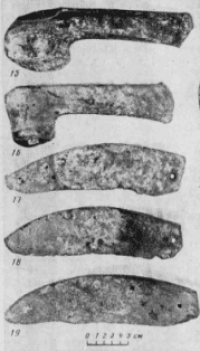
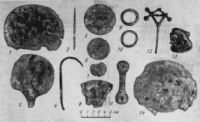
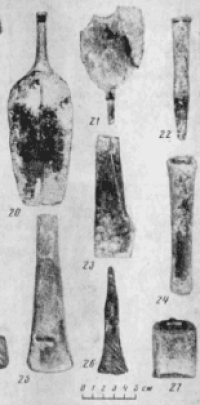
Late Bronze Age Shamsi hoard in Kyrgyzstan.
“He ordered the excavation of ancient settlements and the washing of the soil. Large objects were discovered immediately, while smaller ones were found during the washing process. In this way, he amassed an untold quantity of pearls, gold, and silver. I heard from his trusted associates that in the old fortress of Khotan, a hoard was discovered inside twenty-seven clay jars - jars of such immense size that a man carrying a quiver could step inside without brushing against the walls. Inside each jar stood a copper ewer. The height of the copper ewer exceeded one and a half *gaz*. One of these copper ewers, filled with gold dust, was placed inside each jar; surrounding the ewer on the outside were silver ingots known as *balish*. Nothing was known about these *balish* other than their name. A large number of the *balish* - those placed inside the clay jars around the copper ewers - were kept in the treasury in that state and eventually fell into the hands of the soldiers of Sa’id Khan. I, too, came into possession of a few of them, and that was when I saw them.”
Muhammad Haidar Dughlat. *Tarikh-i-Rashidi*. XVIth c.
An eco-tour in Shamsi Gorge.
Legends continue to live on and stir the imagination. They often emerge following famous archaeological discoveries or unexpected finds - such as those made in the Shamsi Gorge and the Issyk tract. Although located up to a hundred kilometers away, these finds are directly linked to the Issyk-Kul monuments; they offer a glimpse of what scholars might have discovered in the Issyk-Kul burial mounds had they not been looted in ancient times.
This connection is further supported by the few, chance finds made by researchers within the looted Issyk-Kul mounds themselves. Analysis has shown these artifacts to be analogous - and chronologically contemporary - to the materials from the Shamsi and Issyk mounds (the only sites of this type near Issyk-Kul that have preserved their buried treasures to the present day).
Given their unexpected nature and immense value, these finds are classified by the scientific community as "hoards." The Shamsi Gorge lies a few kilometers south of the Frunze (Bishkek)–Issyk-Kul highway. It became the subject of legend following a sensational discovery in 1958.
In early August, while agricultural work was underway at the Shamsi state farm - two kilometers from where the river emerges into the Chuy Valley - a combine harvester’s wheel suddenly sank into a hole. The tractor and combine operators stopped work and picked up their shovels.
The ground was hard and clay-rich, yet beneath it lay a void. It was a catacomb-style burial mound - an ancient tomb featuring a hollow chamber. Descending into the pit, the operators cleared away a thin layer of collapsed earth. And then, suddenly... the dull gleam of gold.
Gold ornaments. A legend brought to life - an encounter one has secretly dreamed of since childhood. Here lay the dried, disintegrated bones of a skeleton belonging to someone who was evidently once a figure of great power. Nearly two thousand years ago, his body had been adorned, a gold-leaf mask placed upon his face, and he was laid to rest in a burial mound alongside the similar tombs of illustrious ancestors.
That very day, a call went out to the Presidium of the Kyrgyz Academy of Sciences: send specialists - a hoard of gold had been discovered in a burial mound. The next day, archaeologists, accompanied by Academy officials, arrived in Shamsi.
Upon their arrival, a security detail was posted, and the excavation proceeded according to standard archaeological protocols. Archaeologists Pyotr Nikitich Kozhemyako and Dmitry Fedorovich Vinnik were the first to reach the site. Their initial step was a thorough external inspection.
Nothing remarkable stood out. A burial ground of mounds had once existed here, but years of plowing had transformed the area into a flat wheat field. It was purely by chance that the entrance to the catacomb was revealed. The opening was carefully widened, the mound’s earth removed, and its entire contents sifted.
For three days, amidst pouring rain, D. F. Vinnik doggedly expanded the excavation, yet few new finds emerged. The discovered mound was situated on the right-hand terrace of the gorge; however, the entire burial ground had been leveled for farmland four years prior, and all the other mounds had been razed to the ground.
Had a combine harvester’s wheel not broken through into the pit under the machine's weight, the burial ground would have been forgotten entirely. Clearing the site revealed that the mound belonged to a type of burial characteristic of nomads from the IVth and Vth centuries AD - specifically, the so-called "catacomb" burial sites.
A shaft was dug into the ground, leading to a vaulted catacomb chamber that remained hollow, while a mound of stone and earth was erected over the site on the surface. A woman was buried in the Shamsi burial mound. She lay in a coffin made of thin planks fastened with copper staples.
The coffin rested on a layer of charcoal. Her skull - as was not uncommon at the time - had been artificially deformed. Nomads of the Catacomb culture practiced the custom of binding an infant's head at birth so that the skull would grow elongated and upward.
Scholars attribute such distinctive skulls to the Catacomb culture of the early centuries AD. The question of exactly which people created this culture is still debated in academic circles, though the majority leans toward the view that the bearers of the Catacomb culture were the Huns - the very same Huns who took part in the Great Migration of Peoples and, during the IVth and Vth centuries, contributed to... ...the collapse of the Roman Empire's might.
They were the very people who participated in the formation of the modern Hungarian ethnos - a name (*Hungari*) that still carries the breath of history's distant winds. The owner of the Shamsi treasures was undoubtedly of noble birth. A gold mask measuring 20 by 15 cm rested upon her face.
Specialists even discern Mongoloid features in it (the Huns, too, were Mongoloid). The almond-shaped eyes were made of carnelian. The mask’s nose was a separate piece, soldered at the edges to the base; the cheeks bore incised tattoo marks.
Holes were visible along the edges, suggesting the mask was secured to the head with straps. Lying near the skull were a gold diadem and three pairs of gold pendants - designed for both braids and ears. Also discovered in the burial were a medallion, a necklace, and a wide leather belt with two buckles.
The medallion is particularly noteworthy: it features a miniature female bas-relief made of amber and garnet set in gold. The face is likewise of an Eastern type: a soft oval shape, the same almond-shaped eyes, a high forehead, a nose with a slight hump, broad cheekbones, and full lips.
It is difficult not to view the medallion as a portrait of the deceased woman herself. Thus, the shape of the skull, the features of the mask, and the relief portrait on the medallion all point to an Eastern physical type. Resting on the skeleton were four bracelets of smoky-hued nephrite and two massive gold-set rings.
Also found here were a miniature gold vessel for incense, a silver spoon, gold bells, and other ornaments. Placed alongside the coffin in the burial pit were a large clay vessel, a four-handled bronze cauldron, a wooden bowl, and richly decorated horse harness trappings.
Excavation of the burial mound revealed numerous animal bones. The Shamsi hoard was fortunate; it proved to be one of the few - perhaps one in a thousand - to escape looting. The hoard comprised twenty-seven bronze items: two axes with drooping polls, a celt-like hammer, a gouge and a spear-shaped chisel, a stepped adze, an adze with a frontal lug, three sickle-knives, a tanged spearhead, a razor, a single-edged knife, four mirrors, four plaques, two rings, a hook, an awl, an openwork pin, and a metal ingot.
Whether it served as a secret burial, or the mound’s external features had vanished in the distant past due to wind and rain, or perhaps looters began the job but never finished - leaving those who followed to assume the mound had already been plundered - this mystery remains unsolved. It is well known that the burials of chieftains and pastoralist tribal elites have always exerted an irresistible pull on looters; the custom of lavish burials gave rise to the profession of grave robbing.
One need only recall the famous Egyptian pyramids: neither strict measures, moral condemnation, armed guards, nor secret chambers and elaborate ruses could save ancient burial mounds from plunder. The first thing a modern archaeologist encounters during excavations is the traces left by ancient looters: pits and side tunnels in burial mounds, scattered skeletons, broken pottery, and an almost total absence of valuable grave goods or weaponry.
Typically, the only items that become archaeological finds and contribute to scientific knowledge are those the looters deemed worthless or objects accidentally dropped in their haste. Archaeologists therefore quite rightly refer to such discoveries as "hoards."
Indeed, the Shamshi burial mound is better known as the Shamshi Hoard. It was originally documented by P. N. Kozhemyako and I. K. Kozhomberdiev (the manuscript is held in the archives of the Archaeology Sector at the Institute of History of the Academy of Sciences of the Kirghiz SSR) and was included in the catalog of the exhibition on ancient Kyrgyz art organized at the State Hermitage Museum.
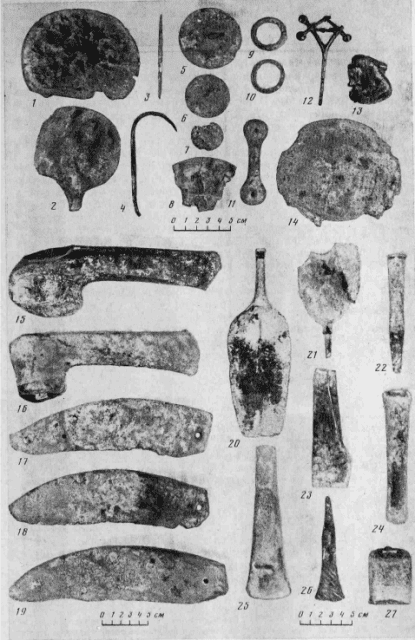
Authority:
Vladimir Mikhailovich Ploskikh, Doctor of Historical Sciences. *Issyk-Kul: A Journey into History*. Frunze, 1981.
Photographs by:
I. Kozhomberdiev, E. E. Kuzmina. "The Shamshi Hoard of the Late Bronze Age in Kyrgyzstan." Academy of Sciences of the USSR. *Sovetskaya Arkheologiya* (Soviet Archaeology), No. 4, 1980.
https://abashin.org/2025/12/18/kozhomberdiev-i-kuzmina-e-e-shamshinskij-klad-epohi-pozdnej-bronzy-v-kirgizii/