




You are here
Pyotr Ivanovich Lerch.
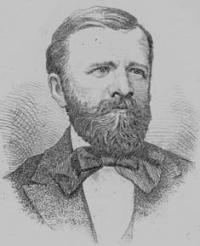
Researchers of Zhankent settlement.
"If a deed is worthily accomplished,
It shall exalt and glorify you."
Persian poet Abolqasem Ferdowsi. *Shahnameh* ("Book of Kings"). March 8, 1010.
P. I. Lerch’s archaeological expedition to investigate the ruins of Zhankent (1867).
Expedition participants: P. I. Lerch and M. K. Priorov (Rittmeister).
Biography of Pyotr Ivanovich Lerch.
Pyotr Ivanovich Lerch (1827-1884) was a Russian Orientalist (specializing in Iranian and Kurdish studies), archaeologist, librarian, and numismatist. He is known for his works on the history and language of the Kurds. He studied at the German St. Peter and St. Paul School in St. Petersburg.
In 1850, he graduated from the Department of Oriental Languages within the Faculty of Philosophy at St. Petersburg University. From 1850 to 1873, he worked as a recording clerk at the Academy of Sciences; from 1873 to 1877, as an administrator and secretary for the Imperial Archaeological Commission; and from 1877, as a librarian at St. Petersburg University
In 1858, he participated in Colonel Ignatyev’s expedition to Bukhara and Khiva, bringing back valuable Oriental manuscripts and coins that were donated to the Hermitage and the Archaeological Society (of which he was elected a member in 1860).
During the 1858-1859 journey... ...acquired over 30 Oriental manuscripts for the Asiatic Museum (described by K. Salemann). This collection included the manuscript of *Kitab al-Ansab* ("Book of Genealogical Names") by the renowned Arab scholar from Merv, Abu Sa'id Abd al-Karim al-Sam'ani (1113–1169); it contained material that served as a source for the historical-geographical dictionary of Yaqut (XIIIth century).
He brought back from Bukhara an extremely rare autograph manuscript of *Majma' al-Ansab* ("Collection of Genealogies") by Shabankara'i (and its continuator, Faryumadi), as well as the manuscript of *Abdullah-nama* by Hafiz-i Tanish, among others.
He described 97 Oriental manuscripts that had been collected by A. L. Kun and donated to the St. Petersburg Public Library in 1871 by the Governor-General of Turkestan, Kaufman. On his return journey, he visited the ruins of Jankent. In 1867, together with Captain Priorov, he examined the ruins of cities stretching from Kazalinsk to Jizzakh.
This expedition was prompted by the following circumstances: In March 1867, officers of the Kazalinsk garrison published an article titled "An Important Discovery" in St. Petersburg newspapers regarding the discovery of the Jankent ruins and outlined a plan for their protection and study. In response, articles by A. I. Maksheev and V. V. Grigoriev appeared, pointing out that the ruins had long been known to the scholarly community and that nothing new or significant had actually been discovered.
That same year, an article by V. V. Stasov - published under the pseudonym "Y. Kaverin" and titled "Ignoramuses and Experts" - appeared; in it, he lashed out at the learned experts ("experts"), dismissively... ...who reacted to the "discovery" made by these "ignoramuses" and their proposals regarding the need to study and preserve the ruins.
(Collected Works of V. V. Stasov, Vol. I, St. Petersburg, 1894, pp. 198-202). Subsequently, at the request of the Orenburg Governor-General's Office, the Archaeological Commission and the Academy of Sciences dispatched P. I. Lerkh - who was already familiar with the site - to investigate the ruins of Jankent.
Captain Priorov was assigned to assist him with surveying work. In the 1870s, Lerkh drafted guidelines for the scientific work of participants in the Khiva campaign. During this same period, he studied Pahlavi, Avestan (Zend), and Sogdian, and deciphered inscriptions on Bukharan coins minted in the 7th and 8th centuries.
Anticipating the later work of V. A. Zhukovsky, V. V. Bartold, and others, he supplemented his data on the ruins of Jankent and other cities with information and commentary drawn from the writings of ancient authors. Also notable in the history of the study of Uzbekistan is the highly detailed set of instructions (or questionnaire) Lerkh compiled in the early 1870s - commissioned by the Russian Geographical Society -for gathering materials to facilitate a comprehensive study of the Khiva Oasis.
He studied the Kurdish language, history, and way of life; published a work titled *A Study of the Iranian Kurds and Their Ancestors, the Northern Chaldeans*; and compiled a grammar of the Kurdish language. In 1876, he oversaw the exhibition for the 3rd International Congress of Orientalists in St. Petersburg and was responsible for compiling its catalogue.
In February 1876, he suffered a paralyzing stroke. "This catastrophe forced the Committee to abandon the description and explanation of the exhibition - Pyotr Ivanovich could not be replaced by anyone in Russia for this task" (Proceedings of the 3rd International Congress of Orientalists in St. Petersburg, 1876, Vol. 1, St. Petersburg, 1879–1880, p. CXVII).
P. I. Lerch was a prominent orientalist. Alongside V. V. Grigoryev, he was one of the first archaeologists to study the antiquities of Central Asia. His scholarly research was published in the *Bulletin of the Archaeological Society* (Vols. V, VI, VII, IX), the *Bulletin of the Russian Geographical Society* (I, V, X), the *Archaeological Herald*, the *Proceedings of the 2nd Archaeological Congress*, and the *Proceedings of the 3rd International Congress of Orientalists* in St. Petersburg.
Information regarding P. I. Lerch can be found in:
1. Veselovsky, N. I., and Tiesenhausen, V. G. Obituary of P. I. Lerch. *Journal of the Ministry of Public Education*, November 1884, pp. 570–66.
2. Obituary of P. I. Lerch. *Historical Account of the Activities of the Imperial Moscow Archaeological Society During the First 25 Years of Its Existence*. Moscow, 1890, No. 23.
3. *Biographical Dictionary of Professors and Lecturers of St. Petersburg University for the Third Quarter-Century of Its Existence (1869-1894). Vol. I: A-L. St. Petersburg, 1896, pp. 321–329. Itinerary: Kazalinsk, ruins of Zhan-Kala (Zhankent), ruins of Khorkhut, ruins of Sauran, Turkestan, Chimkent, Tashkent, Khujand, Ura-Tyube, Jizzakh, Jalan-Uty Gorge, Aulie-Ata, ruins of Akhrar-Tash.
Results of P. I. Lerch’s work.
1. Description of the ruins of Zhan-Kala, Khorkhut, Sauran, and Akhrar-Tash.
2. Description of the Ahmad Yasawi Mosque in Turkestan and the inscriptions on the tombs.
Bibliography of P. I. Lerch’s works.
1. Lerch P. I. Reports on excavations conducted at Zhankent. *Proceedings of the Russian Geographical Society*, Vol. III, 1868, pp. 199–200 (journal section).
2. Overview of major geographical works in Russia for 1867 and 1868. *Proceedings of the Russian Geographical Society*, Vol. V, 1869, pp. 325–380.
3. The Seven Stars in the Firmament of Persian Poetry // *Biblioteka dlya chteniya* [Library for Reading], February 1851, pp. 251–268.
4. A Study on the Iranian Kurds and Their Ancestors, the Northern Chaldeans. Vols. 1–3. 1856–1858.
5. Stone and Bronze Age Tools in Europe. *IRAO* [Proceedings of the Imperial Russian Archaeological Society]. Vol. 4. Issue 2. St. Petersburg, 1863, pp. 145–169; Issue 4, pp. 310–323; Vol. 5. Issue... 4. St. Petersburg, 1865. Pp. 201–220.
6. Survey of materials regarding prehistoric antiquities collected during an expedition to Northern Russia. *OAK* (Report of the Imperial Archaeological Commission]. St. Petersburg, 1865. P. 15, 2); Archaeological journey to the northern provinces... *IRGO* (Proceedings of the Imperial Russian Geographical Society). Vol. 1, No. 10. St. Petersburg, 1865. Pp. 196–197.
7. Similarities and differences observed in the material, form, and intended purpose of stone tools found in Finland, the Olonets, Arkhangelsk, and Vologda provinces, and the Baltic and Northwestern regions. *Proceedings of the IV Archaeological Congress*. Issue 2. St. Petersburg, 1871. Pp. 9–14, 33–61.
8. Archaeological expedition to the Turkestan region in 1867. St. Petersburg, 1870.
9. Asia. *Russian Encyclopedic Dictionary*, ed. I. Berezin, Div. I, Vol. 1, 1873. Pp. 272–296.
10. Lerch P.I. (Review of:) A. Gattsuk, *Investigation of Burial Mounds in Moscow Province in 1863 and 1864*. Moscow, 1865. *IRAO* [Proceedings of the Imperial Russian Archaeological Society]. Vol. 6, Div. 2, Issue 1. St. Petersburg, 1868. Pp. 25–29.
11. *Forschungen über die Kurden und die Iranischen Nordchaldäer*. Erste Abteilung. Kurdische Texte mit deutscher Übersetzung. 1857.
12. Historical information on Jankent and a brief description of the ruins based on 1867 archaeological excavations. 2. Lerkh P. I. On the ruins of Jankent. *Syn Otechestva* (newspaper), 1868, No. 6.
13. The archaeological expedition of P. I. Lerkh. pp. 371–374. 4. Lerkh P. I. Archaeological trip to the Turkestan region in 1867. St. Petersburg, 1870. 39 pp.
The introductory article is an excerpt from the report submitted to the Archaeological Commission. It provides details on the organization of the expedition undertaken by P. I. Lerkh and M. K. Priorov for archaeological research and the mapping of the ruins.
It describes the archaeological excavations of four mounds containing the remains of a pottery workshop and dwellings, as well as the artifacts discovered. ...tiles with Arabic inscriptions. Evidence confirming that the city of Yangikent was located at the site of Jan-Kala, the city of Jend at the site of Khorkhut, and the ruins of Sauran (the Sabran Fortress).
In the city of Turkestan, he meticulously copied inscriptions from tombs within the Ahmed Yasawi Mosque; in the Jalan-Uty Gorge, he copied inscriptions carved into the rock commemorating Ulugh Beg’s campaign of 1424–1425 and the victory of the Bukharan Khan Abdullah in 1571–1572; and among the ruins of Akhrar-Tash, he recorded inscriptions in the Manchu language dating to 1758.
The detailed notes and appendices were painstakingly compiled by P. I. Lerkh himself, citing Arab and Persian geographers and historians. In them, he presents information regarding Jankent found in the works of Russian travelers and scholars - Gladyshev and Muravin, Rychkov, Levshin, Maksheev, and Meyer - as well as in articles from 1867 that predated P. I. Lerkh’s expedition.
No mention is made of the article by V. V. Stasov.
Authority:
Olga Vladimirovna Maslova. "Survey of Russian Travels and Expeditions to Central Asia: Materials on the History of the Study of Central Asia" (Part II: 1856–1869; Tashkent, 1956; published by SAGU).