


You are here
Photo excursion to find Cistanches flava & salsa in Altyn-Emel Park.
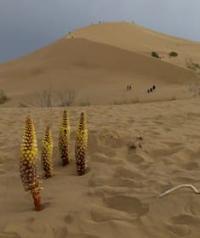
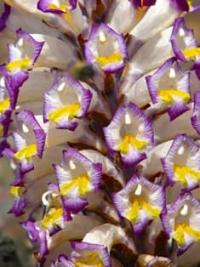
A trip to Altyn-Emel mountain pass.
“Today, along every road,
I overtook a pine-tree grove.
Today, I took a tulip -
Like a child, by the chin.”
Marina Tsvetaeva, “Poems to an Orphan”, August 16-17, 1936.
Sightseeing excursions in Orikty and Matay mountains.
Total route distance: 753 km.
Seasonality: From mid-April to end of month.
Duration: 3 days.
Distance covered on foot (active portion): approximately 7 km.
Optimal timing: Depends on whether spring arrives early or late.
Brief itinerary for excursion via Altyn-Emel Pass to Aktau Mountains:
Almaty – Kapshagay Reservoir – Arkharly Pass – Orikty and Matay Mountains – Basshy Village – Aygaykum (Singing Dune) – Aktau Mountains – Kattu-Tau – Almaty.
An excursion to paleontologically significant Aktau Mountains.
Cistanche salsa and Cistanche flava belong to the genus Cistanche within the broomrape family (Orobanchaceae). The genus is distributed across the desert, semi-desert, and steppe regions of Kazakhstan (specifically in the Zhetysu region, within the Kerbulak and Panfilov districts).
These are perennial herbaceous plants with thick, unbranched stems covered in alternating scale-like leaves. Their flowers are arranged in spike-like racemes. Plants of this genus are parasitic, drawing nutrients from the roots of various shrubs and subshrubs.
They do not produce chlorophyll; instead, they obtain nutrients and water from the roots of a host plant. Several species of Cistanche are used in traditional Chinese medicine and in the folk medicine of Central Asian countries. According to The Plant List database, the genus comprises 27 species.
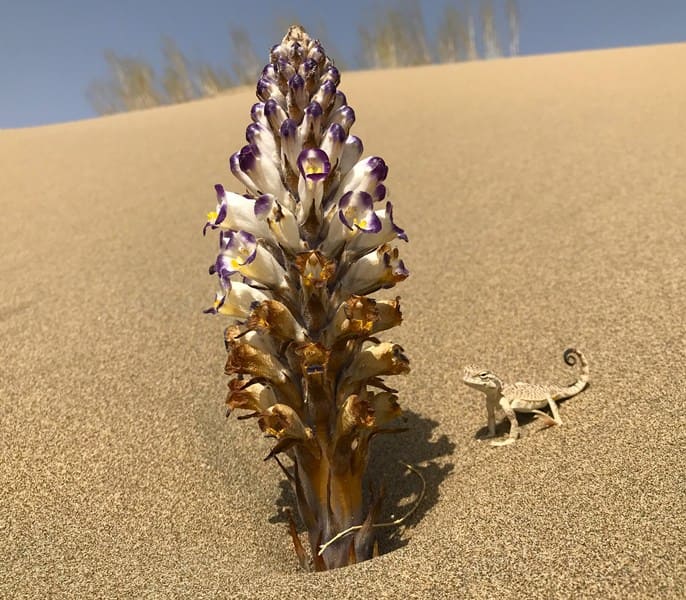
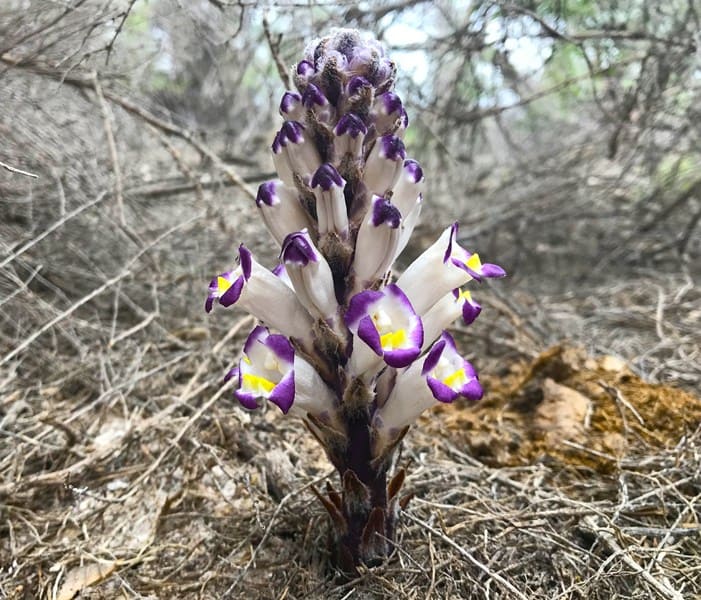
Cistanche salsa is a perennial plant, more or less hairy, reaching a height of 10-40 cm. It has a thick stem-measuring 5-20 mm in diameter in its middle section covered with scales. The inflorescence is short-cylindrical (sometimes significantly shortened), 5-25 cm long, 5-8 cm wide, and dense.
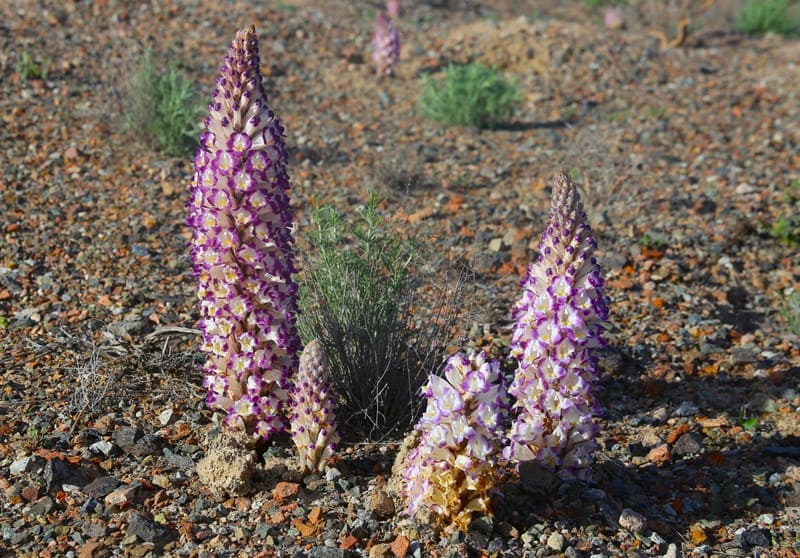
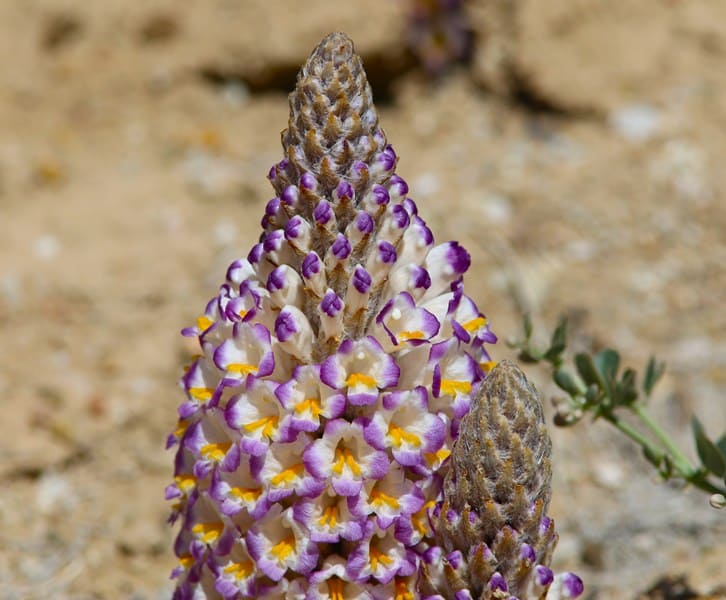
The flowers are sessile or nearly sessile; the corolla is 25-35 mm long, bluntly bell-shaped, slightly curved forward, and features a pale yellow tube with a violet-colored limb. The seed capsule opens via two or, less frequently, three valves.
Flowering occurs in April, and occasionally in May.
(Cistanche salsa) and (Cistanche flava) - unusual, rare parasitic plants with thick, fleshy stems and striking violet-and-white inflorescences can be found within the Altyn-Emel State National Natural Park in the Zhetysu Region.
Detailed description of a photo-excursion focused on Cistanche salsa and Cistanche flava.
Day 1: Almaty – Basshi village (261 km).
Transfer: Almaty – the city of Konayev – the northeastern shore of the Kapshagay Reservoir (86 km).
Leaving Almaty, our route follows the historic Ili Tract - a road opened in 1855 and takes us past the city of Konayev (formerly Kapshagay). We then cross the bridge over the Ili River; 3.4 kilometers beyond the bridge, we turn right onto a sandy rise that resembles a peninsula, located in the northeastern part of the Kapshagay Reservoir.
Botanical excursion along the northeastern shore of the Kapshagay Reservoir.
Administrative location of the excursion area:
Almaty Region, under the jurisdiction of city of Konayev.
Physical-geographical location of excursion area:
The westernmost spurs of the Dzungarian Alatau, the vicinity of the Kapshagay Reservoir, and areas of stabilized sands.
Associated plant species on the northeastern shore of the Kapshagay Reservoir (539 m a.s.l.):
Tulipa buhseana, Rhinopetalum karelini), Takhtajaniantha pusilla, Helichrysum arenarium, Pseudosedum longidentatum, Ferula varia, Silene quadriloba, Rindera tetraspis, Sisymbrium altissimum, Syrenia, Eremopyrum triticeum, Allium caricifolium, Pseudohandelia umbellifera, Astragalus arbuscula, Eremurus cristatus, Tulipa jansii, Astragalus larvatus, Tulipa behmiana, Corydalis schanginii, Tulipa alberti, Allium subscabrum, Echinops albicaulis, Silene quadriloba, Ferula dissecta, Tragopogon ruber, Astragalus balchaschensis, Ferula varia, Erodium hoefftianum, Vicia subvillosa, Lappula microcarpa, Linaria transiliensis, Dendrostellera ammodendron, Eremostachys rotata, Astragalus lasiophyllus, Carex physodes, Eremurus inderiensis, Astragalus lasiophyllus, Xanthium orientale, Goniolimon callicomum, Roemeria refracta, Delphinium camptocarpum, Iris tenuifolia.
Continuing the trabsfer: Kapshagay Reservoir – villages of Saryozek and Tastybastau – foothills of Orikty (143 km).
Beyond the Kapshagay Reservoir, past the Arkharly Pass (940 m. a. s. l.) and to the south of the Arkharly Mountains, one may under favorable conditions find Tulipa jansii and various associated plant species, located about 230 meters to the left of the road.
Further along, past the village of Tastybastau and before reaching the Orikty and Matay mountains, we will make another stop on the foothills near the road to observe Tulipa jansii and its accompanying flora. Tulipa jansii (J.J. de Groot & Zonn.) is a wild tulip species belonging to the lily family (Liliaceae).
It was described by Dutch botanists Jacques J. de Groot and Ben J. M. Zonneveld renowned researchers who have made significant contributions to the study, classification, and description of new wild plant species (particularly tulips) in Central Asia.
The species is named after Harry Jans, a prominent Dutch botanist, traveler, and expert on alpine plants; the herbarium specimens of this plant were collected during an expedition in which he participated. Dr. Ben Zonneveld, from Leiden University, is a world-renowned expert in plant genetics who determined the evolutionary relationships among wild tulips by analyzing their DNA content.
Together with Jacques J. de Groot, he has made numerous botanical discoveries across Kazakhstan and Kyrgyzstan.
Associated plant species in the vicinity of the Arkharly Pass (940 m a. s. l.):
Ferula dissecta), Spiraea hypericifolia, Anisantha tectorum, Cerasus tianshanica, Atraphaxis virgata, Allium dshungaricum Vved, Allium petraeum Kar. & Kir., Allium strictum Schrad, Astragalus angustissimus Bunge, Astragalus campylorhynchus Fisch. et C.A. Mey., Astragalus semenovii Bunge, Capparis herbacea Willd, Carex turkestanica Regel, Ceratocarpus utriculosus Bluket ex Krylov, Clematis songorica Bunge, Goniolimon eximium (Schrenk) Boiss), Lecanora argopholis (Ach.), Linaria ramosa (Kar. & Kir. Kuprian, Linum pallescens Bunge, Lobothallia alphoplaca (Wahlenb), Nepeta micrantha Bunge, Phlomoides iliensis (Regel) Adylov, Kamelin & Makhm), Rusavskia elegans (Link) S. Y. Kondr. et Kärnefelt, Salvia aethiopis L, Sideritis montana L, Tulipa jansii J.J. de Groot & Zonn, Viola pumila Chaix).
Transfer: Tulipa corynestemon, Tulipa jansii old apple tree on the left side of the road (western slope of the Orykty Mountains) (5 km).
After our excursion to see Tulipa corynestemon, we will stop 1.7 km before the Altyn-Emel Pass (1,711 m. a. s. l.) near an old apple tree on the left side of the road. From there, we will take a botanical excursion onto the western slope of the Orikty Mountains. Here, we will encounter Tulipa corynestemon, Paeonia intermedia, and various other associated plant species.
Associated plant species in the vicinity of the Altyn-Emel Pass (1,711 m a. s. l.):
Patrinia intermedia, Allium koksuense R.M. Fritsch, N. Friesen & S.V. Smirn), Allium oreoprasum Schrenk, Androsace maxima L, Astragalus, Astragalus alberti Bunge, Astragalus arbuscula Pall, Astragalus heptapotamicus Sumnev, Astragalus semenovii Bunge, Carduus thoermeri Weinm, Convolvulus tragacanthoides Turcz, Dracocephalum integrifolium Bunge, Dracocephalum peregrinum L, Eremurus altaicus (Pall.) Steven, Euphorbia pachyrrhiza Kar. & Kir, Glaucium elegans Fisch. & C.A. Mey, Glaux maritima L, Goniolimon dschungaricum (Regel) O. Fedtsch. & B. Fedtsch, Iris glaucescens Bunge, Iris loczyi Kanitz, Iris pallasii Fisch. ex Trevir, Iris sogdiana Bunge, Lathyrus pisiformis L, Ligularia altaica DC, Lonicera microphylla Willd. ex Schult, Oxytropis semenowii Bunge, Parrya stenocarpa Kar. & Kir, Pedicularis semenowii Regel, Pedicularis songarica Schrenk, Phlomoides agraria (Bunge) Adylov, Kamelin & Makhm, Phlomoides iliensis (Regel) Adylov, Kamelin & Makhm, Ranunculus polyrhizos Stephan ex Willd, Rosa platyacantha Schrenk), Rosularia platyphylla (Schrenk) A. Berger), Scutellaria sieversii Bunge, Tulipa brachystemon Regel, Tulipa corynestemon A.D. Hall, Urtica cannabina L, Verbascum × candelabrum Kar. & Kir, Verbascum songaricum Schrenk.
Transfer: western slope of the Orikty Mountains – Altyn-Emel Pass – village of Basshy (27 km).
Arrival in the village of Basshy, transfer to the hotel, check-in, dinner, and overnight stay.
Day 2. Village of Basshy – Singing Dune (Aighaikum) – Aktau Mountains – Katu-Tau – Basshy (237 km).
Breakfast. Early departure: village of Basshy – Shagan ranger station – Mynbulak ranger station – Aighaikum (The Singing Dune) (48 km).
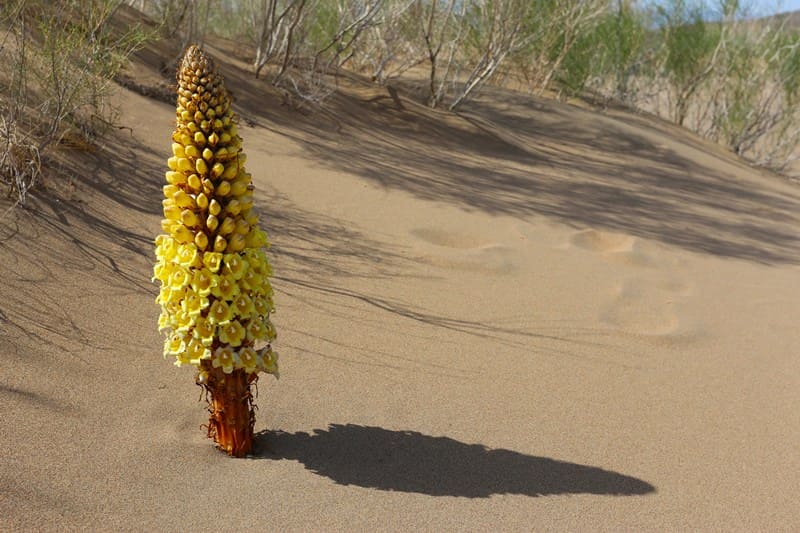
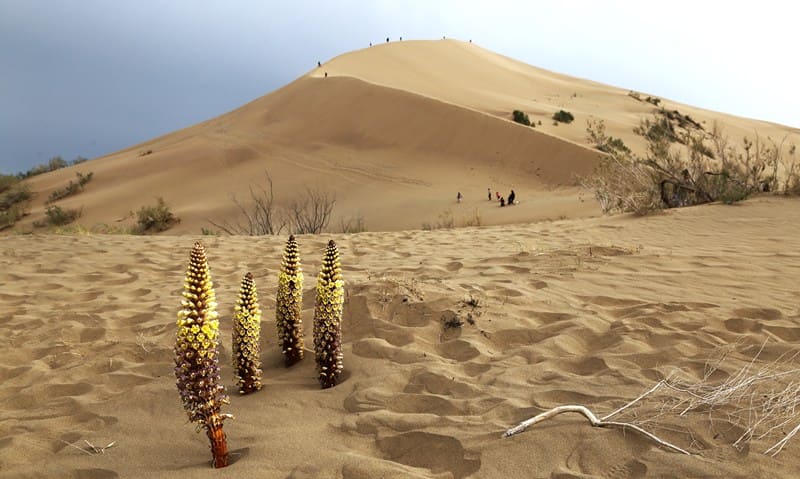
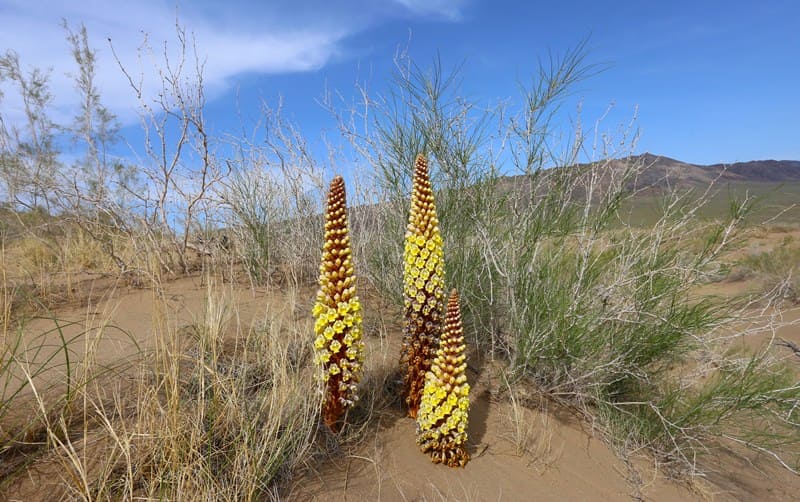
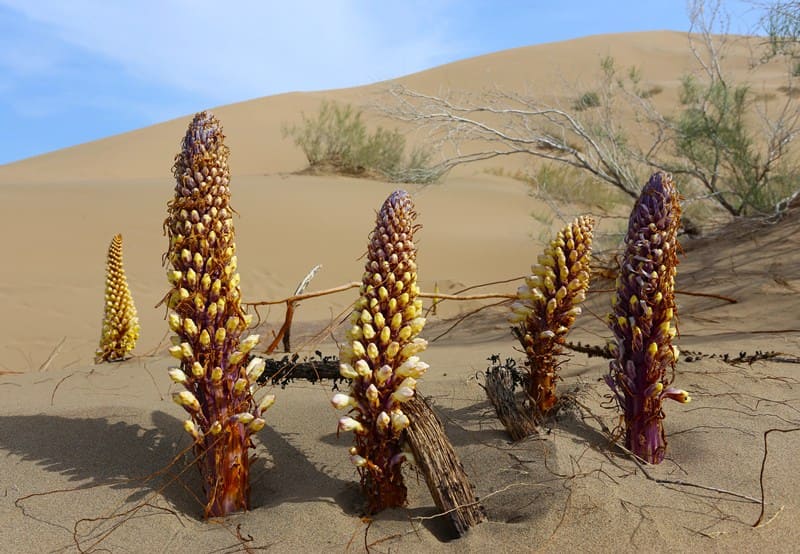
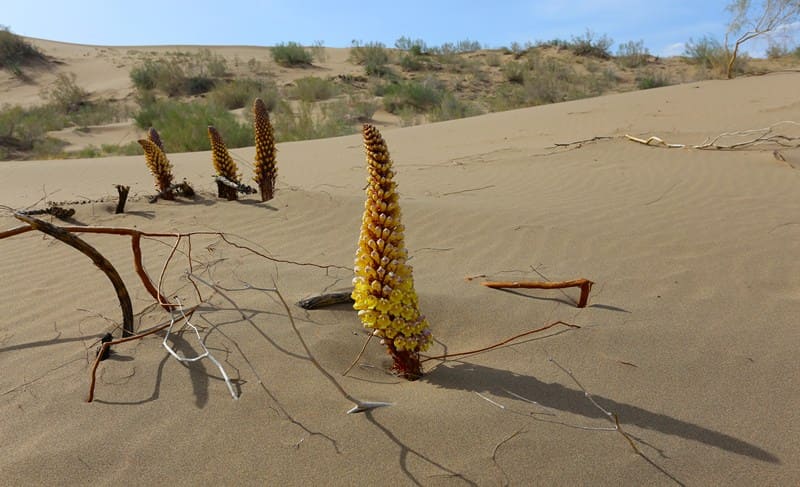
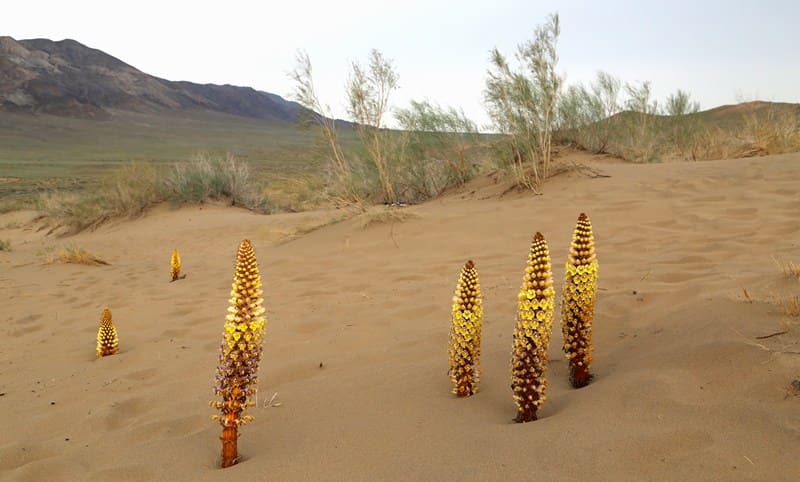
A botanical excursion to find Cistanche flava in the sands at the foot of the famous Singing Dune in Altyn-Emel National Park a journey into a hidden world of desert alchemy. In the sands on the western side of the dune, we will encounter *Cistanche flava*. Here, one can clearly feel the breath of Akkum-Kalkan (the Singing Sands).
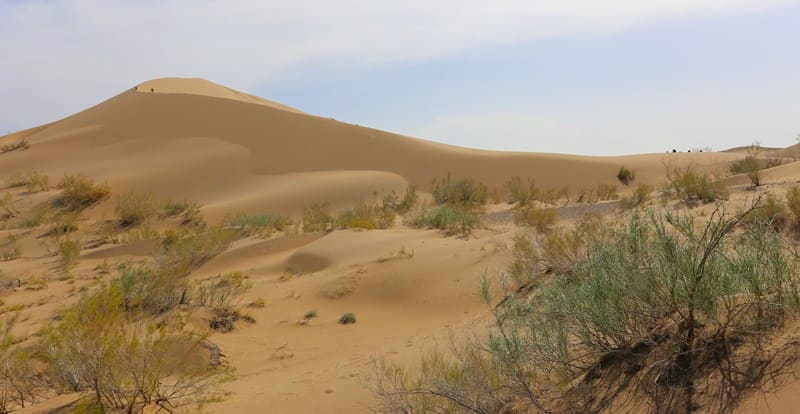
The sun is just beginning to touch the ridges of the Dzungarian Alatau, bathing the foothills in a soft, pinkish light. The air is crystal clear, carrying the scent of sun-warmed quartz sand and bitter wormwood. Our route follows a graded dirt road along the right bank of the Ili River, leading toward the massive, 150-meter-tall dune.
Step by step, we move away from the well-trodden tourist paths. In this place, where the sands form whimsical, undulating patterns, it feels as though time itself has come to a standstill. The dune lies dormant, but as soon as a light morning breeze stirs, a low, vibrating hum emerges from the silence as if, deep beneath the earth, an ancient organ is being tuned.
This is the desert singing, greeting the few wanderers who pass by. Our goal is not merely the sand dune itself, but its silent and remarkable inhabitants. We are not looking for green grass our subject possesses not a trace of chlorophyll but rather for a burst of sun-yellow color against the pale, ochre-hued sands.
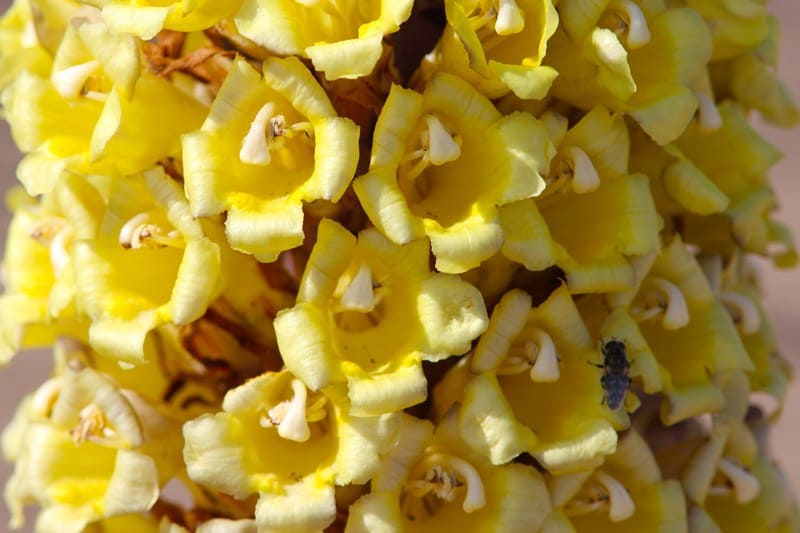
And there, in a hollow between the dune and a thicket of saxaul, we spot it. Rising from the scorching sand toward the April sky is a thick, fleshy, knee-high stalk, densely covered in scales and crowned with a tight cone of brilliant, golden-yellow blossoms.
This is Cistanche, a holoparasitic plant. Lacking green leaves to capture sunlight, it leads a secretive, subterranean existence, extending its haustoria specialized root-like structures into the roots of a host plant, most commonly Calligonum (or sand acacia), from which it draws life-sustaining moisture and nutrients.
The desert is sparing with its bounty, yet Cistanche takes only what it needs, transforming a harsh, sandy wasteland into a striking, candle-like floral display. If you sit nearby, you might hear the soft hum of desert bees and wasps, drawn by the sweetish nectar of the inflorescence.
They carry out their daily ritual of pollination, flitting from one desert torch to the next. For centuries, local inhabitants and herbalists of the East have called Cistanche the "ginseng of the desert," owing to the potent vitality hidden deep within its tuberous roots, buried beneath the sand.
As sunset approaches, the sounds return. By evening, the sun has heated the sandy ridge until it glows a deep, fiery red. We sit on the slope of the Singing Dune, watching the shadows lengthen, while the yellow blossoms of Cistanche at the foot of the dune appear like tiny golden sparks as if dropped, by chance, by the caravans of the Silk Road. Now and then, the sound of Aygaykum the Singing Sands echoes in response to the grains of sand shifting beneath our feet.
The desert follows its own unhurried, harsh, yet subtly poetic rhythm. You may explore the area surrounding this mountain of sand or, if you wish, make the climb up the shifting, loose sand to the very crest of the dune.
Plant species found in the vicinity of the Aigaykum sand dune include:
Cistanche flava (C. A. Mey.) Korsh), Cistanche salsa (C.A. Mey.) Beck, Haloxylon persicum, Cancrinia discoidea, Arnebia guttata, Dendrostellera ammodendron, Eremurus anisopterus, Iris songarica, Ammothamnus songoricus, Astragalus paucijugus, Stipagrostis pennata, Ephedra przewalskii, Agriophyllum pungens.
Transfer: Aigaykum (Singing Dune) – Mynbulak and Shagan ranger stations – village of Nurum – Aktobe – Zhayylbaili tract – Saxaul Ravine – Aktau Mountains (107 km).
Beyond the Shagan checkpoint, we pass two small settlements, after which our route leads eastward toward the Aktau Mountains, following the right bank of the Ili River. Gradually, the dirt road brings us closer to the mountains, and our path continues along the southern slopes of the Katu-Tau range and, subsequently, the Aktau range.
Leaving the singing sands of Aygaykum behind, we head east - toward a place where the steppe haze gives way to an otherworldly, alien-like terrain. The Aktau Mountains greet us with a striking, cosmic landscape a dramatic setting that serves as the perfect backdrop for encountering Cistanche salsa. Lunch.
In the midday heat, on the floor of the ancient Paleotethys Ocean.
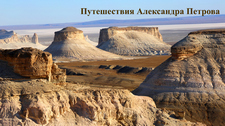
As we enter the Aktau canyons, it feels as though the wheels of our vehicle have crossed the threshold into another world. Before us lies a giant, multi-layered formation a geological layer cake composed of white chalk, grayish-blue sandstone, and striking, vivid red clay.
This is the exposed seabed of the ancient Tethys Ocean. Over millions of years, wind and rain have sculpted these hills into intricate labyrinths, towering spires, and castle-like structures. The familiar, hushed silence of the desert is absent here; a scorching midday wind weaves through the rocky mazes, while the sun reflects off the white chalk walls with such intensity that it is blinding.
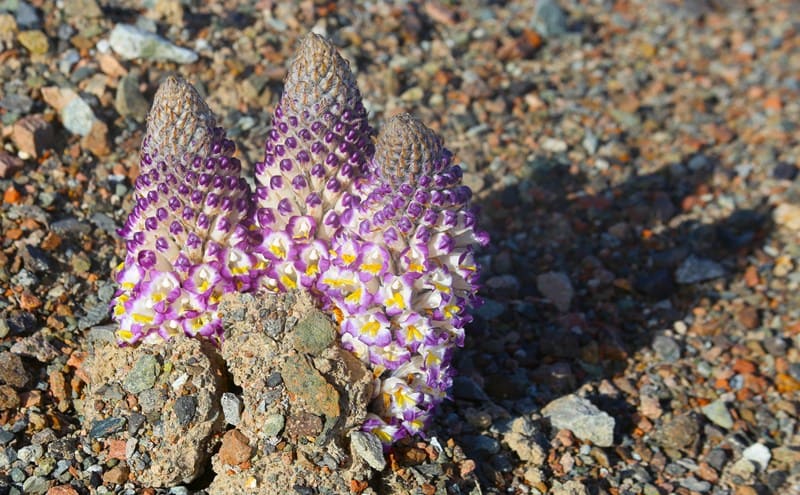
It would seem that nothing could take root in these barren, cracked, salt-encrusted clay flats yet botany is, at its heart, the study of life’s hidden triumphs. And then, a discovery: flashes of amethyst-like color amidst the white cliffs. We descend into the bed of a dry watercourse, where the clay is coated in a distinct white crust a saline efflorescence.
In such extreme conditions, the alligonum gives way to the hardier, true masters of this landscape: the black saxaul and various Salsola. It is near their roots, deep beneath the hardened salt crust, that our latest subject lies hidden. If the yellow Cistanche resembles a golden scepter, then the Cistanche that thrives in these saline soils is like a precious amethyst dropped upon the white salt.
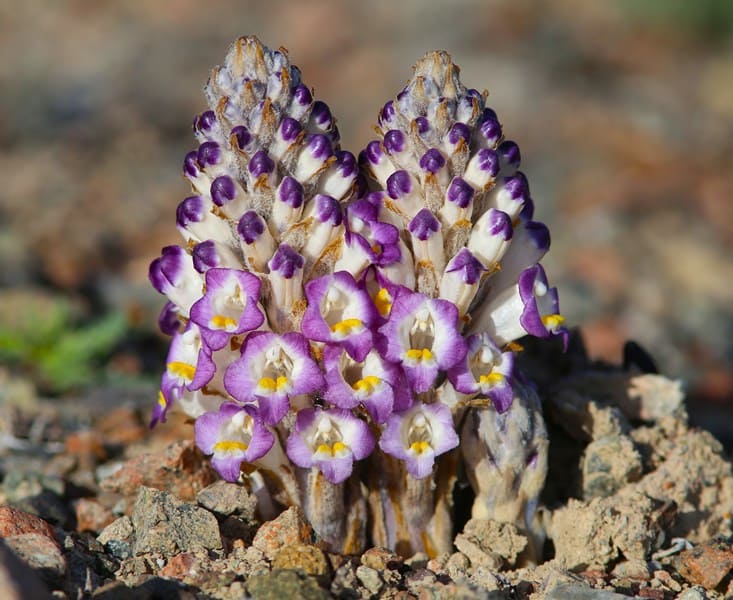
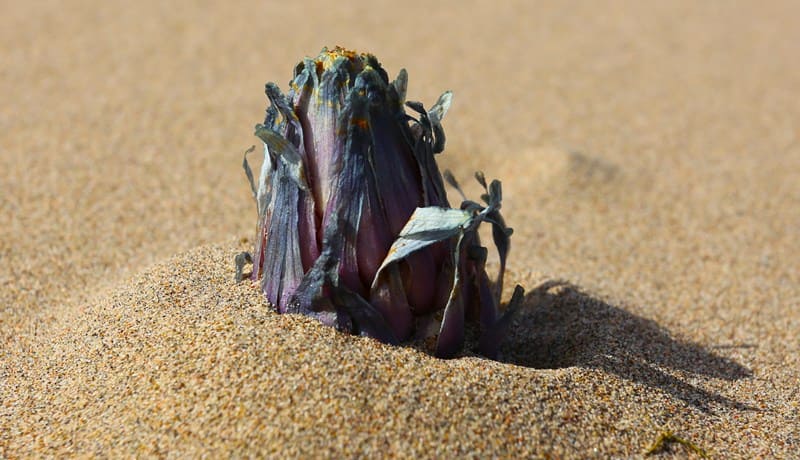
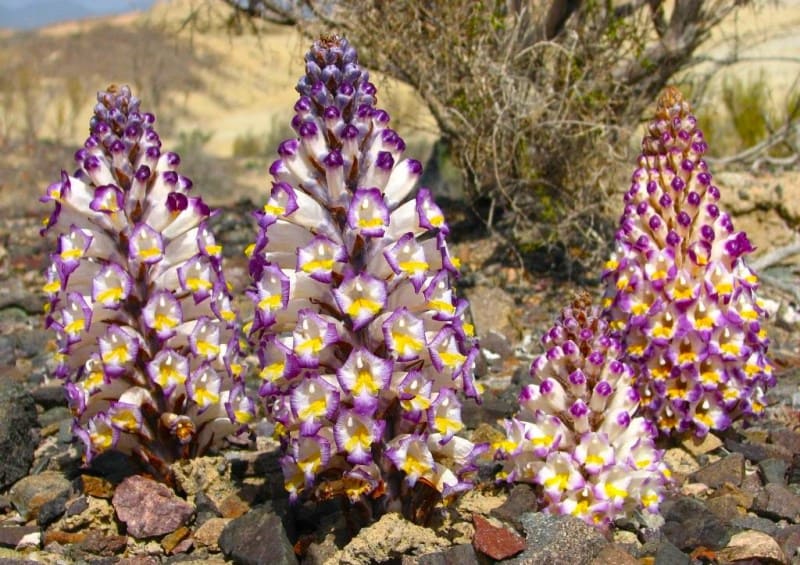
Pushing up through the cracked clay, dense and remarkably fleshy shoots emerge from the earth. Its scaly stem is shorter and stockier than that of its cousin found in the sands, yet its inflorescence is striking for the exquisite refinement of its palette.
Tubular blossoms cluster along the stem in a dense, heavy bunch; the yellowish base of each corolla transitions seamlessly into a deep violet or lilac-purple limb. The contrast is mesmerizing: set against the blinding white chalk and Martian-red clay of the Aktau Mountains, these violet torches appear like frozen neon lights.
Lacking a single green leaf, Cistanche salsa draws moisture and salts directly from the rugged roots of the saxaul shrub, managing to bloom with a lush, cool radiance in a landscape where even the stones seem to glow with heat. As evening gradually approaches, the mystical quality of the cooling clay landscape reveals itself.
With the sun beginning its descent, the Aktau Mountains transform: the white chalk cliffs take on a soft pink hue, while the red strata ignite with a crimson fire. In this twilight, the violet inflorescences of Cistanche salsa seem to glow from within.
We depart from the canyons, carrying with us the lingering scent of desert wormwood and the image of this fragile yet remarkably tenacious flower a plant that has chosen one of the harshest and most beautiful corners of the Semirechye region as its home.
Associated plant species in the Aktau Mountains (Altyn-Emel Nature Park):
Zygophyllum rosowii Bunge, Haloxylon persicum Bunge ex Boiss & Buhse, Nonea caspica (Willd.) G. Don), Cynomorium songaricum Rupr, Echinops nanus Bunge, Plagiobasis centauroides Schrenk, Salsola tragus L, Ferula karelinii Bunge, Lactuca undulata Ledeb, Zygophyllum lehmannianum Bunge, Chenopodiaceae, Heliotropium ellipticum Ledeb, Arthrophytum iliense Iljin, Calligonum junceum (Fisch. & C.A. Mey. Litv), Zygophyllum, Erodium oxyrhynchum M. Bieb, Ephedra przewalskii Stapf, Acanthophyllum pungens (Bunge) Boiss), Haloxylon aphyllum (Minkw.) Iljin), Arnebia guttata Bunge.
Transfer: Aktau – Katu-Tau Gorge (26 km).
Arrival at the Katu-Tau rock massif; walks in the surrounding area.
Katu-Tau Mountains (originally known simply as Katu) are located in the eastern part of Altyn-Emel National Park, south of the Altyn-Emel Range, between the Ili River valley and the park’s desert plains. They are situated approximately 47 km from the village of Basshy and about 25 km from the Aktau Mountains.
This is a fairly extensive mountain massif, stretching from the southwest to the northeast. It spans approximately 40 km in length and 25-30 km in width. Its highest points reach an elevation of about 1,876.7 m. a. s. l. (in the northwestern part of the range).
Unlike the Aktau mountains - characterized by light-colored clays and the gentle contours of erosion-carved canyons - Katu-Tau presents a stark, rocky, and seemingly scorched landscape. Its slopes are dissected by numerous gorges, dry ravines, and narrow valleys.
Amidst the brown, dark red, chocolate-hued, and lilac-tinted rocks, one finds whimsical formations that resemble solidified flows. The name Katu-Tau is typically translated as "harsh mountains" or associated with the concept of "frozen" (or solidified) mountains. In either case, the name captures their appearance with great precision. And this is where the most remarkable part begins.
The geological history of Katu-Tau is far more ancient than that of the neighboring Aktau mountains. At the base of the massif lie rocks from the Carboniferous period, which formed approximately 300 million years ago. In that distant era, this territory existed in a completely different geographical setting.
Marine basins, connected to the ancient Paleo-Tethys Ocean, once occupied this region. Within the marine sedimentary deposits, evidence of ancient life has been preserved remains and imprints of organisms, including foraminifera and algae.
Traces of ancient amphibians have also been discovered in some of the rock layers. This indicates that, long before the volcanic landscape emerged, the area was a marine environment, and the ground that would eventually become the Katu-Tau mountains was once part of an ancient seabed.
Subsequently, the geological landscape underwent a radical transformation. The marine basins gave way to a region defined by active tectonic movement and magmatism. During the Permian period roughly 299 to 252 million years ago the Katu-Tau area became a site of intense volcanic activity.
Fractures formed in the Earth's crust, allowing magma to rise. In some places, it erupted onto the surface, while in others, it cooled and solidified within fissures or beneath layers of older rock.
This process resulted in the formation of extensive volcanic rock complexes, including:
lava;
volcanic tuffs;
breccias;
volcanic bombs and lapilli;
intrusive igneous rocks.
Of particular interest are the tuffs rocks formed from material ejected by volcanoes. During eruptions, ash, rock fragments, and larger pieces of magma were propelled into the air; once they settled and became compacted, this material solidified into rock.
This is precisely why such an unusual variety of colors can be seen at Katu-Tau. Shades of pink, lilac, reddish-brown, and chocolate-brown belong to different types of volcanic rock. In the western part of the massif, researchers have identified two ancient volcanic centers.
It is believed that the structures of magma conduits and volcanic vents filled with fragmented material have been preserved here. Also present are lava domes and numerous magmatic dikes bodies of magma that solidified within fissures. Of particular interest are the radial dikes, which radiate outward from the ancient centers of magmatic activity, in some places extending for considerable distances.
These serve as stone evidence of how magma once penetrated the Earth's crust. Although volcanic activity ceased long ago, the forces of nature continue their work. Over millions of years, wind, temperature fluctuations, precipitation, and surface runoff have gradually broken down and reshaped the volcanic rocks.
More durable sections have remained as outcrops and rock remnants, while less resistant material has eroded more rapidly. This has given rise to whimsical landforms: sheer rock faces, isolated stone blocks, narrow passages, small grottoes, and recesses.
In some places, the landscape resembles frozen waves or piles of gigantic stone fragments. It is important to understand that the current appearance of Katu-Tau is the result not only of ancient eruptions but also of prolonged subsequent erosion.
What we see today are not the original volcanic cones, but their deeply altered remnants. The volcanic rocks of Katu-Tau are also of interest from a mineralogical perspective. Descriptions of the massif mention agate and quartz geodes cavities within the rock where crystalline mineral formations once developed.
In the eastern part of the massif, there are also horizons of black vitrophyres volcanic rocks containing a glassy matrix. Vitrophyres are particularly interesting because they offer insight into the rapid cooling of a magmatic melt, a process that occurs too quickly for well-defined crystals to form.
Naturally, this mineral diversity does not mean that Katutau should be viewed as a place for collecting geological specimens. It is part of a national park, and its natural features must be preserved. There is something remarkably pristine about Katutau. It lacks the typical high-mountain scenery of snow-capped peaks and glaciers; there are no dense forests or rushing mountain rivers.
Instead, a rugged, stony world unfolds before the traveler a landscape where every rock bears witness to geological events that concluded long ago. Once, this area was a sea. Later, volcanic centers emerged, magma flows erupted, volcanic ash settled, and lava sequences and magmatic veins were formed.
Time passed Over millions of years, the climate shifted and mountain formations eroded, while wind and water gradually sculpted the rocks into the shapes we see today. Later, humans arrived in these lands, leaving behind images of animals and scenes from their daily lives etched into the stone.
As we travel through Katu-Tau today, it is as if we are turning the pages of a vast book the history of the Earth unfolding from an ancient ocean to the desert landscape of the present day. Katu-Tau is more than just a range of volcanic mountains; it is a stone chronicle of ancient Zhetysu.
Plant species found in the Katu-Tau mountains (Altyn-Emel National Park) include:
Acanthophyllum pungens, Lagochilus platyacanthus, Seseli iliense, Calligonum, Arnebia guttata, Nepeta micrantha, Rusavskia elegans, Pleopsidium flavum, Xanthoparmelia, Acarosporaceae.
Transfer: Katu-Tau Mountains –village of Basshy (56 km).
Arrival in Basshi, check-in at a guesthouse, dinner, and overnight stay.
Day 3. Transfer: Basshy – Almaty (255 km).
Breakfast. Transfer to Almaty; arrival and conclusion of the tour.
Note:
An original program by Alexander Petrov. Material used with the author’s permission.
Photographs by:
Alexander Petrov.