



You are here
Ikar Fedorovich Borodikhin.
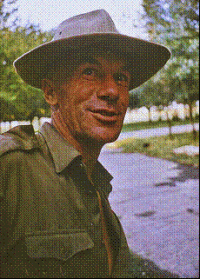
Prominent Ornithologists of Kazakhstan.
"As I have already mentioned, it is also to the female’s advantage if the male brings her food during courtship. In birds, this is generally viewed as a kind of regression to juvenile behavior on the part of the female. When begging the male for food, she performs movements typical of a young bird. It has been suggested that such behavior automatically appeals to the male much in the same way that a man might find it attractive when an adult woman babbles or pouts like a child."
Richard Dawkins. «The Selfish Gene», 1976.
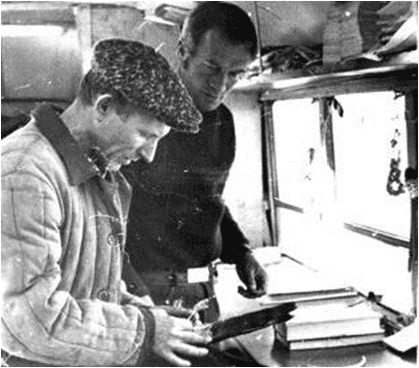
Ikar Borodikhin, founder of the Chokpak field station.
Ikar Fedorovich Borodikhin (on the occasion of his 70th birthday). September 2006 marked the 70th birthday of Ikar Fedorovich Borodikhin a renowned Kazakhstani ornithologist, an expert on local bird species (both in the wild and in captivity), author of the first book on the birds of Almaty, and the primary organizer of the famous Chokpak bird-banding station, operated by the Institute of Zoology.
Ikar Fedorovich was born in the city of Ürümqi (Xinjiang, China), where his father was serving in the diplomatic corps. He grew up in Alma-Ata, where, from a young age, he came to understand the magnificent world of nature with a particular focus on birds. From 1955 to 1960, he studied in the Department of Zoology at the Kazakh State University. Upon graduation, he was immediately appointed as a junior research fellow in the Laboratory of Birds, Amphibians, and Reptiles at the Institute of Zoology of the Academy of Sciences of Kazakhstan an exceptional occurrence!
While still a student in 1958, Ikar Fedorovich conducted observations at a colony of Pallas's gulls (Larus ichthyaetus) on Lake Tengiz in the Kurgaldzhinsky Nature Reserve. In 1960, he participated in an expedition to the Western Tien-Shan, organized by the Institute of Zoology’s ornithology laboratory, visiting the Kyrgyz Alatau, the Karatau range, and the Aksu-Zhabagly Nature Reserve.
Ikar Fedorovich worked in the Institute of Zoology’s bird laboratory from 1960 to 1972 and again from 1973 to 1976. During the first four years (1960-1963), he gathered extensive data on the birds of Alma-Ata, which he later published in a book (1968).
During this same period, commissioned by the Main Directorate for Nature Reserves and Hunting Management, he worked on the acclimatization of bird species in Alma-Ata. To this end, he brought in several groups of great tits from Novosibirsk, as well as laughing doves and common mynas from Tashkent.
All three species successfully established themselves in the city and are now among its most common, characteristic bird species. The great tit acclimated particularly well, spreading into the mountain forests adjacent to the city (and from there, even into neighboring Kyrgyzstan!), as did the laughing dove (also known as the Egyptian turtle dove), which became abundant on the city’s streets during the 1970s and 1980s.
The results of the common myna’s introduction were, in all likelihood, subsumed by a powerful wave of natural expansion by the species, which by the beginning of the XXIst century had reached the Irtysh River and Karaganda. In 1964-1966, at the behest of Igor Alexandrovich Dolgushin the leading figure among Kazakhstani ornithologists Ikar Fedorovich Borodikhin undertook the establishment of Kazakhstan’s first ornithological field station for bird banding.
He made a dedicated trip to the Curonian Spit (on the Baltic Sea, site of the renowned former Rossitten station) to study the operations of the Biological Station of the Zoological Institute of the USSR Academy of Sciences, specifically the techniques for setting up "Rybachy-type" traps.
Subsequently, together with M. N. Korelov and A. F. Kovshar, he selected a location for such a trap at the so-called Chokpak Pass in the Western Tian-Shan. He then worked with E. F. Rodionov and E. I. Gavrilov to build the field station, which he headed continuously for its first six years a period during which all the methodological and organizational foundations for its work were established and tested.
He recounted all of this himself in the article "From the Experience of the Chokpak Ornithological Station" (published in the “Communications of the Baltic Commission for the Study of Bird Migration”, 1974). From October 1972 to September 1973, I. F. Borodikhin served as the head of the bird section at the Almaty Zoo; however, in October 1973, he returned to the Ornithology Laboratory at the Institute of Zoology.
There, until 1976, he led a mobile team dedicated to banding colonial bird species in southeastern Kazakhstan. From 1977 to 1984, he worked as an ornithologist at the Main Botanical Garden of the Academy of Sciences of the Kazakh SSR (Almaty).
In this role, he focused on attracting tits and other cavity-nesting birds to artificial nesting sites, while also placing great emphasis on the conservation of the local birdlife within this green space. Thanks to his efforts, the urban population of the Semirechye pheasant inhabiting the botanical garden grounds increased significantly during those years.
In 1984, he moved to the Almaty Zoo initially as a senior research fellow, and from 1985 as the head of the department for the reproduction of birds of prey where he established a falconry center and began breeding birds of prey. In addition to various species of falcons, the center successfully bred other birds, most notably the bearded vulture (lammergeier), several species of eagles, and the Eurasian eagle-owl.
This breeding center essentially laid the foundation for the "Sunkar" specialized falconry center (established in 1989), where Ikar Fedorovich worked from 1991 to 1994. Since 1995, Ikar Fedorovich has resided in the village of Kush (in the Karachingil tract, at the mouth of the Turgen River).
There, he has cultivated a cactus conservatory of remarkable beauty and diversity; he has been engaged in breeding these plants for over a decade and has become a recognized authority in the field, frequently participating in annual exhibitions.
We wish our dear jubilarian good health and many more years of a creative, happy life!
Key publications by I.K. Borodikhin:
Dynamics of the Ornithofauna of Almaty Over a Century. *Ornithological News*. Almaty, 1965, pp. 45-47;
*Birds of Almaty*. Almaty, 1968, 121 pp.;
Abundance and Distribution of Colonies of Certain Bird Species in Southeastern Kazakhstan. *Biology of Birds in Kazakhstan*, 1978, pp. 58-64;
From the Experience of the Chokpak Ornithological Station (Western Tien Shan). *Communications of the Baltic Commission for the Study of Bird Migration*, 1974, Vol. 8, pp. 81-97 (co-authored with E.I. Gavrilov and A.F. Kovshar).
Authority:
A.F. Kovshar.
Ikar Fedorovich Borodikhin passed away on November 16, 2024, leaving a significant mark on the ornithology of Central Asia.
"Ikar this is neither a literary pseudonym nor a nickname. In the 1930s, it was common to name boys 'Telman' or 'Sun Yat-sen,' and girls 'Communa' or 'Revolutsiya' (Revolution). His father wanted to name him Daedalus, but his mother intervened: 'Don’t ruin the child’s life! Just imagine how they’ll tease him at school!' Daedalus had a son, Ikar a figure of legend in his own right who dreamed of flying toward the Sun. And so, the boy became Ikar. A name can shape a person’s destiny; Ikar was fated to become a biologist. For him, ornithology was not merely a hobby, but his life’s calling."
Svetlana Galieva, Director of the Youth Media Union of Kazakhstan.
Coming from childhood.
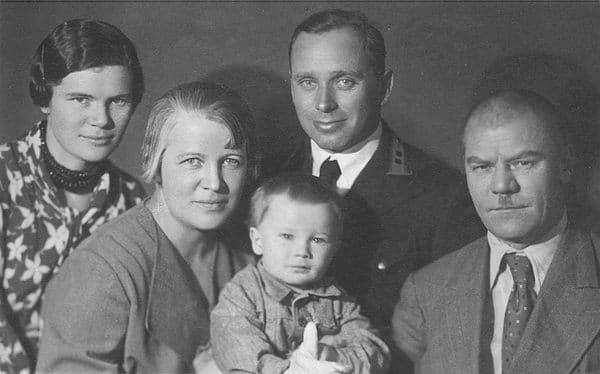
He was born in Urumqi, where his father, Fedor Alekseyevich Borodikhin, served as an executive at "SovSinTorg" a Soviet-Xinjiang trading company. Fedor Alekseyevich was highly proficient in Eastern languages; having graduated from a Cossack school for military interpreters, he was fluent in Chinese, Uyghur, Kazakh, Tatar, Azerbaijani, and various other languages of the peoples of Asia.
He was also well-versed in Manchu a language that has all but faded into oblivion today. His understanding of and ability to observe Eastern customs, combined with an extraordinary capacity for hard work and a strong sense of responsibility, made him an indispensable employee at this company.
Ikar was born on September 10, 1936, and in early 1937 the family returned to the Soviet Union to Moscow where Fyodor Alexeyevich was appointed to a high-ranking position in one of the People’s Commissariats. In the building where the Borodikhin family lived a place from whose windows one could see the towers of the Kremlin arrests occurred all too frequently. Father was a highly sociable man with a wide circle of friends.
It was these friends who warned him:
“You have two or three days to get away.
Go somewhere on the periphery, to a small town; take an inconspicuous job that way, you might avoid being arrested. And indeed, by the standards of the time, the grounds for an arrest were “compelling: he was a Cossack, a former officer, a recipient of the Cross of St. George, and had spent a long time working abroad.
It would have been effortless to add some fabricated charge to these “crimes.” With some help, Father managed to resign from his position in a single day. The family packed their belongings and left for Alma-Ata. From that moment to this very day, the life of Ikar Fyodorovich Borodikhin has been intertwined with this remarkable city.
He graduated from Alma-Ata Secondary School No. 33, and later from the Faculty of Biology at the S. M. Kirov Kazakh State University (now Al-Farabi Kazakh National University). There was never any question as to what he would become a biologist, and nothing else!
During his school years, Ikar was friends with Lev Prygunov, who would go on to become a famous film actor. The Prygunov family was the very embodiment of the true intelligentsia. Lev’s father, Georgy Grigoryevich, was a born educator a rare, gifted individual of the kind students remember for the rest of their lives.
At school, he organized a club for young biologists, for which there was always a waiting list. The club was so engaging and educational that, upon finishing school, many of its members went on to pursue careers as zoologists, botanists, veterinarians, agronomists, and foresters.
This truly gifted teacher, in essence, paved the way for a whole generation of remarkable scientists, researchers, and experts on the nature of Kazakhstan. In the courtyard of his home on Tsentralnaya Street (now Baishev Street) located just below the Green Bazaar Ikar kept a variety of animals.
There were chickens, rabbits, tortoises, and fish. For a time, there was even a squirrel that knew how to escape its cage and would gnaw on everything in sight. He also had two very intelligent dogs, Laska and Troll. And, of course, birds! A golden eagle, a flamingo, a demoiselle crane, and pigeons.
Ornithology became more than just a hobby; it became his life’s work. From a very early age, his father would take Ikar hunting. They would travel to the Ili River, where, in the lower reaches of the steppe streams near the pools where animals came to drink they hunted (Pallas’s sandgrouse), while in the mountains, they hunted chukar partridges.
In the orchards which once stood where today’s residential districts are now located they would hunt wild pigeons and turtledoves. There were also trips to hunt ducks and other game. For his twelfth birthday, his father gifted him a real 24-gauge shotgun.
When Ikar was about to turn fourteen, they went to the city council, where he was issued a hunter’s license, granting him the right to hunt on his own. His mother, Ksenia Fyodorovna, also fully supported her son’s passion. Once, she returned from the bazaar accompanied by a man who was carrying a Eurasian sparrowhawk on his arm.
He was willing to trade the bird for half a pack of gunpowder. The exchange took place, and Ikar’s dream came true: a hawk took up residence in their home, offering endless opportunities to study its habits and train it for hunting. Nowadays, it is hard to imagine teenagers walking around with hunting rifles unaccompanied by adults.
In those days, children grew up early Ikar was a second-year student in the Faculty of Biology when the head of his department, Professor Bronislav Alexandrovich Dombrovsky, sent him to the Far East to collect specimens for the students' practical coursework.
Since the university budget did not cover such materials, the department head funded the entire expedition out of his own pocket. Though only recently a schoolboy, Ikar managed to negotiate with specialized research institutes, navigate all the necessary bureaucratic channels, and even spend time aboard a fishing seiner.
In the end, he returned to the university with zinc-lined crates containing specimens preserved in formalin of octopuses, squids, sea cucumbers, ascidians, starfish, and crabs. It was a true celebration of science! The students were given a unique opportunity to study these rare creatures.
For Ikar, it was a lesson in selfless, devoted commitment to science a life of faithful service to it, coupled with an unconditional love for nature and all living things. His diploma thesis, "On the Biology of the Pallas's Gull at Lake Tengiz," was submitted to an all-Union competition for student research organized by Moscow State University and was awarded a medal for the best student scientific work.
Birds of Alma-Ata.
Over the course of his entire life, he held only a few positions: at the zoo, the Institute of Zoology of the Kazakh SSR Academy of Sciences, and the Botanical Garden. Once, when he mentioned that he was starting a new job the following day, a relative asked him what kind of salary a young scientist like him would earn.
- “But I didn’t ask,”
replied Icarus.
And he was very surprised when, at work, they told him he was entitled to some time off after all, he wasn’t tired at all! He I really never got tired of work. After all, she became his life. Is it possible to get tired of life? She, this wonderful life, gave him interesting meetings - with Dinmukhamed Akhmedovich Kunaev, Bernhard Grzimek, Vasily Peskov, Nikolai Drozdov.
And a real, strong friendship - with Vyacheslav Belyalov, Pavel Chaban, Maxim Zverev. The famous naturalist writer Maxim Dmitrievich Zverev loved to go hunting with Icarus; he vividly and figuratively described many episodes from these trips in his numerous stories.
In the 70s of the last century, a TV program about nature “Open the window!” was very popular on Kazakh television. In one of the episodes, the presenter spent a long time listing the scientific degrees and regalia of the program participants.
When I reached Ikar Fedorovich, I thought for a split second and blurted out
“And this is our famous ornithologist!”
Ikar Fedorovich is really not vested with any titles or degrees. At one time, he wrote the book “Birds of Alma-Ata,” which is still a great success among ornithologists and ordinary readers. He was told that this was a finished candidate's dissertation. Work a little, add fresh material and go out on defense.
Any scientist would do this. But Icarus did not want to waste time on pseudo-scientific activities, collecting various documents, certificates, reviews. He was always interested in real work. At the Almaty Zoo he headed the bird section. I got things right so that bearded vultures began to breed, this is the second such case in the world!
The first result was achieved at the Sofia Zoo. Steller's sea eagles have also begun to breed. Previously, their reproduction in captivity had only been achieved in Japan and Moscow. Condors, bearded vultures, and white-tailed eagles nested regularly.
Together with Vladimir Sokolovsky, he equipped an incubator for hatching chicks without hatching. 95 percent of birds of prey that have a pair began to produce offspring, including small Scops Owls. When the Almaty Zoo applied to join the World Association of Zoos, a voluminous and informative report on the work was prepared.
The application was granted, and the collection of birds of prey was especially noted, which was recognized as one of the best in the world in terms of species composition, keeping conditions and breeding results. And now Icarus remembers his time working at the zoo as the most wonderful thing in his life.
And before that there was Chokpak. The name of the provincial railway station, lost in the vast expanses of Kazakhstan, on the border of Zhambyl and South Kazakhstan regions is now known to ornithologists around the world. This year, on September 10, a double anniversary was celebrated in the field at Chokpak - 50 years since the founding of the ornithological hospital and 80 years of Ikar Fedorovich Borodikhin.
Banding.
In 1964-1966, on behalf of the head of Kazakh ornithologists, Igor Aleksandrovich Dolgushin, Ikar Fedorovich began organizing the first ornithological station in Kazakhstan for bird ringing. Just as in his youth he traveled to the Far East, so now he was sent to the Curonian Spit on the Baltic Sea, to the former famous station Rossiten, now Rybachye, where he thoroughly studied the experience of the Biological Station ZIN of the USSR Academy of Sciences, in particular, the details of installing Rybachin-type traps.
Together with Mstislav Nikolaevich Korelov and Anatoly Fedorovich Kovshar, he chose a place to install such a trap in the so-called Chokpak Gate in the Western Tien Shan, after which, together with Evald Fedorovich Rodionov and Eduard Ivanovich Gavrilov, he began to create a hospital, which he continuously headed for the first six years, when all methodological and organizational basics of work.
Every spring and autumn, millions of birds fly over the territory of our country. Transcontinental bird migration routes pass through Kazakhstan, located in the center of Eurasia, connecting vast areas from Finland to Yakutia in the north and from South Africa to Malaysia in the south.
The most common and effective method of studying the migratory routes of birds is their ringing. Ornithologists put light metal rings on the tarsus of captured birds, which indicate the country of ringing and a personal number. If such a ring is again in the hands of specialists, they will quickly determine when and where the bird was ringed for the first time.
With the help of ringing, it was possible to trace the migration routes of many species. Over the years of the station's existence, more than three million birds of 280 species have been ringed. Thanks to the work of the field station, the migratory routes of dozens of bird species were studied for the first time in Asia.
For instance, scientists discovered that our barn swallows fly to South Africa for the winter. While this was theoretically known, bird banding provided concrete confirmation. Ikar Fedorovich recalls days when they would band as many as fourteen thousand birds in a single day at Chokpak! It is a truly unique location, characterized by such a high density of bird flocks.
Chokpak holds records on bird migration spanning the entire history of the station, and extensive correspondence is maintained with ornithologists from all over the world.
Cacti and Parrots.
Throughout his life, Ikar Fedorovich worked closely with the Almaty Nature Conservation Society. In collaboration with this organization and the Main Administration for Hunting and Game Reserves (Glavokhota) of the Kazakh SSR, he spearheaded efforts to significantly increase the urban population of the Semirechye pheasant, which inhabited the grounds of the Botanical Garden.
He also oversaw the transport of the laughing dove (Egyptian dove) from Tashkent. Together with his loyal friend and associate Rufim Zaynutdinov, he traveled to Semipalatinsk, Novosibirsk, and Omsk to organize the capture and transport of great tits birds that, to this day, help protect Almaty’s gardens from pests.
These birds added vibrant colors to the avian landscape of Almaty. Any scientist could take pride in such accomplishments and contributions! In recent years, Ikar Fedorovich has lived in the settlement of Kush, in the Almaty region, alongside his devoted wife and companion, Olga.
It is here that he keeps an extensive collection of cacti yet another lifelong passion. Parrots live here: a yellow-crested cockatoo named Belyi (Whitey) and an African grey named Lyaka. Dogs named Laska and Zhuk (Beetle) dash about, while Pandik, Roy, and Ryzhaya (Red) keep watch over the house.
Roy “seized” a doghouse for himself it had been sitting empty in a far corner of the yard, and that winter was particularly harsh. A similar thing happened with Ryzhaya; Ikar initially meant to chase the uninvited guest away, but she thin and exhausted crawled toward him and looked straight into his eyes, full of pathos.
Zhuk was found on the side of the road, nearly frozen to death. Olga and Ikar had already driven past, but suddenly Ikar said, “Turn around!” As if he had been waiting for them, Zhuk crossed over to the other side of the road. There is also a feline contingent: a cat simply named Koshka (Cat) and another called Tyubik (Tube).
It’s been put to the test: the house can accommodate about twenty people for the night. Those who don’t fit inside set up tents in the yard. Ikar’s grand-nephews and grand-nieces especially love staying over—and now, the next generation, his great-grand-nieces and nephews, have arrived too! Of course, one could always head back to the city, but staying the night is the best part!
There are conversations that last past midnight, filled with fascinating stories, jokes, and laughter. Everyone is drawn here as if by a magnet. Rarely does a week go by without guests or visitors. Local children gaze with curiosity at the exotic plants, and Belyi the parrot might even strike up a conversation, depending on his mood.
Ikar Fedorovich never turns anyone away; he conducts full-fledged, educational tours.
We have everything here!
Once, the district akim (head of the local administration) paid a visit. He had read an article by Ikar in a scientific journal, which included a brief biographical note at the end listing his address as the village of Kush.
- “To think that such a famous person lives in our neighborhood, and we had no idea!”
he lamented.
Before leaving, he asked if there was anything he needed.
“We have everything; we don’t need a thing!”:
replied Ikar Fedorovich.
And indeed, he does have everything: the love and respect of those close to him and his friends; a calm, joyful spirit that comes from spending one’s entire life engaged in work one truly loves; and a vast wealth of knowledge, skills, and observations all of which he readily shares with his colleagues and friends.
And then there is nature our own Kazakhstani nature which he knows, loves, and perceives with great subtlety, living his life in accordance with its pure, honest, and time-tested laws.
Authority:
Galina Galkina.
https://archive.np.kz/people/20521-ikar.html