




Вы здесь
Up Big Almaty River.
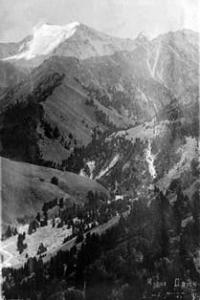
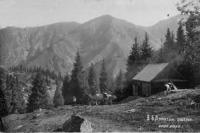
Sightseeing tours in Prokhodnoye Gorge.
"They crash against the rocks with a resounding roar and fly up in fine, dust-like spray. This is the lower Bolshaya Almatinka Waterfall, with a total drop of 150-200 meters. The ascent to the ancient moraine is along a steep, narrow, corkscrew-like path. A loaded horse ascends with a heavy, breathless snort. A little higher up, through the shaggy branches of the spruce trees, the emerald surface of Lake Zhasyl-kul (Green Lake), best known as "Alma-Ata Lake," appears."
"The Nature of Kazakhstan in Essays and Pictures." N.N. Palgov. 1950.
Relaxation at Alma-Arasan Springs.
Big Almaty River, translated into practical terms, is a series of hydroelectric power stations, both built and under construction, a source of water supply for the city of Almaty and thousands of hectares of irrigated fields with industrial, vegetable, and horticultural crops.
The river is formed by two branches originating in the glacial and snow-covered region of the Zailiyskiy Alatau mountain range. The left branch, where the Alma-Arasan resort is located, is called "Prokhodnaya." The right branch, twice as full, is called "Ozernaya."
This latter is the most visited by Almaty workers on their days off. Let's head upstream. A rocky road along the riverbank is accessible by car. The river valley lies between steep mountain slopes at a depth of 800-1000 meters. Thickets of shrubs and slender columns of Schrenk spruce descend into it along the slopes.
Occasionally, the car brushes against the garlands of greenery hanging over the road. Eleven kilometers from the foot of the mountains, the road comes to a halt. Here, the river valley is blocked by a huge dam of stones and rubble. This is an ancient moraine, once deposited by a glacier that reached here from the snow zone.
The glacier that formed it long ago disappeared due to global warming. Its remnants have moved up the valley and now lie at an altitude of 3100 meters and more. The moraine that remains in place is densely overgrown with spruce forest and deciduous shrubs.
Amid the greenery of the forest covering it, the river's waters cascade down the steep slope like a silver stream. With a resounding roar, they crash against the rocks and fly up in fine, dust-like spray. This is the lower Bolshoi Almatinsky Waterfall, with a total drop of 150-200 meters.
The ascent to the ancient moraine is along a steep, narrow path, winding like a corkscrew. A horse carrying a load ascends it with a heavy, breathless snort. A little higher, through the shaggy branches of the spruce trees, the emerald surface of Lake Zhasyl-kul (Green Lake), best known as "Almatinskoye," appears.
To circumnavigate it, you need to travel about 4 km. The lake's waters, greenish from suspended particles carried by the river, rest among winding, picturesque shores. Green capes cut through them here and there, forming cozy bays. In clear, calm weather, the lake's smooth surface reflects the entire surrounding panorama: sharp, rocky peaks, forest clumps with meadow clearings, and a blue sky dotted with clouds.
The lake is quite young. It apparently didn't exist during Alexander the Great's campaigns in Central Asia. From almost any vantage point, one can see the part of the lake from which it is being filled by river sediments. The shore on that side is a flat, level river delta extending far across the valley, covered with damp meadows and, in places, marshy meadows.
According to one researcher, the river delta grows by an average of 117 cm per year. This means that in 800-900 years, the lake will be completely replaced by sand and silt. Due to the uneven influx of water, the lake's level rises and falls. It would be significant if the lake had no outlet.
But the crest of the moraine that dams it is cut by a naturally formed channel, through which the lake's waters flow as a waterfall. This second, upper waterfall is even more spectacular than the lower one. The lake is pleasant in the summer on clear, sunny days.
While people down in the city suffer from the heat on these days, here it's 10-11°C cooler. From the majestic mountains with their gray, mossy cliffs and From the cliffs, from the forest spreading across the river valley and mountain slopes, from the lake itself, reflecting the blue dome of the sky, comes the invigorating freshness of the healthy forces of nature.
Upstream, beyond the river delta, the valley's appearance changes dramatically. Here, it is covered with rocky outcrops scattered by mudflows from the right side gorge. But soon these end, and the soft greenery emerges again. From here, the summer pastures - the zhailau - begin.
Flocks of sheep and herds of horses flit across the valley and mountain slopes, amidst sparse forest and juniper thickets. The closer one gets to the alpine zone, where the woody vegetation disappears and only high-altitude grassland remains, the more the area is used for transhumance by collective farms.
At the fourth or fifth kilometer from the lake, another steep climb to an overgrown moraine is encountered. Beyond it, the valley suddenly widens. Ahead (to the south), it abuts the main ridge with its slopes clad in snow and glaciers. To the west, it stretches in hummocks and ridges to the watershed with the left (passable) branch of the Big Almaty.
To the east, the same rugged terrain approaches the modern moraines of the largest glaciers, located in the upper reaches of the right branch. The short summer, with occasional snowfalls, no longer allows spruce forest to develop here. The basin is covered exclusively by low grassy vegetation, consisting primarily of kobresia and typs.
Cattle quickly thrive on these grasses. From the basin, a route leads south to the Chon-Kebin (Bolshoy Kebin) River valley. Snow-capped peaks rise on either side. They're close from here, but climbing them requires mountaineering experience.
Massive glaciers emerge from the side gorges. Visible from the valley, the firn fields of some of them hang like dazzling white cornices on the mountain slopes. Dark rocks and cliffs peek out from under the snow. A damp haze of cloud sometimes lingers in the gaps between them.
The wild beauty of the surrounding landscape, still undeveloped by man, lingers in the memory.
Authority:
"The Nature of Kazakhstan in Essays and Pictures." N.N. Palgov. Publishing House of the Academy of Sciences of the Kazakh SSR. Alma-Ata. 1950.