




Вы здесь
B. Veyrman on Tillya-Kari Madrasah.
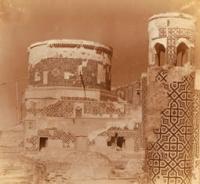
Epigraphy of Tillya-Kari Madrasah.
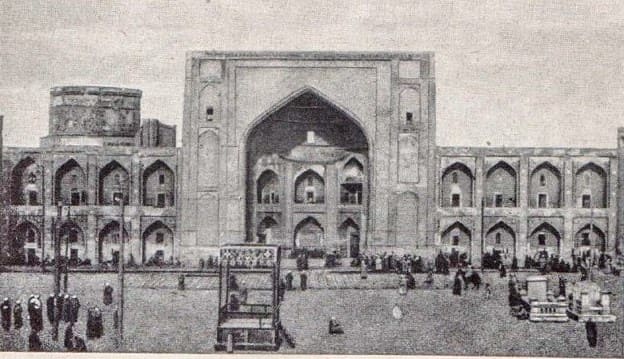
"The Tillya-Kari Madrasah, bordering Registan Square on the northern side, was also built by Yalangtush Bahadur and is only 12 years younger than Shir-Dor. Its façade features a tall portal with a pointed arch, a favorite feature of Central Asian architecture, flanked by two-story khudjras with arches and niches, opening onto the square. These arches, covered with tiles and mosaics, lend the façade a more lively atmosphere than the solid walls of neighboring madrasahs, even though they are dissected with false arches."
V. L. Vyatkin. "Antique Monuments of Samarkand." 1930.
Architecture of Tillya-Kari Madrasah.
Only ten years after the completion of the Shir-Dor Madrasah, in 1646-1647, by order of Yalangtush Bahadur, construction began on a third madrasah on Registan Square. If the architect had followed the path of the Shir-Dor Madrasah's builder, precisely reproducing the forms of the Ulugh Beg Madrasah, he would not have achieved the goal of creating a coherent design for the square.
Undoubtedly, however, the architect possessed a superb sense of ensemble. This sense prompted him to elongate the building's façade, in accordance with the allotted space, so that its corners would be level with the two existing structures. At the same time, seeking a unified appearance with the other buildings in the ensemble, the architect incorporated madrasah-like forms (portal, high walls, and minarets at the corners) into the main façade of the new structure, rather than those of a cathedral mosque, which he placed in the courtyard, displaying only its drum and dome above the building's façade.
This solution imbued the ensemble with the typical character of Central Asian architectural compositions discussed above. While the design of the Tillya-Kari Madrasah is similar to that of the other two madrasahs in the Registan, it differs from them in many ways.
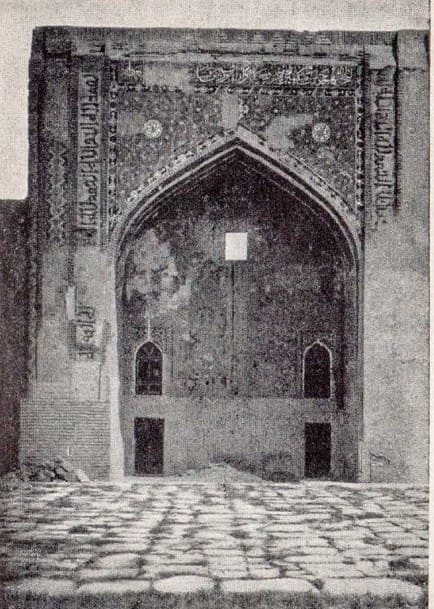
The portal on its façade is smaller and, in proportion to the rest of the wall surface, occupies relatively little space. Nevertheless, it is the architectural focal point of the square and the first one perceived from Registan Street. The portal's pentagonal niche contains three doors at its depth.
The niche offers a beautiful view of the square and the slightly foreshortened façades of the Shir-Dor and Ulugbek Madrasahs. On either side of the portal, the building's façade is decorated with two rows of pointed niches, opening onto the doors and windows of the sixteen hujras located along the front façade.
These loggia-like niches on the façade deprive the building's steppe of the monolithic appearance characteristic of earlier structures. This new approach to façade design became widespread in the XVIth century in Bukhara during the construction of madrassas.
The architect of the Tillya-Kari Madrasah adopted this Bukharan tradition and applied it with some modifications. Of particular interest are the corner minarets on the front façade, designed as turrets topped with lanterns. The courtyard lacks the sense of enclosure and isolation we noted in the Shir-Dor Madrasah.
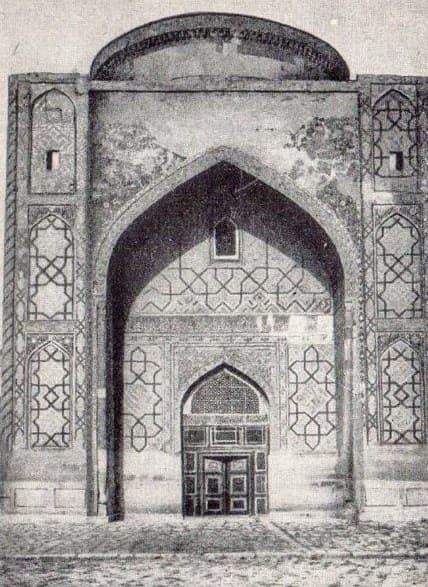
This is explained not only by the courtyard's large size, but also by the fact that it is surrounded on three sides by single-story buildings. Neighboring houses are visible beyond their walls, and street noise can easily be heard. The courtyard is surrounded on three sides by a typical arcade of hujras, interrupted in the middle of each side by a small portal.
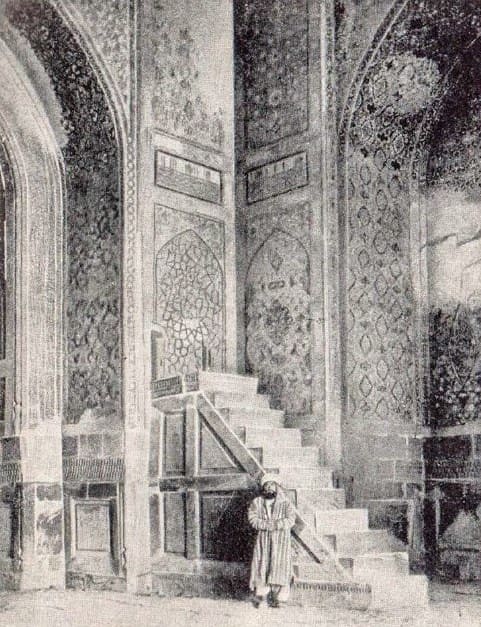
The western side of the courtyard is occupied by the mosque's chambers. In the center is a high portal, behind which lies the main chamber of the mosque, which has a cruciform plan. Here are the mihrab and minbar - the pulpit for the imam.
Above this domed chamber, a second high decorative dome once towered, of which only the cylindrical drum, visible from the square, now remains. The side sections of the mosque are large, elongated halls, intersected by two rows of pillars supporting a ceiling composed of small domes.
Wide arches open onto these halls facing the courtyard. The impressive tiled decoration of the Tillya-Kari Madrasah is significantly diminished by its severe damage. During an earthquake in the early 19th century, the upper part of the main portal collapsed and was restored under Emir Haidar, but without its tiled decorations.
Other parts of the decorative paneling have also suffered greatly from time. In the courtyard, besides the pishtaks, colored decorations have survived in the tympanums of only two arches, which serve as entrances to the hujras. At the same time, it must be noted that the technical and artistic quality of most of the colored paneling in the Tillya-Kari Madrasah is lower than that of the Shir-Dor Madrasah.
Along with the carved Mosaic was widely used here to decorate wall surfaces with square ceramic tiles featuring painted and glazed patterns. These majolica tiles imitated the patterns of carved mosaics, with the difference that the pattern elements were not individually carved but painted onto the tile surface and then glazed.
This technique simplified and reduced the cost of producing colored ceramic decorations, but simultaneously diminished their artistic value. Painting on tiles never achieved the clarity of design and purity of color that distinguish panels and friezes with mosaic patterns.
The majolica tiles decorating the tympanums of many arches in the madrasah courtyard feature stylized floral patterns, executed primarily in lemon yellow on a blue background. The glaze colors are faded and impure. The mosaics preserved in the tympanums of the large arches in the courtyard are also dull, sometimes even dirty in color.
The tiled decoration of the madrasah reveals a careless, hasty appearance, perhaps explained by the fact that the building was undoubtedly completed and decorated after the death of Yalangtush Bahadur. The paintings decorating the interior of the main building of the mosque are original and interesting.
Lavish, decorative paintings cover the walls of the high domed chamber, from the marble panel at the bottom to the very top of the inner dome. The paintings are executed with glue paints and generous use of gilding. The decorative cornice of the stalactites is adorned with an ancient relief painting technique called "kundal," well known from XVth-century monuments in Samarkand.
A distinctive feature of this painting is that the main lines of the pattern were first applied to the smooth surface of the wall using a thick clay paste. These lines were then left raised during the painting process. The patterns combine geometric and stylized plant motifs, executed in blue, red, and white.
Particularly interesting are the panels depicting flower bouquets in vases, the stylized cypress motif in the painting of flat stalactites, and the geometric interweavings forming star-shaped and polygonal figures filled with plant rosettes. The abundance of gilding in the mosque's wall paintings gave the entire madrasah its name: Tillya-Kari, meaning "gilded" or "covered with gilding."
The three madrasah buildings on Registan Square in Samarkand are outstanding artistic monuments not only of Central Asian architecture but also of world architecture. The finest of these, the Ulugh Beg Madrasah, most fully embodied in its architectural forms and decoration the distinctive features of Central Asian architecture, rooted in ancient traditions and enriched by a number of advances in construction techniques and art from neighboring countries.
The typical Central Asian pishtak (pointed-arched dome) and the fortress-like monolithic building block were organically combined with high domed roofs and slender, slender minarets, the forms of which echo Iranian architecture. The superb mosaics of the Ulugh Beg Madrasah served as a model for the beautiful buildings of Navoi-era Herat, for the builders of the mosque in Anau (near modern-day Ashgabad), and for many other structures.
The other two buildings of the Samarkand Registan are inferior to the Ulugh Beg Madrasah in the perfection of their execution and the subtlety of their decoration, but together all three buildings create a unique architectural whole, characteristic of Central Asia during the era of powerful feudal states.
From the first years of the revolution, the Soviet government placed these unique monuments of Central Asian architecture under its supervision and protection. The Registan was declared a nature reserve. Since the early 1920s, work has been continuously underway to strengthen the architecture and cladding of the monuments and restore individual sections.
Particularly noteworthy is the long-term work to straighten the northeastern corner minaret of the Ulugh Beg Madrasah. Due to seismic vibrations, the minaret had tilted and was in danger of falling. A detailed study of the minaret's structure and its foundations made it possible, using sophisticated equipment and machinery, to straighten it and restore it to its original position without dismantling the masonry or disrupting the unique work of the ancient architects.
Another major and complex restoration project, completed in 1925, involved the rebuilding and restoration of the enormous arch of the Shir-Dor Madrasah portal, which had sagged and was on the verge of collapse. At the same time, the mosaic depicting lions in the portal's tympanum was reinforced.
Restoration work on the Registan monuments continued even during the Great Patriotic War. During the war, major repairs were carried out on the southern portal of the Ulugh Beg Madrasah, along with other work. Preparations are underway to correct the deformations of the large arch of the main portal of this madrasah.
The study and restoration of the Registan ensemble allows for a more complete and profound understanding and appreciation of the artistic merits of this remarkable creation of the brilliant architects of the fraternal Uzbek people.



Authority and photographs by:
B. Veyrman. "Registan in Samarkand."
USSR Academy of Architecture. Institute of the History and Theory of Architecture. Architectural Treasures of the Peoples of the USSR. Edited by Academician V. A. Vesnin. 1946.