




You are here
Boris Veimarn on Ulugh Beg Madrasah.

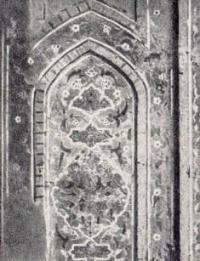
Tour for architects to Ulugh Beg Madrasah.
"Ulug Beg - a sea of knowledge and wisdom,
Who was the support of earthly life and faith,
Because of Abbas, he tasted the honey of martyrdom
And the words "Abbas killed" became the tarikh of his death.”
"Babur nama." "Book of Babur" or "Notes of Babur." Memories of Zahir ad-Din Muhammad Babur. 1526-1530.
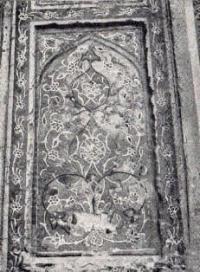
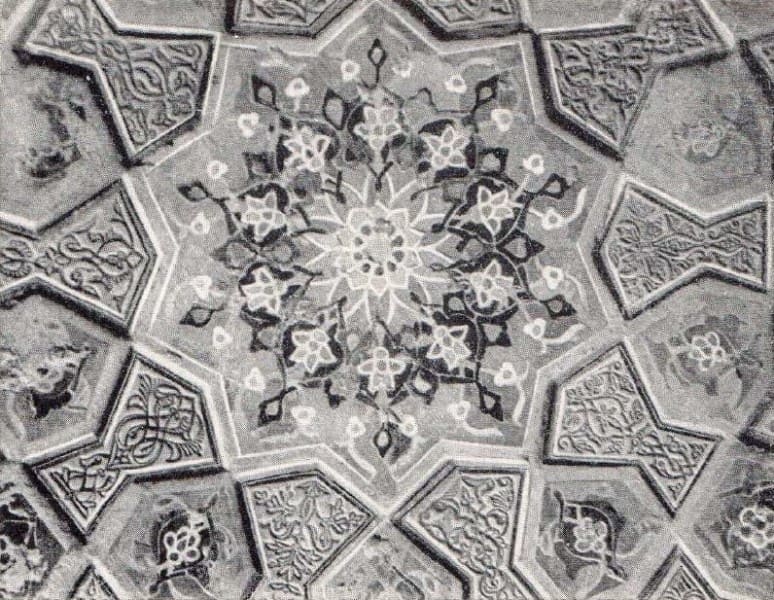
Colored mosaic of main portal of Ulugh Beg Madrasah.
Boris Veimarn's book "Registan in Samarkand" (1946) is a fundamental study of the architectural ensemble, describing the Ulugh Beg, Sherdor, and Tillya-Kori Madrasahs. The author analyzes the composition, decor, construction features, and history of the buildings. The work emphasizes the ensemble's role as a masterpiece of Central Asian architecture.
Key aspects of B. Weimarn's work:
Composition: The ensemble was formed at different times, but represents a coherent architectural ensemble.
Design features: The madrassas had two-story khudjras, and their courtyards were a single, enclosed space.
Decoration: The author describes in detail the marble panels, stalactite cornices, and unique cladding.
History: The book examines the buildings' functional purpose as centers of education.
B. Weimarn's work serves as an important source for understanding the historical significance of this architectural monument.
In 1417, as evidenced by an inscription executed in colored mosaic in one of the niches of the main portal, the Ulugh Beg Madrassah was already under construction. The building was completed in 1420, as evidenced by another inscription, a wide band framing the portal arch. It can be assumed that, even at the fastest construction pace, the madrasah would have taken 5-6 years to build.
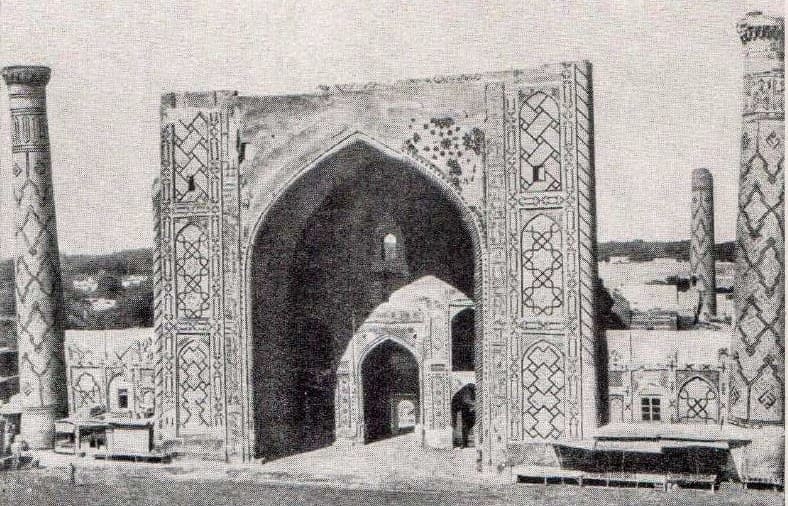
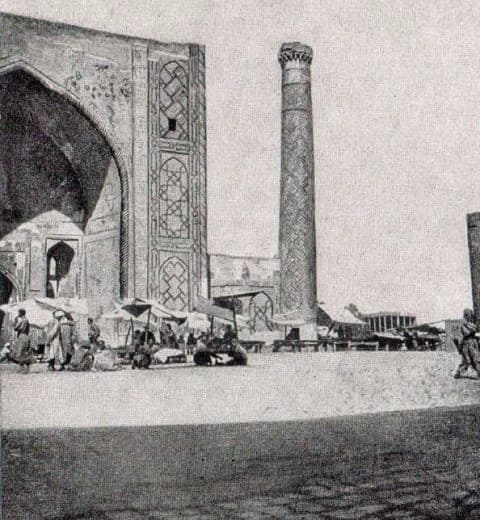
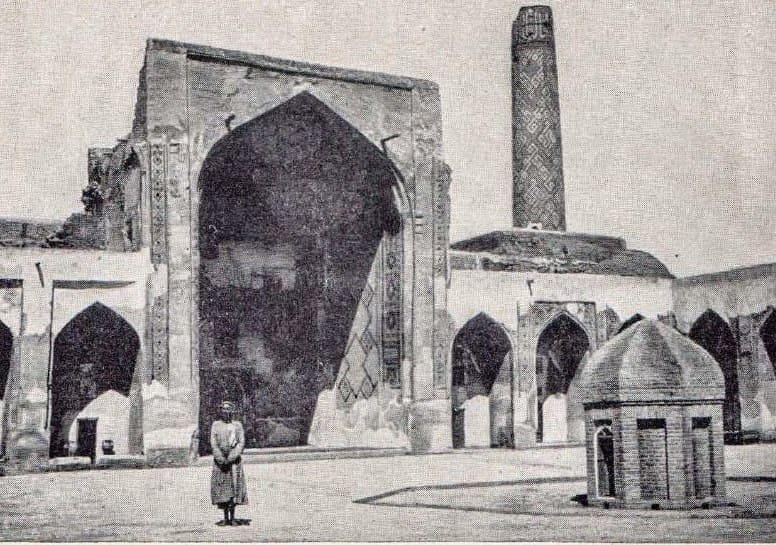
The madrasah building is a large rectangle (56x81 m), with one of its narrow sides facing the square. From the outside, we see relatively low, blank walls enclosing the rectangle along its perimeter. Slender, round minarets rose at the four corners of the building.
Two remain on the front façade and one, dilapidated, on the northwest corner. The northern and southern façades each have a small rectangular portal in the center with a shallow pointed niche. A significant architectural feature of the building is the gigantic, also rectangular, portal, occupying two-thirds of the length of the main façade and facing the square with a huge, wide, and deep pointed arch.
This is a typical, yet uniquely beautiful, Central Asian pishtaq - an architectural form that developed in ancient Maverannagra and, apparently, spread from there throughout the Near and Middle East. The massive pylons flanking the portal arch are adorned with decorative pointed niches, arranged one above the other in three tiers.
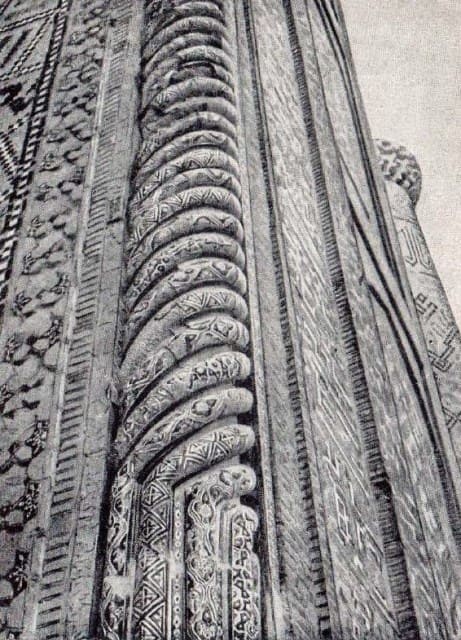
Similar, but smaller, niches adorn the exterior of the building's blank walls. A thick, braided cord is woven from brick along the contour of the large portal arch. In the rear wall of the portal niche is a smaller arch with an entrance to the madrasah courtyard.
Two other doors are located on either side of this niche. Nowadays, entering the portal arch requires descending several steps from the square. However, when the building was constructed, the square's surface was different; the floor of the portal arch was higher than the square's level, and access to it required ascending several steps of a wide staircase.
The central door of the portal is now covered with a grate, but even previously it was likely opened only on ceremonial occasions. The courtyard can be entered through one of the side doors, which lead into narrow corridors covered with small domes, twice bending at right angles.
The courtyard is located in the center of the building and is a perfect square, approximately 30 meters on each side. The courtyard area is paved with large stone slabs. On all four sides of the courtyard, a pishtak with a deep pointed niche rises in the center of the wall.
These niches served as classrooms for madrasah students during the summer. To the right and left of the portals are small, elongated rectangular rooms – khudjras - where the madrasah students and teachers lived. Some hujras consist of one room, others of two, covered by vaults.
From the courtyard, the hujras are marked by shallow pointed niches, symmetrically and rhythmically arranged on each side of the courtyard portals, three on each side. Thus, the overall architectural design of the courtyard has a pointed arcade typical of medieval Muslim buildings.
However, to recreate the original appearance of the madrasah courtyard, one must imagine the second floor of the hujras, dismantled during one of the uprisings in Samarkand in the XVIIIth century for strategic reasons. The courtyard of the second-tier hujras was accessed through the same pointed arches as the lower ones, but the niches were shaped like balconies, connected by doorways cut into the thickness of the walls.
The roof of the second floor of the hujras was flat, concealing the vaults of the rooms and allowing free movement along the building's roofs. With the second floor, the courtyard had a unified, spatially enclosed appearance. The destruction of the second floor significantly distorted other parts of the building.
Behind the courtyard's western portal, along the building's rear facade, is a large, elongated room that served as the main auditorium and mosque. This tall room now has a wooden roof, constructed in the late XVIIIth or early XIXth century, but originally it had a vaulted brick ceiling.
At the four corners of the madrasah building are tall, cruciform auditoriums, accessed from the courtyard by narrow, curving, domed passages. A dome on a round drum rose above each of the four auditoriums. These domes perished along with the second floor of the hujras.
When examining the building from the outside, one must imagine the walls raised to almost twice their current height and place domes on round drums between the portals and the corner minarets. Only by reconstructing all the destroyed parts can one fully comprehend the original appearance of the Ulugh Beg Madrasah, renowned as one of the finest buildings in Timurid Central Asia.
Even now, in its dilapidated state, the Ulugh Beg Madrasah on the Registan in Samarkand impresses with its harmonious proportions, the clarity and thoughtfulness of its plan, and the artistic expressiveness of each individual architectural form and the entire architectural structure.
Before us is a fully developed and detailed architectural type of building for a higher Muslim theological school. The madrasah, as an institution, emerged in Central Asia earlier than in the central and western parts of the Muslim world, likely arising under the influence of Buddhist monasteries (viharas).
The madrasah building type also apparently developed under the influence of the architectural composition of Buddhist monasteries, but in local Central Asian forms: with massive fortress-like walls, corner towers, a large rectangular portal, and the characteristic profile of a pointed arch.
The history of Central Asia mentions a madrasah building that existed in Bukhara in the 10th century and burned down in 937 during a great fire. Of the surviving monuments of this type, the earliest are the madrasahs built by Ulugh Beg; the first of these, in 1417, was built in Bukhara, followed by one in Samarkand, and in 1423-1424, the madrasah in Gijduvan.
These buildings were undoubtedly preceded by some prototypes, but Ulugh Beg's masters developed and perfected the architecture of the buildings. The numerous madrassas built in subsequent centuries in Bukhara, Samarkand, Khiva, and other cities essentially replicate the type of buildings constructed under Ulugh Beg, with variations only in detail.
Among the madrassas erected by Ulugh Beg, the Samarkand madrassah is the finest. It is more majestic than those in Bukhara and Gijduvan, larger, richer in architectural detail, and more refined in proportions. The Ulugh Beg Madrassah in Samarkand is one of the finest architectural monuments of the XVth century, and is deservedly considered a masterpiece of medieval Muslim architecture.
It is no coincidence that Eastern panegyrists said that the building's façade is as tall as the vault of heaven, and its heaviness makes the spine of the earth tremble. The remarkable architectural qualities of the madrassah also include the highly artistic decorative finish of the walls with colored tiles, both inside and outside.
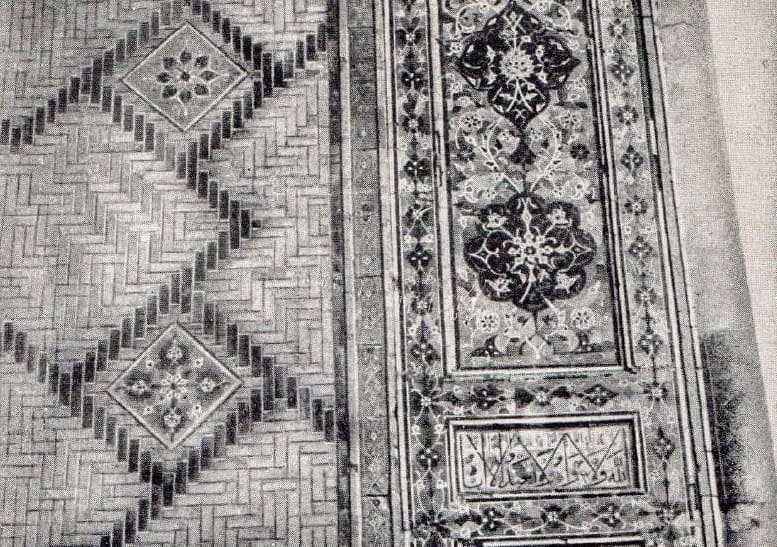
On the main façade, the base of the wall was adorned with a tall marble panel, topped with a stalactite cornice and a frieze with a relief inscription. Above, the entire wall surface was covered with large geometric patterns, laid out in white, blue, and manganese-black tiles on a terracotta-yellow background of unglazed facing brick.
On the surface of the portal's pylons, in the decorative pointed niches of the walls, and on the round bodies of the minarets, the pattern forms a complex grid of cross-shaped and diamond-shaped figures and endlessly repeating monograms of geometric Arabic letters.
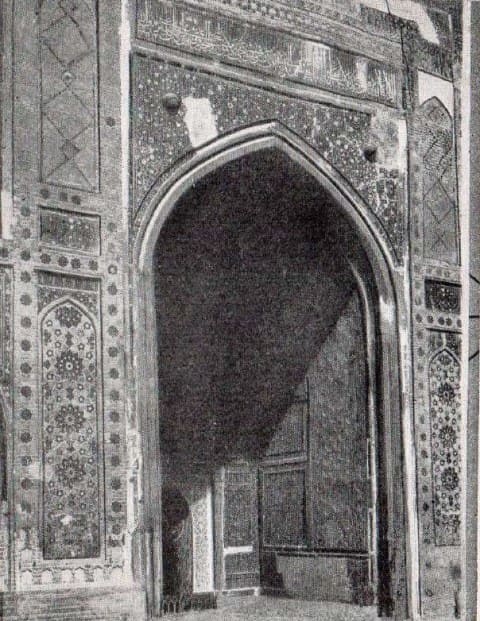
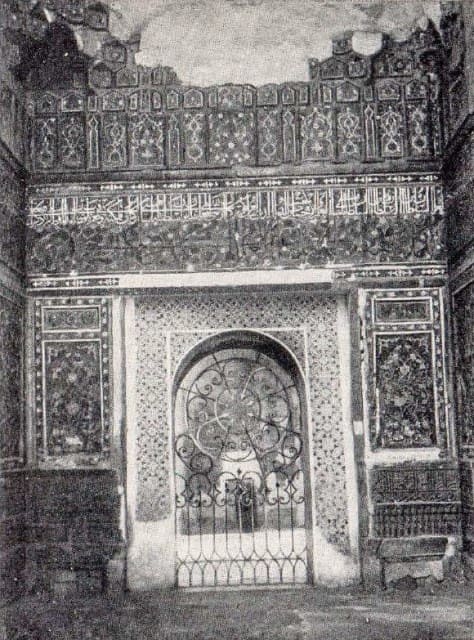
The most lavish decorative embellishment is concentrated on the walls of the main portal. Here, medallions and rosettes composed of plant stems, leaves, and flowers, intricate ligatures of Arabic inscriptions, and polygonal stars predominate.
The patterns are made using so-called colored ceramic mosaics, invented in Central Asia or Iran and especially widely used in the XVth century. The production of ceramic mosaics required great labor and skill. From a special type of ceramic mass called "kashin," the craftsman produced thin tiles, which he coated with glazes of various colors.
Fired in a kiln, these tiles acquired a remarkable property: they could be cut with a knife, and the glaze did not chip, but rather easily separated along with the entire mass of the shard. Having prepared the required number of tiles, the craftsman, according to a pre-prepared design, cut out the pattern elements from the tiles, down to the thinnest plant stems, just a few millimeters wide.
The multicolored pattern elements prepared in this way were carefully fitted together and then attached to the wall surface using alabaster. Thus, the patterns of large panels and friezes, sometimes several meters long, are painstakingly crafted. Mosaic stars of varying sizes adorn the tympanums of the large portal arch.
Superb mosaic panels and a frieze with a multi-line inscription cover the walls of the main entrance niche. Nearby, a wide band running along the soffit of the arch and descending to the marble panel is filled with colorful mosaic rosettes of varying sizes, set among raised marble tiles. In the mosaics of the Ulugh Beg Madrasah, a symphony of white, yellow, green, and manganese-black flowers, blue and green stems, and white and yellow letters is displayed against a deep blue background.
The elements of the pattern are meticulously crafted. Each stylized flower motif is executed in two or three colors: the core is cut from a tile of one color, the petals are of another color, and the leaves are of a third. The letters of the inscriptions, intertwined with spiraling plant stems, are executed with striking fineness.
The superb, lustrous glaze of pure tones, the unique, subtle harmony of the color combinations, and the beauty of the design's lines allow the mosaics of the Ulugh Beg Madrasah to be considered among the most accomplished works of Eastern decorative art.
In addition to the main portal, mosaics adorn the portals on the southern and northern facades of the building, the pishtaqs in the courtyard, and the tympanums of the arches serving as entrances to the hujras. Every detail of the decorative finish is executed with inimitable skill, and the entire decoration as a whole is consistent with the architectural concept of the building's creator.
The decoration of the Ulugh Beg Madrasah building is free from the deliberate overload of decorative elements that we often observe in Central Asian architecture of the subsequent period. The master builders of the Ulugh Beg Madrasah harmoniously blended the colorful decorations on the walls with the building's architectural lines.
The decorations avoid the impression of excessive opulence. While austere in their own way, the colorful decorations, both in the details and overall, create an impression of refined luxury, created with great artistic taste and tact. Ulugh Beg attached great importance to the Samarkand madrasah.
It was even said that he personally participated in the building's construction. Under Ulugh Beg, the madrasah in the Samarkand Registan was a center of literary theology and scholarship. The madrasah's first mudarris (rector) was Maulana Muhammad Khavafi, appointed by Ulugh Beg for his extensive scholarly knowledge.
Tradition relates that on the day of the madrassa's opening, Maulana Muhammad delivered his first lecture in the presence of 90 scholars, including Ulugh Beg. The lecture was so complex in content and replete with scientific terminology that only Ulugh Beg and the astronomer Qazi-zade Rumi understood it.
There is evidence that Qazi-zade Rumi and Ulugh Beg themselves lectured at the Samarkand madrassa. According to the historian Dauletshah, the number of mullahs studying at the Samarkand madrassa exceeded 100. After the tragic death of Ulugh Beg, assassinated by his eldest son, Abdal-Latif, the madrassa in Samarkand's Registan long retained its significance as a center of scholarly and theological studies.
In any case, in the XVIth century, the senior mudarris of this madrassa was considered the foremost scholar of Samarkand. The madrasah building, like apparently other structures within the Registan complex, was repeatedly renovated under the Shaybanids in the XVIth century, although Samarkand was no longer the capital at that time.
In the 17th century, amid a renewed surge in public life in Samarkand, the Registan again attracted attention, and as a result, the complex of buildings created under Ulugh Beg underwent extensive reconstruction.
Authority:
B. Veyrman. "Registan in Samarkand."
Academy of Architecture of USSR. Institute of History and Theory of Architecture. Architectural Treasures of Peoples of USSR. Edited by Academician V. A. Vesnin. 1946.