




You are here
Registan Complex in XVIIth century.
Ashtarkhanid Dynasty in Samarkand.
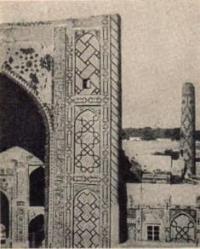
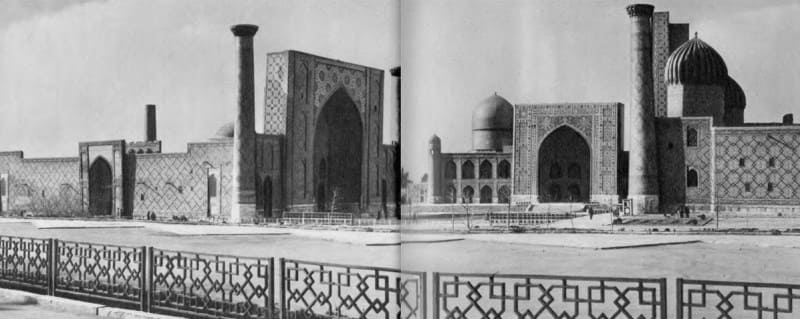
"Approaching the Registan, we see three enormous structures with mighty monolithic walls, their surfaces covered like a carpet with tiled decorations that glitter in the sun's rays. The gigantic portals of the buildings, surrounding a large square on three sides, face the viewer with enormous arches. Their pointed, pointed form evokes the colossal weight of the architectural mass pressing down on the mighty pylons and walls. The arches seem frozen in a powerful tension. It seems as if an inhuman force holds the enormous domes, pylons, and minarets motionless so that the vibrant colors of the intricate tiled patterns shimmer peacefully across their walls. A stunning, unforgettable spectacle...”
B. Veyrman. “Registan in Samarkand.” 1946.
Educational tours of Registan in Samarkand.
The majestic and colorful buildings of the Registan are memorable to anyone who has visited Samarkand at least once. Located in an elevated part of the city, they attract attention even from afar with their unique architectural forms: grand pointed arches of the portals, ribbed colorful domes, and slender minarets.
From a distance, the building's architectural masses seem to be fancifully piled one upon another, forming a picturesque grouping of colorful blocks. Approaching the Registan, we see three enormous structures with powerful monolithic walls, the surface of which, like a carpet, is covered with tiled decoration that glitters in the sun's rays.
The gigantic portals of the buildings, surrounding a large square on three sides, face the viewer with enormous arches whose pointed, upward-pointing forms evoke the colossal weight of the architectural mass pressing down on the mighty pylons and walls.
The arches seem frozen in mighty tension. It seems as if an inhuman force holds the enormous domes, pylons, and minarets motionless, so that the vibrant colors of the intricate tile patterns shimmer peacefully across their walls. A stunning, unforgettable spectacle...
The buildings of the Registan are widely known from the paintings and drawings of many artists. They are captured by the brush of V.V. Vereshchagin. And yet, painting cannot convey the full charm of these structures. Registan is the central square of old Samarkand. It is approached from all sides by the main streets, radially intersecting the Old City (Drawing I).
In ancient times, excavations have established that a powerful canal crossed the territory of today's square, leaving behind a mass of sand deposits. The sand deposits of the canal likely determined the name of this place, as the word "Registan" literally means "place of sand" or "sand field."
Three madrassas, or higher Muslim religious schools, currently stand tall on Samarkand's Registan. Two of them, named Shir-Dor and Tillya-Kari, were built in the 17th century, while the third, located on the western side of the square, was erected in the XVth century, during the reign of Timur's famous grandson, Ulugh Beg.
Historical sources report that this madrassah was part of an interesting, but now lost, complex of monumental buildings erected around Registan Square during Ulugh Beg's reign.At the beginning of the XVIIth century, under the first rulers of the Ashtarkhanid dynasty, favorable conditions for a new surge in construction activity emerged in Samarkand.
A major role in this development was played by the ruler of the Samarkand vilayet (region), an Uzbek military leader from the Alchin-Yalangtush-bahadur clan. Successful campaigns against Kabul, Mashhad, and other cities brought Yalangtush great wealth and an entire army of slaves.
A capable politician, he managed to establish himself as a de facto independent ruler and maintained his power in Samarkand despite frequent changes of power in the capital, Bukhara. According to Yalangtush-bahadur's plan and with his funds, construction of a new architectural ensemble began on Registan Square.
By this time, Ulugh Beg's khanaka had fallen into complete disrepair. In its place, opposite the Ulugh Beg Madrasah, which still retained its original appearance, Yalangtush built a second madrasah, known as "Sher-Dor." In its architectural form, this building was essentially a replica of the Ulugh Beg Madrasah.
Somewhat later, Yalangtush erected a third major structure on the Registan - the Tillya-Kari Madrasah, whose main façade occupied the northern side of the square. This madrasah also became the new cathedral mosque of Samarkand. The Tillya-Kari building featured a large courtyard capable of accommodating a large congregation, and the entire western portion of the building was dedicated to the mosque.
The building's exterior also differs from the other two madrasahs in the Registan. The madrasah faces the square with a wide façade topped with low minarets at the corners. Beyond the large, squat portal on the left, one can see the pishtak and the cylindrical drum above the mosque, now without its dome.
In its architectural appearance, the Tillya-Kari building is similar to Bukhara madrasahs. The ensemble of buildings on the Samarkand Registan, created by the construction of Yalangtush Bahadur, is unique, yet characteristic of Central Asia. No single main structure stands out; all three buildings are architecturally equivalent and essentially follow the same form.
Despite the simplicity of the composition underlying the ensemble, it is very expressive and majestic. The rhythmic repetition of identical or similar architectural forms and decorative color patterns creates a sense of exceptional monumentality and simultaneously defines the organic unification of all three buildings, constructed at different times, into a single, integral architectural image.
The Registan complex served as the religious center of Samarkand for several centuries. It was with this in mind that Yalangtush Bahadur built it, wanting Samarkand to rival Bukhara in importance, where numerous madrassas were built in the XVIth and VIIth centuries.
At the same time, the Registan became and remains a vital architectural center.
Authority:
B. Veyrman. "Registan in Samarkand."
Academy of Architecture of USSR. Institute of History and Theory of Architecture. Architectural Treasures of Peoples of USSR. Edited by Academician V. A. Vesnin. 1946.