





Вы здесь
History of Boom Gorge Railway.
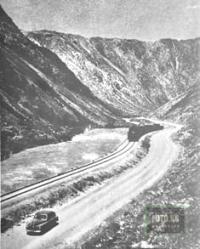
Train Journey through Boom Gorge.
"The Boom Gorge is a desolate and deserted place. Our progress was extremely difficult because our path could not follow the riverbank uninterruptedly, as in some places the cliffs dropped vertically into the river, forcing us to climb the side walls of this rocky corridor. Instead of these detours, we sometimes waded, where possible, at the foot of the cliff, against the raging current through the rocks that filled its bed, with the constant danger of being swept away by the raging waves."
P.P. Semenov-Tyan-Shansky. "Journey to the Tien-Shan." 1856-1857.
Journey through Boom Gorge.
Boom Gorge Railway: A Road Built During the War.
The history of the railway crossing the Chu Valley and connecting it with the western part of the Issyk-Kul Basin occupies a special place in the history of Kyrgyzstan's transport development. This line was more than just another section of the railway network.
Its construction required overcoming one of the most challenging natural barriers in the Northern Tien-Shan – the Boom Gorge, where the swift Chu River cuts through mountain ranges, leaving extremely limited space between the rocky slopes for many kilometers.
The Lugovaya-Frunze-Bystrovka-Rybachye railway line crossed the main areas of the Chu Valley and gradually became an important transport artery linking northern Kyrgyzstan with the Issyk-Kul Basin. The railway reached Frunze in 1924. The line subsequently continued eastward: during the war, the section to Bystrovka was developed, and then construction began on the most difficult route – through the Boom Gorge to Rybachye, today's Balykchy.
It was this last section that became one of the most complex railway projects in the republic's history.
Railway to Issyk-Kul.
While construction on the Chuya Plain took place in relatively favorable conditions, after Bystrovka, the terrain changed dramatically. Here, the mountains began, and with them, a completely different engineering challenge. The railway line had to be built through a narrow natural corridor already occupied by the Chu River bed and a highway.
In some places, the track had to be placed literally between the river and a steep slope, and sometimes it had to be elevated above the highway, using narrow terraces and specially prepared platforms. Landslides, rock falls, and the region's high seismic activity posed a particular danger.
The rocky slopes of the Boom Gorge are dissected by numerous cracks, and weathering processes constantly pose a threat of individual stone blocks falling. The Chu River itself also posed a significant natural obstacle. In narrow sections of the gorge, it flows rapidly among the rocky banks, and during high water periods, it can actively impact the banks and base of the slopes.
Therefore, construction required not only constructing a route through the mountains but also ensuring the stability of the roadbed and artificial structures.
Construction of the Boom Gorge Railway in Wartime Conditions.
A particularly intense period of construction occurred in 1941-1942, when technical development of the railway section between Bystrovka and Rybachye began. Construction took place under exceptionally difficult conditions. The Great Patriotic War required enormous quantities of men, equipment, metal, fuel, and building materials for the front and industry.
Under these conditions, railway construction in the remote mountainous region faced a constant shortage of essential resources. On January 16, 1942, by decision of the Bureau of the Central Committee of the Communist Party (Bolsheviks) of Kyrgyzstan, construction of the Bystrovka-Krasnyi Most railway section was transferred to the Turkestan-Siberian Railway.
Construction was expected to be completed in 1942-1943, and the cost of the work was initially estimated at approximately 65-67 million rubles. However, there was a huge difference between the project on paper and the actual work in the Boom Gorge.
During 1942, over a million cubic meters of earthworks were completed over a distance of about 29 kilometers. For the mountain railway, this meant constant excavation, development of rocky areas, creation of embankments and preparation of the future track.
Particular attention was paid to the most difficult sections of the future road. In construction documents and memoirs there are expressive names of sites - “Dead Loop”, “Arc”, “Red Rock”. These names themselves convey the nature of the terrain that the builders had to face.
Each of these sections required a separate engineering solution: in some places it was necessary to cut off part of a rocky slope, in others it was necessary to create an artificial embankment, strengthen slopes or change the direction of the route in order to fit the railway line into an extremely complex mountainous terrain.
Thousands of people at construction of railway in Boom Gorge.
One of the features of the construction was the widespread mobilization of the republic’s labor resources. Residents of the Frunze, Issyk-Kul and Tien Shan regions were involved in the excavation work. Collective farms sent people, horse-drawn carts, chaises and the simplest tools at their disposal for construction.
In February 1942, collective farmers from Chuisky, Kantsky, Kalininsky, Voroshilovsky districts, as well as suburban farms of Tokmak, were sent to build a railway embankment on the Bystrovka - Dzhel-Aryk section. The work was carried out mainly by hand.
The land had to be mined with shovels and picks, transported on horse-drawn carts, and then used to create embankments and level the future railroad track. In the summer of 1942, the scale of mobilization increased significantly. Thousands of residents of the Issyk-Kul and Tien-Shan regions were sent to the route.
According to some data, at the end of July several thousand people were simultaneously working on construction. They were given an extremely difficult task: to complete a huge amount of earth and rock work in a short time and prepare new kilometers of railway track.
During one of the construction periods, approximately 24 kilometers of roadbed were created, approximately 380,000 cubic meters of earthworks were completed, including a significant amount of rock excavation, and filter embankments were installed.
For wartime conditions, with an acute shortage of equipment, this was a huge result. Women and teenagers at a mountain construction site a significant part of the construction participants were women and teenagers. Many men of working age were at the front, so the arduous work of building the railway was carried out by people who would rarely have been entrusted with such work under normal conditions.
Women worked in excavation work, transporting soil, preparing embankments and other construction operations. Older men also took part in the construction. In some areas, among the mobilized collective farmers there were men aged 45 to 60 years.
Thus, the construction of the road through Boom became a kind of reflection of the entire wartime era: a huge amount of physical labor had to be performed by those forces that remained in the rear. Regional and district headquarters were created to coordinate the work.
Construction organizations operated sanitary stations, propaganda groups and other services. The builders published their own newspaper, “Narodnaya Stroika,” which was initially the organ of the Issyk-Kul regional headquarters, and later became a publication associated with the work of both regional headquarters.
Today the very existence of such a newspaper is of great historical interest. The construction of the railway was not just an economic undertaking: it was perceived as a major nationwide task that required the constant mobilization of people and resources.
One of the main problems was the acute shortage of building materials. Railway construction required cement, wood, bricks, petroleum products, graded iron, sleepers and rails. However, wartime supplies were extremely uneven. According to available reports, in Only a few materials arrived in full during a given period, while most other items were in serious short supply.
A particularly difficult task was the fact that not all materials could be replaced with locally sourced raw materials. While soil and stone for earthworks could be sourced directly in the construction area, rails, metal structures, special bridge components, and other equipment required industrial production and delivery.
Therefore, the construction of the railway was a constant search for a compromise between engineering requirements and the actual capabilities of wartime.
"Loop of Loop" and other difficult sections in Boom Gorge.
The most difficult sections of the route were given their own names during construction. Among them, the "Loop of the Loop" stands out-a section whose name has been preserved in documents related to the construction of the road through difficult mountainous terrain.
Nearby were other difficult sections-"Duga" and "Red Rock." Such names are typical of large engineering projects. They arise not on geographical maps, but directly in the work environment, when construction workers daily encounter a particular slope, a rock wall, a bend in the future route, or a dangerous section.
It can be assumed that it was precisely these sections that became unique "bottlenecks" in the entire construction project: until a difficult section was completed, it was impossible to fully advance. Work here required particularly careful preparation of the roadbed.
In the gorge, an error in routing could lead to the need to redo already completed work, and insufficient slope reinforcement created the risk of their collapse. According to data cited by researchers of the history of Kyrgyzstan, between 1941 and 1945, approximately 40,000 labor army collective farmers were mobilized for various railway construction projects in the republic.
The mobilization was primarily seasonal. People were recruited during periods when agricultural work allowed part of the population to be temporarily diverted to construction. But even temporary participation meant extremely difficult physical labor.
The builders lived in difficult living conditions, worked with a shortage of materials and equipment, often manually moving enormous volumes of earth. A significant portion of the work was carried out far from large population centers, directly in a mountain gorge.
The use of prison labor during construction remains a separate chapter in history. They were involved in laying and ballasting the track, constructing artificial structures and utility buildings. This fact is an important, albeit difficult, part of the construction history.
Without it, the picture of the development of the railway through Boom would be incomplete.
From Bystrovka to Red Bridge in Boom Gorge.
One of the key stages was the construction of the line towards the Red Bridge, located in the Boom Gorge. It was here that the natural conditions particularly clearly demonstrated why this section was considered one of the most difficult. The railway line had to be located between the Chu River and the steep mountain slopes.
In some areas, the gorge's space was so limited that the road, railway, and riverbed were located practically in the same natural corridor. In some places, artificial shelves and terraces had to be created to accommodate transport routes. Rocky slopes were leveled, the roadbed was reinforced, and dangerous sections required additional protective measures.
Thus, the construction of the railway changed not only the region's transport map but also the very appearance of certain parts of the Boom Gorge.
Completion of the Boom Gorge railway and its opening.
Despite enormous difficulties, a lack of resources, and delays from the original planned pace, construction gradually progressed. The war years significantly complicated the implementation of the original plans. Therefore, construction took longer than initially anticipated.
However, by the late 1940s, the railway line had reached the western coast of Issyk-Kul. In 1948, train service opened to Rybachye, and final development and commissioning of the line continued in the following years; sources also mention the date 1950 for the opening of the section to Rybachye.
This discrepancy in dates is likely due to the difference between the first train run, the opening of service, and the full commissioning of the line. Therefore, in the historical description, it is more accurate to distinguish between the start of service on the new line and the completion of its construction as a fully functional railway section.
For the residents of the Issyk-Kul Basin, the arrival of the railway was of great significance. The region gained a new connection with the Chui Valley and the most important transport routes of Central Asia.
Railway through Boom Gorge, as a monument to engineering excellence.
Today, the railway line through the Boom Gorge is perceived primarily as a familiar part of the landscape. Travelers see rails, bridges, rock cuts, protective structures, and the railway line rising above the road. But this familiar appearance conceals the story of many years of labor.
Every kilometer of the line required an enormous amount of earthworks. Every embankment and cut represented the labor of hundreds of people. Every bridge and artificial structure had to be built amid shortages of metal, cement, machinery, and skilled labor.
It is especially important to remember that a significant portion of this work was completed during the Great Patriotic War, when the country's resources were extremely limited. The construction of the railway through Boom became an example of how Kyrgyzstan's most important transport artery was created under exceptionally harsh natural and historical conditions.
Today, driving through the gorge, one can see several eras of its development. Somewhere, the old road's course has been preserved, a modern highway runs nearby, a railway line runs higher up the slope, and below, the Chu River continues its course, just as it did thousands of years ago.
It is this combination of nature and human labor that makes the railway through the Boom Gorge more than just an engineering feat. It is a monument to the development of the Northern Tien-Shan mountain range, created by the labor of thousands of people during one of the most difficult periods in the history of the XXth century.
Protective galleries on the railway in the Boom Gorge.
Today, the Bishkek-Balykchy railway line, passing through the Boom Gorge, is perceived as a natural part of the mountain landscape. However, an attentive traveler quickly notices how unusually it is laid out. The tracks sometimes run almost alongside the Chu River, sometimes rise above the road, and sometimes disappear behind rocky outcrops and protective structures.
The modern route effectively utilizes the only convenient natural corridor through the mountains. Over the course of millennia, the Chu River carved a deep valley here, and humans later built a road and a railway line in the same space. As a result, Boom is a unique multi-level transport corridor, with the river at its base, the road running alongside it, and the railway in some sections occupying higher terraces.
One of the most distinctive features of the Boom railway is the protective galleries. They are necessary because the track in places runs directly beneath steep rock slopes. The danger here lies not only in large avalanches, but also in the constant fall of individual rocks and small blocks.
The gallery creates a kind of protective roof over the track. Rocks falling from the slope fall not directly onto the rails, but onto the structure, after which they roll off. It is particularly interesting that the protective structures here are not uniform. Their design is determined by the specific nature of the slope and the hazards of the area. In some sections, the railway track is protected by massive structures resembling concrete canopies; in other places, retaining walls and engineering structures are used, combining track protection with slope stabilization.
Documents on the current state of the railway confirm that galleries remain a necessary element of route protection. In the Boom Gorge area, sections prone to avalanches and landslides are officially designated, requiring galleries, retaining structures, slope stabilization, and clearance.
The galleries are particularly striking from the roadside. From a distance, it may seem as if the railway simply disappears beneath the cliff. In reality, what's revealed is the result of a complex engineering solution: part of the mountain slope has effectively been transformed into a protective structure over the railway track.
In some places, these structures are arranged in tiers. This is due to the slope above the railway being very high and complex in structure. Rocks that fall from the upper part can travel a considerable distance downward, so engineering protection must consider not only the location of the fall but also the direction of movement of the debris.
This type of protection is especially important in Boom, where slope erosion continues today.
Bridges over the Chu River in the Boom Gorge.
Another important element of the railway line is the bridge crossings. The Chu River accompanies the railway along almost the entire length of the Boom Corridor, but the distance between its riverbed and the railway track is constantly changing.
Where a riverbed crosses the railway line or where lateral streams descend from slopes, bridges and culverts are required. One characteristic section is the crossing of the Chu River in the Boom Gorge. Recent reports on the condition of the railway infrastructure highlight the bridge over the Chu River as a particular feature requiring attention during line operation.
Bridges here serve more than just a river crossing. They must also withstand the potential impact of floodwaters, riverbed erosion, sediment movement, and seismic loads. Therefore, railway operation in Boom requires constant monitoring of both the structures themselves and the surrounding terrain.
Are there railway tunnels in Boom?
The Boom railway is more accurately characterized primarily by galleries, cuttings, bridges, and artificial ledges, rather than a system of long tunnels. This is due to the peculiarities of the local terrain. When laying the line, engineers sought to utilize the natural terraces and side slopes of the valley, adapting the route as closely as possible to the existing topography.
Where the mountain range could be bypassed or cut through with an open cut, this was more efficient than constructing a long tunnel. Therefore, a traveler observing the line from a car can clearly see the open cuts in the rock and protective galleries.
This construction method also has historical significance: today, it allows us to literally "read" the work of mid-XXth-century builders from the topography itself. Cuts indicate places where slopes were cut; embankments, where artificial platforms were created; retaining walls, where soil needed to be retained; galleries, where the mountain could not be left unprotected.
Thus, the complexity of a route is determined not only by its length. For a railway, the slope, curve radii, stability of the track bed, its position relative to the river, and the condition of the surrounding slopes are of fundamental importance. Nature continues to test the railway.
Perhaps the most interesting thing about the modern history of the Boom Railway is that its construction is long since complete, but the natural processes encountered by the first engineers continue. The rocks continue to erode. In the fall and winter, water seeps into cracks, expands when it freezes, and gradually erodes the rock.
In the spring, surface runoff intensifies, increasing the risk of landslides and avalanches. Strong earthquakes can undermine the stability of large rock masses. In official documents from the Ministry of Emergency Situations of Kyrgyzstan, the Boom Gorge is still listed among the areas prone to rockfalls, avalanches, and landslides.
On certain sections of the railway line, slope clearance, terracing, retaining walls, and the construction of protective galleries are planned. The resulting picture is astonishing: engineering structures built decades ago are constantly interacting with the ongoing natural process of mountain erosion.
The railway as part of the Boom landscape.
Today, the train passing through the Boom Gorge travels along a route that allows you to see this landscape in a completely different way than from a car. The train window offers views of the Chu River below, the rocky walls to the side, and the road on the adjacent terrace.
In some sections, the railway line is higher than the highway, highlighting the valley's stepped structure. In the summer of 2026, passenger service between Bishkek and Balykchy will once again be provided by a seasonal train; from June 26 to September 13, it runs daily.
The route passes directly through the Boom Gorge, making the train one of the most interesting ways to see its transport infrastructure from the inside. For the modern traveler, this is especially symbolic. The railway, the construction of which was a tremendous challenge for thousands of people of the war generation, has now become a unique observation point, allowing one to see Boom from a completely different perspective.
An engineering monument in the vibrant landscape of the Boom Gorge.
The Boom Railway is interesting because it cannot be separated from the surrounding nature. It doesn't pass through a settled and tranquil mountain landscape; on the contrary, the line itself constantly adapts to the terrain. The rock determines the position of the cut, the river determines the direction of the valley, the slope determines the need for a gallery, and seismicity and rockfalls determine safety requirements.
Therefore, the modern railway through Boom can be viewed as an engineering monument of the mid-XXth century, continuing to operate in the conditions of an active mountain system. Bridges, retaining walls, cuts, protective galleries, and artificial terraces serve as reminders of the colossal amount of labor required to build the line.
And the Chu River, rocky slopes, and scree remind us that it is impossible to completely "conquer" the mountain-it can only be carefully studied and learned how to build a safe route through it. This is precisely why the railway in the Boom Gorge is of interest not only to railway history buffs.
It is a rare example of how geology, geomorphology, transport engineering, and the history of human labor merged into a single space.


Authority:
Alexander Petrov.
Balykchy Museum of Local History.