





Вы здесь
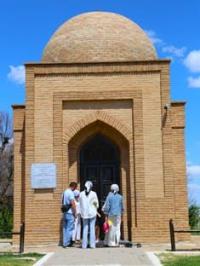
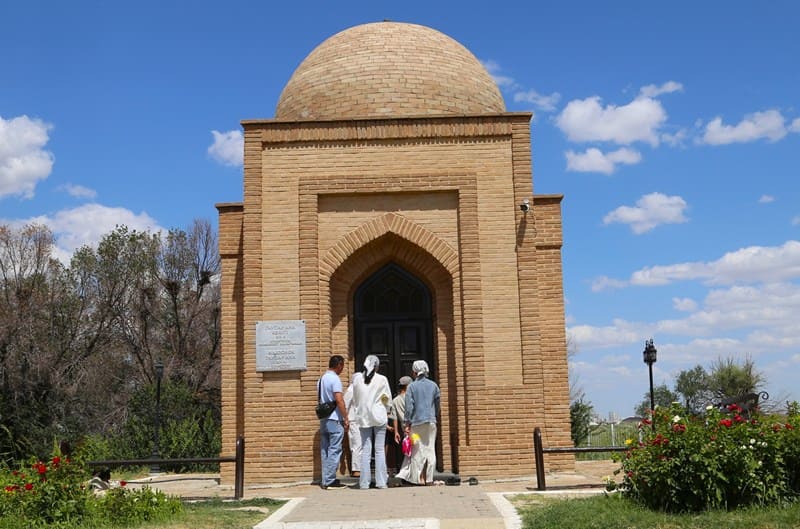
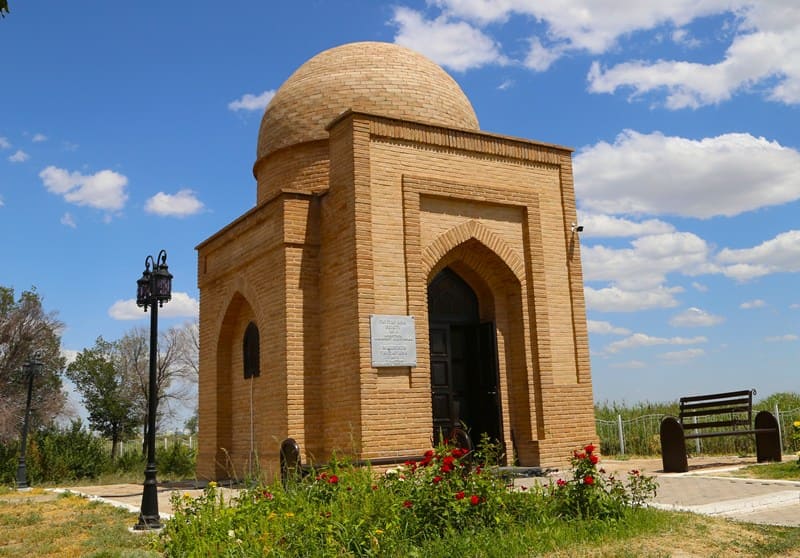
Gaukhar ana mausoleum.
Central Asia and Shymkent tours.
“Sheikh Ibrahim had two sons - Sadr Sheikh and Ahmed Kozha. Sadr Sheikh had sons: Abd al-Malik (Ali Kozha ata) and Danyshmand (Oryn Koilaky). Ahmed Kozha (Yassavi) had a son - Ibrahim Sheikh (Nauryz Kozha) and a daughter named Gauhar Khushtaj. Ahmed Kozha married his daughter Gauhar to Abd al-Malik, and they had their only son, Sadan Kozha.”
Historian Safi ad-din Oryn-Koylaky. “Osiet-name.” First half of the XIIIth century 1230.
Exclusive tours in Shymkent to Turkestan.
The Gauhar Ana Mausoleum – the shrine of Khoja Akhmed Yasawi's daughter
A few kilometers southeast of ancient Turkestan, amidst the flat steppe plain, stands a small mausoleum, venerated by generations of pilgrims as the resting place of Gauhar Ana, the daughter of the great Sufi thinker, poet, and spiritual mentor of the Turkic world, Khoja Akhmed Yasawi.
Despite its relatively modest size, this shrine occupies a special place among the monuments of the "Aziret Sultan" National Historical and Cultural Museum-Reserve, being one of the most revered sites of Turkestan's spiritual heritage. For centuries, people have come here not only to honor the memory of the great sheikh's daughter, but also in the hope of finding healing, peace of mind, and blessings.
Therefore, the Gauhar Ana Mausoleum is not just an architectural monument, but one of the centers of the folk religious tradition of Southern Kazakhstan.
Geographical location of the Gauhar Ana Mausoleum.
The Gauhar Ana Mausoleum is located at an altitude of 206 m. a. s. l., 758 meters east of the Turkestan-Shaulder highway. It is approximately 4.1 kilometers southeast of the Khoja Akhmed Yasawi Mausoleum, 2.4 kilometers north of the ancient settlement of Shaitobe, and 6.3 kilometers northwest of the village of Shoitobe.
The monument is part of the "Aziret Sultan" National Historical and Cultural Museum-Reserve and is located within the Turkestan city.
The surrounding landscape is the gently rolling plain of the middle reaches of the Syr Darya River. An arid, sharply continental climate prevails here, and the natural vegetation consists of wormwood-grass steppes and semi-desert communities.
It is in this open space that the ancient mausoleums, which for centuries served as landmarks for caravans and pilgrims, stand out particularly vividly.
Gaukhar Ana is the daughter of the great Khoja Akhmed Yasawi.
Historical information about the life of Gaukhar Ana is extremely sparse. To this day, the exact dates of her birth and death have not been established, but folk memory has preserved her image as a pious woman who dedicated her life to serving people.
In many legends, she is depicted as continuing her father's spiritual path. According to popular belief, Gaukhar Ana possessed amazing compassion for people, helped the sick, supported those in need, and was highly respected among the residents of the Turkestan oasis.
For this reason, after her death, her name gradually acquired special veneration.
History of the Gaukhar Ana Mausoleum.
According to available information, the original mausoleum differed significantly from the modern structure. The old mausoleum was a brick structure without a ceiling, consisting of four walls. Nearby was a small three-room chamber intended to accommodate pilgrims visiting the shrine.
In its architectural features, the mausoleum resembled the famous tomb of Rabia Sultan Begim, indicating the preservation of Timurid architectural traditions in late medieval Turkestan. Over time, the ancient structure gradually fell into disrepair.
In 2014-2015, at the initiative of the Aziret Sultan National Museum-Reserve, specialists from the Kazrestavratsiya State Enterprise erected the modern mausoleum. The reconstruction project was carried out by Turkestan architect Zhumakhan Zhylysbayev, who used the memoirs of renowned researcher Orazbek Dastanov, who saw the original mausoleum in the 1930s.
Thus, the modern mausoleum is a scientific reconstruction of the historical monument.
Architectural features of the Gauhar Ana Mausoleum.
The modern building is constructed of fired brick in the traditions of medieval architecture in southern Kazakhstan. The design sought to preserve the composition of the old mausoleum as much as possible, based on the available information and archival materials.
Despite the reconstruction, the mausoleum fits harmoniously into the historical ensemble of the surrounding area of Turkestan and continues the traditions of the local architectural school, which dates back to the time of Timur.
Legends of Gauhar Ana.
Numerous folk tales are associated with the name of Gauhar Ana. One of the most authoritative written sources is the "Nasab-nama," which contains the genealogy of the Kazakh Khojas. The manuscripts known today from the 15th and 16th centuries are later copies of the earlier work of Safi ad-din Oryn-Koylaki, the "Osiet-name," and are represented by several editions.
According to one of the most famous legends, Gauhar Ana wished to be buried where the blood of her brother Ibrahim was shed. Tradition relates that Ibrahim once drank water from a well without asking its owner's permission. For this seemingly insignificant act, he was killed.
Shocked by the tragedy, his sister bequeathed a burial near the site of his death, so that her brother's memory would forever be preserved.
There is another beautiful legend about Gauhar Ana.
They say that Gauhar Ana had no children of her own.
However, her father told her:
- "Every person to whom you restored health and hope becomes your spiritual child."
Therefore, many generations of Turkestan residents called her the mother of all who suffer. According to the recollections of the long-time director of the museum-reserve, Orazbek Dastanov, the people firmly believed in her extraordinary gift of healing.
This belief explains the continuous flow of pilgrims, which continued even during the years when the mausoleum was in a dilapidated state.
Healing well near the Gauhar Ana mausoleum.
An ancient well located next to the mausoleum occupied a special place. According to popular belief, its water possessed healing properties. Women have long come here hoping to find health, family happiness, and prosperity. During the pilgrimage, the custom of washing themselves with water from the well has been preserved, symbolizing spiritual and physical cleansing.
Similar sacred springs are known at many Sufi shrines in Central Asia, where water is considered a symbol of the Almighty's mercy and spiritual renewal.
Archaeological research at the Gauhar Ana Mausoleum.
Since the late XXth century, the mausoleum has been under state protection. In 1989, it was included among the monuments of the Aziret Sultan Museum-Reserve. In 2011, the museum-reserve staff conducted archaeological research, which allowed them to clarify the features of the original structure and collect materials for further study of the monument's history.
Since 2019, the Gauhar Ana Mausoleum has been officially included in the list of historical and cultural monuments of Kazakhstan of national significance.
Tourist and pilgrim information for visiting the Gauhar Ana mausoleum.
The Gauhar Ana Mausoleum is a must-see when exploring the historical monuments of Turkestan. The most convenient route starts from the architectural complex of Khoja Ahmed Yasawi and continues to the nearby ancient settlements and holy sites.
A visit to the mausoleum not only allows one to learn about the family history of the great Sufi but also to better understand the spiritual atmosphere of medieval Turkestan, which for centuries remained one of the most important religious centers of Central Asia.
The Significance of the Gauhar Ana Mausoleum
The Gauhar Ana Mausoleum is not only an architectural monument but also a symbol of the continuity of spiritual traditions associated with the name of Khoja Ahmed Yasawi. It recalls the role of women in the history of Sufi culture, the popular memory that has preserved the names of righteous figures for centuries, and the continuity of Turkestan's pilgrimage traditions.
Even today, people come here, for whom this place remains a source of spiritual solace and hope, and the quiet steppe around the mausoleum seems to preserve the memory of events from the distant past.
Geographical coordinates of the Gauhar-ana Mausoleum: N43°15'45 E68°17'10
References:
Tyyaqbaev M., Oeserov T., Musabaev K., Kumiysbaeva U. Report on archaeological excavations at the Gauhar-ana Mausoleum conducted in May 2011. Turkestan, 2011. Archive of the Department of Archaeology and Monument Protection.
Gaukhar-ana Mausoleum. Encyclopedia "Turkestan", Vol. I. Astana, 2023. P. 54.
Gaukhar-ana Mausoleum, 12th-14th centuries. Encyclopedia "Azіret Sultan", Vol. I. Turkestan, 2021, pp. 105-106.
Gaukhar-ana Monument, XIIth-XIVth centuries. Historical and Cultural Monuments of the Turkestan Region. Almaty, 2016, pp. 116-117.
Islamization and Sacred Genealogies in Central Asia. Almaty, 2008.
Zhandarbek Z. Versions of "Nasab-nama" and Turkic History. Almaty, 2002.
Gaukhar-ana. Turkestan - the Cradle of Spirituality. Lingvo-Regional Studies Encyclopedia. Nur-Sultan, 2019, pp. 126-127.
Authority:
Alexander Petrov.
http://azretsultan.kz/rus/mavzolej-gau-ar-ana-hii-hiv-vv/
Photos by:
Alexander Petrov.
Authority and photos:
http://azretsultan.kz/rus/mavzolej-gau-ar-ana-hii-hiv-vv/