




You are here
Sacred heart of Turkestan is mausoleum of Akhmed Yasawi.
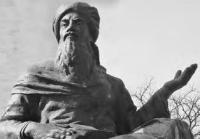
Fazlallah ibn Ruzbihan Isfahani. "Mihman-name-yi Bukhara" ("Notes of a Bukharan Guest"). XVIth century.
"...in Turkestan, at the grave of the holy Khoja Akhmed Yasawi, according to our tradition, the Surah Fatiha was recited, and I was elevated to the khanate..."
A detailed letter to Catherine II from Ablai. 1771.
"...in Turkestan, where our holy Hazrat Khoja Akhmed Yasawi died, the Fatiha was recited over his grave, and I was elevated to the khanate."
Letter from Ablai Khan to Orenburg Governor N.A. Reinsdorf. 1779
Landmarks of Akhmed Yasawi architectural complex.
Khoja Ahmed Yasawi Mausoleum is a unique XIVth-century architectural monument erected in Central Asia. This structure is not only a religious center but also a meeting point of architectural, historical, cultural, and spiritual traditions. Many pages in the works of historians, geographers, travelers, orientalists, archaeologists, and architectural scholars are devoted to the biography of Khoja Ahmed Yasawi, as well as descriptions of his mausoleum.
According to historical records, the mausoleum was built by order of Amir Temir in 1397, and construction continued for several years. It is known that many other structures erected by Temir in Central Asia eventually collapsed, and only ruins remain today.
However, the Khoja Ahmed Yasawi Mausoleum in the city of Turkestan has retained its original structure and remains a true testament to medieval architecture. The eminent XVIth-century historian Fazlallah ibn Ruzbihan Isfahani, in his work "Mihman-name-yi Bukhara" ("Notes of a Bukhara Guest"), praised this structure highly.
He described the mausoleum of Khoja Ahmed Yasawi as "one of the greatest buildings ever created in the world and one of the marvelous creations of humanity." At the beginning of the 20th century, one of the first to scientifically study the mausoleum was the Soviet scholar M.E. Masson.
In his works, he called this monument "an unparalleled architectural structure in Central Asia" and praised it as "a unique, original building." The mausoleum is an architectural ensemble consisting of thirty-four distinct rooms. These rooms were intended for religious and economic purposes: a library, a dining room, a mosque, a mausoleum, a room with a well, and more.
The structure reaches a height of thirty-nine meters, comparable to a modern multi-story building, and its main dome is considered one of the largest in Central Asia. One of the key aspects of the mausoleum's uniqueness is the preservation of its artistic objects, created by XIVth-XVth-century masters.
Among them is a huge cauldron, the Taikazan, a gift from Tamerlane and cast from seven precious metals, as well as bronze candlesticks, carved doors, and ancient standards. The Taikazan is considered particularly valuable, being not only a religious symbol but also an outstanding example of medieval foundry art.
The Taikazan is a symbol of unity, abundance, peace, and happiness. The renowned architectural researcher L. Yu. Mankovskaya called this architectural complex a "city of monuments," aptly reflecting its scale and structural complexity. The mausoleum's value lies not only in its interior design and decorative elements, but also in the space in which it is located.
The city of Turkestan is one of the most ancient cultural and historical centers of the region. Surrounding the mausoleum are the XIIth-century underground Khilvet Mosque, Chilyakhana, the Rabia Sultan Begim Mausoleum, a XVIth-century medieval bathhouse, and other archaeological sites, further emphasizing the historical significance of the area.
Turkestan was the capital of the Kazakh Khanate. The region of Turkestan, that is, the middle reaches of the Syr Darya, finally became part of the Kazakh Khanate (1470-1847) at the end of the 16th century. This region was typically subordinate to the Turkic states that dominated the Great Steppe.
The leading orientalist V.V. Bartold wrote: "The territory of Turkestan was under the rule of the Turkic states for centuries." The first Kazakh khan to make Turkestan his capital was Yesim Khan (1598-1614; 1627-1628). The Khiva khan and renowned historian Abilgazy noted that he personally resided at Yesim Khan's headquarters for three months.
One of the Kazakh khans who ruled Turkestan was Tursun Muhammad (1613-1627). The orientalist P. Lerch, who visited this region in 1867, reports that among fifteen documents kept by the descendants of Khoja Ahmed Yasawi, he saw a yarlyk of Tursun Khan from 1035 AH (1625-1626).
In Turkestan, the Kazakh khans received foreign ambassadors. Russian sources note that on July 22, 1694, Tauke Khan (1652-1717) received a Russian embassy. From 1719 to 1724, the ruler of the Kazakh lands, Abulkhair Khan (1718-1748), made Turkestan his capital. In 1724, he liberated the city from the Kalmaks, and in early 1725, yielding to superior enemy forces, he was forced to abandon the southern regions. Kazakhstan.
Historian I.V. Erofeeva wrote about this in detail in her article "Kazakh Khans and Khan Dynasties in the 18th-19th Centuries." Solemn ceremonies for the election of Kazakh khans were held in Turkestan.
For example, the election of Abylai in 1771 is described in detail in sources:
"...in Turkestan, at the grave of the holy Khoja Ahmed Yasawi, according to our tradition, the Surah Fatiha was recited, and I was elevated to the khanate..."
Therefore, the mausoleum of Khoja Ahmed Yasawi became a crucial site for the legitimization of supreme power. Turkestan was also a center of religious education. Schools and madrassas, listed in the works of Abd al-Gafur Turkistani, operated there.
Some of Khan Qayip's charters contain the signatures of the servants of the Khoja Ahmed Yasawi mausoleum, confirming their important role in the political and religious life of the region. Throughout history, the high status of the city of Turkestan has been inextricably linked with the name of the Sultan of Saints, Khoja Ahmed Yasawi.
He was popularly known by various names: Khoja Ahmed, Azret Sultan, Pir-i Turkistan, Sultan-ul-Arifin, Ata Yasawi, and others. The years of Ahmed Yasawi's birth and death have not been precisely established. Most modern studies place his death in 1166-1167, but several XVIth-century sources date the Sultan of Saints' death to 1120.
His year of birth also varies: 1093, 1103, 1105, or 1107. Early sources cite two versions of Yasavi's birthplace: one is that he was born in Sairam and moved to Iasi in his youth; another is that he was born and died in Iasi. Living in an urban cultural environment, he spoke both Persian and Turkic.
According to genealogical data, Akhmed Yasawi belonged to the descendants of the Prophet Muhammad through the line of Hazrat Ali. His ancestor was considered to be Ishaq Bab, one of the first spreaders of Islam in the Syr Darya region. Traditions say that his father was Ibrahim, his grandfather was Mahmud, and his great-grandfather was Iftikhar.
It is mentioned that his father held the position of tax collector. Akhmed's mother was Aisha Khatun, the daughter of Sheikh Musa, while popularly known as Karashash Ana. The graves of Yasawi's parents are in Sayram. Sources from the XIVth century also mention his brother, Sadyr Sheikh, and Khazini reports a sister whom Akhmed raised after their father's death.
Sources about the life of Khoja Ahmed Yasawi are extremely scarce, and those that exist are often contradictory. This is due to the rivalry between later Sufi brotherhoods, which sought to appropriate the spiritual authority of the Sultan of Saints, include him in their silsila, or establish family ties.
Some of these legends became so ingrained that they came to be accepted as reliable facts. For example, virtually all early sources claimed that Yasawi was a student of Yusuf al-Hamadani. According to established opinion, he was considered the third of Yusuf al-Hamadani's four main disciples.
In Yasawi's hikmats, folk tales also name him as a student of Arslan Baba (Arystan Baba). According to legend, Arslan Baba, who lived an unusually long life, gave the young Ahmed a date entrusted by the Prophet - a spiritual symbol of knowledge.
Many scholars have been critical of the reference to Arslan Baba's 340-year lifespan, but Islamic tradition is rich in stories of long-lived individuals - "mu'ammarun." The transmission of the date to Yasawi should be understood metaphorically - as a symbol of the transmission of spiritual knowledge.
Oral traditions also say that Yasawi was engaged in wood carving (making wooden spoons) and hunting. The latter is confirmed in the hikmats of Suleiman Bakyrgani. Over time, this developed into a Sufi tradition, and followers - "kusshy" - are known to have hunted with falcons. Beginning in the XVIth century, legends of Yasawi's miraculous deeds appeared in written traditions, sparked by controversy between various Sufi orders.
It was said that he leveled hills with the power of knowledge, transformed enemies into animals, and so on. After the death of Khoja Ahmed Yasawi, his body was buried in Iasi, and a mausoleum was erected over his grave. The modern mausoleum was built on the site of his burial.
The Sufi poet Khoja Ahmed Yasavi was highly respected among the region's Muslims, exerting a significant influence on Islam in Central Asia. A settlement of Sufis, who considered themselves his descendants, formed around him. Over the centuries, thousands of pilgrims from around the world have visited this site.
The history of the mausoleum is closely linked with the name of the Great Emir Timur. Having established a vast empire, he patronized Sufi movements. It was by his order that a grand architectural complex, including a mosque, madrasah, mausoleum, and auxiliary buildings, was erected on the site of the old mazar.
This became one of the largest construction projects of the era. According to Sharif ad-Din Yazdi, in 1397, Timur, en route to Tashkent, visited Yasy and ordered the construction of a magnificent mausoleum to replace the old tomb. There's a popular legend about this construction: supposedly, a black bull repeatedly destroyed the walls under construction until Timur was told in a dream to first build the Arystan Baba mausoleum.
Only then did the construction succeed. Both religious beliefs and political goals were at play. By erecting a mausoleum on the grave of a respected figure, he asserted his authority and strengthened his prestige. Some historians believe that Tamerlane personally participated in the design of the future mausoleum.
For example, he is said to have determined the building's basic dimensions, in particular the diameter of the large dome (41 kez, circumference 131 kez), and entrusted construction management to Ubaydullah Sadyr. Kozha Hasan and Shams-i Abd al-Wahhab were also mentioned among the master craftsmen.
Furthermore, Tamerlane's decree contained recommendations regarding certain decorative details of the building and its interior decoration. The waqf deed listed the lands and canals that provided income for the building's maintenance and the salaries of the clergy.
Mirali-Kozha, a descendant of Yasawi's brother, was appointed the first abbot, and Hazret Dervish-Ali was appointed the muezzin. The production of bricks for the mausoleum was a complex technological process: clay mortar, thoroughly washed to remove salts, was kept all winter, then mixed with straw, felt, wool, and reeds.
The bricks were dried and fired at a temperature of 1000-1100°C. Many bricks retain the handprints of the craftsmen. In the XVIIIth century, the Yasawi Mausoleum remained the burial place of the most prominent figures of the Kazakh Khanate. Tauke Khan (1680-1715), Zholbarys Khan (1720-1740), and Abilmambet Khan (1739-1771) were buried here.
A separate mausoleum was built for Yesim Khan next to the main building. The only fully explored burial inside the mausoleum was that of Ablai Khan (1771-1781). Archaeological and anthropological data confirmed the authenticity of this burial. O. Smagulov and M. Kozhayev wrote about this in their "Historical and Anthropological Study."
The mausoleum began functioning as a museum in 1978. In 1989, it was renamed "Aziret Sultan" and the State Historical and Cultural Museum-Reserve. By the end of 2024, by decree of the President of the Republic of Kazakhstan, it was renamed the "Aziret Sultan" National Historical and Cultural Museum-Reserve, which includes more than twenty historical monuments.
Throughout history, the high status of the city of Turkestan has been inextricably linked with the name of the Sultan of Saints – Khoja Ahmed Yasawi. Today, the mausoleum is one of the most significant and well-preserved structures of that era. Recognized as an outstanding example of medieval Islamic architecture, the mausoleum became the first site from Kazakhstan to be inscribed on the UNESCO World Heritage List in 2003.
This status confirms its significance as a common heritage of all human civilization. For centuries, the Khoja Akhmed Yasawi Mausoleum has remained the sacred center of the Turkic world. This majestic structure embodies the spiritual tradition, artistic taste, and worldview of an entire civilization.
True beauty does not emerge by itself - it must be seen with the eyes and felt with the heart. In conclusion, it can be said that the Khoja Akhmed Yasawi Mausoleum is a treasure that defines the spiritual identity and cultural code of the Kazakh people.
It is not simply an architectural structure, but a sacred center reflecting the historical memory of the nation.
Authority and photographs by:
Kunsulu Asetova, researcher at the Scientific Center for Yasawi Studies, National Historical and Cultural Museum-Reserve "Aziret Sultan."
https://prostor-zhurnal.kz/wp-content/uploads/2026/02