




Вы здесь
Sholak mountains.
Bird Watching Tours in Altyn-Emel Park.
“In nature, everything is wisely thought out and arranged, everyone should do his own thing, and in this wisdom - the highest justice of life”
Leonardo da Vinci.
Photos Altyn-Emel Park.
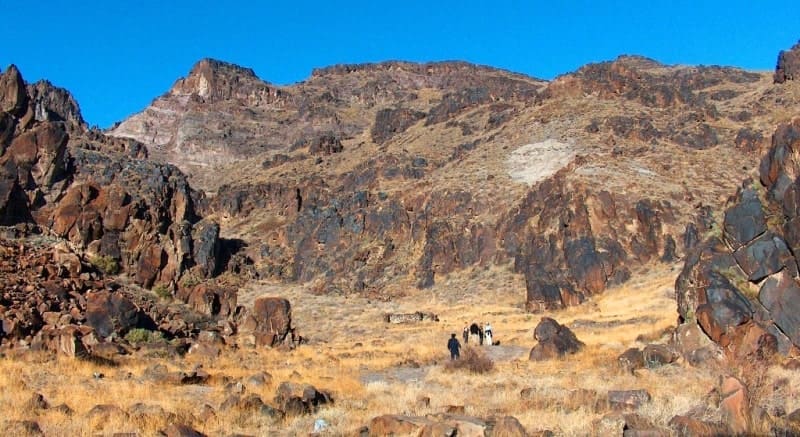
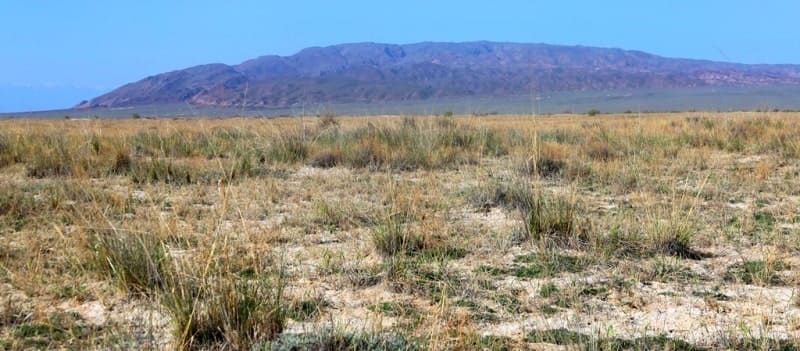
Sholak Mountains (Chulaktau, Chulakskie) are located at an altitude of 793 to 1628 m. a. s. l., are located on northern coast of Kapshagai reservoir, administrative border of Zhetysu and Almaty regions divides mountains almost in half, western part of mountains is subordinate to tosn administration of town of Konaev, eastern part is subordinate to Panfilov district of Zhetysu region.
The mountains are the westernmost spurs of the Altyn-Emel ridge, located in the foothills of the Dzhungar Alatau. The southern slopes of the Sholak mountain range, starting from the Taigak gorge and further to the east, are located on the territory of the Altyn-Emel National Natural Park.
The Sholak Mountains are the beginning of the Altyn-Emel mountain range, which stretches from southwest to northeast, consisting of several mountain ranges - Degeres, Matai, Orikty, Altyn-Emel, Bugul, Koyandy and Suat-Tau. In the west, the Sholak Mountains border on the Itzhon Plateau, in the north, on the sublatitudinal Arharly Range.
In the eastern part, the mountains are adjacent to the Degeres Mountains. The dominant landmark in the southeastern part of the mountains is Mount Sholak, 1628.5 m. a. s. l., located between the Taigak and Kyzylaus rivers. Four kilometers north of Mount Sholak is the second highest peak - Kyzylsoran, 1548.5 m. a. s. l.
The western part is dominated by an unnamed peak 1101.4 m. a. s. l. The length of the Sholak Mountains, from west to east, is 42 kilometers, the greatest width, from south to north, is 25 kilometers.The hydrography of the mountains is represented by a small number of seasonal rivers and watercourses with extensive channels with flow into the Kapshagai reservoir, these are the river beds of Kyzylauz, Taigak, Teriktysay, Sholakzhide and Monshasay.
The Sholak Mountains are composed of effusive and granitoid deposits of the Carboniferous, which are 300 million years old, the deposits are represented mainly by volcanics, Permian and Carboniferous deposits, and the most ancient deposits are Silurian. Most of the rocks are mainly Paleozoic rocks, which are between 200 and 400 million years old.
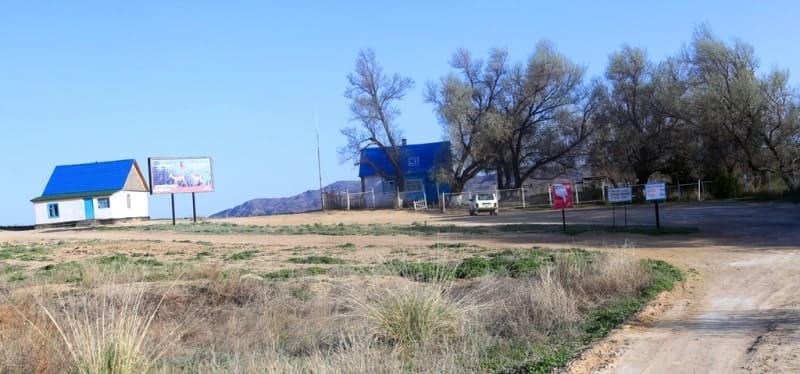
To the north, the following watercourses flow onto the Itzhon plateau: Karashoki, Zhideli, Kusain-Sai, Taldy. At the beginning of the Taigak gorge, 4 kilometers northwest of the Kapshagai reservoir, there is the westernmost cordon No. 1 of the Altyn-Emel park and the visitor center of the park of the same name.
On the territory of the visitor center there are 5 guest houses, two yurts, a large camping site, a cafe, and an observation deck. The length of the mountain range encircling the Altyn-Emel natural park from the north is 182 kilometers, the greatest width in the eastern part is 23 kilometers.
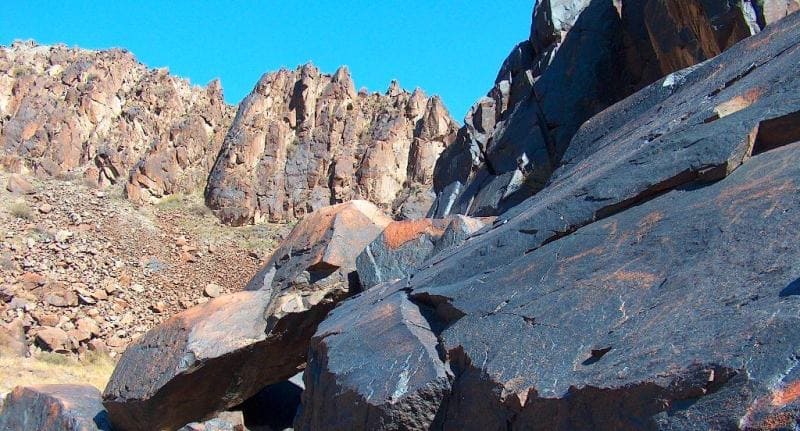
On the southern side of the Sholak Mountains there are several gorges that are natural, archaeological and historical-cultural attractions: Zholak-Zhide, Taigak, Terikty-Sai, Kyzylauz and Sary-Bastau. In the Taigak gorge there are rare images of two elephants, as well as Buddhist inscriptions, the main meaning of which is contained in the universal prayer formula - “Om mani padme hum”.
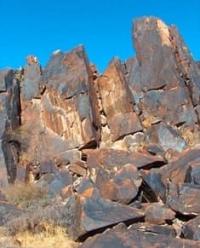
Their appearance is associated with the beginning of the spread of Buddhism among nomads. In the Tirekty-Sai gorge there are rock paintings from the Bronze Age that depict scenes of hunting, wild and domestic animals, rituals, as well as sun-headed deities.
Geographic coordinates of Sholak Mountains: N43°58'08 E77°52'32
Authority and photos:
Alexander Petrov.