





You are here
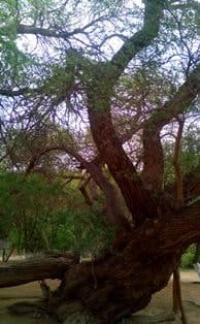
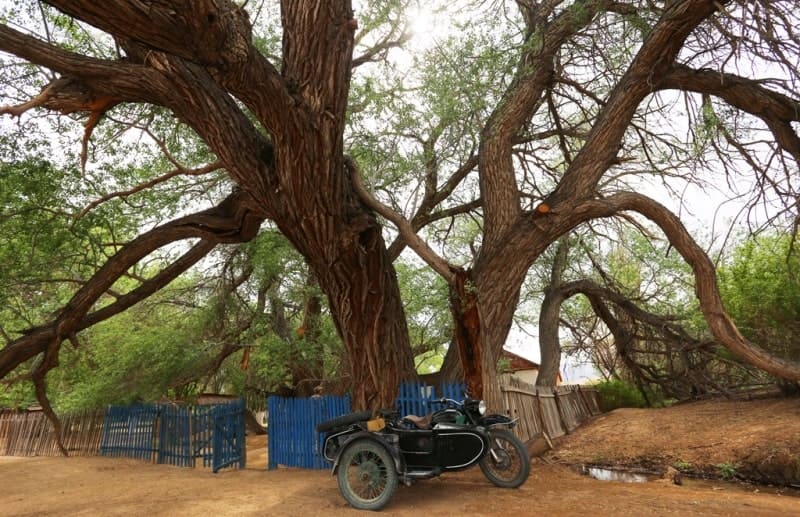
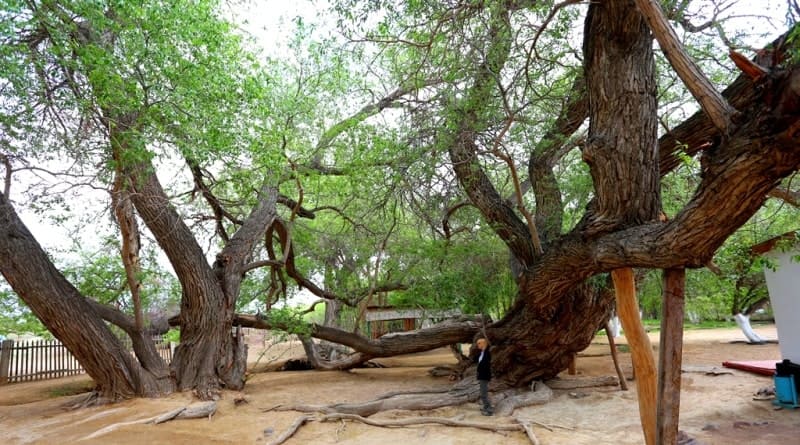
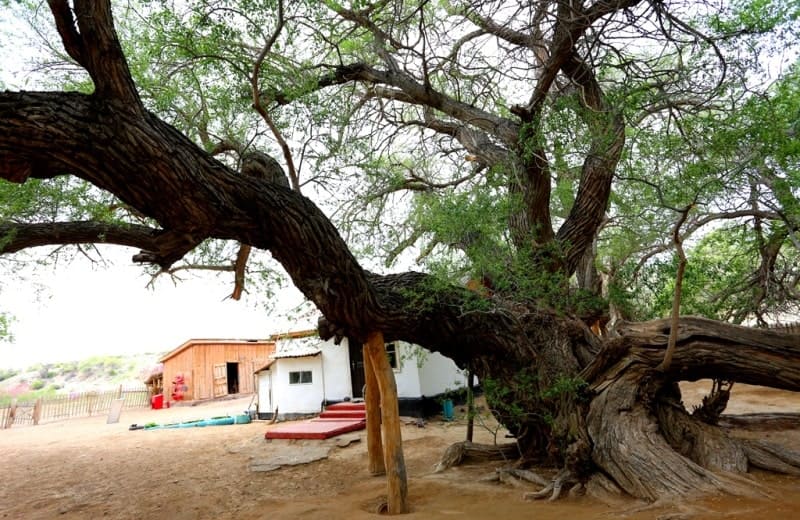
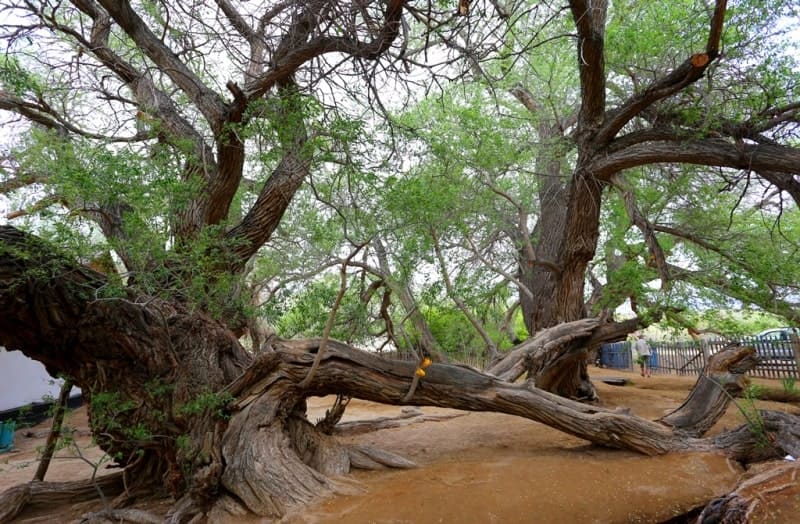
A 700-year-old willow at Kosbastau cordon.
Ecological tours in national parks of Kazakhstan.
"These gray-haired, knobby, low-browed, with twisted joints, bent, crooked, enormous, amazing, long-armed, deformed, hunchbacked, ugly old oaks stand, wait, and watch, century after century."
F. Kilvert. England.
Photo tours in parks and reserves Kazakhstan.
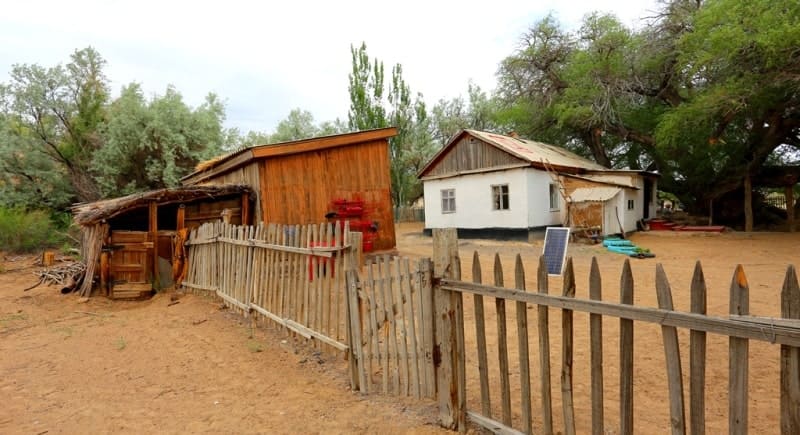
Willow grows at an altitude of 594 m. a. s. l. It is located between Zhelbulak and Zhalandybulak tracts to west and Tonerek and Samasha to east, 8.6 kilometers from right bank of Ili River, 574 meters from abandoned Korzhantai geological exploration party, and next to Kosbastau ranger cordon, named after Kosbastau spring in Altyn-Emel Park in Kerbulak district of Zhetysu region.
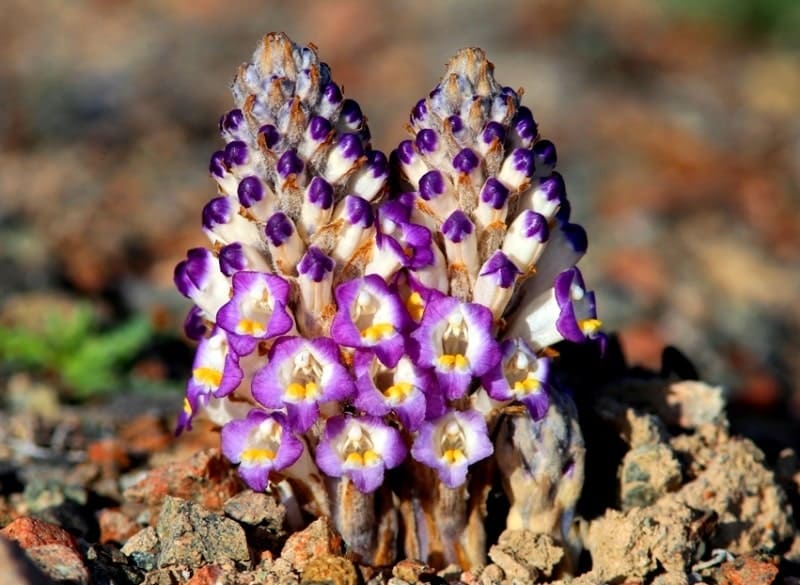
The Kosbastau tract is a unique natural oasis formed at the site of a groundwater outflow. Geographically, it adjoins the floodplain terraces of the Ili River. The arid climate here has created a unique clay desert with constant subsoil moisture, resulting in a rich local flora.
The center of the oasis is a small picturesque pond surrounded by dense riparian (floodplain) vegetation. Typical species of the Semirechye river valleys grow here: relict turanga poplar, jida, tamarisk, Ili barberry, nitrate, chia, chingil, and southern reed.
The main attraction of Kosbastau is a group of ancient trees. The largest of them is a giant willow, 20 meters tall and with a trunk girth of 15 meters. This tree is estimated to be approximately 700 years old. It is safe to assume that this tree is sacred, for its testimony to past centuries.
Old trees, like old people, become ill and age, requiring attention and care. This is an ancient and unique specimen of a tree that has reached its venerable age and deserves protection from an aesthetic, scientific, and environmental perspective.
In the culture of the peoples of Central Asia, such aksakal trees have long been considered sacred. The cult of veneration for old trees precludes any harm to them, which is why this natural monument has survived to this day. Perhaps the willow's age is influenced by the unique chemical composition of its water (the water source is near the Kosbastau cordon), which has slowed the aging and decay processes of the wood.
Authority:
https://altynemel.kz
Alexander Petrov.
Regarding age of willow (700 years?) in Kosbastau tract of Altyn-Emel Park.
Here, a classic contradiction arises between biological norms and the official status of a particular tourist attraction. From a dendrological perspective, willow (Salix) is a soft-leaved, fast-growing tree. Under normal conditions, its wood begins to rot from the inside out by the age of 60-80, and by 100-150 years, the tree is physically destroyed.
The "700 years" figure for Altyn-Emel is not the result of radiocarbon dating or ring counting (it is impossible to take a core sample from such an old willow, as it is most likely hollow inside). In the 1960s, a group of geologists from the Kazakh SSR (the exploration party's settlement was located 574 meters northeast of the willow, now ruins) recorded the tree's gigantic size during an initial "by eye" description of the willow in the Kosbastau tract.
Based on the trunk's girth reaching almost 15 meters, an age of approximately 700 years was calculated using standard growth formulas (diameter - annual increment). In modern site passports, the 700-year figure is recorded as an "approximate age."
In the park's dendrological maps, the tree is listed as a "unique long-liver." There is a theory that this is not a single trunk, but a fused group of shoots or The result of the tree repeatedly "self-rejuvenating" (old trunks falling and giving rise to new ones from the same root system). In documents, this may appear as the age of a single organism, rather than a specific trunk.
In the "Annals of Nature" of the national park, the age of 700 years is most likely stated as a historical and biological fact. However, dendrologists admit that this is more likely an anomaly or a scientific assumption that has become part of the park's brand.
Perhaps the willow's age is influenced by the special chemical composition of the water (the water source is near the Kosbastau cordon), which slowed the aging and decay processes of the wood. In the official "Annals of Nature" of the national park, the age of 700 years is stated as a historical and biological fact.
However, professional dendrologists would admit that this is more likely an anomaly or a scientific assumption that has become part of the park's brand. The willow is listed as a specially protected natural area (SPNA) with the status of a scientific and educational site. and a nature conservation institution.
Information about it is contained in the Altyn-Emel State National Nature Park Passport, where its biological parameters are recorded (a height of approximately 20 meters, a huge trunk diameter that requires 8 people to encircle). To determine the willow's age, precise drilling (core sampling) is necessary, which can be traumatic for the tree.
I wonder if there is currently a single scientific document (drilling protocol or radiocarbon dating) that would confirm the tree's age at 700 years? In dendrology, willows rarely live longer than 150 years due to the fragility of their wood and the decay of their core.
Some botanical experts, in informal comments, have suggested that this is most likely a "family tree." Old willow branches, under their own weight, fall to the ground, take root, and produce new trunks. Thus, it could be a single genetic organism living for centuries, but a specific standing trunk is unlikely. It's more than 100-150 years old.
There's also a legend that Genghis Khan rested under a willow tree; this legend is purely a tourist trap. Biologically, this is impossible, as willows don't live that long, and Genghis Khan's army passed through this area at the beginning of the 13th century (more than 800 years ago).
A "700-year-old willow" is not a botanical object, but a recreational (tourist) one. For a botanist, this isn't a phenomenon; from a scientific perspective, it's an overgrown clump of willow (probably Salix alba or Salix caspica), which, through vegetative propagation and the constant influx of water from springs, has created a gigantic mass.
Biologists can't confirm the 700-year age, so they don't compromise it by including it in official scientific reports. To confirm such an age, dendrochronology (ring counting) is necessary. Willows of this size almost always have rotten pith, empty.
There's nothing to count, which means... There's no scientific evidence to support this. The park administration (RSU) is obligated to promote the site to attract tourists and meet visitor numbers. Therefore, the number "700" will appear in tour passports and on billboards, but not in scientific reports from institutes.
The willow in Kosbastau is a beautiful natural monument and a very old tree for its species (perhaps 100-120 years old), but the "700 years" and "Genghis Khan" tropes are pure marketing, lacking any biological documentation.
Authority:
Alexander Petrov.
Photos by:
Alexander Petrov.