




You are here
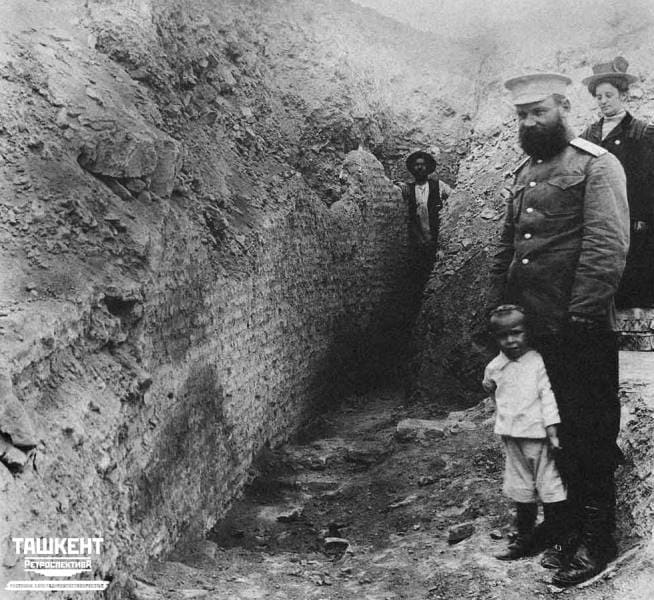
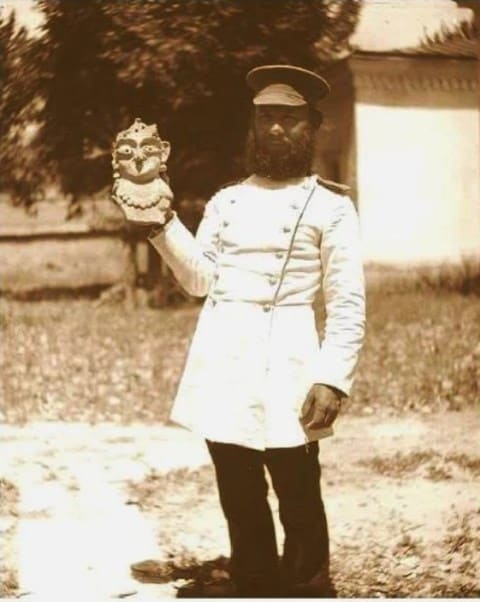
Archaeologist Vasily Vyalkin.
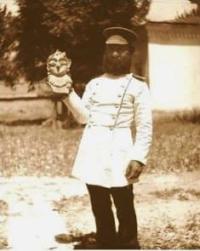
Curator of Samarkand Antiquities Vasily Vyalkin.
"Samarkand emerged in its present location after the Mongol invasion (13th century) and was surrounded by a city wall in 1369 by Emir Timur. Surrounded by gardens and vineyards, situated in a vast valley bordered on three sides by mountains and cut by irrigation canals, Samarkand, with its architectural monuments, was the most beautiful city in Central Asia, and its climate was pleasant. The founding of Samarkand is shrouded in poetic legends - according to one tradition, it was founded by Alexander the Great, according to another, by the Yemeni king Shamar, and so on. The names of the epic kings and heroes of Persia are associated with Samarkand. The most populous city between the Amu Darya and Syr Darya rivers, the brilliant capital of the world empire conquered by Timur, Samarkand is celebrated by poets and writers. "Samarkand rui zamanet" - Samarkand is the face of the earth. It is one of the most colorful cities of the Central Asian East.
V.L. Vyatkin. "Antique Monuments of Samarkand." 1927.
Historical Past of Samarkand.
V.L. Vyatkin was born on August 18, 1869, in the town of Verny in the Semirechye region, to a Cossack family. After graduating from the Tashkent Teachers' Seminary in 1894, he worked for a time as a teacher in Osh, where he began an intensive study of the history of Asian peoples.
After some time, he moved to Samarkand, a place he loved until the end of his life. Over time, the name V.L. Vyatkin's work became an integral part of the history of the study of Samarkand and its environs, the preservation and description of local monuments, and the collection of antiquities and oriental manuscripts.
Vasily Vyatkin's interest in local history led him to become a member of the Samarkand Regional Statistical Committee, founded in 1877. Subsequently, with his active participation, the "Museum of the Samarkand Statistical Committee" was opened in Samarkand on July 21, 1896.
V.L. Vyatkin's worldview was formed primarily under the influence of the Russian intelligentsia of Turkestan, as well as through his study of the works of great thinkers of Central Asia. Having sincerely fallen in love with the Turkestan region, its rich history, and its people, V.L. Vyatkin began to make every effort to develop historical science and education there.
Attaching great importance to the creation of public libraries – one of the fundamental factors in the development of education – in 1902, in a short article, he attempted to respond to a complaint from readers of the newspaper "Russkiy Turkestan" about the lack of a public library in the city of Samarkand:
"... In Samarkand, there was a need to build a museum... The military governor of the region, sympathizing with the cause of the public reading circle and the long-overdue need for a public library, at the beginning of last year (1901-F.Sh.) filed a petition with the governor-general for permission to construct a building for the museum at city funds, simultaneously requesting permission to build... a library building with a reading room and a hall for public readings.
Currently, the approval of the project and estimate is close to implementation, and we hope that the building will open during the upcoming construction season." 5
Most likely, V.L. Vyatkin contributed significantly to this project. In Samarkand, V.L. Vyatkin began by studying numerous waqf documents, gradually moving on to other written sources.
Here, it is appropriate to cite the following statement by V.A. Shishkin:
"The young Vyatkin, who had not received a specialized historical-oriental education, without any academic guidance, two years after arriving in Samarkand, began publishing a series of scholarly works that attest to his deep and comprehensive knowledge."6
Thus, the scholar's works on regional studies, such as "On the Historical Geography of the Tashkent Region"7 and "Materials for the Historical Geography of the Samarkand Vilayet"8, attracted the attention of the scientific community. These works were written using a large number of waqf documents, which were being introduced into scholarly circulation for the first time.
In particular, V.V. Bartold wrote about V.L. Vyatkin's article on the historical geography of the Samarkand Vilayet:
"Despite its relatively small size, V.L. Vyatkin's article, given the wealth of new material it contains, fully deserves to be called a major work." 9 V.L. Vyatkin repeatedly asserted that knowledge of and the ability to work with written sources is the most important task and should become "the fulcrum for Russian researchers" in the study of Central Asia.
He strongly criticized the increasing number of cases of manuscripts being purchased from private individuals and their mass export abroad. In particular, he wrote: "A person familiar with the texts..."
Anyone who has some knowledge of the local languages and wishes to study the past of our region in one way or another encounters a serious obstacle from the very first steps – the lack of a decent public collection of primary sources and raw materials in the region, which such a person would first have to work on, i.e., Eastern manuscripts.
Anyone capable of this, not intimidated by this obstacle, must either travel to St. Petersburg and Western Europe, where there are libraries of Eastern works.” 10
V.L. Vyatkin wrote with great regret about the export of rare and valuable manuscripts outside the region:
“The number of manuscripts is constantly decreasing in Turkestan; manuscripts are being energetically bought up for foreign libraries and individuals; their price is rising very quickly, since foreigners are generally not shy about prices... Practical study will, over time, give way to scientific, comprehensive, and profound study, and then the issue of collecting manuscripts will become even more pressing.
Not only in Islamic countries, which have historically been distinguished by a widespread literacy, but everywhere else, written monuments, reflecting both the external and internal life of the people, are the cornerstone of the study of the past - often the only source of our knowledge of this or that aspect of the people's historical life.
It is necessary to save those written treasures that still remain in the region from plunder by foreigners and acquire them for the Tashkent Public Library." 11
V.L. Vyatkin himself assembled a large collection of oriental manuscripts (273), which after his death entered the collections of the State Public Library. 12 Another branch of historical science - the study of historical topography - led him to archeology.
This was also facilitated by V.L. Vyatkin's fascination with the ancient architectural monuments of Samarkand, a love for which he retained until the end of his life. The historical monuments of one of the most ancient and beautiful cities of Central Asia – Samarkand - have always attracted and continue to attract the attention of those interested in the history of this region.
V.L. Vyatkin played a huge role in the study and preservation of Samarkand's material culture monuments. On April 18, 1903, V.L. Vyatkin was appointed caretaker of all Samarkand monuments "as a person studying the history of Central Asia from Muslim sources and, incidentally, questions concerning the history of architectural monuments, and, most importantly, as a person knowledgeable in the spoken and written language of the local peoples." 13
V.L. Vyatkin's responsibilities included overseeing the condition of the structures and organizing repairs. Wasting no time, he began his work in this field with a report addressed to the Military Governor of the Samarkand Region14 on the state of Samarkand's historical monuments, in which he raised the need to address "relevant petitions simultaneously to
1) the government,
2) the Samarkand City Economic Administration,
3) the Imperial Archaeological Commission, and
4) private philanthropy, requesting permission to open a subscription to replenish a special fund for the restoration and repair of ancient monuments in the city of Samarkand among the population of the Turkestan Region and the Bukhara Khanate."
"It seems to me," wrote V.L. Vyatkin, "that private charity, coupled with Muslims' responsiveness to matters related to 'sawab' (reward in the hereafter), which includes the maintenance of their sacred sites - ancient monuments - through the skillful dissemination of subscription lists among the population with the corresponding appeal through the administration and honorable, respected individuals, should yield favorable results." 15
A year earlier, in 1902, an article by V.L. Vyatkin appeared in print, lamenting the deplorable state of Samarkand monuments and calling on the authorities to take responsibility for their preservation.
It noted, in particular:
"We cannot but acknowledge that the responsibility for maintaining majestic ancient monuments, valuable in cultural and historical terms, regardless of whether they previously possessed a waqf land tax or not, but solely because of their significance for science, should rest with the government." 16
This suggests that V.L. Vyatkin considered all possible ways to raise funds for the preservation of Samarkand's monuments. V.L. Vyatkin saw his primary professional calling as studying the city's architectural monuments and caring for their preservation.
While serving as the caretaker of Samarkand's monuments, Vasily Lavrentyevich recorded and compiled a plan of the locations of all the monuments in Samarkand and its environs. He devoted all his time to carefully studying the sources in which they were mentioned.
This was facilitated by his knowledge of Eastern languages, the study of waqf documents, and constant communication with the local population. Thanks to this knowledge, he truly appreciated the cultural and the historical heritage of Turkestan, particularly Samarkand.
"Such a marvelous monument to the glorious past of Central Asia as the former Bibi Khanum Mosque, the most extensive and grandiose structure of the great commander Timur, corresponded to the overwhelming grandeur and power of its builder, into the creation of which the art and talent of the best masters of the time were invested.
However, this creation of Timur is rapidly moving towards final destruction.
In our opinion, the following most important ancient monuments in Samarkand deserve, above all, restoration and further maintenance: four madrassas, three of which surround Registan Square on three sides:
1) Mirza Ulugbek, built by the Samarkand ruler, Timur's grandson, the renowned astronomer and historian, after whom it bears its name, in 823 (1420);
2) Shir-dor and
3) Tilla-kari, ... and
4) another one, located at the Khoja Akhrar mazar, on the outskirts of the city, in the gardens, called the Nadir-divan-begi madrasah and built in 1040 (1630-1631).
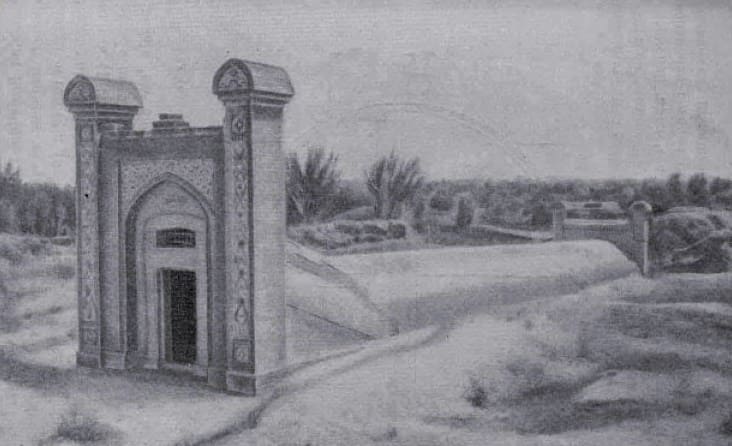
Timur's mausoleum (Gur-i-Amir), built shortly before his death, is among the remarkable structures of this sovereign, whose construction activity was concentrated mainly in Samarkand." 17.
In his article, deeply concerned about the state of Samarkand monuments, which require urgent restoration, Vasily Lavrentyevich was forced to sadly state:
"Time passes; "The silent witnesses of antiquity, which evoke in us delight and wonder, continue to decay and deteriorate: cracks widen, new fissures appear, cornices fall off, tiles crumble, bricks fall out, architectural lines are lost. The work of maintenance and restoration becomes more and more difficult year after year." 18
V.L. Vyatkin considered the theft of individual fragments of historical monuments, which subsequently ended up in museums and private collections abroad, to be vandalism. For example, in the 1880s, the French couple Uyfalvi, traveling through the cities of Turkestan to collect antiquities of historical value, while in Samarkand, hired a teenager, who still understands nothing, to remove colored tiles from the walls of historical monuments with a hatchet.
Afterwards, the tiles were placed in seven crates and taken to France.19 As evidence, we provide a facsimile of V.L. Vyatkin's report to the Military Governor of the Samarkand Region, dated April 21, 1905, 20 describing another instance of such vandalism - the nighttime removal by unknown individuals of a tiled inscription on the entrance door of the Gur-e-Emir mausoleum in Samarkand.
He considered the removal of tiles from the buildings of the Shakhi-Zinda complex by the tsarist administration for storage in the Stieglitz Museum in St. Petersburg to be an equally gross violation of Turkestani rights and cultural hypocrisy.
He wrote with indignation:
"What kind of feeling will this desecration of their sacred place, which attracts pilgrims daily even from remote places, evoke in Muslims? Do we have the right to evoke such feelings? "Finally, one will carry off the doors, another the tombstone, a third the facings from the domes of the buildings, a fourth will want to drag away Tamerlane's tomb, and this plundering will only end when there is nothing left to steal.
We hope that not only assistance, but even permission will not be granted for such a shameful act as the barbaric mutilation of the artistic heritage inherited from bygone times." 21
As the caretaker of Samarkand monuments, he maintained constant correspondence with administrative authorities year after year, requesting funding for the repair and restoration of this or that historic building. Not limiting himself to appealing to administrative authorities and without waiting for a response, V.L. Vyatkin also sought assistance from local entrepreneurs and artisans. 22
Another appeal from V.L. Vyatkin's work concerned the Mirzo Ulugbek Madrasah, the rescue and preservation of which has a long and multi-year history, and whose beginnings, as it turned out during the study of Vasily Vyatkin's personal collection, date back not to 1918, as M.E. Masson noted in his brochure 23, but to 1916.
As early as January 1916, V.L. Vyatkin, as the caretaker of Samarkand monuments, wrote a report to the Military Governor of the Samarkand region regarding the deteriorating condition of the Ulugbek Madrasah building in Samarkand 24.
In the report, he requested "to appoint a commission to inspect the minaret, which should determine the degree of stability of the minaret, the possibility of its actual preservation by means of some adaptations or the need to remove the top and to what height."
From the contents of this report it becomes clear that as early as 1916 the threat of the collapse of the north-eastern minaret of the Mirzo Ulugbek madrasah was discovered and already then V.L. Vyatkin sounded the alarm and He began to make efforts to preserve the historical monument, which now forms part of the unique, holistic picture of Registan Square in Samarkand.
Thanks to Vasily Lavrentyevich's exceptional knowledge of Samarkand, no historical research into this ancient city, otherwise known as the "face of the earth," or archaeological excavations, most of which were organized on his initiative, were carried out without his direct participation.
One of the scholar's primary archaeological sites was Afrasiab, in whose study he participated beginning in 1904 under the direction of V.V. Bartold, commissioned by the Russian Committee for the Study of Central and East Asia in Historical, Archaeological, Linguistic, and Ethnological Relation.
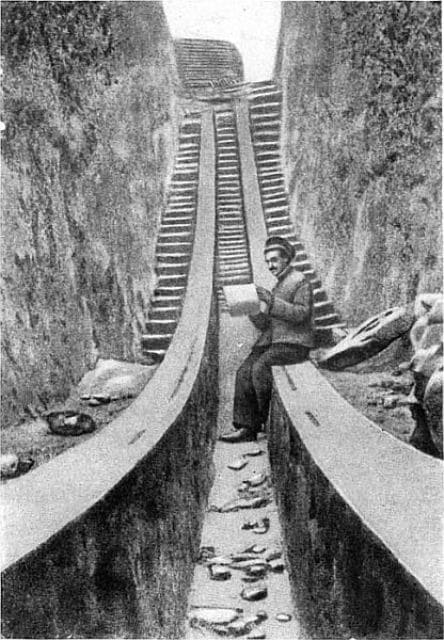
After V.V. Bartold's return to St. Petersburg, further excavations at Afrasiab were supervised by V.L. Vyatkin. The result of these many years of research was the work "Afrasiab – the ancient settlement of Samarkand" 25. However, the most significant achievement in all respects, which brought V.L. Vyatkin worldwide fame, was the search, discovery, and opening of the Mirza Ulugh Beg observatory, which was one of the greatest archaeological discoveries of the early XXth century.
He carefully collected and analyzed information about the observatory's location, about which he later wrote:
"Although the observatory built by Mirza Ulugh Beg in the vicinity of Samarkand is mentioned by many Muslim writers, and Mirza Babur even indicates its approximate location in his famous memoirs, until recently, despite the understandable interest in this historical monument, it was not known exactly where this, judging by the descriptions, grandiose structure was located" 26.
In 1908, V.L. Vyatkin, with the help of Abusaid, a well-known calligrapher from the Zargaron quarter (V.L. Vyatkin was renting an apartment from Abusaid at the time – F.Sh.), while sorting through a basket of waqf documents from the mid-XVIIth century, discovered the word "tal-i-rasad" (observatory) in one of them.
Although, since the late 19th century, various researchers had proposed different theories regarding the location of Mirzo Ulugh Beg's observatory, it was this waqf document, read by Vasily Lavrentyevich, that finally settled the matter. Having carefully studied the document, he determined the exact location of the observatory, now known as Naqsh-i-Jahan, near the Obi-Rahmat irrigation ditch.
"We owe the discovery of the observatory's location to a waqf document I discovered, written about 250 years ago. Among the land boundaries described, it listed the observatory's hill (tal-i-rasad) and the Abi Rahmat irrigation ditch and Naqsh-i-jahan area, now known by the same names.
This document provided such precise and specific indications of the observatory's location that finding the hill mentioned in the document in real life presented no difficulty," 28,
wrote V.L. Vyatkin in his report on the excavations of Mirzo Ulugh Beg's observatory, published in 1912.
After the establishment of Soviet power in Turkestan, V.L. Along with his other duties, Vyatkin continued his work on the protection of Samarkand's monuments and was elected chairman of Samkomstaris (the Samarkand Committee for Museums and the Protection of Ancient, Artistic, and Natural Monuments), which was part of Turkomstaris (the Committee for Museums and the Protection of Ancient, Artistic, and Natural Monuments of the Turkestan ASSR).
All researchers visiting Samarkand on archaeological, historical, and architectural expeditions, or for any other scientific purpose, first turned to Vasily Lavrentyevich Vyatkin, as he was a leading specialist in Samarkand's monuments. It was on his initiative that a commission was formed in 1918, including engineers M.F. Mauer and B.N. Kastalsky, to provide emergency assistance to the northeastern minaret of the madrasah, built in 1417-1420 by Mirzo Ulugh Beg.
The State Archives of the Republic of Uzbekistan, in the personal collection of V.L. Vyatkin, 30 contains numerous documents, minutes, letters, and appeals testifying to the incredible practical and scholarly efforts expended to preserve the present-day appearance of Registan Square in Samarkand during a difficult time for Uzbekistan.
As M.E. Masson wrote,
"The commission members were clearly aware that the famous Ulugh Beg Madrasah is a monument of great scientific and artistic significance, and that its main façade without one corner minaret would be unacceptably disfigured,"
as even without it, one of the madrasah's four minarets collapsed in 1870, and a little later, the second.
Almost every meeting of the commission, some of which took place right on Registan Square, was accompanied by heated debates over the urgent need to save and straighten the madrasah's minaret. The work was carried out between 1918 and 1932 and was successfully completed.
This was an unprecedented case in the world history of restoration practice. Along with his official duties and research work directly in Samarkand, V.L. Vyatkin was repeatedly sent by the Sredazkomstaris to various regions of Uzbekistan to conduct archaeological excavations and survey architectural monuments in the region, with full powers pertaining to his activities. 31
No matter where he worked, he always returned to his native Samarkand. According to one archival document, V.L. Vyatkin preferred to conduct most of his official and research work at home. In this regard, the Chairman of the Regional City Executive Committee signed a certificate allocating him additional living space in the amount of 20 square meters. 32
This tireless, versatile scholar was constantly engaged in scientific research. After the abolition of the predecessor of the Turkomstaris, the Sredazkomstaris, V.L. Vyatkin also served as the first chairman of the Uzkomstaris, located in Samarkand.
It is difficult to overestimate the role of V.L. Vyatkin's contribution to the study and preservation of Samarkand's priceless cultural monuments. Although he lacked specialized training, he excelled as a talented researcher, an excellent organizer, and a great enthusiast, selflessly passionate about his work.
For his discovery of the remains of Mirzo Ulugbek's observatory in 1908-1909, Vyatkin was rightfully awarded the Academician V.R. Rosen Gold Medal. But perhaps the most significant recognition of his work was the immense respect he commanded among the local population of Samarkand.
Vyatkin's character was quite unique.
For example, M.E. Masson, in one of his works, cites the recollections of N.P. Ostroumov:
"Buka" Vyatkin stubborn, somewhat unsociable, a great individualist. He doesn't want, like others, to share with him, Nikolai Petrovich, the tales, proverbs, and riddles he'd heard from the natives. He keeps everything to himself. Despite all this, he's extremely shy.
He's embarrassed that he doesn't know how to behave in society. But overall, he's a promising young man." 33
Recognizing the importance of knowing and being able to read primary sources for a thorough study of the history of Uzbekistan, V.L. Vyatkin wrote at the time:
"We will have to study the language and Arabic script, since we will always resort to primary sources, no matter how we illuminate historical facts. To write a history of culture, a history of everyday life, a history of society and social elements, it is nevertheless necessary to study the history of Central Asia in general. A historian must use all the material in general, and for this, he must be proficient in languages." 34
These statements by the scholar, however, are still relevant today.
While studying the inventory of M.E. Masson's personal collection, we discovered unpublished works by V.L. Vyatkin:
1) a typewritten scholarly work, "On the Study of Uzbeks in Central Asia." 16th Century," comprising 150 sheets;
2) a translation of the manuscript "Vasiqi Sijiyat and the Confirmation of Sales," comprising 513 sheets.
Perhaps the time will come when someone will be able to study and publish these works, as it's likely that few modern researchers know of them. In addition to his scholarly research, V.L. Vyatkin also taught. In particular, he was one of the first professors of history at Samarkand State University and an honorary member of the Academic Councils of the Central Asian State University in Tashkent (now the Mirzo Ulugbek National University of Uzbekistan) and the Oriental Institute.
Academician Yahya Gulyamov, recalling his student years in Samarkand, wrote:
"V. Vyatkin's lectures on the course 'History of the Muslim East' began. He delivered them, pacing from one end of the room to the other... He didn't look at his notes or the students. Selecting and focusing on just one point, he recited Farsi poems related to the topic...
At the very first lecture, he completely overturned my previous views, because in comparison to his knowledge, my knowledge of history seemed insignificant. He characterized the written sources he had studied from the 10th century, in particular the works of Muhammad Jarir al-Tabari, Muhammad Narshahi, and the later Ibn al-Athir, Juwayni, and others, in such a way that the history books I had read until then seemed insignificant.
During the lecture, we interrupted him and asked questions, and he always answered them. Because at the end of the lecture, he left no time for questions and immediately left the room after the bell rang. V. Vyatkin, it seemed, realized from my questions that I had been listening very attentively to his lectures, and one day he waited for me in the hallway.
As soon as I approached him, he began commenting on his answer to my question in Uzbek. It was V. Vyatkin who first advised me to carefully study primary sources. After one of his lectures, V. Vyatkin took me to the old part of Samarkand. He took me to the library on Registan Street.
The staff there, from young to elderly, immediately began to greet him warmly in Uzbek, addressing him respectfully as "domla" (teacher – F.Sh.). I then realized how much the local intelligentsia respected him and what warm relations he had with them. relationships.
The teacher placed a chair next to a tall bookcase and pulled out a dusty book. It was a Turkish translation of "Tarihiy Tabariy" ("History of Tabariy"). He showed me which chapter I should read first. Although the book was in Turkish, the chapter titles were in Farsi.
I couldn't have imagined how well he spoke Farsi and Turkish. That same day, V. Vyatkin took me to his office on the Registan. His office was located in one of the hujras (cells – F.Sh.) of the Tillya-Kori Madrasah. His desk was filled with folders and books, and next to them, in a cigarette box, lay old coins.
On wooden shelves, antique ceramic and glassware, various fragments of wall paintings, fragments of marble inscriptions, ceramic figurines of people, horses, and other animals stood in a row. Later, I learned that V. Vyatkin was the Chairman of the Committee for the Protection of Ancient Monuments.
After politely receiving me and chatting with the visitors, he returned and, seeing me intrigued by the objects, turned to me and said,
- “Well, Mullah Yahya, what do you think of these finds?
- What do they resemble?” and laughed loudly.
- “Presumably, they were discovered through archaeological excavations, but which of them belonged to what period?” I asked.
- “That’s the whole point. This is the archaeology I was talking about,” he replied.
Standing up, he pointed out several pieces of ceramic tableware and tiles with carved inscriptions, and began explaining which ones dated to the Samanid period, which to the Karakhanid period, and which to the XVIth century. As indifferent as I was to them then, he introduced me to the finds with warmth and enthusiasm.” 35
The following memoirs of Ya.G. Gulyamov's work testifies to the reverent care V.L. Vyatkin took of every ancient artifact he discovered and the careful and thoughtful way he nurtured a love of science in young, gifted students. It is probably difficult to overestimate Vasily Lavrentyevich Vyatkin's contribution to the then-nascent field of archaeology in the region, the popularization and development of historical scholarship in Uzbekistan, and the study and preservation of ancient monuments, particularly those of Samarkand.
He dedicated more than 35 years of his eventful and discoveries-filled life to the historical scholarship of Central Asia and the education of a younger generation of scholars. Vasiliy Lavrentyevich Vyatkin died on June 26, 1932. In recognition of his scientific and practical achievements, he was buried in the Registan in Samarkand.
However, later, on December 29, 1934, his remains were transferred and buried on the grounds of the Mirzo Ulugbek Observatory in Samarkand, which he had discovered. In accordance with his will, the collection of antiquities he had assembled (ancient terracotta, fragments of ossuaries, glassware, and examples of artistic ceramics) was donated to V.L. Vyatkin's native Samarkand Museum.
V.L. Vyatkin's scientific and practical work in the study and preservation of Samarkand's historical and cultural monuments and its results served as the scientific basis for more in-depth and comprehensive research by scholars of subsequent generations.
Furthermore, thanks to his knowledge and ability to educate the younger generation, many of the most renowned scientists in the scientific world can consider V.L. Vyatkin their first teacher, who awakened in them a love of science.
Notes:
1 Betger 1960, 124-127; Shishkin 1963, 144–151; and others. 2 Lunin 1958, 88-91. 3 Abbasov 1969, 47.
4 Abbasov 1969, 4.
5 Russkiy Turkestan 12.02.1902.
6 Shishkin 1963, 144-151.
7 Turkestanskie Vedomosti 1900, no. 101.
8 Vyatkin 1902, 1-63.
9 Bartold 196, no. 5, 269.
10 Turkestanskie Vedomosti 1902, no. 92.
11 Turkestanskie Vedomosti 1902, no. 92. 12 Chabrov 1969, 72–73. 13 Shishkin 1963, 145.
14 TsGA RUz. F. R-1591. Op. 2. D. 58. L. 9.
15 CSA RUz. F. R-1591. Op. 2. D. 58. L. 9 rev.
16 Turkestanskie Vedomosti 1902, No. 85.
17 Turkestanskie Vedomosti 1902, No. 85.
18 Turkestanskie Vedomosti 1902, No. 85.
19 Alimova 2001, 376.
20 CSA RUz. F. I-18. Op. 1. D. 6218. L. 1-1 rev.
21 CSA RUz. F. R-1591. Op. 2. D. 58. L. 6-6 rev.; Shishkin 1963, 147.
22 Central State Administration of the Republic of Uzbekistan. F. R-1591. Op. 1. D. 11. L. 1-1v.
23 Masson 1968
24 Central State Administration of the Republic of Uzbekistan. F. R-1591. Op. 1. D. 15. L. 1. 2
5 Vyatkin 1927.
26 Vyatkin 1912, 76.
27 Ostonova 1994, 58–62
28 Vyatkin 1912, 76.
29 Masson 1968, 4–5; Shamukaramova 2006, 16-23.
30 TsGA RUz. F. R-1591.
31 TsGA RUz. F. R-1591. Op. 2. D. 7. L. 1, 3, 4, 7, 8.
32 TsGA RUz. F. R-1591. Op. 2. D. 7. L. 2.
33 Masson 1971, 10-11.
34 Abbasov 1969, 17.
35 Aliyev, Khakimov, Khakimzhonov 1998, 6-8.
Literature.
Abbasov, A. 1969: V.L. Vyatkin – historian-source specialist, historian-archaeologist of Uzbekistan: abstract. dis. ...cand. ist. Sci. Tashkent.
Aliev, B., Khakimov, N., Khakimjonov, A.Yu. 1998: Academician Yago Gulomov. Tashkent.
Alimova, D.A. (ed.) 2001: Tarikh Shohidligi va Saboklari. Tashkent.
Bartold, V.V. 1965: Book Review: Reference Book of the Samarkand Region, Issue VII, 1902. Works. Vol. III. Moscow, 268-373.
Betger, E.K. 1960: List of Works of Vasily Lavrentyevich Vyatkin. Proceedings of Tashkent State University 172, 124-127.
Vyatkin, V.L. 1902: Materials for the Historical Geography of the Samarkand Vilayet. In the book: Reference Book of the Samarkand Region VII. 1-63.
Vyatkin, V.L. 1912: Report on the Excavations of the Mirza Ulugh Beg Observatory in 1908 and 1909. St. Petersburg.
Vyatkin, V.L. 1927: Afrasiab – the ancient settlement of Samarkand. An archaeological essay. Tashkent. unin, B.V. 1958: From the history of Russian oriental studies and archeology in Turkestan. Tashkent.
Masson, M.E. 1968: The falling minaret. Tashkent.
Masson, M.E. 1971: The mine of destruction. Frunze. Kyrgyzstan.
Ostonova, G.Yu. 1994: The history of Ulugbek's life and work on the history of the city. ONU 9-10, 58-62.
Chabrov, G.N. 1969: V.L. Vyatkin – bibliologist. ONU 11, 72-73.
Shamukaramova, F.Sh. 2006: From the History of the Salvation of the Minaret of the Mirzo Ulugh Beg Madrasah. Uzbekiston Tarihi 1, 16-23.
Shishkin, V.A. 1963: Vasily Lavrentyevich Vyatkin (On the Thirtieth Anniversary of His Death). IMKU 4, 144-151.
Authority:
Feruza Shakirovna Shamukaramova, PhD in History, Senior Research Fellow, Institute of History, Academy of Sciences of the Republic of Uzbekistan.
E-mail: shferuza@yandex.ru
https://cyberleninka.ru/article/n/vasiliy-vyatkin-and-samarkand-antiquities