




You are here
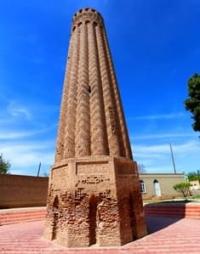
Jarkurgan Minaret.
Tours over historical monuments of Termez.
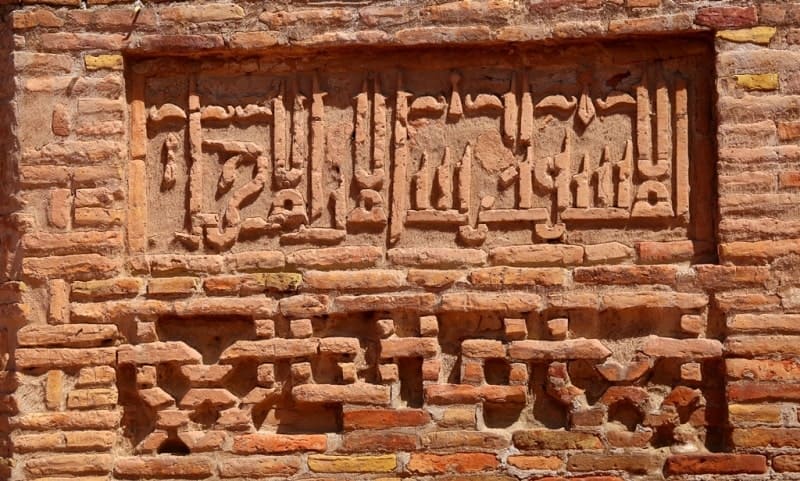
“I donated (funds) in order to be close to the Almighty Allah of this mosque and Amir minaret, head of the army, powerful, great lord, support of the state and faith, assistant of Islam and Muslims, Amir of Khorasan Abu Sa’ad Sungur Badrom, ibn al-Kumach "
Excursion to Djarkurgan minaret.
Jarkurgan Minaret is located at an altitude of 349 m. a. s. l. in village of Minor, 29.3 kilometers northeast of Termez and 3.9 kilometers southwest of Jarkurgan in district of same name in Surkhandarya region.
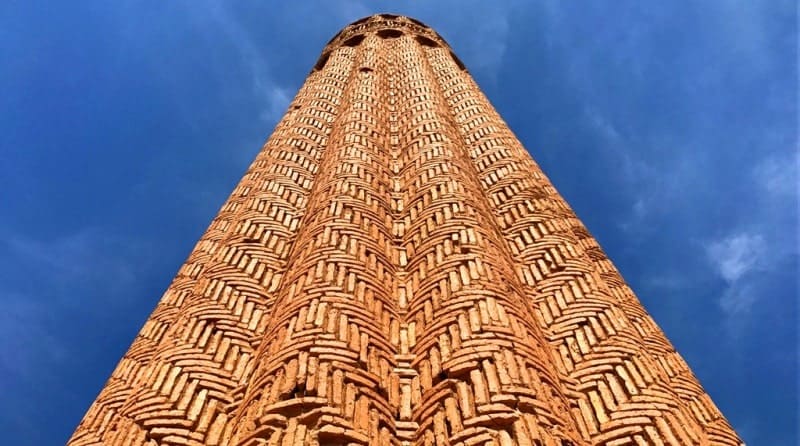
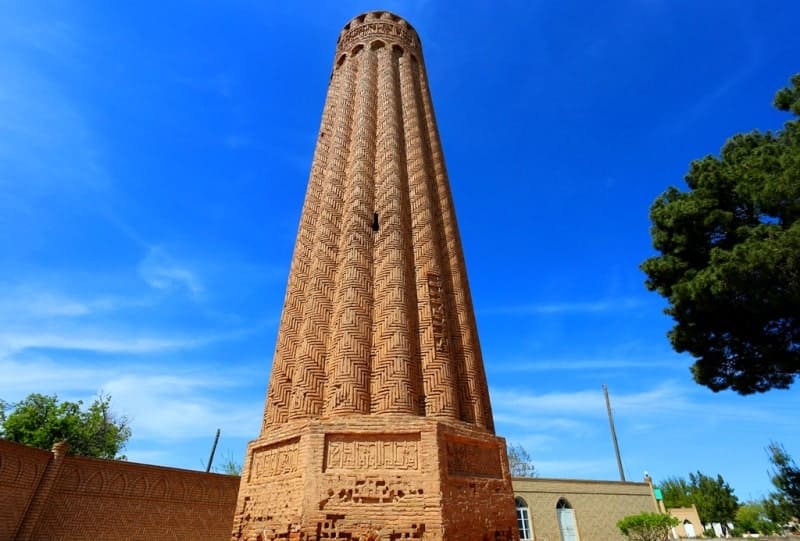
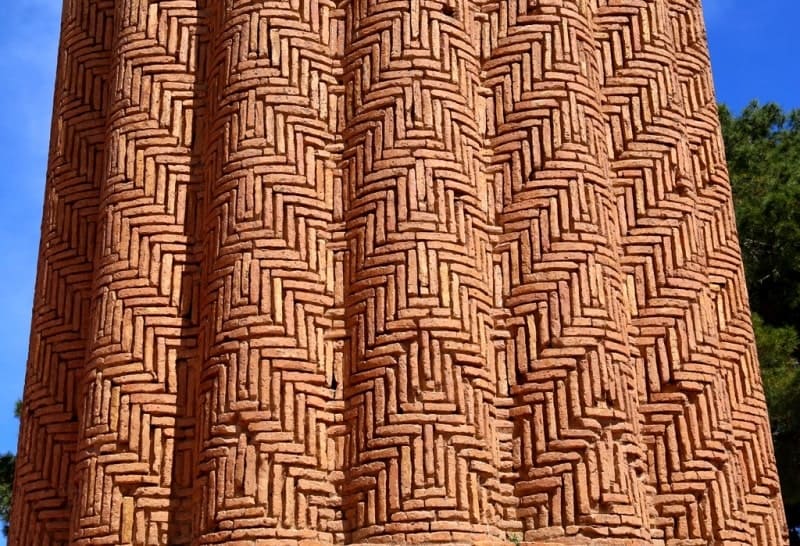
The Jarkurgan Minaret was built in 1108-1110. It is unique for its delicate, unusual, wave-like corrugated masonry. It is 10 years older than the famous Kalyan Minaret in Bukhara. The structure belonged to a large cathedral mosque, built of baked brick.
Its uniqueness in Central Asian architecture lies in its division by vertical decorative corrugations, similar to the tower mausoleums of Khorasan and India. Although this tradition of decorating walls with corrugated patterns has more ancient roots and is known from the early medieval (VIth-VIIIth centuries) castles of feudal lords in Central Asia.
Inside the minaret is a narrow spiral staircase. The minaret currently stands 21.6 meters high, with a diameter of 4.1 meters at this height and approximately 5.4 meters at the base above the plinth. Its height was previously significantly greater, with a second section, apparently once crowned with a lantern.
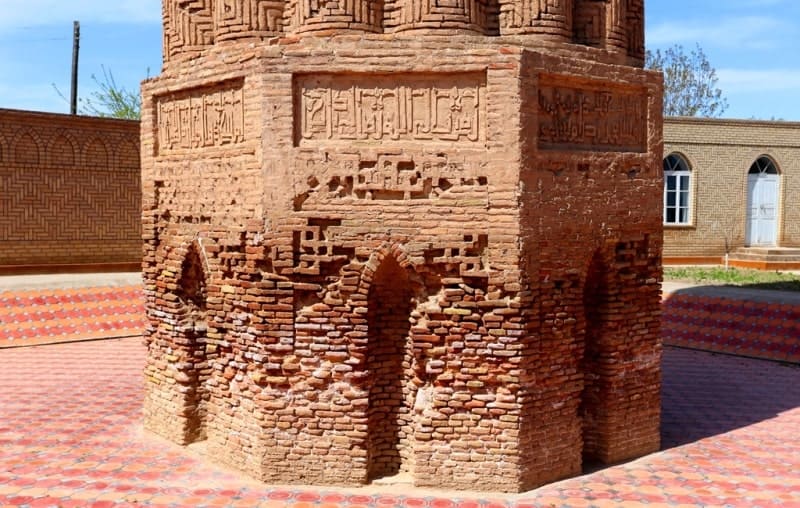
An inscription in a rectangle on one of the ribs of the shaft gives the name of the builder:
"Ali, son of Muhammad, from Sarakhs."
The date on the plinth - 502 AH (1108-1109) - denotes the completion of the minaret's construction. The Jarkurgan minaret is distinguished by the corrugated shape of its trunk. 1 6 closed semi-columns rest on a high octagonal plinth and are connected in the upper, surviving section by a horizontal band of epigraphic ornamentation.
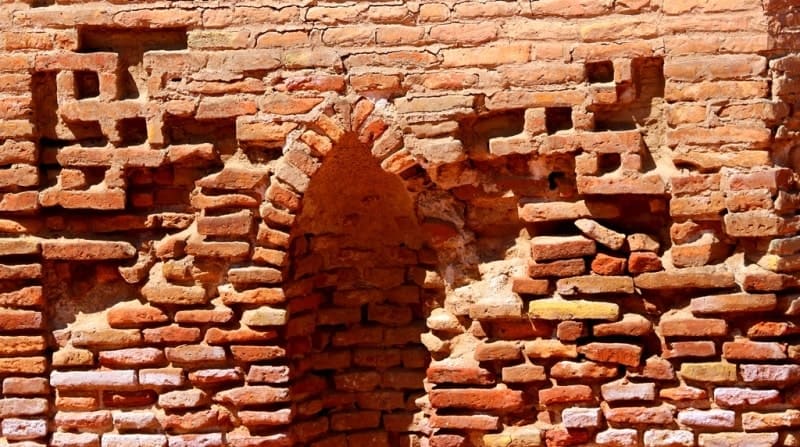
A niche on the southwestern side once opened onto the minaret's staircase, now blocked up. The structure's rich decorative appeal, simultaneously creating a sense of softness and grace, is achieved by the decorative herringbone pattern of its brickwork.
The monument, distinguished by its simple composition, is constructed of baked brick and has a corrugated shape. A mosque, now destroyed, once stood next to the minaret. The architectural construction techniques of the monument are characteristic of the Seljuk period (XIIth century).
Decorative elements and inscriptions have been preserved on the minaret. The inscriptions along the ring band occupy the upper and main part of the minaret. The inscriptions are written in Kufi script (Muwarraq). Variations on the reading of the historical inscription were previously proposed by V.A. Shishkin, M.E. Masson, and B.D. Kochnev.
The reading and translation by B. Babajanov and K. Rakhimov are presented here.
Geographic coordinates of Jarkurgan Minaret are: N37°28'35 E67°23'46
Authority:
http://welcomeuzbekistan.uz
Photos by:
Alexander Petrov..