





You are here
Khamza Yesenzhanov.
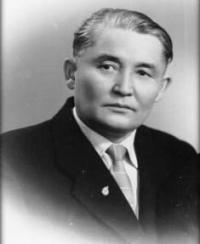
Writers of West Kazakhstan Region.
"Syami didn't understand what 'English and French troops' meant, but it was obviously something terrifying, and at least more terrifying than the Cossacks. So thought the boy. Listening to the guards' conversation, he finally decided that they were "our" people. Shivering from the cold, drawing his knees to his chest, Syami tried not to miss a single word of their conversation. He knew that Cossack atamans were ruthless and evil, but what he now heard from the guards shocked him. "Catch the Bolsheviks?.. That means Uncle Abdrakhman, Uncle Dmitriev?.. How can that be? Uncle Abdrakhman knows nothing about this!.." Syami was about to jump out from under the porch and run to the printing house to tell Aitiev everything he had just heard, but the guards started talking again, and the boy decided to listen to the end.
"Ak zhaiyk" ("Yaik - a bright river"). Khamza Yesenzhanov. 1957.
Great writers of Kazakhstan.
International readers' conference "Tugyry biik talent" was dedicated to creative legacy of Khamza Yesenzhanov. It was organized on December 25, 2023, to commemorate 115th anniversary of birth of this fellow countryman, writer, translator, and teacher.
Khamza Yesenzhanov was born on December 25, 1908, in the Lbischensky District of the Ural Region. He lost his parents at the age of eight. He was raised by his uncle, Kairzhan Yesenzhanov, whose family lived in Alma-Ata. After finishing school, the young man enrolled in the Alma-Ata Zoo-Veterinary College.
But his love of literature prevailed – just two years later, Khamza withdrew from the college and enrolled in the philology department of the Abai Alma-Ata Pedagogical Institute. After graduating, he entered graduate school at the Leningrad Institute of Literature and Art.
In 1936–1937, he headed the literature department of the Kazakh branch of the USSR Academy of Sciences, while simultaneously teaching the history of Russian literature at his alma mater. In 1937, he headed the Kazakh State Philharmonic and the Opera and Ballet Theater.
During these years, he published extensively, and not only poetry and short stories. In 1934, Khamza Yesenzhanov compiled a book for elementary school students, and in 1937, he wrote a Kazakh literature textbook for secondary schools. While still a student, he became close to representatives of the progressive Kazakh intelligentsia - writers Beimbet Mailin and Ilyas Zhansugurov.
Both were subjected to political repression and executed. In 1938, this fate befell Yesenzhanov too: he was arrested and sentenced to 25 years in prison camps and exile under Article 58. He was released in 1947, but his freedom was short-lived.
He survived seventeen years of imprisonment thanks to the love and support of his wife, Sofya Tastemirova, the niece of the poet Magzhan Zhumabayev. After her husband's arrest, Sofya moved several times, changing jobs to be closer to where he was imprisoned.
In his arms was his little son, Emil, named after the French writer Emile Zolya. In 1943, the boy died of an infection. Hamza corresponded with his wife, hoping to meet her and their son, whose death he had not known for many years. During brief visits, he passed on notes to Sofya, which later formed the basis for the novel trilogy "Yaik – Bright River."
After his second arrest, in March 1948, he wrote to his wife that he was experiencing much more hardship than his first exile. Then, having received permission, she followed her husband. Mukhtar Auezov, who knew the Yesenzhanov family personally, called her "the Kazakh Decembrist."
Sofya Zhakievna assisted the exiles as a doctor, trying to alleviate their plight. The local population and the exiles treated her with great respect. More than once, she saved sick exiles from execution by writing "Typhus" on the door of their ward. In 1955, Khamza Yesenzhanov was released, and the family returned to their homeland.
But there was no housing or work in Alma-Ata. They settled in the village of Uzun-Agach. Khamza Ikhsanovich worked as an accountant, and Sofya Zhakievna as a doctor at the district hospital. In 1956, Khamza Yesenzhanov was rehabilitated.
In 1957, "Ak Zhayyk" was published, the first book in the trilogy "Yaik – Bright River," about the civil war and the rise of Soviet power in Western Kazakhstan. The author, a contemporary of the events described, used numerous historical documents and facts.
The book was published in Russian and Kazakh. In 1967, the writer was awarded the Abai State Prize of the Kazakh SSR for his novel "Yaik – the Bright River." Khamza Yesenzhanov's literary language is light and original. Expressive details and images define the unity of man and nature as a symbol of eternal love and life.
Here is one of the parallels the writer draws in his novel "Yaik – Bright River":
"If there were no river, our steppe would turn into a desert, life there would be deprived of beauty. So this book by Abai, like the Yaik for the steppe, is needed by the Kazakh people. It contains an inexhaustible source, giving life force to all suffering people. This book is the Yaik of the Kazakhs!"
The writer and public figure Engels Gabbasov aptly described his special relationship with the Urals: "He loved his native land very much. When visiting the Urals, he first of all gravitated to the banks of the stunningly beautiful steppe rivers – the Barbastau, the Ankata, the Ulenta, and, of course, the majestic Ural."
He was drawn to the blue Chelkar, rippling in the sun...” The rivers of the Urals are constant characters in Yesenzhanov's works - characters, not theatrical backdrops - so lovingly and imaginatively are they described. In 1955–1956, the writer joined a group of Kazakhstani writers who translated Mikhail Sholokhov's novel "And Quiet Flows the Don."
Khamza Ikhsanovich personally translated the first and fourth books of the work. Mikhail Alexandrovich valued Khamza Yesenzhanov as a talented writer, an experienced teacher, and a sensitive translator who carefully preserved the original language, noting that his translations were "particularly beloved" by the people.
The writers' last personal meeting took place in 1972. Khamza Yesenzhanov, while on a trip to the Urals, stopped by to visit Sholokhov, who was staying with his family in a house on Bratanovsky Yar. He presented Mikhail Alexandrovich with the novel "Virgin Soil Upturned," translated into Kazakh.
The novels "Yaik – a Bright River" and "Many Years Later," gifts from Khamza Yesenzhanov to the Nobel Prize laureate, were kept in Sholokhov's personal library. The book "Yaik – a Bright River," with an inscription, is included in the scholarly catalog "M.A. Sholokhov Library.
Books with Autographs," published by the M.A. Sholokhov State Museum-Reserve in 2013. The writer was active in public life, traveled extensively throughout Kazakhstan, and frequently visited abroad. The result of these journeys are travel essays, still only partially known to the general public.
This six-volume collection of works is the fruit of the writer's intense work over the last twenty years of his life. Despite facing trials, he managed to preserve what matters most: his love for his homeland, for people, and for nature. This radiant feeling permeates all of his work, teaching readers lessons in humanism and morality.
Participants in the conference, organized by the public association "Center for Russian Culture" with the support of the West Kazakhstan Library for Children and Young People named after Kh. Yesenzhanov, discussed the need to republish his works and popularize his work, which can and should become a symbol of the Urals region.
In honor of the writer's anniversary, the library bearing his name has been replenished with collections of Kazakh fairy tales and works by Russian writers in the Kazakh language, donated by the Russian Consulate General in Uralsk.
Authority:
"Singer of the Bright River." Author Natalia Portnyagina. West Kazakhstan Region. March 2, 2023. https://kazpravda.kz/n/pevets-svetloy-reki/
Literary creativity of Khamza Yesenzhanov.
In the 1930s, he published a number of poems and short stories. In 1934, he compiled a reading book for elementary school students, and in 1937, he wrote a Kazakh literature textbook for secondary schools. He translated A.S. Pushkin's story "Dubrovsky" and I.S. Turgenev's novel "Rudin," I.P. Shukhov's novel "Hatred," and the first and fourth books of M.A. Sholokhov's novel "And Quiet Flows the Don" into Kazakh.
In the last years of his life, he wrote the stories "Kart Kazakh" (Old Kazakh) and "Danasyn ghoy, Plutarch!" (You are right, Plutarch), "On the Banks of the Olenta River," "The River of Light," "The Heat," "Azhaly Zhok," "Kyzyl Kumaq," as well as short stories, essays, literary criticism, and more.
"Ak Zhayyk" ("Yaik - a Bright River"). In 1957, he published his major work, the first book of the trilogy "Ak Zhayyk" ("Yaik - a Bright River"), about the Civil War and the establishment of Soviet power in Western Kazakhstan. It reflected the socio-historical changes in the lives of the people, and the struggle for freedom and the future is depicted through the destinies of real (Dmitriev, Aitiev, Karatayev, Belai) and fictional characters (Khakim, Alibek, Adilbek, and others).
The book was published in 1958 in Kazakh and Russian.
A second volume was published in 1959, and a third, "Cool Times," in 1965. In 1967, the writer was awarded the Abai State Prize of the Kazakh SSR for his novel "Yaik - Bright River." In 1963, the novel "Many Years Later" was published, a logical continuation of his three-volume novel "Yaik - Bright River."
The book depicts life in a Kazakh village before collectivization.
Recognition and Memory of Khamza Yesenzhanov.
He was awarded the Order of the Badge of Honor (January 3, 1959) and the Order of the Red Banner of Labor. By Decree No. 827 of the Government of the Republic of Kazakhstan dated December 20, 2016, the Regional Library for Children and Youth was renamed the West Kazakhstan Regional Library for Children and Youth named after Khamza Yesenzhanov.
A park and street in Uralsk, as well as in Almaty and villages in his homeland, are named after him. To commemorate the writer's 70th birthday, a six-volume collection of his selected works was launched and completed in 1981. To commemorate the writer's 100th birthday, local historian enthusiasts Sailau and Dametken Suleimenov published the book "Akzhayyk aңsaғan azamat" (Singer of the Bright River).
It includes previously unpublished works by the author, poems from the 1930s-1950s, and three plays. In 2013, to mark the writer's 105th birthday, a complete collection of his works in seven volumes was published in Almaty. On the eve of his 110th birthday, three busts of him were erected in the West Kazakhstan region: on a pink rectangular pedestal in the village of Podstepnoye, Terekty District, West Kazakhstan Region; on a white column in the village of Saryomir; and on a gray pedestal in Victory Square, Uralsk.
Authority:
https://ru.wikipedia.org/wiki/%D0%95%D1%81%D0%B5%D0%BD%D0%B6%D0%B0%D0%BD%D0