




You are here
Lake Eshenkul.
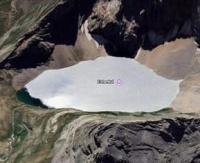
Hiking to Lake Eshenkul in Chatkal Range.
"I walk silently along the shore, the water splashing,
I will never tire of the lake's noise.
Your wondrous attire has turned pink by evening,
The sunset silently gives you its colors."
Alykul Osmonov. "Evening Lake." November 9, 1946.
High-mountain lakes on northern slope of Chatkal Range.
The high-mountain freshwater flowing lake Eshenkul is located at an altitude of 3,290 m. a. s. l., in the upper reaches of the Kara-Tokoy River, on the western slopes of the Chatkal Range, in its northeastern part, in the Chatkal District of the Jalal-Abad Region.
The lake is located in an exceptionally inaccessible part of the Western Tien Shan, amidst harsh high-altitude landscapes shaped by ancient glaciation. It is approximately 2 kilometers northwest of the Chatkal Ushba peak, 4,339 m. a. s. l., approximately 5.7 kilometers south and slightly west of Lake Kara-Tokoy, and approximately 4 kilometers south and slightly west of the Kara-Tokoy Pass, 3,620.3 m. a. s. l.
Eshenkul is one of the highest-altitude bodies of water in the Chatkal River basin. The lake lies in a vast ancient glacial cirque - a natural bowl-shaped basin surrounded by rocky slopes and ridges. The modern appearance of this area is largely shaped by the activity of glaciers, which over a long period of time have deepened and widened the mountain basin.
Lake Eshenkul in a glacial cirque.
Eshenkul's unique location lies in its location amidst modern and ancient glacial landforms. A small glacier of the same name, approximately 1.4 kilometers long, is located in the southwestern part of the cirque. It extends along a rocky ridge separating the Eshenkul cirque from the Kara-Tokoy River valley.
The southeastern part of the Eshenkul Glacier terminates directly at the lake of the same name, forming a complex characteristic of high mountains: glacier, proglacial lake, and river source. Melted glacial waters flow into the lake, maintaining its flow. The lake basin is of glacial origin.
In the distant past, a mass of ice settled here, gradually moving across the mountain cirque and eroding its bed. After the glacier retreated, water accumulated in the depression. Moraine deposits left by the ancient glacier may have played an additional role in the formation of the modern lake.
Thus, today's Eshenkul is the result of the long-term interaction of glaciation, mountainous terrain, and meltwater. The lake is semi-oval in shape. Its length from southwest to northeast reaches 655 meters, its greatest width in the central part is 433 meters, its surface area is approximately 0.18 sq. km., and the shoreline reaches 1.67 kilometers.
The water in Eshenkul has a bluish tint. The surface color changes with changing light: in the morning, the water may appear soft blue, and in the late afternoon, it takes on cooler, grayish hues. Such changes are typical of high-mountain bodies of water surrounded by light-colored rock, snow, and glaciers.
Glacier feeding determines the lake's temperature. Even in the warmest months, the water remains very cold. From late autumn until approximately mid-May, the surface of the lake is usually covered in ice.
Eshenkul River and Waterfall.
A small river of the same name, approximately 590 meters long, flows from the northern part of the lake. It is a left tributary of the Kara-Tokoy River. A particularly impressive section of the river is located just a few hundred meters after exiting the lake.
After approximately 450 meters, the stream reaches the edge of a high-mountain escarpment and tumbles down sheer cliffs. The drop reaches a height of approximately 210 meters, so the short stream here transforms into a spectacular high-mountain waterfall.
This short section particularly well illustrates the character of the local topography: the calm surface of the high-mountain lake almost immediately gives way to a rapid flow of water down a steep rocky slope. The stream then flows toward the Kara-Tokoy River, and through it, to the Chatkal River basin.
High-mountain nival-glacial zone of Lake Eshenkul.
Eshenkul is located in a harsh natural environment, close to the upper limit of vegetation distribution. The lake's surroundings belong to the high-mountain nival-glacial zone, where snow and ice remain for much of the year. The terrain here is constantly exposed to frost weathering processes.
Water seeping into rock crevices expands when it freezes, gradually eroding the rocks. Therefore, the slopes of the cirque are covered with scree, rubble, and large rock fragments, and the rocky outcrops acquire sharp, bizarre shapes. Vegetation is extremely sparse.
In snow-free areas, mosses, lichens, and individual high-altitude plants are found, able to survive the short growing season, strong winds, sudden temperature changes, and prolonged snow cover. Continuous plant communities typical of the lower parts of the Chatkal Range are practically absent here.
Only in protected areas can they thrive. Only in wind-protected areas among the rocks can certain species of high-mountain flora survive. Fauna is also represented by a few species capable of surviving in harsh conditions. Mountain goats and other mountain fauna can be found in the vicinity of high-mountain cirques, while raptors and scavenging birds fly over the slopes.
Lake Eshenkul and surrounding glaciers.
The lake is also of particular interest because it is located in close proximity to the glacial complex of the upper Kara-Tokoy River. Eshenkul Glacier is one element of the complex system of modern glaciations in the Chatkal Range. Its location at an altitude of 3,290 meters allows one to observe the unique transition from lake basin to glacial relief.
Here, within a relatively short distance, glacial formations, moraine deposits, rock cirques, scree slopes, snowfields, and a high-mountain reservoir coexist. It is the combination of these natural components that gives Eshenkul its distinctive character.
This is not just an isolated mountain lake, but part of a single high-altitude natural complex in which water, ice, and rock are in constant interaction.
Legend of Lake Eshenkul.
The lake's name sounds unusual and, as is often the case in the Tien Shan Mountains, has given rise to local legends. Elders said that a lone shepherd once found refuge in these deserted places, each summer climbing higher and higher into the mountains with his flocks.
One summer, he did not return to the valley. People searched for him for a long time, but found only traces of a campsite near the high-altitude lake. His staff lay near the water, and a horse, lost from the herd, grazed on the shore. From then on, shepherds passing through these parts tried not to make noise near the lake or disturb its waters.
It was believed that on clear days, the reflection of a man who had once gone into the mountains and remained their eternal guardian could be seen in the mirror of Eshenkul. Of course, this is just a mountain legend, but such stories help us understand the special relationship locals have with high-mountain lakes.
In traditional mountain culture, water was never simply a natural resource: springs, lakes, and river sources were perceived as places requiring respect and caution.
Tourist Value and Accessibility of Lake Eshenkul.
Lake Eshenkul is of significant interest to lovers of the little-known high-mountain regions of the Western Tien Shan, geographers, glaciologists, botanists, and photographers. However, access is extremely difficult. There are no roads or developed tourist infrastructure in the immediate vicinity of the lake.
The route traverses high-mountain terrain with rocky areas, scree, glacial formations, and steep slopes. The best time to visit is the short summer season, when most of the routes are clear of snow. Even in summer, it is necessary to anticipate the possibility of sudden deterioration in weather, strong winds, fog, snowfall, and a sharp drop in temperature.
Traveling to this area requires good physical fitness and experience in high-altitude travel. Particular caution should be exercised near glaciers, on scree slopes, and in steep valley sections. Due to the remoteness of the area, it is necessary to plan your route, water and food supplies, overnight accommodations, and communication means in advance.
Eshenkul is one of those places in the Tien Shan where people travel not so much for a comfortable journey as for the opportunity to see a virtually untouched high-altitude landscape. Here, the sheer scale of the mountains is particularly evident: a small lake is surrounded by glaciers, snow-capped peaks, and enormous rock faces, and the short river flowing out of it almost immediately turns into a powerful waterfall.
It is this proximity of water, ice, and sheer cliffs that creates Eshenkul's unique appearance.
Geographic coordinates of Lake Eshenkul are: N41°58'38 E71°49'13


Authority:
Alexander Petrov.