






You are here
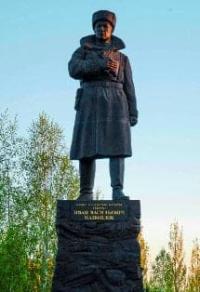
Monument of I.V. Panfilov in Astana.
Museum tour in Astana.
"I don’t need you to perish; I need you to stay alive. Protect the soldier! Protecting the soldier means striking the enemy! A soldier goes into battle not to die, but to live. And a commander is duty-bound to do everything possible to preserve his life and achieve victory. Do not be in a rush to die - learn how to fight. A living soldier is worth more to the Motherland than a dead hero.Victory is forged in the trenches, long before the battle begins."
V. Panfilov. From the book *Volokolamsk Highway* by A. Bek, 1943
Tour from Astana to Lisakovsk.
Memorial complex dedicated to Ivan Panfilov and the Panfilovites in Astana.
The memorial complex dedicated to Ivan Vasilyevich Panfilov is situated at an elevation of 359 m. a. s. l., in the southeastern part of Zheruyik Park, at the intersection of Koshkarbayev and Zhumabayev streets in the Almaty District of Astana.
Located within Zheruyik Park in the capital of Kazakhstan is a memorial complex dedicated to Major General Ivan Vasilyevich Panfilov and the soldiers of the 316th Rifle Division - formed in Kazakhstan, which later became the 8th Guards Rifle Division.
The memorial was unveiled on May 7, 2015, on the eve of the 70th anniversary of the Victory in the Great Patriotic War. The centerpiece of the composition is a bronze monument to General Ivan Panfilov, standing approximately 2.5 meters tall.
The sculpture was created by the Kazakhstani artist Renat Abenov. On the eastern side of the memorial, there are red granite plaques dedicated to the "28 Panfilov Guardsmen." The stelae bear information about these heroes, and the composition is complemented by depictions of the "Gold Star" medal - the insignia of the title "Hero of the Soviet Union.".
Thus, the memorial serves not only as a monument to one of the most renowned military commanders of the Great Patriotic War, but also as a commemorative gallery for the soldiers of the division whose name became inextricably linked to the defense of Moscow.
Ivan Panfilov and the Defense of Moscow.
The history of the memorial is directly tied to the fate of the 316th Rifle Division, which was formed in the summer of 1941 in Alma-Ata and Frunze. The unit was commanded by Major General Ivan Vasilyevich Panfilov. In the autumn of 1941, the division was deployed to the Volokolamsk sector, where it took part in grueling defensive battles on the approaches to Moscow.
The soldiers of the division had to withstand a numerically superior enemy amidst fierce combat and relentless pressure from German forces. A particularly significant place in military memory is held by the battle at the Dubosekovo railway siding on November 16, 1941.
It is this engagement that is associated with the well-known story of the "28 Panfilov Heroes" - a narrative that, during the war, became one of the most potent symbols of the courage shown by the defenders of Moscow. Today, however, this story must be recounted with caution.
The image of the "28 Panfilov Guardsmen" took shape within Soviet military-themed literature and journalism, gaining widespread fame through newspaper reports, books, films, and songs. At the same time, subsequent archival research has revealed significant discrepancies between the original newspaper account of these events and the available documentary evidence.
This does not negate the reality of the fierce battles fought by the 316th Division or the mass heroism displayed by its personnel; rather, it allows for a distinction to be made between the actual historical events and the legendary tradition that has grown up around them.
The death of General Panfilov.
Ivan Vasilyevich Panfilov was killed on November 18, 1941, during fighting near the village of Gusenevo, in the Volokolamsk District of the Moscow Region. He was in the immediate vicinity of the combat operations when he was mortally wounded by a piece of shrapnel from a mortar shell.
Following Panfilov’s death, his unit continued to fight in the Volokolamsk sector.Before long, the division was reorganized into the 8th Guards Rifle Division - one of the most renowned formations of the Red Army. The legacy of Panfilov is widely honored, not only in Russia but, most notably, in Kazakhstan and Kyrgyzstan, where his division was originally formed.
In 1942, Ivan Panfilov was posthumously awarded the title of Hero of the Soviet Union.
Remembering the "Panfilovites."
The memorial in Zheruyik Park continues the tradition of commemorating Panfilov and his soldiers in Kazakhstan. Its presence in Astana is particularly symbolic: the division - formed in Alma-Ata and Frunze- became one of the most celebrated units associated with the defense of Moscow.
The memory of the "Panfilovites" lives on in the names of streets, squares, schools, military units, and memorial sites across Kazakhstan and Kyrgyzstan. The image of these defenders of Moscow has also become a part of popular culture. One of the most well-known works is the song "Near the Village of Kryukovo" ("U derevni Kryukovo"), dedicated to the memory of the defenders of Moscow who fell in battle.
Furthermore, the memorial complex in Astana serves as more than just a monument to specific individuals who fought in the war; it stands as a reminder of a much broader phenomenon: the mass participation of the people of Kazakhstan - and other Soviet republics - in the defense of the country between 1941 and 1945.
Geographic coordinates of monument to I. V. Panfilov: N51°08'41 E71°29'30
Authoruty:
Alexander Petrov.
Alexander Bek, “Volokolamsk Highway". 1943.
During the battles near Moscow in 1941, the battalion endured fear, cowardice, encirclement, and the death of its division commander. Yet the soldiers held firm, thanks to strict discipline; they defended the capital and brought the Germans to a halt. The USSR, autumn 1941, the Battle of Moscow.
Senior Lieutenant Bauyrzhan Momyshuly commanded a battalion within the 316th Rifle Division, which was being formed to defend the capital. He instilled rigorous discipline and trained his men through grueling marches and night combat. Bauyrzhan Momyshuly - the narrator, a senior lieutenant and battalion commander - is a Kazakh in his thirties.
A former herdboy, he is a man of principle: demanding and stern, yet fair, and deeply concerned for the well-being of his soldiers. The division commander, the wise and solicitous General Ivan Panfilov, supported the battalion commander’s initiatives.
He taught the men tactical ruses, offered both criticism and guidance, and instilled in them an unwavering belief in victory. Ivan Vasilyevich Panfilov - a major general and division commander in his fifties - is a man of short stature and a slight stoop, with distinctively Mongolian features.
He is a wise, seasoned military leader who cares deeply for his troops. In their initial engagements, the battalion successfully executed ambushes along German-controlled roads, but they were soon encircled near the village of Novlyanskoye.
Despite having no communication with headquarters and no reserves, Momyshuly chose to take up a defensive position in the forest, opening fire to signal their presence:
"With the roar of cannon fire - erupting suddenly over the hushed fields and rolling far into the darkness - I proclaimed: 'We are here! Attack us! Turn your forces against us' Cut off from all communication and caught in a pincer, we did not retreat - even though the final road out beckoned us to leave."
Later, the battalion fought its way toward Volokolamsk with great difficulty. Following the loss of the city, the troops retreated while engaged in combat, struggling with command and supply issues. General Panfilov provided guidance to the battalion commander, urging him to protect his men while exercising initiative to halt the German advance.
Throughout intense fighting, the battalion suffered defeats and casualties. The commander had to contend with instances of betrayal and cowardice among his soldiers, yet he chose to forgive them and bolster their morale. Near Moscow, General Panfilov was killed - a loss that deeply shook the troops.
Despite these hardships, the battalion continued to fight, successfully halting the German offensive near Matrenino station and helping to defend the capital. While gathering material on the Battle of Moscow, the author met Senior Lieutenant Bauyrzhan Momysh-Uly, a battalion commander in the Panfilov Division.
Initially, the commander was reluctant to speak about the war, but he eventually agreed to share his story. Momysh-Uly spoke candidly about the fear experienced in war, criticizing the tendency to idealize soldiers. He described his battalion’s arrival near Volokolamsk and their preparations for defense.
The appearance of the first retreating troops sparked panic among his men. The commander ordered the execution of Sergeant Barambayev for a self-inflicted wound - an act intended to demonstrate that betrayal would not be forgiven. I wanted every soldier to know: if you turn coward or commit treason, there will be no forgiveness - no matter how much one might wish to forgive. Write all of this down - let it be read by everyone who has donned, or is preparing to don, a soldier’s greatcoat.
General Panfilov arrived at the battalion; he approved of Momysh-Uly’s actions, issued orders for the defense, and pointed out shortcomings in the defensive layout. The general instilled confidence in the men ahead of the coming battles. Momysh-Uly recalled how he had first met Panfilov in July 1941, when the general appointed him commander of a battalion in a division then being formed.
The general had even gifted the battalion commander a horse, named Lysanka. Upon arriving at the battalion, Momysh-Uly familiarized himself with the personnel and established strict discipline. To test the battalion, he organized a "tobacco march."
The soldiers faced significant hardships due to poor equipment and exhaustion. The battalion commander taught them how to prepare their own food and overcome obstacles, readying them for the realities of war. General Panfilov was satisfied with their training.
However, when the battalion reached the outskirts of Moscow, Panfilov criticized Momysh-Uly for being insufficiently prepared for active combat operations and conducted an inspection of the combat readiness of Sevryukov’s company. Acting on the general’s orders, the battalion carried out a successful night raid on a German supply point in the village of Sereda.
The men returned with captured equipment and a prisoner, emboldened by their first taste of combat. On the eve of the engagement, while in his dugout, Battalion Commander Momysh-Uly pondered the Germans' likely next moves, the vulnerabilities in his own defensive lines, and the urgent need to find a way to halt the enemy - despite a critical shortage of manpower and reserves.
He received orders to report to the command post of a neighboring battalion. During a meeting with Panfilov, Momysh-Uly was given instructions regarding the defense and coordination with his new neighbor, Captain Shilov. The general criticized any passivity, urging instead for proactive operations in the no-man’s-land between the lines, while emphasizing the critical importance of time and the need to preserve the lives of his soldiers.
After inspecting the positions, Momysh-Uly tasked Lieutenants Brudny and Donskikh with setting up ambushes along the roads. Donskikh’s platoon successfully engaged a German column and repelled the attack, a victory that boosted the morale of the entire battalion.
Brudny - a lieutenant and commander of the reconnaissance platoon - was a small, dark-complexioned, and sharp-witted man. Although he had once shown cowardice, he had redeemed himself and become one of the best officers. Before long, however, Brudny’s platoon found itself encircled and was forced to retreat.
Enraged, Momysh-Uly accused Brudny of cowardice and abandoning his positions; he stripped him of his command and expelled him from the battalion. "You think you just gave up a road? No! You surrendered Moscow! You cannot fight a war by simply throwing the chests of your infantrymen into the fray - especially not now.
We have very few troops here, near Moscow. We must protect our soldiers - not with empty words, but through our actions and our fire." Analyzing the reasons for the retreat of Brudny’s platoon, the battalion commander developed a new ambush tactic.
Brudny returned, having redeemed his honor. Soon after, however, Donskikh’s platoon fell into an ambush, suffered a defeat, and retreated with heavy losses. Momysh-Uly realized there had been a flaw in his tactics. On October 23, Momysh-Uly’s battalion came under heavy artillery fire.
When company commander Sevryukov was wounded, Momysh-Uly assumed command. He directed artillery fire, visited the positions, and provided support to the soldiers. As the Germans broke through the front line, the battalion commander decided to abandon the village of Novlyanskoye in order to establish a new defensive position.
Under heavy fire, Momysh-Uly rallied the men, while Senior Political Commissar Tolstunov led them in a counterattack, forcing the Germans to flee. The village was retaken, but the battalion found itself encircled. Tolstunov - a senior political commissar and propaganda instructor at the regimental headquarters - was a brave and resourceful officer who bolstered the soldiers' morale and spearheaded the counterattack.
Refusing to retreat without an order, the battalion commander decided to set up a defensive position in the woods and ordered his men to open fire on the Germans to signal their presence. He informed the battalion that they were surrounded and ordered them to fight to the end.
Political Commissar Bozzhanov was tasked with retrieving the abandoned artillery pieces. Dzhalmukhamed Bozzhanov - a political commissar of Kazakh origin - was a good-natured, energetic man with round cheeks; he was fiercely loyal to Momysh-Uly, a skilled cook, fond of giving orders, and deeply concerned for the well-being of his soldiers.
Although Momysh-Uly declined to incorporate Captain Shilov’s men into his own battalion, he dispatched them behind enemy lines under Bozzhanov’s command. The detachment successfully attacked Novlyanskoye. Shortly thereafter, Brudny arrived with an order to retreat.
As the battalion began its withdrawal toward Volokolamsk, Momysh-Uly sent Bozzhanov back to recover the artillery. During the retreat, the battalion faced a difficult situation: Bozzhanov’s detachment returned, but the soldiers had become demoralized by rumors of a general withdrawal.
Panic led to casualties, and the battalion found itself cut off by German columns. The battalion commander made the decision to engage. Surrounded by the Germans, the battalion opened fire on the enemy columns, then broke through to their own lines by forming a diamond-shaped formation and unleashing a concentrated volley of fire.
Artillery destroyed a tank, providing cover for the withdrawal. The battalion commander emphasized the importance of sudden, intense fire and strict discipline. The battalion reached Volokolamsk, which had been devastated by bombing. Meeting with the regimental headquarters and General Panfilov brought a sense of relief.
Panfilov asked about the fighting, shared the current situation, and announced the arrival of reinforcements. Momysh-Uly’s battalion was in reserve when an alert was sounded. The battalion commander was summoned to ...to the general, while the battalion moved out to its positions.
At the division headquarters, Momysh-Uly received orders to counterattack the Germans, who had broken through the front line. Zvyagin, a representative from the Stavka (High Command), criticized Panfilov for the breach and had a major who had retreated placed under arrest.
Faced with conflicting orders, Momysh-Uly sent Lieutenant Filimonov to Ivankovo, then redirected the battalion toward Timkovo. Company commander Panyukov moved ahead, and the fighting began. The battalion commander hurried to provide support, leaving some of his forces behind.
Efim Efimovich Filimonov - a lieutenant and commander of the third company - was a former border guard and a career officer; he was disciplined, diligent, and deeply concerned for the well-being of his soldiers. In the darkness, Momysh-Uly searched for the Germans near Timkovo.
The artillery pieces became stuck, and men were getting lost. Political instructor Dordiya demonstrated genuine leadership qualities. Zaev’s company launched an attack, but the mud rendered their weapons inoperable. The battalion commander fell ill and began to deliriously wander in his thoughts, yet by morning, he resolved to continue the fight.
Dordiya, the company’s political instructor - a former teacher with light-blond hair and dark eyes - was typically hesitant and awkward, but in a critical situation, he revealed strong command abilities. Semyon Zaev, a lieutenant and company commander - lanky, ungainly, sullen, and blunt - had a deep affinity for weaponry; although he had once fled the battlefield, he had since redeemed himself.
In the morning, Momysh-Uly inspected the positions held by Dordiya’s company and reflected on the man’s transformation. Then, the shelling began. At headquarters, the battalion commander was briefed on the situation, while Zaev and Bozzhanov spent the time repairing a machine gun, which they subsequently tested with success.
The battalion was fighting while encircled after the Germans captured Volokolamsk. The battalion commander analyzed the situation, issued orders, and reflected on duty and the Motherland - ultimately deciding to retreat. "No," he thought, "if I am destined to witness a rout, a collapse, the destruction of my battalion, I shall not be the one to report it.
I will pass judgment upon myself, and I will carry it out myself. We are surrounded by the Germans on all sides. We shall now form an all-around defense." Following the order to withdraw, Momysh-Uly organized the battalion’s retreat under enemy fire.
Moved by their commander’s concern for them, the soldiers refused his last pack of *Belomor* cigarettes. After wandering, the battalion managed to reach their own lines, only to be met with indifference from Colonel Khrymov’s regimental staff.
The battalion commander restored discipline - punishing his orderly, Sinchenko - and later accidentally poisoned some soldiers with opium, though, fortunately, no lasting harm was done. Sinchenko, Momysh-Uly’s orderly - a Russian from Kazakhstan, dark-complexioned and gray-eyed - was attentive, loyal, and the only person permitted to grumble at the commander.
Momysh-Uly briefed Panfilov on the fighting that took place after the fall of Volokolamsk. At the division headquarters, he encountered Khrymov and confronted him with his grievances. Panfilov explained the defensive strategy and emphasized the importance of maintaining the soldiers' morale.
After retreating to the village of Byki, Momysh-Uly’s battalion was ordered to hold a bridge. The commander once again encountered the indifference of Khrymov’s staff; he disciplined soldiers for leaving their posts without authorization, spoke with Zayev, and dismissed an officer who had arrived in the middle of the night to conduct an inspection.
Toward morning, a shipment of ammunition and a meager portion of meat arrived. On October 28, the battalion was engaged in heavy fighting. The Germans attacked and suffered losses. Zayev fled the battlefield, abandoning his positions. Momysh-Uly halted the panic, organized an all-around defense, and withdrew into the forest.
Momysh-Uly briefed Panfilov on the fighting. The general analyzed the situation and discussed a new defensive tactic based on the initiative of the individual soldiers. A photojournalist arrived, and pictures were taken. Panfilov instructed Dorfman to rewrite the report on the battles for Volokolamsk, acknowledging the mistakes that had been made.
In the village of Gorki, Momysh-Uly put Zayev - who had returned - on trial for desertion. Despite Zayev’s pleas to be allowed an honorable death in battle, the battalion commander remained unyielding; he sent him to a tribunal with a demand that he be executed by a firing squad in front of the ranks.
I am a human being. Everything human within me cried out:
"Don't do it! Have mercy! Forgive him!"
But I did not forgive. I am a commander - a father. I was, in effect, killing a son, yet before me stood hundreds of other sons. I was duty-bound to impress upon their souls, in blood, that there is no mercy for a traitor! Panfilov paid an unexpected visit to Momysh-Uly, inquiring about the soldiers' living conditions and the progress of the work on the battalion’s history.
He recalled Momysh-Uly’s past mistakes and spoke of the importance of mutual understanding. The battalion commander pondered the purpose of the general’s visit and his stance regarding the case of Zayev. Momysh-Uly secured supplies for the battalion in Strokovo, and subsequently learned the outcome of Zayev’s case.
He released Zayev from custody and reinstated him to his position. Aware of what had happened, Panfilov brought up an incident involving a medical orderly named Varya Zaovrazhina, who had ended up with the battalion during the retreat. Although she had been handed over to the medical corps, she later showed up to visit while the unit was resting - stirring up jealousy and promptly taking charge of things.
The battalion commander remained firm: there was no place for a woman in the ranks. Panfilov arrived at Momysh-Uly’s position for lunch to discuss the defense. He pointed out the need to prepare for a German breakthrough from five different directions and instructed the company commanders on combat tactics while encircled, emphasizing the importance of fully grasping the mission at hand.
Momysh-Uly presented the battalion’s action plan to Panfilov. As he shaved, the general mused on ...the secrets of a clean shave and the nature of courage. Reinforcements arrived, including Lieutenant Ugryumov, a commander of anti-tank units, sent to share his expertise.
Panfilov informed Momysh-Uly of a German offensive and ordered him to take up defensive positions along the fifth route, warning that heavy fighting lay ahead. Momysh-Uly issued the order to move out and said goodbye to Islamkulov, sensing that a battle was imminent.
The battalion took up positions near Matrenino station and Hill 131.5. General Zvyagin criticized Momysh-Uly for carrying a saber and for failing to follow orders, reminding him that this was the final line of defense. On November 16-17, under heavy German artillery fire, Momysh-Uly’s battalion prepared for the enemy’s advance.
Fierce fighting broke out around Matrenino and the hill; Zayev’s company found itself encircled. As he received further orders from Panfilov, Momysh-Uly reflected on the gravity of the situation. A son of the distant steppes, a son of Kazakhstan - an Asian - why am I fighting here for Moscow, defending this land where the feet of my father, my grandfather, or my great-grandfather never once trod?
To me, the Soviet land is my own kin, my own Homeland. After yielding Matrenino, Momysh-Uly launched a counterattack and routed the Germans. Zayev’s company, having feigned death, destroyed enemy tanks and seized spoils of war. Though the battalion commander was summoned to headquarters, he remained elated by the victory and proud of his men.
Ultimately, Momysh-Uly was relieved of his command. After bidding farewell to his battalion, he headed to the division headquarters, where Panfilov informed him that the division had been granted the title of "Guards" unit, spoke about the fierce fighting, and issued instructions for the future.
Upon receiving orders to take command of a task force in Goryuny, Momysh-Uly learned that retreating soldiers and commanders were arriving in the area. Following Panfilov’s directives, he organized a defense and prepared for potential night combat, despite the prevailing exhaustion and chaos.
As Momysh-Uly’s battalion retreated, it continued to engage the enemy, suffering casualties along the way. There was an encounter with Zayev, a tank attack was repelled, and both Kuzminich and Shakoev were killed in action. Nearing the end of their journey, the battalion met Varya Zaovrazhina and Belenkov, from whom they learned of Panfilov’s death.
Upon receiving this news, Momysh-Uly informed his men and delivered a speech highlighting Panfilov’s heroism and his innovative approach to warfare. The battalion then encountered Zvyagin, who rescinded the order to remove Momysh-Uly from command and showed him Panfilov’s cigarette lighter.
"Comrades, I just called Panfilov a 'general of reality.' No - that is not enough! He was a 'general of truth.' The memory of Ivan Vasilyevich Panfilov, comrades, will live on in our actions and in the heroic feats of his division!"
Authority:
https://ru.wikisum.org/%D0%92%D0%BE%D0%BB%D0%BE%D0%BA%D0%BE%D0%BB%D0%