




You are here
Signs and inscriptions o Tamgalytas stone on outskirts of Betpak-dala.

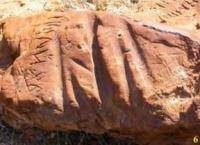
Petroglyphs in Tamgalynura tract.
"On the Sary-Su River, 120 miles before its mouth, toward the Chu River, there protrudes a cape known to the Kyrgyz (Kazakhs) as Tamgaly-Dzhar. Since time immemorial, a wild stone on the bank of the Sary-Su River has been preserved, on which up to 500 tamgas, or seals, are carved. This place is located on the caravan route from Tashkent to the Peter and Paul Fortress; some of Tamerlane's army units likely passed by the Tamgaly-Dzhar cape, so it can be assumed that the carved tamgas were carved by order of Tamerlane. It would be interesting to know their meaning; perhaps they contain some kind of historical document. The Turkestan authorities could easily have obtained copies of them."
Russian military historian M. I. Ivanin. "Notes on a Review of Information from Eastern Authors on Timur's Campaign against the Golden Horde in 1391," 1875
"If we proceed east (from Sarysu) after 22 miles, we reach the Tamgaly-Tasa tract, which is located at the top of Tamgaly-Dzhar and is famous for its sacred stone. This sandstone stone is three cubic fathoms in size, with carved wedge-shaped petroglyphs and colorful patches with which the Kyrgyz (Kazakhs) decorated the bolyush bushes surrounding the stone; nearby is a large Kyrgyz (Kazakh) cemetery. The Tamgala spring is located at the top of a ravine, 100 fathoms from the stone."
Yu. A. Schmidt. "Field, Astronomical, and Meteorological Measurements in the Sarysu Valley Related to the Preparation of this Area of the Akmola Region for Topographic Surveying in 1888-1889." Schmidt, 1894.
Overview of historical study of site.
One of the earliest mentions of the area in the lower reaches of the Sarysu with the significant name "Tamgaly" is found in an entry from August 3, 1796, in the travel journal of a diplomatic trip by Second Lieutenant Dmitry Telyatnikov and Sergeant Alexei Beznosikov from the Irtysh Line to Tashkent:
"On this day, the sands ended. The route was SW 25° until midday, and from midday, SW 75° to the Tamgaly tract, from which a freshwater spring flows". (IKRI, 2007, p. 159).
However, the document makes no mention of other landmarks in the tract. It is generally accepted that A. I. Shrenk "was the first to provide a scientific description of the famous Tamgalytas rock art" (Margulan et al., 1966, pp. 26-27), but the materials from his 1840-1843 journey along the western end of Betpak-Dala remain poorly accessible (Yakovlev, 1941, p. 22).
Only in the last quarter of the 19th century did written sources appear that reliably report on the Tamgalytas rock with inscriptions and images of symbols.
A participant in the Khiva campaign of 1839-1840, Russian military historian M. I. Ivanin (1801-1874), in a note to a review of accounts by Eastern authors about Timur's campaign against the Golden Horde in 1391, noted that:
- "On the Sary-Su River, 120 miles before its mouth, toward the Chu River, there is a cape known to the Kirghiz (Kazakhs) as Tamgaly-Dzhar, where, since time immemorial, a wild stone on which up to 500 tamgas, or seals, are carved, has been kept on the bank of the Sary-Su River.
This place is located on the caravan route from Tashkent to the Peter and Paul Fortress; some of Tamerlane's army detachments likely passed by Cape Tamgaly-Dzhar, so it can be assumed that the carved tamgas were carved by order of Tamerlane.
It would be interesting to know their meaning; perhaps they contain some kind of historical document. The Turkestan authorities could easily obtain copies of them". (Ivanin, 1875, p. 196).
The assumption that the monument is connected to Timur's campaign turned out to be erroneous: the stone with the famous conqueror's inscription was discovered in 1935 by geologist K. I. Satpayev in the Ulytau foothills and was later thoroughly studied (Grigoryev et al., 2004; "From Altai to the Caspian," 2011, pp. 535-537).
M. I. Ivanin does not indicate the source of his information about the Tamgalytas stone, although he does provide a number of geographical landmarks indicating the monument's location. As is known, up until the 1870s Information on the geography of the Turkestan region - at that time still little studied - was extremely limited (Maksheev, 1871, pp. 12-17).
M.I. Ivanin developed his cartographic materials primarily based on survey data collected during the Khiva campaign and later, during his service on the temporary council for the governance of the Inner (Bukei) Horde in 1853-1856 (Ivanin, 1864, p. 21; 1873, pp. 2-3).
Apparently, the report about Tamgalytas, with its implausibly large number of signs, is a retelling of folk tales about a remarkable place on the northwestern outskirts of Betpak-dala. While M.I. Ivanin was finishing his last military history work, the Tamgalytas site became the subject of special study.
Archival documents from the office of the governor-general of the Turkestan region contain correspondence from the 1870s-1890s regarding the settlement of the land issue regarding the use of summer camps in the lower reaches of the Sarysu and Chu rivers by Kazakhs of the Syr Darya and Akmola regions (TsGA RUz., I-1, op. 14, d. 600; TsGA RUz., I-1, op. 16, d. 755, 911).
To resolve long-standing disputes between nomads, Major Kalugin, head of the Perovsky district of the Syr Darya region, made an official visit to this sparsely populated region in 1877 and compiled a schematic map. It was discovered that the Sarysu River connects with the Chu River through its Boktykaryn channel.
On the high left bank of this channel, the Tamgaly-Dzhar and Tamgaly-tau elevations, located on the southeastern side of the Tamgaly-tuz salt marsh, are marked on the map as landmarks for delineating the administrative border of the adjacent regions (TsGA RUz., I-1, op. 16, d. 911, pp. 34, 35).
However, even here, there are no mentions of an eponymous monument. The first field survey and scientific description of Tamgalytas was made by Yu. A. Schmidt (possibly the first after A. I. Shrenk), who conducted the survey in 1888-1889.
Field astronomical and meteorological measurements in the Sarysu Valley, related to the preparation of this area of the Akmola region for topographic survey.
Description of the monument and surrounding area published by Yu. A. Schmidt reveals history of its study:
"If we proceed east (from Sarysu) ... after 22 miles we reach the Tamgaly-Tasa tract, which is located on the summit of Tamgaly-Dzhar and is famous for its sacred stone; this stone is made of sandstone, three cubic fathoms in size, with wedge-shaped petroglyphs carved into it and colorful patches with which the Kyrgyz (Kazakhs) decorated the bolyush bushes surrounding the stone; nearby is a large Kyrgyz (Kazakh) cemetery. The Tamgala spring is located at the top of a ravine, 100 fathoms from the stone" (Schmidt, 1894, pp. 59-60).
Thanks to the research of Yu. A. Schmidt, information was obtained about the exact location of the "stone," which was subsequently used in the compilation of military topographic maps. On the ten-verst map of the West Siberian Military District of 1896 (R. XIV, p. 8), which conveys the terrain in detail, the "Tamgaly-Tash stone" is indicated on the southern shore of the Tamgaly-Tuz salt lake, in the elevated Tamgaly-Dzhar tract, next to the Tamgaly spring.
In 1895, during a trip to resolve a protracted land dispute between the nomads of the Syr Darya and Akmola regions, the translator of the Atbasar district, Hasan Bekkhozhin (since 1890, he had acted as a trusted representative of the Kazakhs of the Baganaly clan of the Naiman tribe of the same district (TsGA RUz., I-1, op. 16, d. 911, p. 227 et seq.) examined Tamgalytas, sketched the signs on the stone, and translated some of the inscriptions there.
He also took the first photograph of the stone.
Probably, the first scientific documentation of the monument was carried out by H. Bekkhozhin at the personal request of L. Kuznetsov, a local historian and military doctor of the Atbasar district, who himself is unlikely to have seen the "Tamgalytas stone":
"Having familiarized myself with Ivanin's instructions, I became interested in the inscriptions" "On the Tamgaly-Tas stone, and during one of his trips, back in 1895, this stone was photographed... by H. Bekkhodzhin; he also copied the inscriptions by hand. Unfortunately, both the photograph and the drawing are rather poor". (Kuznetsov, 1927, p. 123).
Having thus familiarized himself with the monument, L. Kuznetsov came to the conclusion that:
- "there are no hieroglyphs on the stone, as Schmidt wrote, but rather tamgas of various tribes. There are no legends among the local population about when these inscriptions were carved on Tamgaly-Tas, and the Kyrgyz (Kazakhs) attribute them to an immemorial era.
The inscriptions in Turkic located along the edges of the stone may be of later origin". (Kuznetsov, 1927, pp. 123-124).
Along with a short note by L. Kuznetsov He published a series of Tamgalytas inscriptions and signs; it also includes translations of some texts, including the following:
"Kara-Naiman, Alchin, Argyn, Kara-kisek, Koysyn, Tabyn, Mullah Karchike. May the Lord have mercy on them six."
Below are six different tamgas, along with the note:
"Translated by Bek-Khadzhi."
Obviously, the Tamgalytas texts and translations published by L. Kuznetsov, as well as the images of the signs, cannot be considered Hasan Bekkhozhin's 1895 autographs, as all signatures are written according to modern Russian orthography.
The illustration for the article was also likely prepared by L. Kuznetsov based on an old drawing and a poor-quality photograph; all of this precludes the document included in the article from being considered a fully reliable source. This limited information exhausts the results of the initial stage of the monument's study.
During Soviet times, Tamgalytas was visited by various scientists. In the autumn of 1934, the monument was examined by members of a natural science expedition from the Central Asian State University (SASU) led by zoologist V. A. Selevin, as evidenced by an inscription deeply carved into the vertical sandstone surface, located 165 meters from the "stone," above the spring.
In a publication of the expedition's results, the researcher reports:
"These tamgas we saw here in 1934 were deciphered by the guide as Cossack. Among them are inscriptions of very recent origin". (Selevin, 1935, p. 31).
A little earlier, from 1927 to 1931, the route of the famous geological and hydrological expedition of D. I. Yakovlev passed through here. With their work in Betpakdala, they “filled a ‘blank spot’ in our knowledge of the geography and geology of this virtually unexplored vast part of Kazakhstan, an area significantly larger than Belgium and Holland combined” (Yakovlev, 1941, Preface) – and one of the inscriptions in Tamgalyzhar testifies to this.
In the mid-1930s, geologist K. I. Satpayev, while studying ore deposits in the Dzhezkazgan region, discovered and examined a number of ancient monuments and was the first to record a historical legend about the origin of the Tamgalytas signs, which existed among some Kazakhs of the Middle Zhuz.
In particular, he wrote that:
- “in the lower reaches of the river. Sarysu, 20 kilometers to the east, in the Tangbaly-nura tract, is a cliff where the clan insignia (tamgas) of almost all the clans and tribes that make up the Kazakh people are carved into stone. Folk legend among the indigenous population of the region (the Naimans) suggests that it was here, at the Tos-bulak spring, that the first historic clan meeting took place to discuss the organization of the new "Kazakh" nationality.
The decision was supposedly recorded here by the accumulation of clan insignia of all the tribes participating in the meeting on the cliff. The strategic importance of the Ulutau Mountains was also appreciated by the new "Kazakh" nationality, which established its political center here". (Satpayev, 1941, p. 71).
Apparently, K. I. Satpayev did not personally visit the monument:
- "he indicated the location of Tamgalytas approximately, the toponyms (typos?) and geographical landmarks were inaccurately conveyed, the name of the "cliff" was not mentioned, and most importantly, there is no geological and geomorphological description, which a professional geologist in other cases invariably provided when describing familiar archaeological sites (for example, about the Baikonur petroglyphs - "numerous drawings carved on steeply dipping planes of separation in metamorphic schists", or about Timur's inscription - "slightly lower down the slope" - "a stone slab of the same dark amphibolites" "with slag-covered and glazed surfaces". (Satpayev, 1941, pp. 69, 72).
From the time of the first search routes of the Central Archaeological Museum, the Tamgalytas epigraphy attracted the attention of its director, Corresponding Member of the Academy of Sciences of the Kazakh SSR, and then Academician A. Kh. Margulan:
- "A large series of clan signs carved into rocks is located in the area of Lake Tamgaly-Nura, not far from the lower reaches of the Sary-Su. Kazakh oral traditions associate these tamgas with the division of the Kazakhs into three hundreds, when each zhuz received its own clan sign in this area, but there is no data on when this occurred. Judging by the inscriptions, most of these tamgas date back to the XVth-XVIIIth centuries". (Margulan, 1948, p. 127).
Unfortunately, the materials from the site's survey remained unpublished for many years. Even in the major scientific reference publication "Archaeological Map of Kazakhstan," the compilers were forced to cite A. Kh. Margulan's oral report on the location of the rock carvings "near Lake Tamgaly" (AKK, 1960, pp. 195, 400; No. 2837), mentioning next as an independent monument "Turkic inscriptions and about 500 Kazakh tamgas - on the Tamgalytas stones, on the banks of the Sarysu River, 120 km from its mouth.
In 1927, they were examined by L. Kuznetsov" (AKK, 1960, pp. 195, 400; No. 2838). Only in the scholar's later works, published posthumously, can one find indications of personal acquaintance with the monument:
- "They (the signs) were first examined by the traveler A. I. Shrenk, who recorded a large series of tamgas (Archive of the USSR Academy of Sciences), then they were studied by A. Kuznetsov, K. I. Satpayev, V. A. Selevin and the author of these lines". (Margulan, 1997, p. 36).
However, there is no new specific data about A. Kh. Margulan does not provide any information about the location of Tamgalytas, the number of tamgas and the variety of forms of signs, or the nature of the epigraphy.
His interpretation of the historical significance of the monument is based on a retelling of a folk etymological legend previously recorded by K. I. Satpayev and on an arbitrary change made by Kh. Bekkhozhin in the translation of one of the Tamgalytas inscriptions:
“Kipchaks, Naimans, Alchins, Argyns (Karakesek), Uysyns (Kuysyn) and Tabyns! O grant prosperity to these six!”
(Margulan, 1997, p. As a primary source, the most valuable is an old, undated photograph of the Tamgalytas stone, included in Volume 3 of the scholar's works (Margulan, 2003, Fig. 361). Recently, a dedicated historical and archaeological study of Tamgalytas has been conducted twice.
In 2009, an archaeological survey of the site was conducted by an archaeological team (A.E. Rogozhinsky) of the integrated expedition of the Kazakh Research Institute for the Problems of the Cultural Heritage of Nomads, which was conducting research for the preparation of the "Historical and Cultural Atlas of the Kazakh People" under the direction of I.V. Erofeeva.
Some of the results of this research have been published (Historical and Cultural Atlas, 2011, pp. 172-173; Rogozhinsky, 2011, pp. 219-220). Following this, in 2013, an independent study of the site was undertaken by an archaeological expedition from the Shymkent Regional Museum of History and Local Lore (A. A. Erzhigitov).
Tamgalyzhar Tract Monuments.
The current location of the "Tamgalytas Stone": South Kazakhstan Region, Suzak District, 155 km north of the village of Aksumbe, 120 km northwest of the village of Kyzemshek, northwestern end of the Betpakdala Desert, on the left bank of the Boktykaryn River (a branch of the Sarysu River), on the southwestern shore of Lake Tamgalynura, in the Tamgalyzhar Tract, near the Tamgaly Spring.
In the western part of the Tamgalyzhar tract, a high lake terrace is cut by short erosional valleys (ravines), one of which contains a freshwater spring – the Tamgaly Spring. Above it, along the left side of the ravine, for 200 meters, are several isolated outcrops of coarse-grained sandstone.
The substrate has a loose structure and is easily worked; the surface of the stones is rough, reddish-brown in color, in places covered with a black patina ("desert tan"). The sandstone outcrops lie on alternating layers of sand and clay; water erosion and weathering have created many picturesque forms here, but are also the main factors in the destruction of hard rock, disintegration of the monolith, and the fall of debris.
The destruction is most noticeable on the sandstone outcrop closest to the spring, which contains the remains of the "Tamgalytas Stone." It is here that the largest number of ancient signs and inscriptions from various periods have been discovered.
Above the "stone," on the left and right sides of the ravine, are three more sandstone outcrops with a small number of inscriptions and symbols. In total, there are four clusters of rock carvings and inscriptions from various periods.
Cluster 1 ("Tamgalytas Stone").
Today, this is a group of large sandstone fragments, some of which remain stable in place, while others have collapsed. On the north and south sides of the "stone," sections of the face are preserved, bearing images of several symbols and Arabic script inscriptions, in places obscured by lichen and adjacent to modern "autographs."
Later inscriptions abundantly cover sections of the rock exposed by the collapse of the upper part of the "stone." Upon examination, a 1924 USSR 3-kopek coin was found at the bottom of a crack in the center of the "stone"; the find was photographed and left in place.
Fifteen fragments of varying sizes were discovered at the base of the cliff, bearing ancient and modern signs and inscriptions on their faces. Particularly notable is fragment 15 – a large fragment (approximately 1.5 meters long), whose faces are covered with ancient inscriptions and signs.
There are at least ten Arabic script inscriptions, varying in the arrangement of lines, paleography, technique (punched, rubbed, or scratched with a sharp instrument), depth, and degree of weathering. Some inscriptions are accompanied by tamgas, predominantly two slanted lines, sometimes with an additional connecting line at the edge.
The smoothest section of the side face is occupied by an Arabic script inscription with a tamga located on the right ("Karim bek Dulat," 19th century; translation and dating by T.K. Beisembiev). The inscriptions and tamgas overlap, in places, older signs of several varieties.
Modern "autographs" are dated "24/VII.44," "1944." Four groups of signs and texts from different periods are distinguished: "ancient" (signs without epigraphy), "early" and "late" Arabic script epigraphy and tamgas, as well as modern "autographs."
The fragment's appearance and individual distinguishable texts allow us to confidently identify it with the upper part of the "Tamgalytas stone," shown in a photograph published in Volume 3 of A. Kh. Margulan's works. Fragments 1-5 and 13 retain incised or deeply worn ancient signs of various shapes, a two-line Arabic script inscription ("Mukatay Kasym," XIXth century; translated and dated by T.K. Beisembiev), and numerous modern graffiti.
Fragments 6-12 and 14 bear only modern inscriptions, dated 1974, 1978, 1987, and 1997. t least 40 ancient signs of 12 types, more than 10 Arabic script inscriptions, sometimes also accompanied by tamgas, have been recorded on the "Tamgalytas Stone," along with the images on its fragments.
The modern inscriptions on the fragments are dated between 1944 and 1997; apparently, the destruction of the upper part of the "Tamgalytas Stone" occurred relatively recently, at the turn of the 20th and 21st centuries.
Cluster 2 at Tamgalytas.
Modern inscriptions with dates of 1969 and 1975 are cut into the vertical face of the sandstone. A large fragment covered with inscriptions with dates of 1974 and 1976 lies 3 meters from the cliff on the riverbed. No ancient images were found.
Cluster 3 in Tamgalytas.
Modern inscriptions predominate on the cliff surface, including "Betpak-Dala Expedition. Selevin. Mironov. Karpenko. September 23, 1934" (V. A. Selevin's second Betpak-Dala Expedition in 1934 included geobotanist B. A. Mironov and zoologist V. P. Karpenko);
"Yakovlev Expedition" (D. I. Yakovlev, 1927-1931), as well as an inscription by members of another, apparently geological exploration group - "Expedition 1958. Lisunov. Mikhailov. Krokha(lion?)". On the southern face are modern "autographs" and an Arabic script inscription.
The latest date for the inscriptions is 1983. At the foot of the cliff are three large sandstone fragments; deeply carved symbols of various shapes are visible on one of them.
Cluster 4 in Tamgalytas.
A large sandstone outcrop with a vertical surface (about 3 m high, over 5 m long) and a small overhang. Two Arabic script inscriptions are well preserved; to the left of one of them is the tamga "kos alip". The second inscription contains the name "Kurmanbay Musa", XIXth century. (Translated and dated by T.K. Beisembiev).
The remaining inscriptions are in Cyrillic. On the opposite slope of the valley, a modern inscription in Kazakh is carved into a large sandstone fragment.
Tamgalytas Necropolis.
On the left terrace of the valley, in close proximity to the "Tamgalytas Stone," lies an unnamed necropolis mentioned by Yu. A. Schmidt. The cemetery occupies a small elevation and consists of approximately 20 burial structures of varying state and appearance.
The center is home to graves in the form of low, rounded earthen mounds. Some mounds bear unique structures up to 2 meters high, constructed of rows of shrub branches alternating with layers of clay. On the southeastern side of one of the graves, a stone slab (50x60 cm) with an epitaph and a deeply incised "kos alip" tamga has been preserved.
A three-line Arabic text:
"La ila ilalla Muhammad rasul Allah" (there is no god but Allah, Muhammad is His prophet); the text's translation was done by orientalist T.K. Beisembiev, who dates it to the late XIXth - early XXth centuries. Along the edge of the terrace are the ruins of at least four mudbrick mausoleums; fired "royal" brick has been observed in the foundation of one mausoleum, possibly the latest in the necropolis.
Tamgalytas Monument.
1.2 km southeast of the "Tamgalytas Stone," on the left bank of another eroded valley, lies a dilapidated modern monument made of white brick. A brick wall rises on a massive foundation, into which a large sandstone fragment with ancient carvings is fixed with cement mortar.
The stone is reddish-brown in color, covered in places with black patina and lichens; dimensions The slabs are 0.7x0.9 m, approximately 10 cm thick. The symbols are deeply carved into the surface (up to 1.0-1.5 cm). There are eight symbols in total; a pattern of two parallel lines is repeated twice, while the rest are tamgas of various types.
The surface of the symbols is covered with a black patina in places. The slab with the symbols used to construct the monument may be one of the fragments of the "Tamgalytas stone," but more likely originates from another location of similar petroglyphs.
A survey of the valley on the edge of which the monument is erected provides grounds for this assumption.
Peripheral cluster of symbols in Tamgalytas.
A small cluster of stones with tamgas was discovered 120 m east of the monument, on the right slope of a deep erosional valley. None of the Tamgalytas researchers of the XIXth-XXth centuries mention this location; Apparently, this is the first time the author has discovered and examined it.
There are no large rock outcrops here, as in the valley containing the "Tamgalytas Stone," and the graffiti are carved on isolated sandstone slabs. This location suggests that the stone with the signs on the Tamgalytas monument may have come from here.
Four slabs contain images of signs, executed using a similar deep carving technique (0.5-1 cm). In two cases, the signs form collections of different types of tamgas, while in the others, they are single signs. A total of 17 individual signs, representing nine varieties, were identified; only three modern inscriptions were found, and there is no Arabic script epigraphy at all.
Thus, during the 2009 survey of the Tamgalyzhar tract, two isolated locations of epigraphy and signs were discovered: in the valley containing the "Tamgalytas Stone" and in the adjacent unnamed valley, including the tamgas on the stone from the monument.
The total number of discovered signs exceeds 60 images. Aside from geometric signs, not a single zoomorphic or anthropomorphic rock carving was found here. This allows us to consider this petroglyph site a unique type of historical and cultural monument, traditionally referred to in western Central Asia as "tamgalytas" ("tamgalytash", "tanbalytas") (Rogozhinsky, 2014, pp. 536-537), and to classify it as one of the largest clusters of identification signs known to date in Kazakhstan and Central Asia.
Relative dating and comparative analysis of signs at Tamgalytas.
Accompanying epigraphy plays an important role in determining the relative age and origin of the signs. Unfortunately, the study of this epigraphy has not yet been completed, and the limited data available allows only a few preliminary conclusions.
The later period of the monument's history is characterized by numerous visitor inscriptions in Russian and Kazakh, spanning the period from the early 1930s to the late 20th century. It is associated with active scientific exploration in western Betpak-dala and the economic development of the region.
The Arabic script epigraphy is also primarily of a visitor nature. Thus, the identification mark accompanying one of the "autographs" on the "Tamgalytas stone" resembles the tamga of the Saryzhomart clan of the Naiman tribe of the Kazakhs of the Middle Zhuz (Talasbaeva, 2014), whose compact settlement from the second half of the XVIIIth century is associated with the northeastern regions of Saryarka (Vostrov, Mukanov, 1968, pp. 174, 178).
At the same time, one of the unread inscriptions in cluster 4 near the Tamgaly spring is accompanied by a sign that, along with the sign on the slab with the epitaph from the necropolis, can be confidently identified with the Kipchak tamga "kos alip".
In addition to the main areas of compact settlement of this numerous Kazakh tribe of the Middle Zhuz, individual Kipchak subdivisions inhabited the Perovsky district of the Syrdarya region and used summer camps in the Sarysu Valley, in the administrative territory of the Turgai and Akmola regions (Vostrov, Mukanov, 1968, pp. 148-149).
Perhaps the monuments of the Tamgalyzhar tract (the burial ground and inscriptions with the Kipchak tamga) reflect the land use order that developed after the formation of the Syr Darya region (1868), which the military governor N. I. Grodekov defended for several years before the Omsk administration in the interests of the nomadic population of the region:
"If the said nomads are unconditionally prohibited," he reported to the Turkestan chief in 1891, "from using their usual camps in the Atbasar district, as required "The steppe governor-general, then their livestock, deprived of their last pastures, will inevitably perish and a national disaster will ensue" (TsGA RUz., I-1, op. 16, d. 911, p. 237).
It is extremely difficult to trace the relationship and superposition of the Arabic script inscriptions and symbols on the "Tamgalytas stone." A small collection of four tamgas stands out here, carved into the stone in a similar manner and arranged in a row, but it cannot be said that they are related to the two-line inscription above.
It can be seen that on the best areas of the surface, the inscriptions are "inscribed" in the free space between the symbols; in some cases, some symbols overlap each other. Obviously, some of the ancient symbols predate the creation of the Arabic script inscriptions on the "stone."
On two fragments of the "stone," large, deeply worn symbols occupy the best part of the surface, while the remaining tamgas are smaller, carved in a different manner, and arranged around them on uneven, rough areas. In one case, a small tamga overlaps the surface of a large symbol.
There are no Arabic script inscriptions here, and both fragments, judging by their appearance, formed the upper, relatively flat horizontal part of the "Tamgalytas Stone," which contained the oldest part of the "tamga encyclopedia." Based on these observations, it can be assumed that the ancient period of the "Tamgalytas Stone"'s history includes two stages of surface decoration: the "pre-literate" period (the free placement of symbols on the most convenient edges) and the epigraphic period, when Arabic script texts (sometimes with tamgas) were created on the remaining unoccupied areas of the rock.
The existence of a "pre-literate" stage in the monument's history is confirmed by the absence of ancient epigraphy in the peripheral clusters of Tamgalyzhar petroglyphs, whose signs bear a resemblance to the earliest tamgas of the "Tamgalytas Stone."
The cluster of tamgas from the peripheral site contains nine distinct types of signs, five of which are identical to the tamgas on the monument's slab, totaling 11 forms. At least 12 types of signs can be identified on the "Tamgalytas Stone" and its fragments, of which only 5-6 match the tamgas of the peripheral clusters.
Moreover, among the similar forms, a large proportion are simpler types (Nos. 1, 2, 8); At the same time, among the tamgas from both locations, a group of more complex signs stands out, present exclusively on the "Tamgalytas stone" (Nos. 12, 13, 15-19) or in peripheral clusters (Nos. 5-7).
There is no compelling reason to consider these two groups of tamgas as being from different periods, as the graffiti are very similar in execution technique and other parameters. These similarities and differences between the signs from the two isolated locations may indicate that the tamgas belong to two related but independent associations - assuming they coexisted in this territory during some historical period.
Accepting this assumption, we will examine the results of a comparison of the combined series of signs from the Tamgalyzhar tract with known tamgas of a number of modern and medieval nomads in the region. The comparison with Kazakh tamgas is based on the materials of pre-revolutionary and modern studies, relying on authentic sources on the tribal insignia of the Kazakhs of the Younger (Kishi) (Dobrosmyslov, 1893, Table I; Azhigali, 2002, Table V), Middle (Orta) (Konshin, 1905, pp. 104-105; Mukanov, 1974; IKRI, Vol. 8, pp. 921-922; Talasbaeva, 2014) and Senior (Uly) zhuzes (Rogozhinsky, 2010).
The greatest similarity is found between the tamgas of the Kazakhs of the Younger zhuz (47%); the share of matches with the clan insignia of the Middle and Senior zhuzes is 21%. Overall, the degree of typological similarity between the combined series of signs from Tamgalyzhar and Kazakh tamgas is estimated at 63%.
Significantly, the absence among the Kazakh tamgas of a number of complex types (Nos. 7, 12, 13, 19) included in the collections of signs on the "Tamgalytas stone," on the monument, and in one of the peripheral clusters. Note the identity of sign No. 15 with the tamga of the Alzhan clan subdivision of the Albanian tribe of the Greater Zhuz, the affiliation of which was previously reliably established by the author (Rogozhinsky, 2010, pp. 113-114).
The isolated nomadic existence of this subdivision, which possesses a clan sign significantly different from the general Albanian tribal tamga, is documented in written sources from the last quarter of the XVIIIth century:
"Alzhan volost, in which the elder is Alaman."
"The nomadic camps are located near the Chinese city of Kulzhi". (Andreev, 1998, p. 78).
The complete similarity between the distinctively shaped clan tamga of one of the Albanian subdivisions and the sign on the "Tamgalytas stone" is difficult to dismiss as coincidental, but this issue requires special study. The combined series of Tamgalyzhar signs acquires a significant degree of correspondence (78%) when compared with the tamgas of Turkmen tribes, which were recorded at the beginning of the last century by the ethnographer G. I. Karpov, and which have recently been studied by the ethnologist S. E. Azhigali on religious architectural monuments in Western Kazakhstan (Karpov, 1929; 1945; Azhigali, 2002) (g.,).
These results are complemented by a comparison of a series of signs with the tamgas of the Turkic peoples of Iran (Kashkai) (Novozhenov, 2015) and the medieval Oghuz (Mahmud al-Kashgari, 2005, pp. 93-94). Their degree of similarity with the most ancient Tamgalyzhar signs reaches almost 90%.
Two signs (Nos. 4 and 9) cannot be found among Kazakh or Turkmen tamgas. Sign No. 9 may be a variation of tamga No. 8. Sign No. 4 is among the Bashkir tamgas (Sokolov, 1904, Table I-6), and the proportion of similarities between Tamgalyzhar signs and Bashkir tamgas is quite high - 13 signs (68%) - but this is primarily due to the coincidence of signs of the simplest forms: Nos. 2-5, 8, 10, 11, 13, 14, 16-18.
Thus, a comparison of the signs allows us to establish with the highest probability the Oghuz origin of the ancient Tamgalyzhar tamgas. Given the geographical location of the monument, the origin of this largest "encyclopedia" of Oghuz tamgas, based on historical sources, should be dated to the 9th-10th centuries.
(Agadzhanov, 1969, pp. 157-162), at least until the mid-XIth century, when "instead of the name of the region 'Mufazat-at-guz,' i.e. 'Steppe of the Guzes,' the name 'Dasht-i Kipchak,' i.e. 'Steppe of the Kipchaks,' was used" (Mukanov, 1974, p. 55).
A significant role in the emergence of Tamgalytas as an object of particular ethnopolitical significance was undoubtedly played by the site's location at a key point for traditional nomadic routes and communication routes, which have historically run along the Sarysu River through the Moyynkum and Betpakdala deserts from the western part of Saryarka to the Karatau Mountains and the Syr Darya and Talas valleys.
The border settlement line of the Kazakh clans of the Middle and Younger Zhuzes later developed here, and the vast pastures of this area sparked protracted disputes between them until the end of the 19th century. Witnesses to these and other historical upheavals are late signs and inscriptions on the "Tamgalytas Stone" - the as-yet-unfinished "Chronicle of the Great Steppe."
References:
AKK – Archaeological Map of Kazakhstan. Register. Alma-Ata: Publishing House of the Academy of Sciences of the Kazakh SSR, 1960, 488 pages.
Agadzhanov, S.G., "Essays on the History of the Oghuz and Turkmens of Central Asia in the 9th-13th Centuries." Ashgabat: "Ylym," 1969, 296 pages.
Azhigali, S.E. “The architecture of nomads is a phenomenon of the history and culture of Eurasia” (monuments of the Aral-Caspian region). Almaty: Scientific Research Center “Gylym”, 2002, 654 p.
Andreev I.G. “Description of the Middle Horde of Kirghiz-Kaisaks.” Almaty: Gylym, 1998, 280 p.
Vostrov V.V., Mukanov M.S. “The tribal composition and settlement of the Kazakhs (late 19th – early 20th century).” Alma-Ata: Science, 1968, 256 p.
Grigoriev A.P., Telitsyn N.N., Frolova O.B. "Inscription of Timur 1391" Historiography and source study of the history of Asian and African countries. SPb.: Publishing house St. Petersburg. University, 2004. Issue. 21. pp. 3-24.
Dobrosmyslov A.I. "Cattle breeding in the Turgai region." Orenburg, 1893, 360 p.
Ivanin M.I. "Internal or Bukeyevskaya Horde." "Epoch". St. Petersburg, 1864 No. 12. pp. 1-48.
Ivanin M.I. "Khiva and the Amu Darya River." St. Petersburg, 1873, 66 p.
Ivanin M.I. “On the art of war and the conquests of the Mongol-Tatars and Central Asian peoples under Genghis Khan and Tamerlane.” St. Petersburg, 1875, 252 p.
ICRI. Vol. 6. "Travel Diaries and Service Notes on Journeys across the Southern Kazakh Steppes. 18th-19th Centuries." History of Kazakhstan in Russian Sources of the XVIth-XXth Centuries. Almaty: Daik-Press, 2007. Vol. 6. 516 p.
IKRI. Vol. 8. "On the Most Honorable and Influential Horde Members." History of Kazakhstan in Russian Sources of the 16th-20th Centuries. Almaty: Daik-Press, 2006. Vol. 8, Part 2. 962 p.
"Historical and Cultural Atlas of the Kazakh People's Year." Ed. I.V. Erofeeva. Almaty: Print-S, 2011. 300 p.
Karpov, G.I. "Turkmen Tribal Tamgas." News of the Turkmen Branch of the USSR Academy of Sciences. 1945, Nos. 3-4, pp. 43-49.
Konshin, N. Ya. "On the History of the Discovery of the Kokpekty District." Notes of the Semipalatinsk Subdepartment of the West Siberian Department of the IRGO. Semipalatinsk, 1905, Issue 11, pp. 1-127.
Kuznetsov, L. "
On the Inscription on the Tamgaly-Tas Stone in the Betpak-dala Desert in the Atbasar District of the Akmola Province." Notes of the Semipalatinsk Subdepartment of the West Siberian Department of the Russian Geographical Society. Semipalatinsk, 1927, Issue 16, pp. 122-124.
Maksheev, A.I. "Geographical, Ethnographic, and Statistical Materials on the Turkestan Region." Notes of the IRGO. St. Petersburg, 1871. T. 2. P. 1-60.
Margulan A.Kh. “Archaeological exploration in Central Kazakhstan (1946)” News of the Academy of Sciences of the KazSSR.
Ser. society Sci. 1948 Issue. 4. pp. 119-145.
Margulan A.Kh. "The world of the Kazakh." Almaty: Foundation named after. acad. A. Kh. Margulan, 1997, 57 p. Margulan A.Kh. "Essays." Almaty: Dyke-Press, 2003. Vol. 3-4. 50 s. with on 246 pp.
Margulan A.Kh., Akishev K.A., Kadyrbaev M.K., Orazbaev A.M. "Ancient culture of Central Kazakhstan." Alma-Ata: Science, 1966, 436 p.
Mahmoud al-Kashgari. "Divan Lughat at-Turk." Almaty: Dyke-Press, 2005, 1288 p.
Mukanov M.S. “Ethnic composition and settlement of the Kazakhs of the Middle Zhuz.” Alma-Ata: Science, 1974, 200 p.
Novozhenov V.A. "Turkic Petroglyphs and Tamgas on the Ruins of Pasargadae in Iran." Materials and Research on the Archaeology and Ethnography of Kazakhstan. Almaty: KazNU Publishing House, 2014. Issue V. pp. 21-36.
"From Altai to the Caspian. Atlas of Monuments and Sights of Nature, History, and Culture of Kazakhstan." In 3 volumes. Almaty: Brand Book, 2011. Vol. 1. 584 p.
Rogozhinsky, A.E. "We, who have attached the true tamgas below..." (an attempt to identify the tribal signs of the Kazakhs of the Elder Zhuz). The Role of Nomads in the Formation of Kazakhstan's Cultural Heritage.
Scientific Readings in Memory of N.E. Masanov: Collection of Proceedings of the International Scientific Conf. Almaty: Print-S, 2010. – pp. 101-127.
Rogozhinsky, A.E. "Identification Marks of Nomads of the Modern and Medieval Periods in the Mountain Landscapes of Semirechye, Southern and Eastern Kazakhstan." Rock Art in Modern Society. On the 290th Anniversary of the Scientific Discovery of the Tomsk Pisanitsa: Proc. of the International Scientific Conf. Kemerovo: Kuzbassvuizdat, 2011. Proceedings of the Samarkand Institute of Archaeology and Informatics. Issue VIII. Vol. 2. Pp. 217-225.
Rogozhinsky, A.E. "Tamgas-Petroglyphs of Medieval Nomads of Kazakhstan (An Attempt at Typology and Identification of Signs)." Dialogue of Eurasian Cultures in the Archaeology of Kazakhstan: A Collection of Scientific Articles Dedicated to the 90th Anniversary of the Outstanding Archaeologist K.A. Akishev. Astana: Saryarka Publishing House, 2014, pp. 534-547.
Satpayev, K.I. "Prehistoric Monuments in the Dzhezkazgan Region." National Economy of Kazakhstan. Alma-Ata, 1941, pp. 69-72.
Selevin, V.A. "Introduction to the Natural History Study of Betpak-Dala." Transactions of the Central Asian State University. Series XII-a. Geography. Tashkent: Central Asian State University Publishing House, 1935.
Sokolov, D.N. "On Bashkir Tamgas (with an Appendix: a Table of Bashkir Tamgas)." Transactions of the Orenburg Scientific Archival Commission. Orenburg, 1904, Vol. 13, pp. 96-96.
Talasbaeva, A.K. "Naiman Tribal Tamgas Based on Archival Sources of the 18th-19th Centuries." In: Problems of Studying the Intangible Cultural Heritage of the Peoples of Kazakhstan and Central Asia: Toponymy, Epigraphy, and Art: Collection of Proceedings of the International Scientific Conf. Almaty: EVO PRESS Publishing House, 2014, pp. 283-287.
Shmidt, Yu. A. "Essay on the Kyrgyz Steppe South of the Aral-Irtysh Watershed in the Akmola Region." Notes of the West Siberian Department of the Russian Geographical Society. Omsk: Printing District Headquarters, 1894. Book 17, Issue 2, 166 p.
Authority and photos by:
Rogozhinsky, A. E. "Signs and Inscriptions of the 'Tamgalytas Stone' on the Outskirts of Betpak-Dala."
Archaeological Heritage of Central Kazakhstan: Study and Preservation. A collection of scientific articles dedicated to the 70th anniversary of the Central Kazakhstan Archaeological Expedition of the Academy of Sciences of Kazakhstan. Almaty: Begazy-Tasmola Research Center for History and Archaeology, 2017. Vol. 2. 380 p.