




You are here
Emba Fortification.
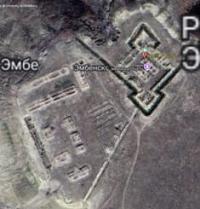
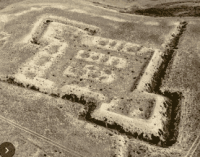
Fortifications of Russian Empire in Central Asia.
"The next day, we moved toward the former Emba fortification, built in 1839. A cold northwesterly wind, with a temperature of 4°C at 4 a.m., blew all day, raising sand and whipping it around like a winter snowstorm. The wind barely allowed us to set up benches; there had been a gust before; but even then, it penetrated every crack in our field shelters, and the entire structure swayed from side to side, despite the ropes holding it in place."
"Ethnographic and Historical Materials on Central Asia and Orenburg Region." M.N. Galkin. 1868.
"Moving march after march, we moved south and, near the southern spurs of the Mogadzhar Mountains and Ust-Urt, reached the small Emba fortification, lost in the steppe. It was to become the center of our reconnaissance and operations, and part of our rifle detachment was to be sent for the winter to reinforce its garrison. Here, having rested a bit from the campaign, we heard the same news:
"The Kirghiz are fleeing south, plundering what they can along the way, and the Emba garrison is forced to be a passive spectator of this unrest in the steppe, powerless to oppose it."
M. Priorov. "In Pursuit of Predators." Russian Review, No. 9. 1896.
Trip to Emba Fortification on Emba River.
Emba fortification is located at an altitude of 241 m. a. s. l., 433 meters from left bank of Emba River, 1.8 kilometers north of small village of Zharkemer, 18.5 kilometers southwest of village of Birlik in Mugadzhar district of Aktobe region.
Emba fortification, along with Uilsky and Temirsky forts, was founded by Russian Empire as a strategic outpost in the second half of the XIXth century. It served as a stronghold for controlling nomadic Kazakh tribes, implementing administrative policies, and securing trade routes, becoming an important link in the development of the region.
The fortification was built to strengthen the Russian Empire's influence in the region, ensuring control over the Ural-Emba steppes. The Verkhne-Emba outpost is a small town located 30 versts from the station of the Kyrgyz Orenburg-Tashkent Railway on the Emba River.
Here, the steppe roads leading from Temir to Kungrad and from Irgiz to the mouth of the Emba River and the Nizhneembensky fortification intersect. From the latter, a caravan route leads to Khiva, via Ust-Urt, to the Uilsky fortification. The fortification was located in a strategically important area of the Emba River, which allowed it to control movement and economic activity in the region.
The fortification was founded in 1870; another source cites 1879 (the original name was Karakamys), when the Embensky outpost (built on the Emba River in 1862) was transferred here. "Each steppe fortification - Uralsky, Karabutaksky, and Embensky - was garrisoned by two hundred Cossacks with 50 infantrymen, two guns, and twelve personnel.
In some places, such as the Embensky outpost, there was an additional special team of up to 170 men. In February, the organizational commissions again set out for the steppe, accompanied by 25 Cossacks and former sultan-rulers. Simultaneously, a detachment of 200 Cossacks with two guns under the command of Captain Novokreshchenov was sent to the Emba outpost to support the commissions and reinforce the garrisons of the steppe fortifications. One hundred Cossacks each were sent to the Ural fortification, the Karabutak fort, and the Iletsk defensive line, while another two hundred were sent down the Ural River.
Nevertheless, this time too, the commissions encountered serious resistance from the local population. The people demanded exemption from the new tax, the abolition of the district administration, represented by tsarist officials, the preservation of freedom of migration, the abolition of land sales, and the election of foremen.”
Geographic coordinates of Emba fortification: N48°32'30 E57°39'40
Authority:
Alexander Petrov.
https://www.vostlit.info/Texts/Dokumenty/M.Asien/XIX/1860-1880/Lobysevich_F/text2.htm