




You are here
E. A. Eversmann. Hunting Saiga Antelopes.
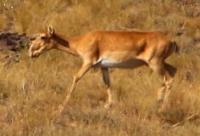
An excursion to observe saiga antelopes in Aktobe Region.
“A saiga flashes past the burial mound, bounding across the field,
Or suddenly, a swarm of locusts descends, their wings a-clatter.”
Aleksey Konstantinovich Tolstoy. Poem “Burial Mound” (“Kurgan”), 1840.
“The steppe seems dead, yet in the distance, saiga antelopes - those wary ‘steppe goats’ - dart by like arrows, their slender legs barely touching the ground.”
Ivan Alexandrovich Goncharov. Sketches from “Frigate Pallada”, 1858.
Observations of saiga antelopes in Korgalzhyn Nature Reserve.
Saiga antelopes live in large herds - numbering several hundred - across the southern and central parts of the Kyrgyz steppes, east of the Caspian Sea: on the Ustyurt Plateau, in the sandy regions near the Aral Sea, and in the vicinity of the Syr Darya River, as well as several degrees of latitude further north.
These regions serve as their primary, permanent habitat, where they remain year-round. In winter, however, a greater or lesser portion of the population migrates southward, depending on the depth of the snowfall; others, conversely, remain even further north, frequenting snow-free areas such as sandy tracts and salt flats.
In the summer, seeking better forage, the saigas move northward, as the grass in the southern steppes dries up completely, scorched by the sun - and where any fodder does remain, the Kyrgyz people graze their own livestock. The hotter and drier the summer, the greater the number of saiga antelopes that migrate into the northern steppes.
Along the border between Orenburg and Uralsk, they reach the Ural River but do not cross it; however, further downstream - between the Ural River and the Caspian Sea - they cross over in immense numbers every year, spreading throughout the Caspian steppe between the Volga and the Ural.
As winter approaches, most of the saiga antelopes head back south, though many remain to overwinter in the vicinity of the Caspian Sea. The large nostrils of the saiga likely facilitate easier breathing when the animal is running at high speed.
Among the Kyrgyz - and, less frequently, the Bashkirs - there is a common practice of widening the nostrils of horses that were born with narrow nasal openings, or of those intended for fast-paced riding. For the saiga, however, these wide nostrils are a source of great torment.
In the spring and summer, the air is thick with myriads of tiny midges; these are constantly drawn into the saigas' nostrils as they breathe, or they fly inside, often driving the animals into a frenzy. In such a state, a saiga may charge straight toward a human, oblivious to everything around it.
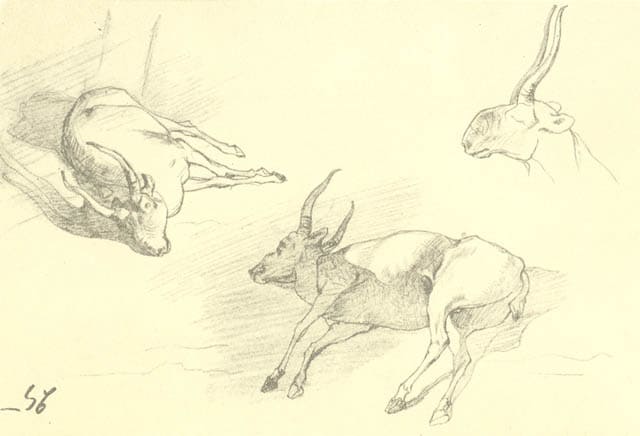
These midges cause misery not only to the saiga but also to humans and livestock. In some places, the air is so densely packed with them that entire clouds drift across the steppe, carried by the wind. Consequently, during periods of intense heat, saigas typically spend the day lying on the slopes of hills, thrusting their muzzles as deep as they can into the openings of animal burrows, where they remain perfectly still.
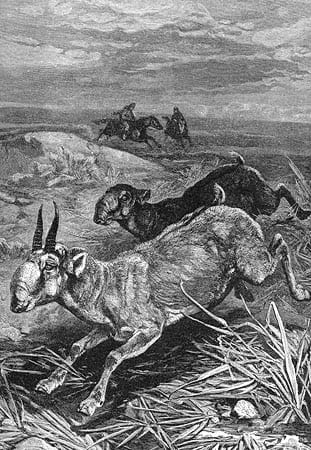
The Cossacks living along the frontier line - particularly in the vicinity of the Orskaya and Guberlinskaya fortresses, where the steppe is hilly - take advantage of the terrain when hunting saiga antelopes; they creep up on the animals and shoot them with small-caliber rifle bullets.
Furthermore, saiga antelopes suffer more than other animals from botflies. During the hot summer months, their bodies become covered in lumps and sores caused by the larvae of these flies. The larvae feed within these sores until it is time to pupate, at which point they drop to the ground to undergo their transformation.
In summer, it is rare to find a saiga hide that is not riddled with holes from these sores; some are rendered entirely useless, bearing as many as 30 to 40 perforations. Consequently, saiga are hunted more in the autumn than in the summer, though, in general, the value of their hides remains very low.
Their meat is not highly regarded in those regions, although it is consumed. The yellow, translucent horns of the saiga are purchased in large quantities along the frontier, transported to Kyakhta, and sold to the Chinese. It is said that in China, the horns are melted down and fashioned into various items - for instance, transparent panels for lanterns and the like.
The substance of a saiga’s horn differs significantly from that of an ox’s horn: it lacks visible concentric layers and is considerably softer and more pliable. Although the saiga’s build is not particularly graceful, its speed is incredible. By moving against the wind or staying hidden behind hills, one can sometimes approach the animals quite closely; it is truly astonishing to witness how rapidly they scatter in a single instant, vanishing beyond the horizon in a matter of seconds.
A horse cannot overtake a young, eight-day-old saiga antelope. In the lower reaches of the Ural region, Cossacks hunt saiga by sneaking up on them through the hollows between sand dunes - always moving against the wind - because, despite their large eyes, these animals have rather poor vision, though their sense of smell is exceptionally keen.
It also frequently happens that the Cossacks kill a large number of saiga antelopes with clubs, specifically as the animals are crossing the Ural River. They always swim in large herds, with the boldest individuals in the lead, while the rest - much like sheep - blindly follow those in front. In such instances, the hunters typically allow the leaders to reach the opposite bank; as the others follow, a great many can be killed before the animals realize what is happening and attempt to turn back.
The Kyrgyz people hunt saiga using a rather peculiar method: on the flat steppe - which is covered in wormwood, the saiga’s preferred food - they construct mounds of earth or turf, each about 3 feet high. These mounds are arranged in straight lines that diverge at an angle of approximately 45-60 degrees.
Near the vertex of this angle, the mounds are placed very close together - only 3 to 5 paces apart - but as they extend outward, the spacing increases, with the outermost mounds situated as much as 70 sazhens (about 150 meters) apart. The wide opening of this V-shaped trap spans about 3 versts (roughly 3.2 kilometers), while the narrow end - which is also left open - is about 15 feet wide. In front of this narrow opening, reed stalks are planted half a foot apart, angled toward the opening with their tapered ends pointing forward.
These reeds are quite sturdy - about as thick as a finger at the base - and sharp at the top, where the plume has been cut away. Once the trap is set, the Kyrgyz wait on horseback; upon spotting a herd of saiga grazing near the wide end of the enclosure, they maneuver to drive the animals inside.
The timid animals mistake the mounds of earth for human beings; not daring to approach them, they flee between the mounds toward the far end, pursued by the shouts of the Kyrgyz. The closer the mounds are to one another, the greater the animals' fear becomes; unable to break away to the side, they attempt a final escape through an opening, only to be impaled on reeds.
It seems almost incredible that an animal as large as a saiga antelope could be pierced to death by reeds, yet it is nonetheless true - I myself witnessed one of our own hunting dogs, while in pursuit of game, run into these reeds and be impaled to death.
On the Ustyurt - or, more accurately, along the upper edge of this escarpment, which the Kyrgyz call the "Cliffs" - they hunt antelopes in the following manner: a suitable area, about 300 paces long and of varying width depending on the terrain, is enclosed by a hastily constructed wall of stacked stones, three or four feet high.
A small opening is left in this wall. Below this area, on the slope, lies a ravine, which is also encircled by a stone wall - one high enough that the antelopes cannot leap over it. Such locations are chosen specifically to minimize the labor required.
A Kyrgyz man then mounts his horse and rides out across the Ustyurt into the steppe - ten, fifteen, or more versts away - to locate a herd of antelopes. By skillfully mimicking the whistling call of a female, he lures the males and draws them along after him.
Leaving his horse behind, he guides them through the opening into the enclosed area, then moves to the other side of the barrier and continues to call out, imitating the female. Immediately after, another Kyrgyz man - who had been hiding until that moment - appears in the opening of the upper trap, shouting; the startled animals, attempting to escape, make a bold leap over the wall into the lower enclosure, where they remain trapped.
Authority:
E. A. Eversmann, *Natural History of the Orenburg Region. Part II: Natural History of the Mammals of the Orenburg Region, Their Habits, Methods of Capture, and Economic Significance*. Translated by V. I. Dal. Kazan, 1850.
https://rus-turk.livejournal.com/162241.html
Photographs by:
Alexander Petrov.