




You are here
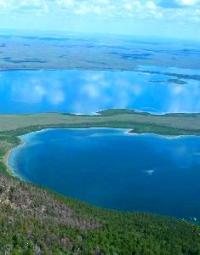
Lake Shortankol in Burabay.
Travel to "Burabay" natural park.
"I know the Kazakhs have their own hero - Aldar-Kose.
He caught up with Allah in no man's land.
Listen, friend, why did you offend him?
You must be so capable.
Or perhaps you never saw the country at all,
Giving the Kazakhs only the steppe.
Where can we, in the scorching rays,
Rest at the end of the road?
No forests, no merciful mountains, no watering hole to be found.
But Allah didn't quite believe it,
Tossed a few stones,
And having gained Kose's trust, he did so,
To be sure. With a hole in his sack,
He saw Allah off on his further journey.
And Allah, unwittingly, rewarded the Kazakh country."
Poem by V. Shcherbakov.
Ecological tour to "Burabay" park.
Lake Shortankol (Shchuchye) is located at an altitude of 395 m. a. s. l. Lake, located east of Shchuchinsky Hills, is 722 meters northeast of Shchuchinsk, administrative center of Burabay District, within Burabay Nature Park in Akmola Region.
The lake covers an area of 14.96 square kilometers, with a shoreline of 17.64 kilometers. The lake extends 6.4 kilometers from southeast to northwest, and its greatest width in the central part is 3.1 kilometers. The lake's name derives from the abundance of pike that once inhabited its waters.
Lake Shaortankol is the deepest of the lakes in Burabay Park, reaching depths of up to 18 meters in the central part. Even on the hottest days, the lake's water remains cold. This is partly due to the fact that 60% of the lake is fed by underground springs.
All lakes in the region are surrounded by pine forests. In Burabay, the mountains are abundant with pine forests, which, near the peaks and on the ridges, retain the character of a pristine forest. At the foot of the mountains, the pine forest is sparsely interspersed with birch, aspen, and poplar.
The pines reach eleven sazhens (11 fathoms) in height. Interestingly, before the Ice Age, oak and alder, not pine, grew here. With the advent of ice, the deciduous forests disappeared, giving way to taiga forests. After the warming, pine forests replaced the taiga thickets.
The pine forest is called the "keeper of water." The forest seems to attract clouds, causing them to rain over it one and a half times more often than over the steppe. The green community collects moisture bit by bit, subsequently feeding it through visible and invisible veins to the forest lakes.
Hydrologists have long discovered that many large and small lakes in the forest zone are connected by underground channels. However, just 70 years ago, channels also existed on the surface. The excess water in one lake compensated for the shortage in the other.
Thus, Lake Auliekol and Lake Kotyrkol were connected by the full-flowing, turbulent Sary-Bulak River. The Gromotukha River, flowing from Lake Auliekol, flowed into Lake Ainakol. And the Kylshakty River, flowing from Lake Shortankol, fed the Kokshetau lakes of Kopa and Chagly.
It was so full-flowing that it was possible to raft down it. They say the forest attracts water. According to meteorologists, Burabay receives one and a half times more precipitation than the surrounding steppe. Thunderstorms are frequent in summer, but fog is almost never present.
The Burabay forest resists wind well, but sometimes it is buffeted by strong snowstorms and blizzards. The region is renowned for its long sunshine hours, surpassing even the sun-drenched resort of Kislovodsk, and for its higher air ionization than other high-altitude resorts.
Lake Shortankol is home to pike, perch, roach, peled, vendace, tench, and even crayfish. Dozens of sanatoriums, health centers, boarding houses, and holiday homes line the lake's shores. Therefore, both those seeking a relaxing and rejuvenating holiday, as well as those who enjoy active recreation, fishing, diving, or simply boating, can find complete relaxation and entertainment.
Geographic coordinates of Lake Shortankol (Shchuchye) are: N52°58'50 E70°12'25
A source:
Guide to Kazakhstan. Edition of the Ministry of Tourism and Sports.
Photos by:
Alexander Petrov.