



Вы здесь
Tulipa jansii.
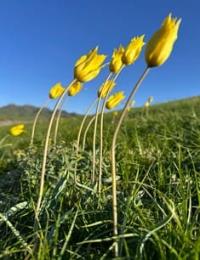

Tulipa jansii J.J. de Groot & Zonn.
“Your face is a rose, your tresses are musk,
Your cheeks are a tulip, your stature a cypress.
In the garden of eternity, God created you,
So that the world might forever shine and radiate because of you.”
Omar Khayyam. “Rubaiyat” (“Tarab-khaneh”), XIXth century; “Bodleian Manuscript,” 1460 (dating from 1070-1110). Samarkand, Isfahan, Nishapur.
International Rock Gardener.
Tulipa jansii, J.J. de Groot & Zonn, a new specie.
Description:
The bulbs are pear-shaped and covered by a dense, reddish-brown tunic; the inner surface of this tunic, near the top (at the neck), is covered with short, felt-like hairs. The flowering stem is 123 mm tall, greenish with a brownish tint, and glabrous (smooth-hairless).
There are three leaves; they are narrow, lanceolate, glaucous-green, straight, and channeled. The narrow, translucent margins of the leaves are covered with short hairs. The basal leaf is situated at ground level and measures 108×9 mm. The second leaf measures 84×4 mm, and the third measures 76×3.5 mm
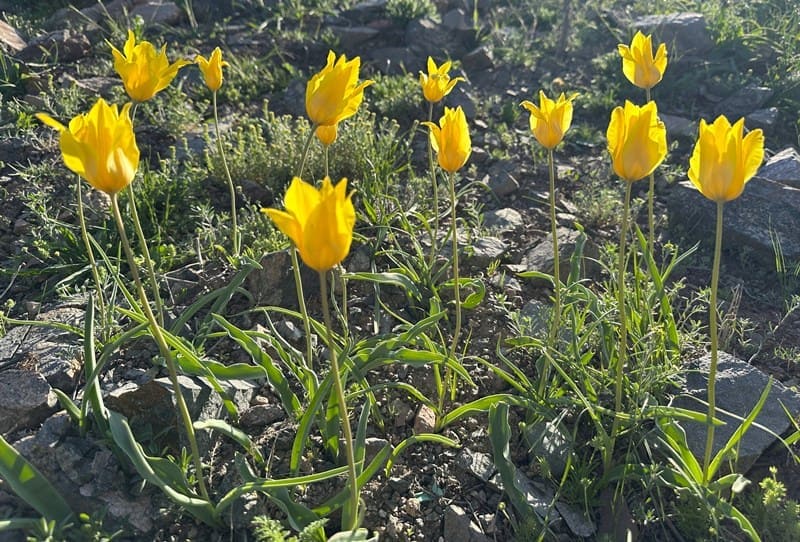
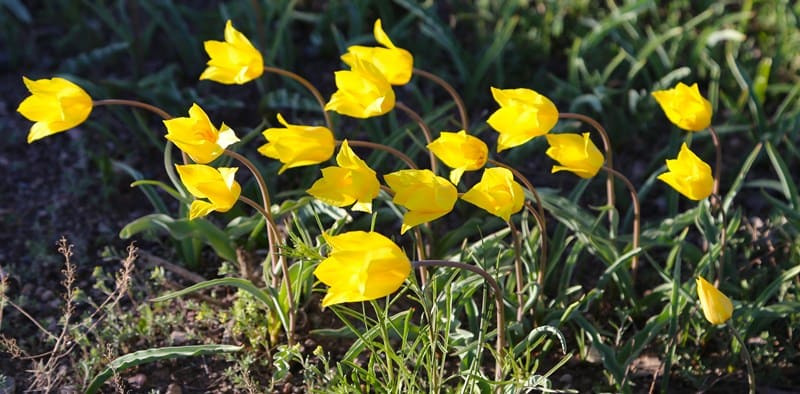
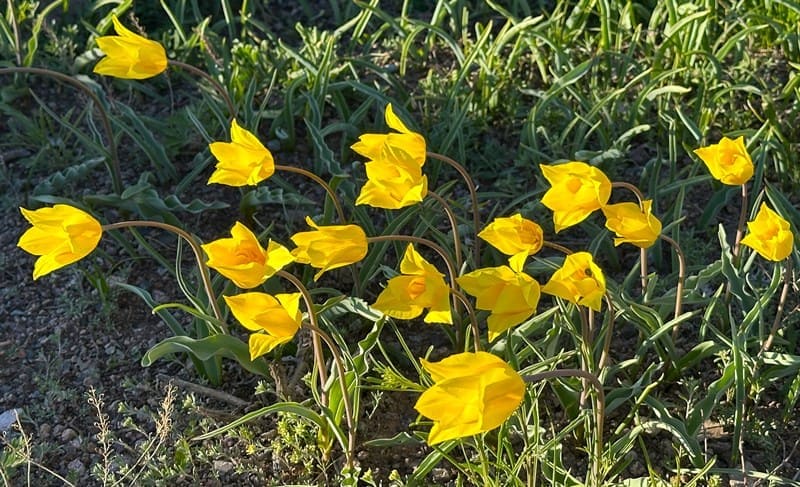
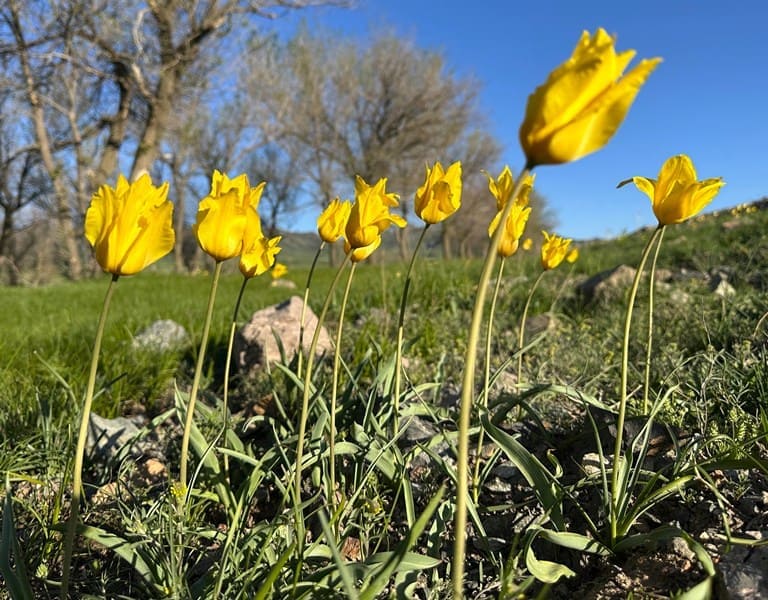
The flower is yellow and pointed; the outer perianth segments (tepals) are lanceolate, measuring 30×10 mm, with their tips and adjacent margins covered in short hairs. The inner perianth segments are obovate, measuring 28×11 mm. The stamens are yellow and of equal length (11 mm); the filaments are narrow, nearly straight, and 5 mm long.
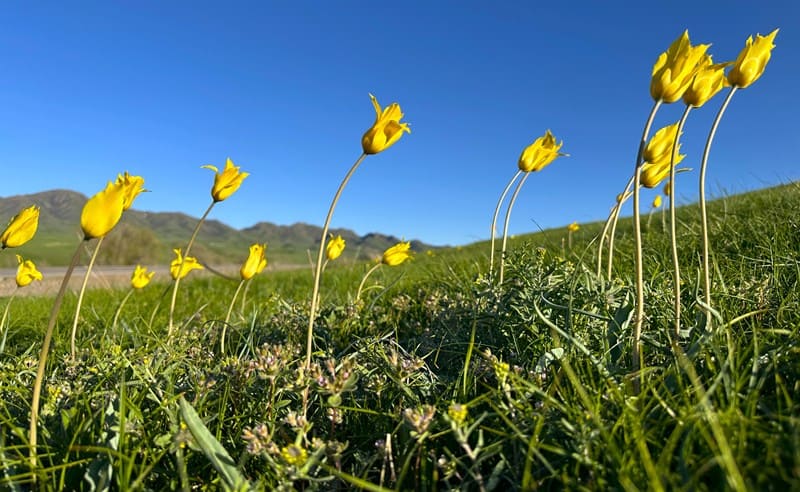
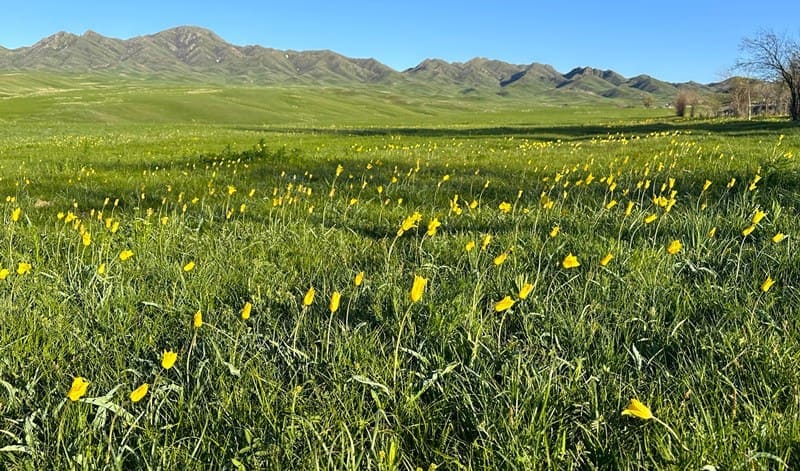
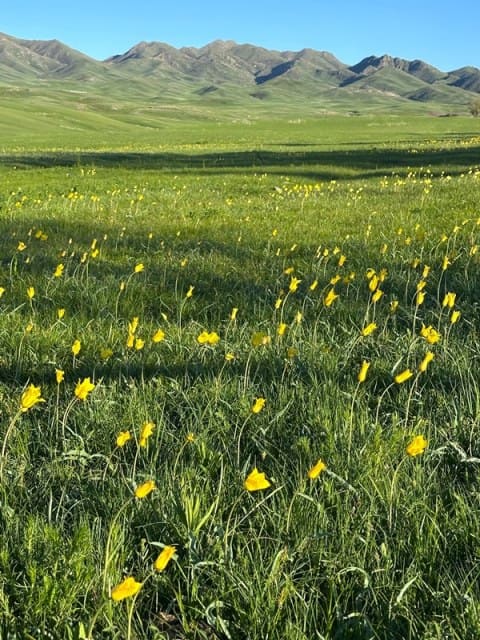
The ovary is straight, light green, and 8 mm long. The stigma is yellow, with prominent lobes. (T. Jansii) is the only member of the section (Kolpakowskianae) that produces stolons. The species (T. Jansii) belongs to the subgenus (Tulipa Kolpakowskiana). In its natural habitat, it grows in sheltered locations within the steppe zone situated between the western foothills of the Dzungarian Alatau (to the east) and the Chu-Ili Mountains (to the west), in the Almaty Region (southeastern Kazakhstan).
Type form.
Material collected in the wild in the Ili River valley, north of Kapchagay; holotype: L4513065. The species was first discovered in 2005 during a visit to a site where (Tulipa behmiana) grows in Kazakhstan; a yellow patch apparently consisting
f more than a hundred flowering tulips - was observed at the base of a rock formation, covering an area of only a few square meters.
Initially, they were mistaken for a long-stemmed form of the steppe species (T. Kolpakowskiana); however, a population of red-flowered tulips, identical in appearance, was later found at another location also at the base of a rock formation. Among the nearby shrubs, there were clusters of yellow, orange, and red tulips each cluster consisting of plants of a single color.
Upon excavation, it was revealed that the bulbs are very small and possess stolons. Furthermore, these bulbs lacked the long, fibrous apex characteristic of (T. Kolpakowskiana). When revisiting the site in 2023, we found only a few flowering specimens, along with a number of non-flowering plants that were half the size of those previously observed there.
In another year, further east along the road to Taldykorgan we discovered this tulip in large numbers among rows of planted trees. These plantings serve to protect roads and railways from snowdrifts blown in from the steppe during the winter.
This recently described species grows to the north of the range of the steppe tulip (T. Kolpakowskiana) (partially overlapping with it), while its eastern range borders the distribution area of (Tulip Corynestemon). It is difficult to cultivate; the plants perish quickly.
(Tulipa jansii) is named after Harry Jans, a well-known traveler.
Literature:
Botschantzeva, Z.P. 1982. Tulips: taxonomy, morphology, cytology, phytogeography and physiology. Translated and edited by H.Q. Varekamp. A.A. Balkema. Rotterdam.
Everett, D. 2013. The Genus Tulipa. Royal Botanic Gardens Kew.
Govaerts, R. 2017. World Checklist of Tulipa. Facilitated by the Royal Botanic Gardens, Kew. Published on the internet; http://apps.kew.org/wcsp/
Retrieved 05/10/2017 Hall A.D. 1940 The Genus Tulipa.
Ivaschenko A. 2005 Tulips and other bulbs plants of Kazakhstan.
Regel E. Acta Hort. petrop. 5- 1877
Veldkamp J.F., Zonneveld B.J.M. The infrageneric nomenclature of Tulipa (Liliacaea). revised. Plant Syst Evol. 298-1:87-92
Vvedensky A.I. in Komarov V.L. (ed) 1935 (1968). Flora of U.S.S.R. Vol. VI, 267p. Israel
Program for Scientific Translations. Jerusalem.
Zonneveld, B.J.M. 2009. The systematic value of nuclear genome size for ‘all’ species of Tulipa L. Plant Systematics and Evolution 281: 217-245.
Zonneveld, B.J.M. 2012 T. kolbintsevii., a new species from Eastern Kazakhstan. Plant Systematics and Evolution Vol 298, issue 7-2012
Authority:
https://www.jansalpines.com/news/
International Rock Gardener. www.srgc.net
Tulipa jansii.
Division: Magnoliophyta
Class: Liliopsida
Order: Liliales
Family: Liliaceae
Genus: Tulipa
(Tulipa jansii J.J. de Groot & Zonn.) is a wild tulip species belonging to the family Liliaceae. It was described by Dutch botanists Jacques J. de Groot and Ben J. M. Zonneveld renowned researchers who have made significant contributions to the study, classification, and description of new wild plant species (particularly tulips) in Central Asia.
The species is named after Harry Jans, a prominent Dutch botanist, traveler, and expert on alpine plants; the herbarium specimens of this plant were collected during an expedition in which he participated. Dr. Ben Zonneveld, from Leiden University, is a world-renowned expert in plant genetics who has determined the evolutionary relationships among wild tulips by analyzing their DNA content (genome size).
In collaboration with Jacques J. de Groot, he has made numerous botanical discoveries across Kazakhstan and Kyrgyzstan.
Among the tulip species they have discovered or described are:
(Tulipa kolbintsevii) - found in the Dzungarskiy Alatau mountains (Kazakhstan).
(Tulipa annae) - found in the Kazakhstani Altai; named after the prominent Kazakhstani botanist Anna Andreyevna Ivashchenko.
(Tulipa dianaeverettiae) - found in the Altai Mountains, Western Mongolia. (Tulipa lemmersi) (Lemmers’ tulip) was discovered in the Mashat Canyon (in the Shoshkabulak and Mashat-Tau mountains, which are spurs of the Talas Alatau range). The species was found in the spring of 2005 by Dutch researcher Arie Peterse during a botanical expedition.
The expedition was organized by Wim Lemmers, a prominent expert on the wild flora of Central Asia, after whom the new flower was named. The bulbs were brought to the Netherlands, and it was only after they bloomed in 2008 that scientists were able to fully confirm the plant's uniqueness.
A genetic DNA analysis, conducted by Dr. Ben Zonneveld in 2009, definitively proved that it is an entirely new, distinct species of tulip, possessing the smallest genome size within its section (Kolpakowskianae). The official scientific description (Tulipa lemmersii Zonn., Peterse & J. de Groot) was published in 2012.
(Tulipa kujukense) Kujuk tulip - for a long time, this tulip was not recognized as a separate species. In terms of its external characteristics (morphology), it is very similar to two other Central Asian species: (Tulipa orthopoda) and (Tulipa bifloriformis).
In recognition of the contributions made by Zonneveld himself, one of the Central Asian species was named in his honor: (Tulipa zonneveldii). Taxonomy and botanical description of (Tulipa jansii). Section: It belongs to the section (Kolpakowskianae).
Range of Tulipa jansii.
An endemic species of Central Asia (primarily Southern Kazakhstan). Its range borders that of (Tulipa kolpakovskiana), and it occasionally grows alongside it, though it is generally found to the north of the latter’s primary distribution area. Locations include the Almaty Region, the southwestern part of the Dzungarskiy Alatau, the Ili River canyon near the Kapshagay Reservoir, the southwestern spurs of the Dzungarskiy Alatau, the Malay-Sary Mountains, and the upper reaches of the Arkharly Pass.
Bulb of Tulipa jansii.
Small and pear-shaped, the bulb is covered by a dense, reddish-brown tunic; the inner surface near the apex (the "nose") is lined with short, felt-like hairs. The primary feature distinguishing (Tulipa jansii) from other members of the section (Kolpakowskianae) is its ability to produce stolons (underground shoots).
Furthermore, its bulbs lack the long, fibrous "neck" extension characteristic of (T. kolpakovskiana).
Stem and leaves of Tulipa jansii.
The stem is smooth, approximately 12 cm tall, and greenish with a brownish tint. The plant bears three narrow, lanceolate, glaucous-green leaves with a channeled surface and translucent, finely hairy margins. The basal leaf lies almost flat against the soil surface.
Flower of Tulipa jansii.
Solitary and pointed. The coloration ranges from bright yellow to orange and red. The outer perianth segments (petals) are lanceolate (approximately 30×10 mm) with short hairs near the tip, while the inner segments are obovate. The stamens and anthers are yellow, and the pistil is light green with prominent, protruding stigma lobes.
Cultivation characteristics and status of Tulipa jansii in horticulture.
This plant is considered highly temperamental in collections and gardens; under artificial conditions, it tends to perish quickly (often due to rotting or other causes of decline).
Significance of Tulipa jansii.
It is of great scientific interest for the study of the phylogeny and evolution of wild tulips from Central Asia. It is an entirely new species described as a new species rather than merely a revised or "re-described" form of (Tulipa kolpakowskiana).
Although (Tulipa jansii) is indeed very closely related to (Tulipa kolpakowskiana) and belongs to the same section (Kolpakowskiana), botanists Jaap de Groot and Benjamin Zonneveld have classified it as a distinct species based on key morphological and biological differences not found in (T. kolpakowskiana):
The primary unique feature: (Tulipa jansii) is the only known member of its section capable of producing stolons (underground shoots). (Tulipa kolpakowskiana) reproduces differently and does not form stolons. Thus, this is not a revision of an existing species, but the discovery of a separate taxon possessing unique genetic and anatomical traits. In the field, botanists, travel photographers, and nature enthusiasts long mistook this plant for a variant of Kolpakovsky’s tulip (Tulipa kolpakowskiana).
There is a striking external resemblance between (Tulipa jansii) and (Tulipa kolpakowskiana Regel).
The shape of the flower, the bright yellow or reddish coloration of the petals, and the overall proportions are indeed very similar. Distinguishing between them with the naked eye in a natural setting is incredibly difficult.
Overlapping ranges:
These tulips often inhabit similar ecotopes and their geographical ranges overlap; consequently, in Kazakhstan, populations of (Tulipa jansii) long remained hidden in the "shadow" of the better-known and more widespread species its more common relative.
The complexity of genus taxonomy:
The genus Tulipa is traditionally considered one of the most difficult to classify. Many species within a single section are incredibly plastic, varying significantly in color and size; consequently, distinguishing between them was nearly impossible until detailed analysis of their bulbs (which is when the stolons were discovered) and genetic studies were conducted.
Prior to its formal scientific description in 2010, this flower simply led a secretive existence under the "name" of its neighbor. This is a common occurrence in botany: a plant may have always existed, but it had to wait for a researcher to take notice of its subtle, hidden anatomical details.
Authority and photographs by:
Alexander Petrov.