




You are here
Lower Ili River.
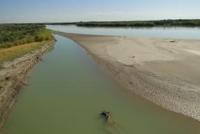
A Journey along Ili River.
"At the mouth of the Ili, the Kyrgyz set tiger traps consisting of several alert logs, to which knives are often attached for greater security. But these structures are generally no match for the beast's strength; the tiger, having destroyed them, escapes and subsequently takes revenge on people and livestock."
A. M. Nikolsky. "Journey to Lake Balkhash and Semirechye Region." 1885.
Ili River in Almaty Region.
Four huge waterways flow through Kazakhstan: the Irtysh, Ural, Syr Darya, and Ili. While these rivers and their basins are natural communication routes, they still offer far less than can be achieved with modern technology and culture. The Ili River, which begins with one of its branches within China and ends in Central Kazakhstan, is the most underdeveloped in this regard.
Only comparatively recently has a small amount of navigation been established along its middle section. There are no large settlements along the river's entire length, with the exception of the industrial settlement of Iliysk, located on the Turkestan-Siberian Railway, 70 km from Almaty.
The lower basin of the river, which encompasses its delta and the adjacent Tau-Kum sands to the west and the Sary-Ishik-Otrau sands with ancient bakanas beds to the east, is underdeveloped but holds great promise. This region is distinguished by its unique geographical location.
To the north, it is close to Lake Balkhash, home to one of the largest copper mining bases in the Soviet Union. To the south, beyond a strip of wormwood steppes, it is bordered by the Turkestan-Siberian Railway. The Ili River Delta is, first and foremost, a mass of water trapped within an impenetrable jungle of reeds and shrubs.
The water here spreads through large and small channels, gleams with a smooth, mirror-like surface in oxbow lakes and lakes, and stagnates to the point of giving off a putrid smell in the swamps. The land here is low-lying and damp, but in places it is heaved by mounds of sand, dimly visible in the hazy horizons.
Rarely are these patches of land, lost in the lush vegetation, convenient for travel. The landscape in Tau-Kum and Sary Ishik-Otrau is different. Here, the area is covered with turf (overgrown) sandy ridges and wide loamy plains. Water is hidden in the ground, and the surface is dry, like ash or burnt brick.
Tusks of gray, stiff grasses - wormwood, selenium, feather grass, and others - stem from the soil. Thorny bushes, battered by sandstorms, are scattered in sparse clumps. Haloxylon forests stretch over vast expanses. Natural resources are also varied.
The river delta abounds with fish, wild boar, and other game. Muskrats were introduced here several years ago, and they have now multiplied in enormous numbers. Along the shores of Lake Balkhash, there are many lakes with salt deposits that have separated from it.
The Tau-Kum and Sary-Ishik-Otrau sands are rich in winter pastures. The loamy plains can yield tens of thousands of hectares for irrigated agriculture. Saxaul forests provide colossal fuel reserves. Currently, the main industries in the lower reaches of the Ili River are hunting and fishing.
The main hunting species is muskrat, the income from which accounts for the majority of the local budget. The region's proximity to the railway and its connection via Lake Balkhash with Central and Eastern Kazakhstan, and via the river with the Almaty and Jarkent oases, as well as with the Kuldja province of Xinjiang, raise the question of developing the lower reaches of the Ili River into a highly profitable region of the republic's economy.
Here, the prospect of using the Ili River for hydroelectric power generation naturally arises.
Thus, problem of developing lower reaches of Ili River boils down to following main objectives:
1) developing the muskrat and fisheries;
2) exploiting the saxaul forests;
3) irrigating several hundred thousand hectares of land in the Bakanas area;
4) organizing winter pastures and livestock farming;
5) exploiting salt deposits and other mineral resources, etc.
To practically resolve these problems, and to ensure that the interests of all promising economic sectors are not in conflict with one another but are closely interrelated, a comprehensive knowledge of the region is essential. This has been achieved through many years of work by the Academy of Sciences of the Kazakh SSR.
Currently, the development of the lower reaches of the Ili River is well underway.
Authority:
"Nature of Kazakhstan in Essays and Pictures." N.N. Palgov. Publishing House of Academy of Sciences of Kazakh SSR. Alma-Ata. 1950.
Photos by:
Alexander Petrov.