




You are here
Alabuga River in Kyrgyzstan.
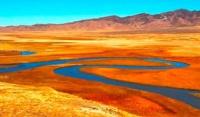
Alabuga's tributaries are Arpa and Pychan Rivers.
"And even in summer there is a coolness from the mountains,
From the high snows and never-melting ice
Water cascades, the roar rolls
Of a waterfall dressed in rainbows."
Ilyas Dzhansugurov. "Summer."
A journey through Alabuga River Valley in Kyrgyzstan.
Alabuga River is formed by confluence of two rivers: Arpa and Pychan. At an altitude of 2,093 m. a. s. l., it is a left tributary of Naryn River and flows through Aktala District of Naryn Region. Mouth of Alabuga River is located at an altitude of 1,530 m. a. s. l.
The river's sources originate on the northern slopes of the Fergana Range, Torugart Too and At-Bashi, and flow through a vast intermountain valley between the Akshiyrak Range to the west and the Baybiche Too and Djaman Too to the south. The river is 180 kilometers long, with a drainage basin area of 5,820 square kilometers.
The river begins in the Arpinskaya Depression, where it receives 70% of its water. It flows west along the southern slopes of the Djamanty Range. It then turns north, crosses the range through a narrow canyon, enters the Alabuga Depression, and flows northeast for 85 kilometers along the Akshiyrak Range.
In the lower reaches, the river valley ranges from 2 to 4.5 kilometers wide and 500 to 800 meters deep, relative to Neogene and Quaternary lake sediments. The valley is filled with pebble and boulder alluvium for 50 to 150 meters, into which the modern river canyon, 50 to 130 meters deep and up to 1 kilometer wide, cuts.
Due to its steep slope, the river inclines rapidly, averaging 10 to 20 centimeters per year. Its main source of water is snowmelt and glacier water. Floods occur from May to October. The average annual water flow is 26.5 m3/s. It is used for irrigation.
The main tributaries are the Guyuksu (Jamandavan, right), Makmal (left), Jergetal (right), Pychan (left), Kashkasu (right), and Karakal (left). The average annual water flow is 903 million cubic meters. Settlements located along the banks of the Alabuga River include Kosh-Dyube, Jerge-Tal, and Konorchok.
Several hot springs are located in the river basin: springs at the headwaters of the Ak-Terek, a tributary of the Alabuga, and the Alabuga-Naryn warm springs near the river's mouth.
History of Alabuga River.
In the 9th and 10th centuries, one branch of the Great Silk Road passed through the river valley.
Geographic coordinates of beginning of Alabuga River: N41°00'41 E74°15'14
Geographical coordinates of Alabuga River: N41°14'41 E74°29'48
Geographical coordinates of mouth of Alabuga River: N41°25'52 E74°41'48
Authority:
https://ru.wikipedia.org/wiki/%D0%90%D0%BB%D0%
Photos by:
Alexander Petrov