





You are here
Baizak Batyr Mausoleum.
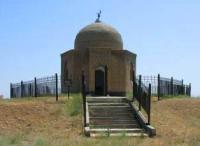
Tour of Baizak Batyr Mausoleum.
"The river of time in its rush
Carries away all the deeds of men
And drowns in the abyss of oblivion
Nations, kingdoms, and kings."
"The river of time in its rush..." (known as "Towards Mortality"). Gavriil Romanovich Derzhavin. 1816.
Architectural monuments of Baizak District.
Baizak Batyr Mausoleum is located at an altitude of 558 m. a. s. l. on a hill in the western part of the Syrtbeldyk Mountains, located 1 kilometer off the bypass road around Taraz, 5.1 kilometers northeast of the village of Sary-Kemer, 5.1 kilometers south and slightly west of the small village of Askarbay, 6 kilometers southwest of the village of Tegistik, 775 meters from the right bank of the Talas River, on the border of the Dihansky and Sary-Kemersky rural districts, in the Bayzaksky (formerly Sverdlovsky) district of the Zhambyl region.
Bayzak Mambetuly, also Bayzak-bi (Kazakh: Байзақ би, Байзақ Мәмбетұлы; 1789, Taraz - 1864, Shymkent) - batyr, participant in the anti-Kokand uprising of 1821 led by Tentek-tore. The uprising was brutally suppressed, and Baizak was appointed head of the Kazakh Dulat tribe (Datkha).
In 1858, Baizak led another joint uprising of Kazakhs and Kyrgyz against the Kokand Khanate. He became a trusted ally of Sultan Kenesary in his rebellion against the Russian Empire. His sarbazes, joining Kenesary's troops, captured several Kokand fortresses in 1841 and also participated in the conquest of the Sozak region.
In 1860, near Almaty, in Uzyn-Agash, he and his detachment fought in the Battle of Uzungach against the troops of Tsarist General Gerasim Alekseevich Kolpakovsky. Under the leadership of Baizak and his sons, a 160-kilometer-long system of irrigation canals was dug, which still serve the residents of the area around the city of Taraz.
Baizak was one of the eight sons of the famous Kazakh batyr Mambet Baizak, in turn, had 17 sons, one of whom, Akmold, later also became a batyr and received the rank of captain in the Russian Imperial Army for being among the first to storm the Aulie-Ata fortress with his warriors. In the summer of 1864, unable to bear the oppression the Kokand government inflicted on the regional nomadic population, he sent his son Akmold to the Russian troops stationed near Aulie-Ata, proposing that they unite in the fight against the Kokandis.
Upon learning of Baizak's actions, the ruler of Kokand, Mulda Alimkul, ordered his capture and delivery to Tashkent. In August 1864, on Alimkul's personal orders, the 75-year-old Baizak was sentenced to a severe punishment. By order of Alimkul, the ruler of the Kokand Khanate, Baizak was tied to a cannon and blown to pieces by a shot.
His remains were buried in the village of Sary-Kemer on the banks of the Talas River. The harsh punishment meted out to this old man and hero, who bore his name among the people, led to an uprising by the clans of the Great Zhuz against the Kokandis and also contributed to the defection of most of them to the Russians.
The Baizak Batyr Mausoleum was built in 2000 on the site of the destroyed monument. The architect was A. Momynzhanov. In 2017, plans were underway to carry out a major overhaul of the Baizak Batyr monument, including improvements to access roads, lighting, and landscaping.
Geographic coordinates of Baizak Batyr Mausoleum are: N43°02'50 E71°32'55
Authority and photos by:
https://www.madenietmura.kz/ru/article/mavzolej-bajzak-batyra-mambetuly/