




You are here
"Japanese road" in Big Almaty gorge.
History of Big Almaty Gorge.
"The less the story is true, the more enjoyable it is."
F. Bacon.
Walk along «Japanese road» in Big Almaty gorge.
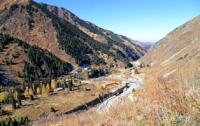
Technological road is located on western (right) slope in Big Almaty gorge at an altitude of 1738 to 1900 m. a. s. l., on northern slope of Zailiysky Alatau ridge, on territory of Ile-Alatau natural park in Bostandyk district of Almaty.
The beginning of the road is located in the southeast, 1.6 kilometers from the mouth of the Ayusai River. From the visitor center of the Ile-Alatau Park, the beginning of the road is 1.2 kilometers up the gorge. A bit of history about the construction of a cascade of hydroelectric power plants in the Big Almaty Gorge.
From HPP-1 for about 7 kilometers in the 50s of the last century, an underground water conduit was laid along the western slope of the gorge at an altitude of 1900 meters above sea level to the beginning of the pipe that leads to HPP-2.
The difference in height from 1 HPP, where the underground pipeline begins, to the beginning of the pipe above HPP-2 is 38 - 40 meters.
After the construction of the water conduit, a 5.8 km long technological road remained, which starts from the right bank of the Bolshaya Almatinka at an altitude of 1738 m. a. s. l. The road traverses the western slope from the southeast to the northwest and leads to an altitude of 1900 meters above sea level, where a pipeline starts from the hydroelectric power station-1 emerges from the slope of the gorge.
Local tourists called this road Japanese, apparently in memory of Japanese prisoners of war participating in the construction of separate buildings in the city of Almaty. At this time, the technological road is used for walking and is very popular among tourists.
Participants in construction of hydroelectric power plant cascade in Big Almaty Gorge.
There are many different opinions about the participants in the construction of the hydroelectric power plant in the Big Almaty Gorge. Since the hydroelectric power plants were considered strategically important in the republic's energy infrastructure, it is unlikely that Japanese or German prisoners were employed in their construction.
The construction was carried out using the popular construction method, involving over 6,000 city residents, military personnel, and prisoners. Regarding prisoners involved in the construction of the hydroelectric power plant, Japanese prisoners of war did not participate in its construction, and this was strictly prohibited.
The creation of the cascade of hydroelectric power plants in the Big Almaty Gorge was one of the largest engineering projects of the Soviet era in the mountainous region of the northern slope of the Trans-Ili Alatau. The work was carried out in exceptionally challenging natural conditions – in a narrow, high-mountain gorge with steep slopes, active geodynamic processes, seasonal floods, and a harsh climate.
The construction of the cascade was carried out by workers and specialists from Almaty, as well as a contingent of prisoners who were forced to perform heavy earthworks, mining operations, and auxiliary work. The use of prisoners of war on these projects was prohibited, as the hydroelectric facilities were of strategic importance for the power supply of Almaty and the surrounding industrial areas.
In the post-war era, the security and control of energy infrastructure facilities were considered a national priority. The bulk of the work was carried out manually or with a limited amount of mechanized equipment. Diversion channels, tunnels, and pressure pipelines were laid in mountainous conditions, and dams, water intake facilities, and turbine buildings were constructed.
A significant portion of the future utility lines ran along the rocky sides of the gorge, requiring drilling and blasting operations and the construction of retaining walls. Construction in the rugged mountainous terrain presented particular challenges: landslides, rockfalls, and mudflows repeatedly destroyed temporary roads, construction sites, and auxiliary structures.
Work was carried out under tight deadlines, often year-round, given the short construction season at high altitudes. Prisoners were primarily used for unskilled and physically demanding tasks - excavation, stone transportation, construction of earthen dams, and riverbed clearing.
Engineering calculations, equipment installation, hydraulic engineering, and commissioning were performed by civilian specialists, hydraulic engineers, and power engineers. The construction of the hydroelectric cascade not only ensured a stable power supply for the city but also marked an important stage in the development of the Zailiskiy Alatau mountainous areas.
Roads, power lines, and a technical settlement were built along the gorge, further facilitating the development of infrastructure, research stations, and recreational facilities. Today, the hydroelectric power plants of the Big Almaty Gorge are perceived as an organic part of the mountain landscape, but their quiet operation conceals the labor of thousands of people who carried out their construction in conditions where engineering constantly collided with the power and unpredictability of the mountainous landscape.
Japanese prisoners of war in the Big Almaty Gorge worked near the current dam, harvesting stone. Soviet prisoners of the free settlement, commonly known as "chemists," participated in the construction of the hydroelectric cascade and associated structures.
For the prisoners, a penal colony-settlement was built 100 meters above the First Hydroelectric Power Plant. It consisted of solid brick and stone (wild stone) houses, a dining hall, kitchen, medical unit, clubhouse, and punishment cell. The punishment cell still exists today on the grounds of the former penal colony-settlement. Its premises consist of a common corridor and four 4 x 2-meter cells with massive metal doors.
Each cell has a small barred window and a stove. In the mid-1970s, the penal colony was converted first into a pioneer camp, then into the "Kommunalnik" holiday home, which began to be intensively demolished in the early 2000s. Information about this was published in the newspaper "Central Asia," published in Almaty and Bishkek in the early 1990s.
Research into the history of the Big Almaty Gorge and the construction of the hydroelectric power station was conducted by an Italian journalist in 1992, who met with residents of the village of Kazachka, located near the mouth of the Kazachka River.
Almost 150 meters south of the Second Hydroelectric Power Station was the power workers' settlement of Kokshoky.
Geographic coordinates of technological road in Big Almaty Gorge: N43°06'24 E76°56'56
Authority and photos by:
Alexander Petrov.