




You are here
Jaudir Ana Mosque-Madrasah.
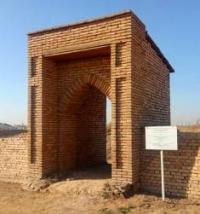
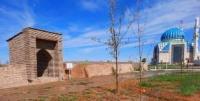
Tour of Jaudir Ana Mosque-Madrasah.
"After making copies of the best-preserved inscriptions found on them, Mr. Lerch examined the remains of a small fortification known as Mir, located six versts from the Sabran fortress, and then proceeded to Turkestan. There, he undertook a study of the local mosque, erected in 1404 over the remains of the Turkestan holy man Ahmed Yasawi. This mosque is the most significant in Central Asia. In addition to the saint's tomb, the site houses the graves of Timur’s great-granddaughter Rabia-Begim (daughter of the renowned Ulugh Beg, who died in 880 AH / 1475–1476 AD); Abulkhayr-Suyunj-Khoja Khan (who died in 931 AH / 1524–1525 AD) and two of his sons, a grandson, and a daughter; prominent members of the Qongrat clan who died in the first half of the 16th century; as well as Turkestan Sheikh-ul-Islams and Kyrgyz sultans."
"Archaeological Expedition to Turkestan Region in 1867 by P. Lerch." St. Petersburg. Printing House of Imperial Academy of Sciences. Vasilyevsky Island, 9th Line, No. 12. 1870.
Mausoleums of Khoja Ahmed Yasawi architectural complex.
Jaudir Ana Mosque-Madrasah is located at an altitude of 209 m. a. s. l., 779 meters southeast of Akhmet Yasawi Mausoleum, in northeastern part of First President's Park, on grounds of "Azret Sultan" Historical and Cultural Reserve and Museum in city of Turkestan.
One of the madrassah mosques that operated in the first half of the XXth century in the city of Turkestan is remembered by locals as the Zhaudir Ana Mosque. It is located in close proximity to a historic site covering 88.7 hectares and belonging to the Azret Sultan State Historical and Cultural Reserve and Museum.
The following information is available about Zhaudir Ana, who was educated at the Turkestan mosque in the 1840s and became a healer. Zhaudir Ana, who arrived in Turkestan, spent most of her life in the vicinity of the Khoja Ahmed Yasawi Mausoleum.
She taught at the madrassah and cultivated a garden. Her moral deeds, as well as her teaching and gardening activities, remain etched in the memory of the local people. Zhaudir was born in 1810 with congenital illnesses that only improved when she was 10 years old.
At 15, he became a renowned beauty. At 18, in 1828, she married a man named Zhappas from the Ungut tribe, and they had a daughter. But later, during the wars, her husband and then their daughter died, after which she returned to Turkestan.
There, she received an education and became a healer. According to researcher Kadirbay Sarmoldayev, she directed the Akhmet Yasawi madrasah-mosque in the 1840s. At that time, she was 30 years old. Zhaudir visited Mecca twice. According to these data, in 1914, Satbay and Samurat volost residents arrived in Turkestan and brought Zhaudirana back home with a call to "open a mosque and set an example."
According to the source, they agreed that she would teach children and build a mosque. According to the source, under her terms, a mosque was built in the Kostanay region, in the Kamystinsky district, between the Karasu and Kindikty rivers, under Aulie Azim.
According to these sources, Zhaudir ana died at the age of 100 in 1918 and was buried next to Azim Aulie. Political, economic, and other circumstances of 1918 prevented Zhaudir ana from being buried in Turkestan. Zhaudir ana spent over 60 years of her life near the Khazret Sultan building.
She ran the mosque, taught, and healed. Zhaudir ana worked in the mosque and contributed to the students' education. In medieval Turkestan, which changed the political situation and elevated culture, mosque-madrasas had a great influence. In the XIVth century.
The mausoleum of Khoja Ahmed Yasawi, built by order of Temerlane, changed religious views in the city and region and contributed to the construction of numerous mosques and madrassas. According to A. I. Dobromyslov's work "The City of the Syr Darya Region": before the Russian conquest in 1864, there were 20 mosques in the city of Turkestan.
After the Russian conquest in 1908, the number of mosques increased to 41, and the number of madrassas to 22. From 1934 to 1939, all religious sites in Turkestan - Russian churches, mosques, and madrassas - were closed and demolished.
The Bab Arab Mosque, the Kok Mosque, and the Jaudir Mosque-Madrassah were demolished then. In 2013, the archaeology department of the Azret Sultan State Historical and Cultural Reserve and Museum conducted archaeological excavations at the Jaudir Ana Mosque-Madrasah.
The excavations revealed that the Jaudir Ana Mosque-Madrasah is surrounded by streets on four sides. At the center of these four streets, the mosque's trapezoidal courtyard is enclosed by a thick, high fence. After deepening the excavation by 20 cm, the upper construction layer is clearly visible.
This structure was the main structure of the Jaudir Mosque, built in the 19th century and consisting of three parallel rooms. In the center of the southwest wall, in one of the rooms, there is a mihrab - a 2.4-meter-wide, 1-meter-deep recess. The interior and two frames are completely plastered and decorated with carved floral patterns.
A stone plaque stood on the threshold. The mosque and its canopy could accommodate 240-250 Muslims simultaneously, exceeding 1,000 people if the mosque's 2,300-meter courtyard is included. Discovered ceramic fragments indicate that this structure was built on the site of an earlier building dating back to the late XIVth century.
The resulting madrasah consisted of seven rooms of varying sizes. The mosque's courtyard was entered through a large gate installed on New Shahar Street, which runs along the eastern side. At the beginning of the XXth century, the oldest (XIVth century) and most famous of the 62 mosques in Turkestan and its environs - the Jaudir Ana Mosque-Madrasah - was the only religious center elevated to the rank of an educational institution for training Quran reciters from a regular mahallalik mosque.
Among the mosques of Turkestan, it occupies a special place as a training center for more than 60 of the aforementioned mosques (a "qari" is someone who has completely memorized the Quran), where only the most eminent scholars teach, who can deeply understand, analyze, translate, and convey the meaning of the Quran, hadith, and Sharia.
Authority and photographs:
Alexander Petrov.
https://azretsultan.kz/rus/mechet-medrese-zhaudir-ana/
In 2013, the Turkestan detachment of the Turkestan Exploration and Exploration Service primarily conducted research on the sites of spiritual and religious structures. The Zhaudir Ana Mosque (15th-19th centuries) and the Khan's Mosque (16th-18th centuries) in the city of Turkestan were excavated and surveyed, followed by the preparation of preliminary restoration projects.
The Zhaudir Ana Mosque is famous for the fact that a special madrassa there trained and prepared "qari" (reciters of the Holy Quran by heart).
Geographic coordinates of Zhaudir Ana Mosque-Mausoleum: N43°17'28 E68°16'25
Authority:
M.K. Tuyaqbaev et al. 2013, inv. No. 28. Tuyakbaev M.K. "Cities and settlements of the Turkestan oasis." History of the study of oasis monuments. (VIth century BC-XIXth century AD). 2025.