




You are here
Nameless saint tomb in Turkestan.
Tour to Turkestan from Ust-Kamenogorsk.
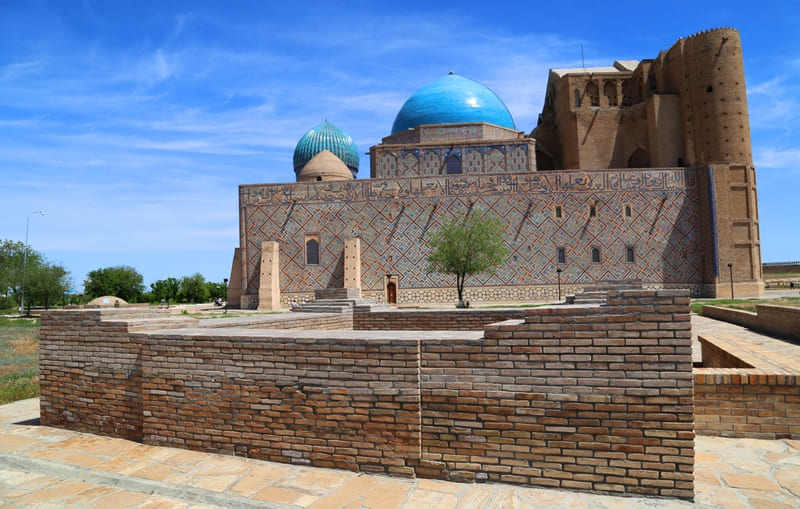
"The Azret Mosque has existed for 463 years. This marvelous creation of human hands, testifying to the talent of the masters of that time, could undoubtedly serve as a model for similar artistic works today, if it better satisfied the harmonious demands of the laws of beauty. The mosque is located beyond the city ramparts, in a special courtyard surrounded by a high clay wall, at the corners of which are bastions of baked brick, armed with fortress guns."
Mir-Salih Bekchurin. City of Orenburg. February 19, 1866.
Individual tours to Turkestan.
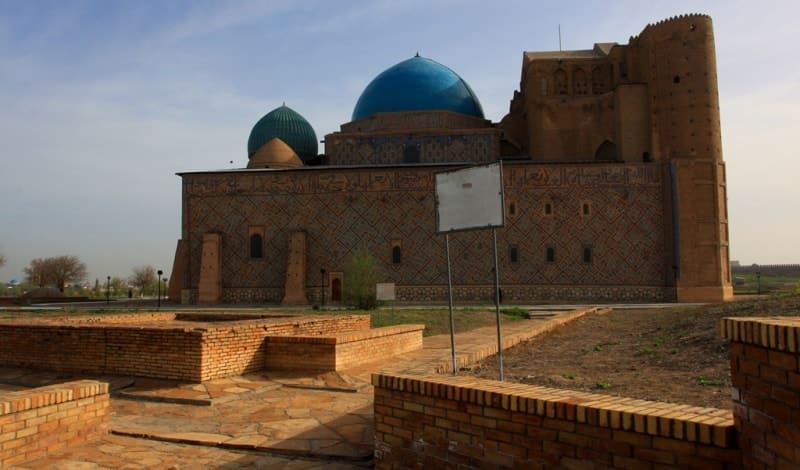
The unnamed saint tomb mazar dates back to XVIth-XVIIth centuries and is located at an altitude of 220 m. a. s. l., is located 52 meters southwest of the Akhmed Yasawi Mausoleum, on grounds of Azret Sultan Historical and Cultural Reserve and Museum in city of Turkestan.
The Nameless saint tomb is a rare example of funerary architecture in Southern Kazakhstan. Among the numerous medieval architectural monuments in Southern Kazakhstan, the so-called Nameless saint tomb occupies a special place – a unique underground burial vault from the XVIth-XVIIth centuries that has preserved not only the architectural features of the era but also important information about the funerary traditions of the region's population.
The monument received its provisional name due to the absence of any inscriptions or historical evidence that would allow us to identify the deceased. Despite this, the site is of significant interest to historians, archaeologists, and researchers of the Islamic culture of Kazakhstan.
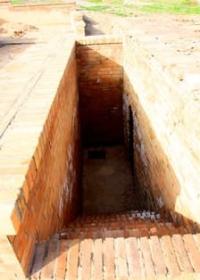
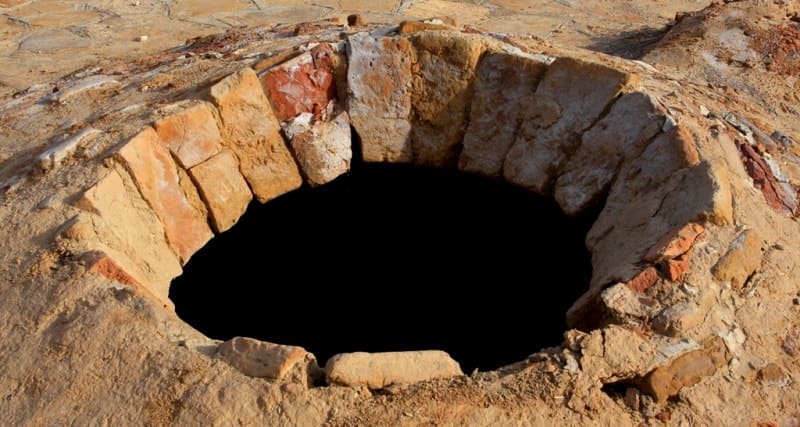
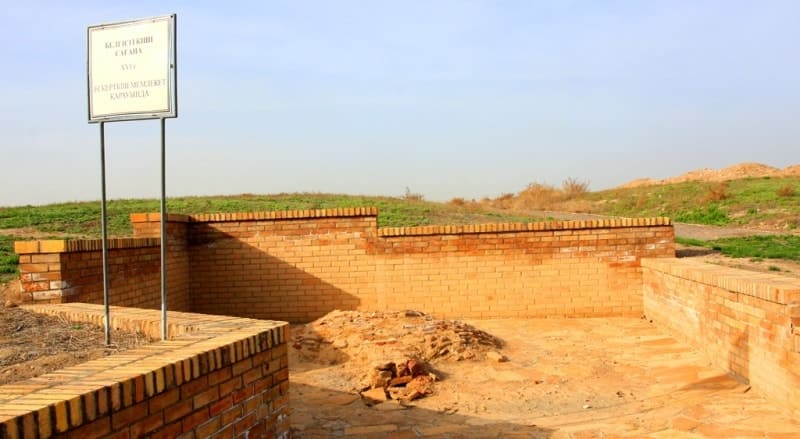
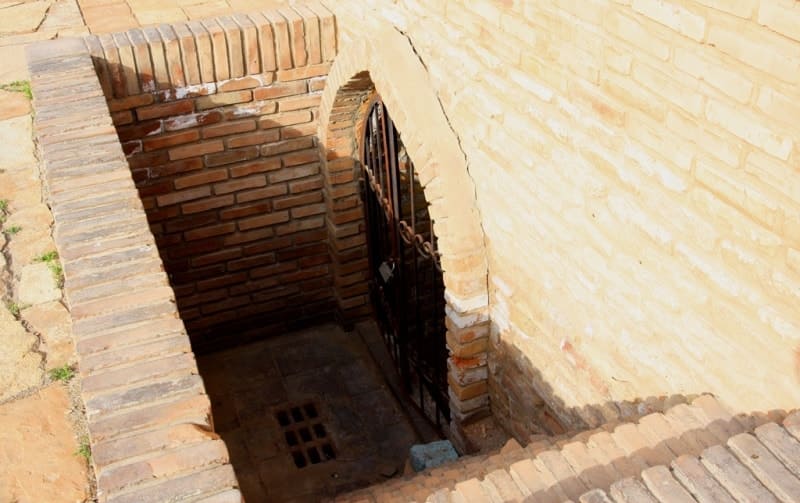
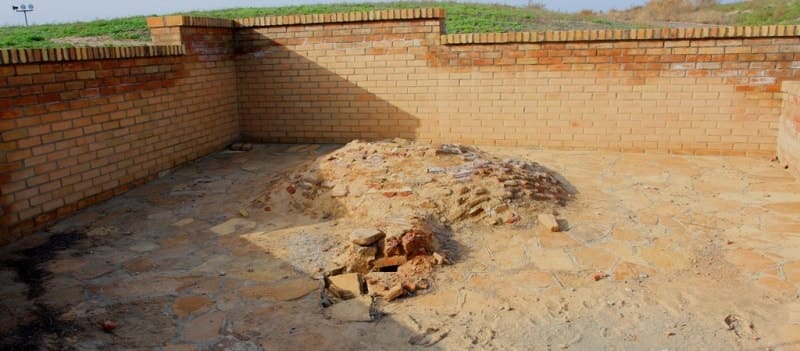
Only the underground portion of the structure has survived to this day. The above-ground structure, likely a mausoleum, was destroyed many decades ago. Nevertheless, the tomb itself has survived to this day in good condition, allowing us to assess the monument's original appearance.
The interior walls of the crypt are made of fired brick and have no plaster covering. The floor is made of compacted clay. The room contains wooden boxes containing the remains of eight people - seven adults and one child. The identities of the deceased remain unknown.
The architectural design of the tomb is of particular interest. The structure has an underground chamber covered by a dome. Inside, there are four arched niches approximately 0.8 meters deep, 4.33 meters wide, and 2.8 meters high. The overall dimensions of the monument are 9x8.75 meters.
The entrance is on the southwest side and leads directly into the burial chamber. Of the above-ground portion of the mausoleum, only a foundation approximately 60 centimeters high remains. Its dimensions suggest that a monumental structure towered over the underground crypt, serving as a place for commemorating the deceased and performing religious rites.
It should be noted that some publications mistakenly refer to this monument as a "sagana." However, in traditional architectural terminology, a sagana is an open-topped rectangular enclosure over a grave. The unmarked mazar belongs to a completely different type of structure.
In its design features, it is closer to concepts such as "lahat," "mäyіtkhana," or "mürdehana," meaning a crypt or underground burial vault. According to experts, the structure served both as a family vault and a mausoleum. The bodies of the deceased were likely not buried directly in the ground, but rather placed inside the vault in shrouds, consistent with certain burial traditions of Central Asia in the late Middle Ages.
This practice was typical for members of noble families, religious figures, and influential families. The creation of family crypts preserved the memory of ancestors and formed unique family necropolises, many of which later became pilgrimage sites.
The history of the monument's discovery is no less intriguing. The tomb was discovered by chance in 1975 during excavation work to level the site. This unexpected find attracted the attention of scientists, and archaeological research began. Renowned Kazakhstani specialists - archaeologists L. B. Erzakovich and B. Nurmukhanbetov, as well as architect-restorer A. Ordabayev - studied the site.
According to the recollections of the participants The discovered human remains were sent to Almaty for anthropological study. The results of archaeological excavations allowed the monument to be dated to the 16th century. In all likelihood, the tomb was used until the mid-XVIIth century, or approximately 150 years.
During this period, representatives of several generations of the same family or clan were buried here. Interestingly, the structure's dome has subsided significantly over the centuries. Currently, its height is approximately 1.16 meters, indicating a settlement of at least 35 centimeters.
Nevertheless, the main elements of the monument have been preserved and continue to be of great scientific value. Today, the Nameless saint tomb is one of the state-protected historical and cultural monuments of Kazakhstan. It is included in the "Collection of Historical and Cultural Monuments of Kazakhstan" for the South Kazakhstan Region and serves as important evidence of the development of funerary architecture in the region.
The Nameless Mazar recalls little-studied chapters of the history of Southern Kazakhstan, the traditions of ancestor veneration, and the complex burial rites of the medieval era. Even without the names of its inhabitants, this monument continues to tell descendants the story of the people who lived here several centuries ago, preserving the memory of the culture and worldview of bygone generations.
Authority:
Alexander Petrov.
https://azretsultan.kz/rus/bezymyannyj-mazar-xvi-xvii-vv/
In 1975, during excavation work to level the surface to the foundation of the Khoja Akhmed Yasawi Mausoleum, a previously unknown underground crypt (the Nameless Mausoleum) was discovered and studied to the west of it - a family burial vault dating from the XVIth to the first half of the XVIIth centuries.
Geographic coordinates of unnamed mausoleum: N43°17'49 E68°16'13


References:
Erzakovich, L.B., Nurmakhanbetov, B., Ordabayev, A. "Underground Burial Structure in Turkestan." Archaeological Excavations in Otrar. Alma-Ata, 1977, pp. 59-72.
"Nameless Mazar," 16th century. Collection of Historical and Cultural Monuments of Kazakhstan. South Kazakhstan Region. Almaty, 1994. P. 279. No. 590. 8.
Tuyakbaev M.K. “Eski Turkistan pantheons.” M. Eleuovtyn 70 zhyldygyna arnalgan conference materialdary. A., 2016, 191-197 bb.
Dictionary of foreign words. M., 1998, p. 358.
Authority:
L.B. Erzakovich et al. 1977, pp. 59-72. Tuyakbayev, M.K. "Cities and Settlements of Turkestan Oasis." History of the Study of Oasis Monuments. (VIth century BC - XIXth century AD). 2025.
Photos by:
Alexander Petrov.