




You are here
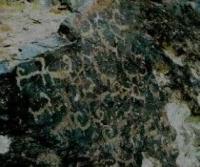
Petroglyphs of Pamirs in Tajikistan.
Central Asia on Silk Road Tour.
"Based on the number of petroglyphs, all of Tajikistan's monuments can be divided into three groups:
1) monuments with over 1,000 or several thousand carvings (Vybistdara - 1,200, Langar - 6,000);
2) monuments with no more than 100-200 carvings (Akjilga, Darshay, Salymulla);
3) monuments with 10-20 petroglyphs or even isolated carvings (Kukhilal, Tamdy, etc.)."
Bobomullo S. Bobomulloev.
Dushanbe and Central Asia on Great Silk Road.
Most interesting rock art, found in over 50 locations, is located in the Pamirs of Tajikistan.
Drawings are known in the Gunta River valleys – on the Chertym Dam, on the Panj River – near the villages of Namatgut, Langar, Porshnev, Shakh-Dara, Yazgulem, Northern Ak-Djilga, and at the mouth of the Bartang River. These are the main concentrations of petroglyphs.
According to the time of their creation, they are divided into several groups: the earliest date back to the Bronze Age, while later ones (early medieval, late medieval, and modern) are found. The most famous rock carvings are located near the villages of Langar and Kisht in the Ishkashim District (the total number of rock carvings exceeds 6,000).
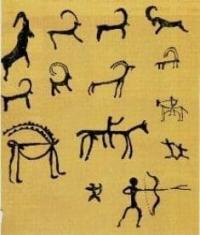
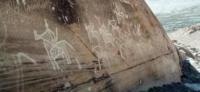
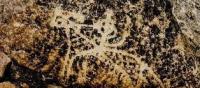
The drawings are made on broad surfaces of granite cliffs. They are grouped into several large "fields" connected by a chain of individual drawings and are found from the foot of the Shakhdara Range almost to the watershed. The rock art depicts primarily ibexes, but also yaks, deer, hunters with bows and dogs, and horsemen.
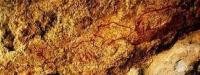
Some of the carvings are located at an altitude of 3,200–3,300 meters above sea level. Most of the carvings are made using the "dot technique," meaning they were carved with a metal object or stone. In isolated cases, deep engravings made with a metal object are observed.
Lyangar Rock Art in Tajikistan.
Sometimes carvings made with a knife point are found. The most common motif in the Langar rock art depicts various hunting scenes, most often of ibexes (nachkhirs). Most of the drawings are 10-20 cm long, with occasional figures 30-40 cm long.
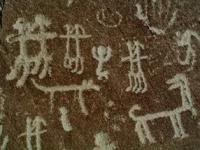
The largest figure is 80 cm, and the smallest is 6 cm. One interesting type of drawing is the rubob, a musical instrument used by local residents. Remarkably, nowhere else in Central Asia are petroglyphs depicting musical instruments found in such large numbers (approximately 300 have been found here).
There is a theory, based on Pamiri folklore, that the rubob represents a personification of a human being, which is why the existing images are very similar to stylized drawings of people.
Vybist-Dara Petroglyphs in Tajikistan.
Another area of considerable interest for its petroglyphs is Vybist-Dara. It is located 7-8 km above the village of Debasta (30 km from the city of Khorog), at the end of the gorge of the same name. There are four groups of rock carvings here. Among them is the "central" group, the largest cluster of petroglyphs.
Unlike most rock art in the Pamirs, which primarily depict wild goat hunting with bow and dog, the Vybist-Dara paintings depict humans and ornamental motifs. The oldest group of paintings dates back to the second half of the 1st millennium BC.
Rock paintings in Ak-Jilga River Valley in Tajikistan.
Numerous petroglyphs are found on a black shale rock measuring 23 x 19 meters in the Ak-Jilga River Valley (the left tributary of the Bazar-Dara River) in the Eastern Pamirs, a few kilometers from the remains of the ancient mining town of Bazar-Dara. Here are depictions of two-wheeled chariots drawn by horses and driven by charioteers, mountain goats, and a beak-nosed archer wearing a pointed cap.
Depictions of chariots are widely known in Central Asia. They are all dated to the same period - the Bronze Age. Ancient people ascribed various meanings to their drawings. Perhaps they had religious content, or depictions of everyday life, or a play of the imagination, a desire to leave some memento of themselves in an accessible way...
The stone carvings reflect the centuries-old history of the people who lived in these places, or who came here from other lands by chance or circumstance.
Authority and photos:
Gafurov.BG. «Tadjiks:The Most ancient, ancient and medieval history»., 1972. Djakonov M.M. « Works Kafirnighan of group»: “Antiquities of Tajikistan: the Exhibition catalogue. Dushanbe, 1985. Bolshakov O.G.