




You are here
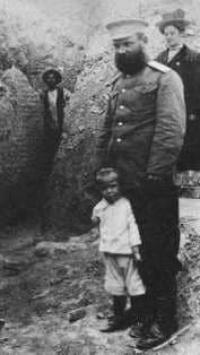
Vasily Vyatkin on Madrasa of Mirza Ulugh Beg.
Architectural monuments in Registan Square.
"Another tall structure by Ulugh Beg Mirza is the observatory at the foot of Kuhak Hill, which houses an instrument for compiling star tables. It has three tiers. Ulugh Beg Mirza wrote the 'Gurganov Tables' in this observatory, which are now used throughout the world. Other tables are rarely used. Previously, seven or eight observatories were used. Of these, one was built by Caliph Mamun, in which the 'Mamun Tables' were written. Bitlimus also once built an observatory; another observatory contained the Ilkhan Tables," compiled by Khoja Nasir-i Tusi during the reign of Khulagu Khan in Maragha. Khulagu Khan is the one also known as the Il-Khan."
Zahir ad-Din Muhammad Babur. "Babur-Name." Events of Year Eight Hundred and Ninety-Nine, 1493-1494 (translated by M. A. Salye).
Minarets on Registan Square.
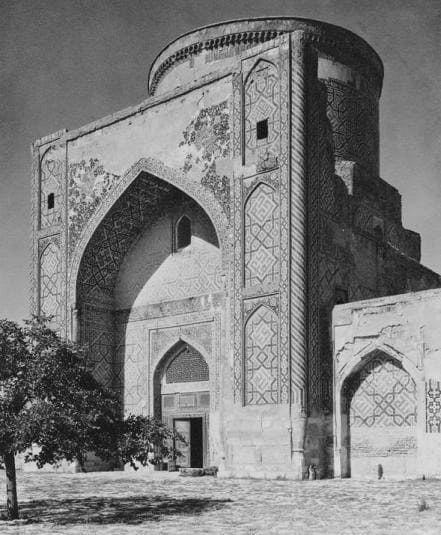
At the Registan, the most important of the three madrasas is the Madrasa of Mirza Ulugh Beg, the oldest surviving madrasa in Central Asia, both for the genius of its architectural execution and for the mosaic and tile work, which reached its peak and originality here.
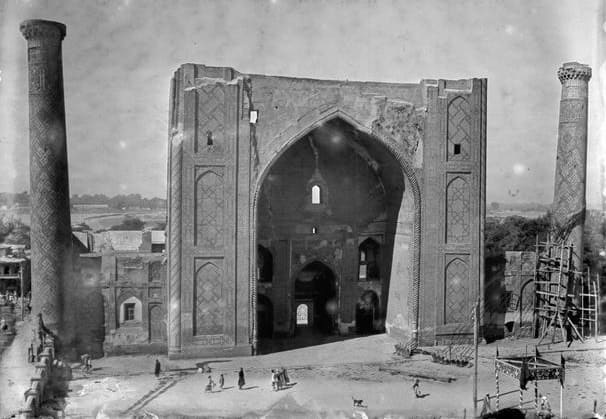
This madrasa, as evidenced by two inscriptions on its façade, was begun in 820 AH and completed in 823 AH. Its builder was Timur's grandson, Mirza Ulugh Beg. Originally, this building had two stories, two domes between the portal and the minarets, as is now the case in the Shir Dora Madrasa located opposite, two domes in the western part of the building, and a long, high hall roofed with vaults in the western part.
Now all this is gone. Even the minaret in the southwest corner is missing. Therefore, the modern outline of this madrasa does not convey the impression of its former lightness, harmonious parts, and special clarity. The consistency and integrity of the structure have been disrupted.
Moreover, the building has sunk into the ground by 2.5 arshins. Unlike other Central Asian madrasas, the Mirza Ulugh Beg Madrasa has two side portals, albeit small and sparsely decorated with tiles. The portal occupied a central place in the architecture and artistic decoration of the madrasa – majestic, with a high arch, columns, and pilasters, it is ornate and opulent, like Mirza Ulugh Bek.
The four (now three) minarets placed at the corners of the building, full of elegance and grace, are a necessary architectural addition – they make the building lighter and more elevated. The master boldly placed them at an angle from the building, giving the impression of falling.
One of them, the north-easterly, is indeed on the verge of collapse, and since 1918, it has been tied to anchors with steel cables, awaiting its righting. Both the madrasa building itself and the minarets, encased in a tiled armor, give the impression of being monolithic.
The minarets are floored from the second floor all the way to the top. Spiral staircases run through their craters. Gradually tapering, the minarets culminate in a cap-like structure with steep overhangs framed by stalactites and a wide band of large script beneath the cap, along the narrowed neck.
The tiled cladding of the Mirza Ulugh Beg madrasah building is varied and achieved to a high level of artistic and decorative perfection, combining geometric and floral ornamentation with calligraphic inscriptions in various handwritings. The wall planes are divided horizontally and vertically by arches in rectangular frames, bands, chains of medallions, and so on; the relationship of the parts is harmonious and symmetrical.
The compositions are free and airy. The surfaces of the walls and minarets, the cheeks, and the arch in the portal are covered with a geometric pattern of blue and white tiles, forming a sort of grid. These geometric patterns, either pointed oval or quadrangular in shape, with various appendages, are filled with Kufic script made of blue tiled bricks, forming inscriptions.
All of this is of incomparable beauty and brilliance. In fact, in the most prominent sections, the inscriptions intertwine with the ornamentation and infuse the ornamental motifs with much life, not only not disrupting the design, but enhancing it. The level of the madrasa courtyard has remained at its original level - t lies much lower than the adjacent square and streets, where, over the course of five centuries, a new layer of soil has formed, deeply burying the building's panel.
Authority:
V. L. Vyatkin. "Antiquities of Samarkand." 1930.