




You are here
Vyatkin on Rukhabad Mausoleum.
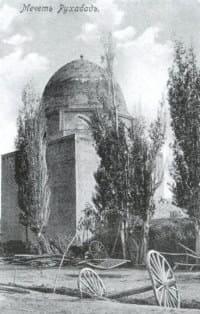
Tour of Rukhabad Mausoleum.
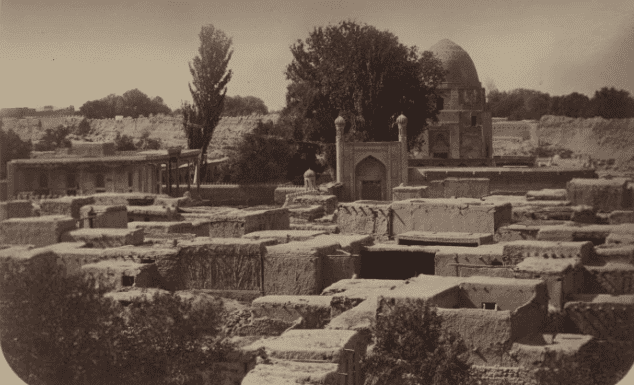
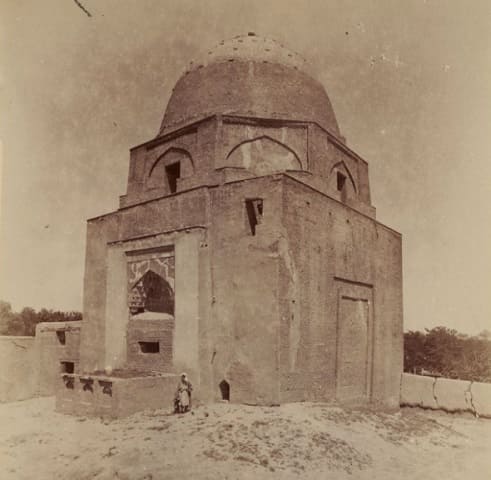
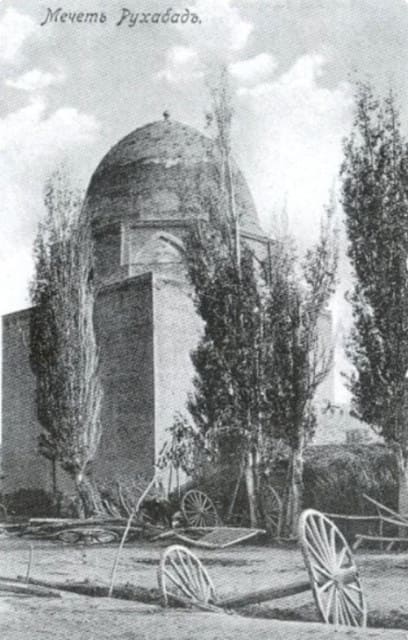
"This is the Rukhabad in Samarkand, built in the 1880s for Sheikh Burhaneddin Sagardji, highly revered by Timur - a centric tomb with a square prism for the main volume, a transitional octagon, and a gently sloping sphero-conical skufia. Its modest decoration in the form of carved, glazed terracotta tiles framing the entrance is already archaic for the heyday of polychrome cladding in Samarkand architecture." In general, single-chamber mausoleums, usually of the portal-dome type, less commonly of the centric type, in Timurid construction, are typically either incorporated into funerary architectural ensembles or form an element of other Muslim religious buildings - mosques, madrassas, and khanakas. At the same time, the dynastic construction of the Timurids developed a unique type of complex layout and spatial composition.”
G. Pugachenkova. "Architecture of Central Asia. XVth Century. Leading Trends and Features." 1976.
Burial of mystic Burhaneddin Sagardji in Rukhabad Mausoleum.
To the north of Guri Emir, a few steps away, stands a large mausoleum built over the grave of the mystic Burhan ed-Din Sagardzhi, who died in the XIVth century. The exact date of construction of this building, known as Rukh-abad (abode of the spirit), which supposedly contains a casket containing a hair of the Prophet Muhammad (mu'imubarak) set into the vault, remains unknown.
According to legend, it was erected by Timur. The relief tile decoration around the bricked-up northern door indicates that the building dates to the mid-XIVth century. The absence of other tile decoration on the building hinders a more precise determination of its construction date based on its exterior.
The cold simplicity of its exterior and a certain heaviness are the main features of this structure. It appears unfinished. It lacks both a drum and an outer dome, which were intended but likely never existed. The building has three entrances: the southern one, with an ancient door, carved and paneled, depicting fish, but blocked up; the northern one, framed with plate-shaped tiles; and the western one, through which the interior is now entered.
The door here is massive, beautifully carved, but new. There is no portal or extensive façade. The overly spacious interior is more than modest, cheerless, and quite in keeping with the exterior. A high, gray, checkered panel, grayish, bare walls, without any signs of painting, shallow niches - all this is too simple, unusual for mazars, which loved to decorate with tiles and paintings.
On the floor is a row of tombstones made of alabaster and stones. Some retain traces of tiled paneling.
Authority:
V. L. Vyatkin. "Antique Monuments of Samarkand." 1930.