




You are here
History of Andijan.
Tours to Andijan.
"There are seven cities in Fergana; five of them are on the southern bank of the Seykhun River, two on the northern bank. One of the cities on the southern bank is Andijan, which is located in the middle. It is the capital of the Fergana region. There is plenty of grain there and abundant fruit, melons and grapes are good; when the melons are ripe (due to their abundance), it is not customary to sell them from the melon patch. There are no better pears than those from Andijan. In Maverannahr, except for Samarkand and Kesh, there is no fortress larger than Andijan. The city has three gates, the Andijan gate is on the southern side. Water flows through nine canals; amazingly, it never runs out. Around the fortress, on the outer side of the moat, is a large road paved with crushed stone; The fortress is surrounded by suburbs, separated from the fortress by a moat, along the edge of which runs a large road. Game is plentiful there, and the pheasants are incredibly fat; it was said that four men, having begun to eat a seasoned pheasant, could not finish it. The inhabitants of Andijan are all Turks; there is not a single person in the city or in the bazaar who does not speak Turkic. The speech of the people is similar to literary speech; the works of Mir Alisher Navoi, although he grew up and was educated in Herat, are written in this language. Among the inhabitants of Andijan are many handsome men; Khoja Yusuf, who is famous in music, is an Andijan native. There is a putridity in the air of Andijan; many suffer from fever in the autumn."
Zahir ad-Din Muhammad Babur. "Babur-Nameh." Events of the year eight hundred and ninety-nine, 1493-1494. (translated by M. A. Salye).
Educational tour of Andijan.
Andijan, over 2,500 years old, is the oldest city in Uzbekistan and one of the most ancient cities in the Fergana Valley. In some areas of the city, archaeologists have discovered artifacts dating back to the 7th and 8th centuries BC. Historically, Andijan was an important stop on the Great Silk Road.
The city is famous as the birthplace of Babur, who, after a series of setbacks, succeeded in founding the Mughal dynasty on the Indian subcontinent and became the first Mughal emperor. Andijan is an important industrial city in the country, producing a variety of industrial goods, including chemicals, household appliances and electronics, food products, furniture, plows, pumps, footwear, agricultural machinery parts, various engineering tools, and wheelchairs.
Andijan is frequently subject to seismic activity and was devastated by a powerful earthquake in 1902.
This was the strongest earthquake to hit Uzbekistan in the XXth century.
Etymology of Andijan.
Historian V.P. Nalivkin believes that the toponym "Andigan" originated from the name of the Turkic tribe Andi. Until recently, residents of neighboring regions often referred to the Andijan Uzbeks by the name Andi, claiming that the Andi were of the same origin as the Turks who lived in the cities of Central Asia.
According to V.V. Bartold, Andijan was founded by the Mongol khans in the late XIIIth century. Turks from various tribes and clans were resettled here. At the end of the XVth century, Andijan was considered a predominantly Turkic city in Fergana.
The state of Andia existed in the southern part of the Caspian Sea.
Antiquity of Andijan.
Andijan is one of the oldest cities in the world (founded in the Vth-IVth centuries BC). Archaeological research has established that the territory of the modern city was inhabited more than 2,500 years ago. In the 6th century BC, by the time of the Achaemenid conquest of Central Asia, Andijan managed to maintain its independence, which led to the emergence of the Davan state with its capital in the city of Ershi (a suburb of Andijan).
The beginning of the period of the replacement of bronze tools with iron, the development of agriculture with artificial irrigation and livestock breeding (including the breeding of "heavenly horses") served as the preconditions for a military conflict between the Davan state and the Chinese Empire, which China lost.
Ancient Andugan was located at the crossroads of the caravan routes of the Great Silk Road. Pottery culture developed in the Davan state from the IInd to IVth centuries BC. The "Eilatan culture" emerged in the Ist-IIIrd centuries CE, the arts developed, and the city grew. In the 5th century CE, Turkic-speaking tribes migrated to the Andijan region, and the indigenous population underwent a process of Turkification.
Andijan in Middle Ages.
In the IXth century, the Arab Caliphate collapsed, and the city became part of the Samanid Empire and became one of the main centers of the Fergana Valley. In written sources, it became known as Andukan from the IXth century. In the Xth century, it became part of the Karakhanid Empire, and in the XIIIth century, it was captured by the Mongols and incorporated into the Chagatai Ulus.
In the XIVth century, it became part of the Timurid Empire, where science, art, and architecture developed. In the early XVIth century, it became part of the Shaybanid Empire (the capital of which is mentioned as Andigan). In 1504, Shaybani Khan ceded Akhsi and Andijan to the Shibanid Sultan Janibek Sultan.
In the mid-XVIth century, the Shibanid Javanmard Ali Sultan ruled Akhsi and Andijan. In the XVIth century, the chronicles of Z. Babur (the founder of the Mughal Empire, who was born in Andijan in 1483) wrote: "In Andijan, the capital of the Fergana region, there are three gates.
Only Kesh and Samarkand have a larger Ark than Andijan." The Babur-Nama also mentions Andijan: "He who has not seen Andijan, who does not remember Andijan in his heavenly wanderings, is not a man worthy of honor."
Andijan as part of Kokand Khanate.
In the XVIth century, Andijan was conquered by the Shaybanids and later became part of the Kokand Khanate. The Kokand ruler Abdurakhim-biy was the eldest son of Shahrukh-biy, who ascended the throne after his father's death. During his reign, Andijan became part of the Kokand Khanate.
Abdurakhim-biy was the first of the Uzbek rulers of the Ming clan to be called a sahibkiran by historians, emulating Amir Timur. From 1745 to 1747, the Kokand Khanate was attacked by the Dzungars, who captured Andijan and laid siege to Kokand.
At a critical moment, Abdurakhim-biy demonstrated his talent as a military organizer. The enemy was subsequently driven back from the capital. In August 1862, during the civil war in the Kokand Khanate, Andijan was besieged and captured in January 1863.
At the same time, Namangan was recaptured, followed by the entire right bank of the Syr Darya. In February, the Kyrgyz Kipchaks besieged Margilan and captured it in April 1863. By the end of 1862, Alimkul managed to assemble a significant force (40,000) of Osh, Aravan, Alay Kyrgyz, and Kipchaks.
The opposition forcibly confiscated wealth from the population of Andijan and the surrounding villages of Balykchi, Kuva, Asaka, Shakhrikhan, Osh, and Paituga, and imposed repeated taxes. After months of fighting, they succeeded in capturing Margilan and advancing on Kokand.
In these areas, many villages were engulfed in fires, fields were trampled, and a large number of people perished.
Andijan as part of Russian Empire.
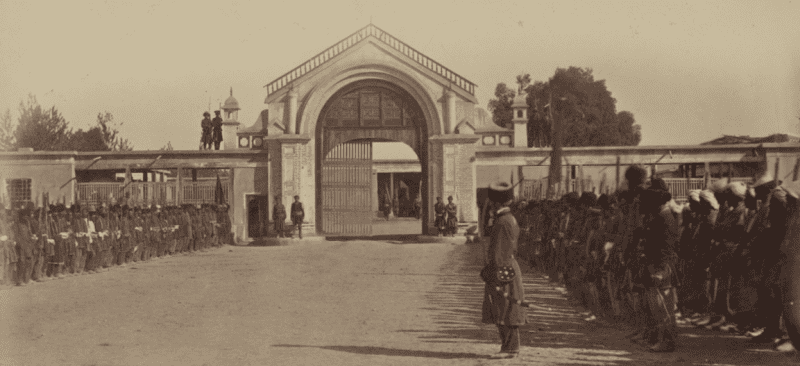
In October 1875, Andijan was captured by General A. Trotsky's troops. In January 1876, it was captured by General M. Skobelev's troops and became part of the Russian Empire. Since 1876, the lands of the Kokand Khanate, including Andijan, became part of the Russian Empire.
At that time, the city produced silk and cotton fabrics, which were renowned not only in the Fergana Valley but also far beyond. In 1902, Andijan suffered an earthquake, destroying many ancient monuments.
Resettlement Movement to Andijan Region.
Between 1893 and 1898, in Andijan County, unlike the rest of Turkestan, land was officially allocated for settlers from the European part of the Russian Empire. Previously, unofficial settlers in Turkestan were returned home due to the high density of the indigenous population and the lack of available land.
Settlers arrived in the Andijan district from various provinces of the Russian Empire: Kharkov, Kyiv, Poltava, the Don Host Region, Yekaterinoslav, Saratov, Samara, Voronezh, Tula, Astrakhan, Kursk, Stavropol, Orenburg, from Siberia, northern Russia, and the Caucasus.
Their ethnic composition was quite homogeneous. They were predominantly Russian, since the "Regulations on the Administration of the Turkestan Territory" permitted resettlement only to "Russian subjects of the Christian faith, belonging to the status of rural inhabitants."
Andijan Uprising.
In May 1898, a rebellion occurred in Andijan, known as the Andijan Uprising, directed against the Imperial authorities. An attempt to restore Kokand's independence was undertaken by Muhammad Ali Ishan, who suffered more than anyone else under the new regime.
Ishan intended to restore the Kokand Khanate, becoming its absolute ruler, who would need income from trade and waqf lands, as well as obedient subjects. The Russians, however, undermined the traditional foundations of Muslim society. The investigation also established that Ishan's closest aides were elderly men who had served under the Khan of Kokand.
They were the ones who agitated for Ishan and recruited "warriors of Islam." On May 17, 1898, over 1,500 people attacked the Russian military garrison in Andijan. The uprising was led by a highly popular local religious leader, Ishan Magomed-Ali Khalif Muhammad-Sabyr-ogly (abbreviated as Madali).
The following day, Dukchi-Ishan was arrested, and one by one, his closest associates were also caught. Of the 2,000 participants in the rebellion, 777 were arrested. News of the uprising's failure quickly spread throughout the region and deterred those who were only planning to attack the Russians from revolting.
However, despite the arrest of the rebel leader, Ishan's supporters still killed the forester and plundered the Cossack camp. This ended the attempt to "free themselves from the infidels." Ultimately, the Andijan uprising forced the authorities of Russian Turkestan to understand the need to better understand the sentiments and intentions of the local population - Uzbeks and Sarts.
Opening of Samarkand-Andijan Railway.
In May 1899, the Samarkand-Andijan Railway opened in Andijan. The first line connected Ursatyevskaya station with Andijan I. The following railway stations were opened: Fedchenko (Kuva), Serovo (Kokand), Gorchakovo (Margilan), Assaka (Zelensk), Vannovskaya, and others.
In 1905, the second line, "Chernyaevo - Andijan II," opened, and between 1913 and 1916, the railway was extended to the outskirts of the Andijan district, to the city of Jalal-Abad. Later, the Samarkand-Andijan and Caspian railways were transformed into the Central Asian Railway.
Following the construction of the railway, the cities of the Fergana Valley and the surrounding area began to develop and grow rapidly. Construction of large factories and plants began, mineral extraction increased, and processed cotton gin products began to be sold and exported in large quantities to other regions.
Construction of new European-style urban neighborhoods took place in Andijan (the new city) and Zelensk (near Assaki station), as well as in the suburban settlements of Russkoye Selo (south of Andijan), Moskovsky (west of Andijan), Pokrovskoye (east of Andijan), Bogorodskoye (northeast of Andijan), and Topolino (east of Andijan).
Andijan Earthquake.
In 1902, the largest earthquake in the history of the Fergana Valley struck Andijan, killing more than 4,600 people. Approximately 40,000 buildings were destroyed in Andijan County and parts of Margilan County. The earthquake was so powerful that people were unable to stand.
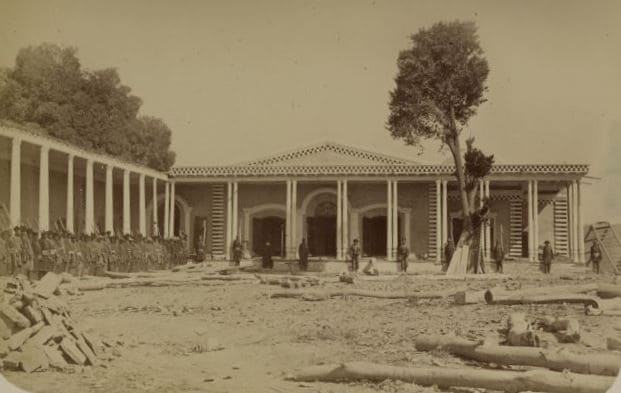
Afterward, Andijan lost its ancient architectural monuments and buildings with centuries of history. Only the government and residential buildings made of baked brick in the new part of the city survived (the Andijan I railway station, the city officers' assembly building, the churches of Saints Sergius of Radonezh and Nicholas the Wonderworker, and the chapel of Saint George the Victorious in the Garden Cemetery).
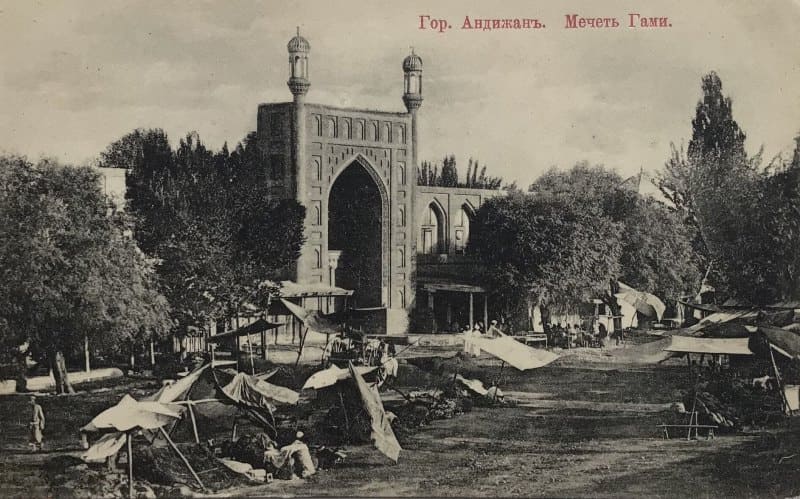
In the old part of the city, the 600-year-old (at the time) 32-meter minaret of the XIIIth-century main Friday mosque of Andijan, the tallest in the Fergana Valley, survived the earthquake. The main mosque itself also survived, as did the Jami madrassa, the largest in the Fergana Valley, which is now the most beautiful architectural structure in Andijan and the entire Jami memorial complex.
Soviet period in Andijan.
During the national-territorial demarcation in Central Asia, Andijan became part of the Uzbek SSR, becoming the administrative center of the Andijan Region. During the Soviet period, Andijan was a major city in the USSR, with over 50 educational institutions (universities, institutes, technical schools, and colleges).
The majority of the population of the Andijan, Fergana, Namangan, Osh, Jalal-Abad, and Leninabad regions studied in Andijan. The city had approximately 100 industrial enterprises (factories, plants, and factories). Andijan's population more than tripled, reaching a third of a million people (the Andijan region ranked first in the USSR and third in the world in terms of population density).
The high population density and small size of the Andijan Region facilitated commuting. It was the smallest region in the post-Soviet space, at 4,200 km² (and today it occupies 1% of the country's area, but is home to 10% of the Republic of Uzbekistan's population).
At night, 330,000 residents resided in the city, while during the day, approximately 1,000,000 people traveled there for work and business. For the aforementioned reasons, a commuting pattern developed, more typical of megacities. Also in the post-Soviet space, in the Central Asian region, there was the Andijan-Osh agglomeration (the distance between the cities, 40 km, was compactly developed).
Andijan and independent Uzbekistan.
During the years of Uzbekistan's independence, Andijan and its suburbs (an agglomeration with a population of 657,000) were practically rebuilt from scratch. This is happening thanks to the current Presidential Program, the main goal of which is to improve the quality of life of the population.
It was initiated by the first President of the Republic of Uzbekistan, I. A. Karimov, and is currently being continued by the newly elected President, Sh. M. Mirziyoyev. Furthermore, century-old historical buildings were preserved and restored; new, well-appointed neighborhoods with an oriental flair and new Western-style buildings were built; old streets were widened and reconstructed, transforming into wide avenues.
New 6-8-lane highways and modern 5-6-story buildings appeared in the city. The city's area increased from 70 square kilometers to 120 square kilometers. The city's borders, with continuous development, extend to the embankment of Andijan's main river, the Karadarya (Green Bridge, Agricultural Institute), in the north; to the National Park named after the Great Commander Z. Babur in the southeast (microdistricts of the Bogishamal residential complex); To the west, it extends to the satellite town of Asaka (formerly Leninsk), which is currently the capital and birthplace of Uzbekistan's automobile industry.
In 2005, Andijan experienced large-scale unrest against the regime of Islam Karimov, in which, according to official figures alone, 187 people were killed. In 2025, the Council of CIS Heads of State awarded Andijan the honorary title of the Commonwealth of Independent States "City of Labor Glory. 1941-1945."
Geographical coordinates of Andijan: N40°46'34 E72°20'56


Authority:
https://ru.wikipedia.org/wiki/%D0%90%D0%BD%D0%B4%D0%B8%D0%B6%D0%B0%D0%BD