




You are here
Third Beloubinskoye lake.
Landmarks of Kazakhstan Altai.
"Man has sufficient objective reasons to strive to preserve wildlife. But ultimately, he can save nature only through his love for it. Since man cannot live in this world without beauty, if he has even a little love and appreciation for the environment, nature will be able to free itself from the danger it faces."
French ornithologist, zoologist, and one of the pioneers of the global environmental movement, Jean Dorst. "Before Nature Dies" (Avant que nature meure). 1965.
Itineraries in West-Altay reserve.
Third Beloubinskoye Lake is a freshwater high-altitude moraine-glacial lake located at an altitude of 1991 m. a. s. l. in eastern Kazakhstan.
It is located within the West Altai State Nature Reserve, in the Ridder city administration of the East Kazakhstan Region, in a complex mountain system formed by the eastern spurs of the Ivanovo Range and the western slopes of the Koksu Range. The lake is the third in a group of four closely located Beloubinskoye Lakes. It is located approximately 823 meters northeast of the Second Beloubinskoye Lake and only 358 meters southwest of the Fourth Beloubinskoye Lake. Kedrovoe Lake is located approximately 1.1
kilometers to the northwest, and Shcherbakov Lake is 2.2 kilometers to the northwest. This arrangement suggests that the four Beloubinskoye Lakes form a compact group of high-mountain reservoirs formed within a single mountain region. Moreover, the Third Lake occupies a unique position: it is located below the Second Beloubinskoye Lake and is directly connected to a system of subsequent small moraine reservoirs.
Dimensions and features of Third Beloubinskoye Lake basin.
The Third Beloubinskoye Lake is elongated from southwest to northeast. Its length reaches 277 meters, and its greatest width in the northern part is approximately 293 meters. The water surface area is 59,293 square meters, or approximately 5.93 hectares.
The shoreline length reaches 1,056 meters. In terms of area, the Third Beloubinskoye Lake is the larger of the two previously described reservoirs - the First and Second Beloubinskoye Lakes. Moreover, It is distinguished not so much by its considerable length as by its comparatively wide width, which gives its basin a more compact outline.
The shape of the lake and the surrounding topography suggest that its modern basin was formed as a result of the prolonged influence of ancient mountain glaciation. During periods of cold weather, glacial masses occupied the depressions between the mountain ranges and slowly moved along the slopes and valleys.
The moving ice impacted the underlying rocks, deepening and widening certain areas of the relief. Glacial exaration - the destruction and erosion of rock by moving ice - may have formed local depressions that subsequently became lake basins.
At the same time, the glacier transported large quantities of debris, which, after its retreat, was deposited as moraines. Most likely, the modern basin of the Third Beloubinskoye Lake is the result of the interaction of several processes. An ancient glacier formed a depression in the mountainous terrain, and moraine deposits partially restricted its flow, creating a natural reservoir for water accumulation.
After the glacier retreated, the basin gradually filled with meltwater from snow and glaciers, precipitation, and seasonal runoff from the surrounding slopes. Thus, the lake's current appearance can be viewed as the result of a long-term glacial development, in which the original basin, created by ancient glaciation, gradually acquired its present shape under the influence of meltwater, precipitation, weathering, and the activity of small mountain streams.
Snowfields are source of water for Lake Third Beloubinskoye.
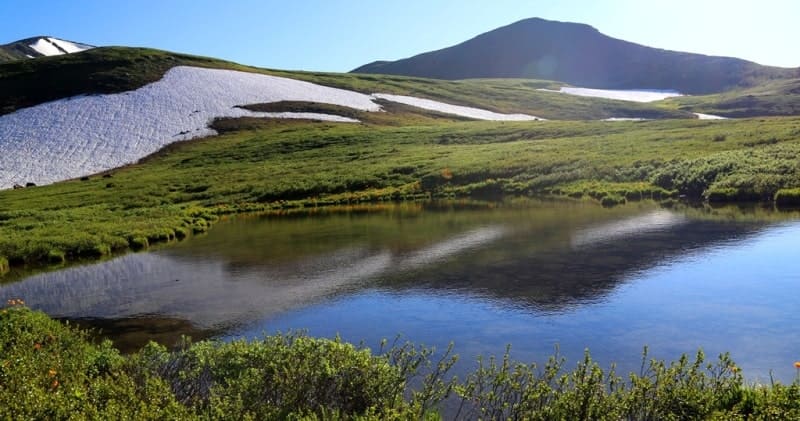
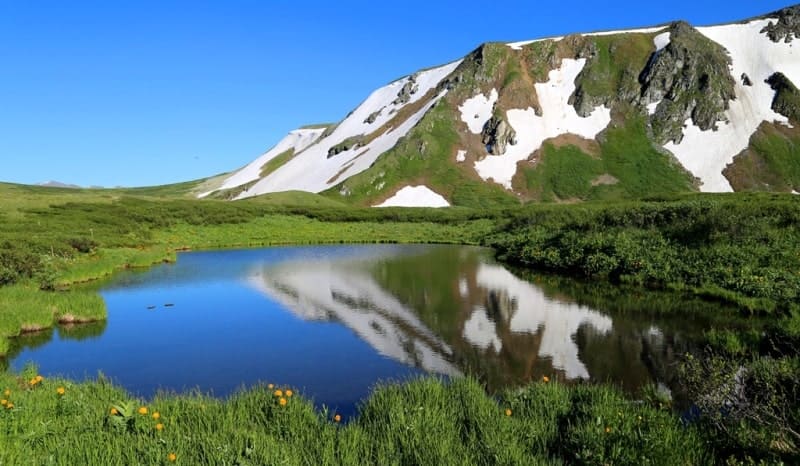
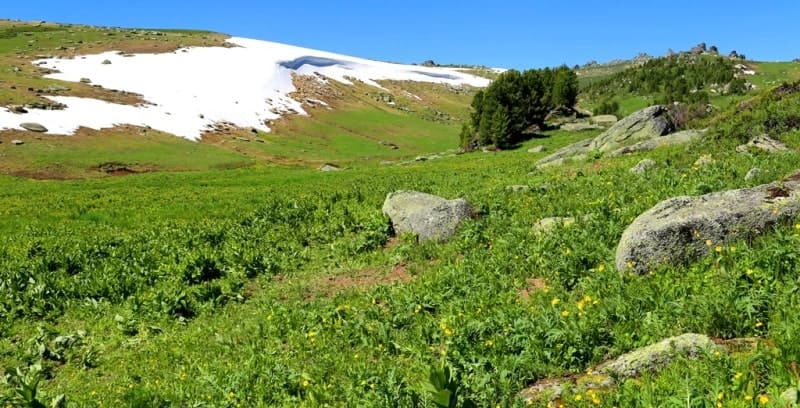
Snowfields located on the steep southern slope play an important role in the existence of Lake Third Beloubinskoye. Even in summer, significant accumulations of snow remain here, gradually melting under the influence of solar heat. Meltwater flows down the slope and enters the lake basin, providing its current supply.
For this reason, the hydrological regime of Third Beloubinskoye Lake is closely linked to the high-altitude terrain and the duration of snow cover. In years with high winter precipitation and cool summers, water reserves in snowfields can persist longer, providing a longer supply of meltwater.
In warm, low-snow years, snowfields shrink more quickly, which can affect the volume of water entering the lake. This type of recharge is typical for high-altitude bodies of water in the Altai, where snow and seasonally preserved ice are the most important components of the local water balance.
Cascade of moraine Beloubinskoye lakes.
One of the most interesting features of Third Beloubinskoye Lake is its connection to a cascade of three small moraine lakes located downstream. One of the northern tributaries of the Belaya Uba River flows from the northwestern part of Third Beloubinskoye Lake.
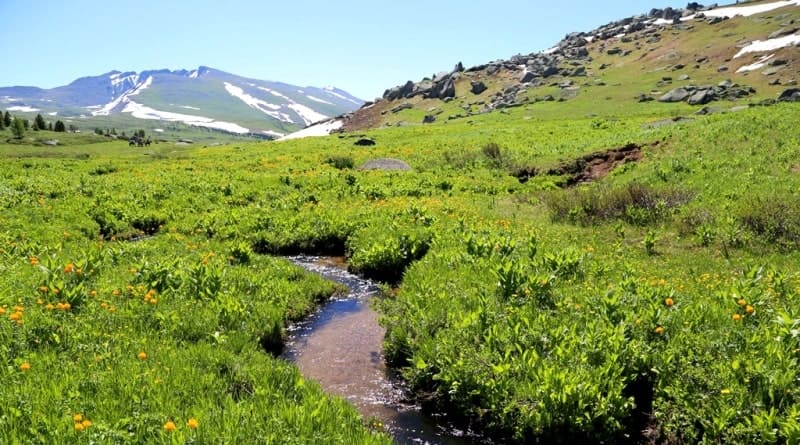
A stream originating from the lake flows successively through three small moraine reservoirs, forming a unique cascade system. This area is of particular interest from a geomorphological perspective. The sequence of lakes connected by a single stream may be related to the arrangement of moraine ridges and other glacial deposits that created the stepped nature of the relief.
Water, leaving the main lake basin, flows successively through small depressions filled with water. Such cascades are a unique legacy of ancient glaciation. Where the glacier left behind moraine ridges and natural barriers, small lake basins formed, connected by streams.
As a result, Lake Third Beloubinskoye can be viewed not as an isolated lake, but as the apex of a small natural hydrological system comprising several successive moraine lakes.
Shores and vegetation of Lake Third Beloubinskoye.
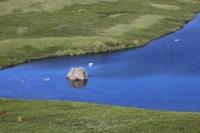
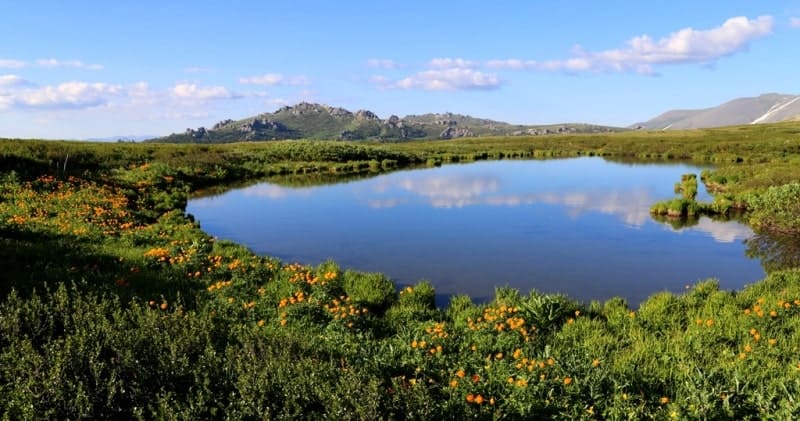
The lake's shoreline is diverse. The southern shore abuts a steep mountain slope where snowfields remain. This section has a harsh, high-mountain appearance and is virtually devoid of dense vegetation. The northern, western, and eastern shores have a completely different character.
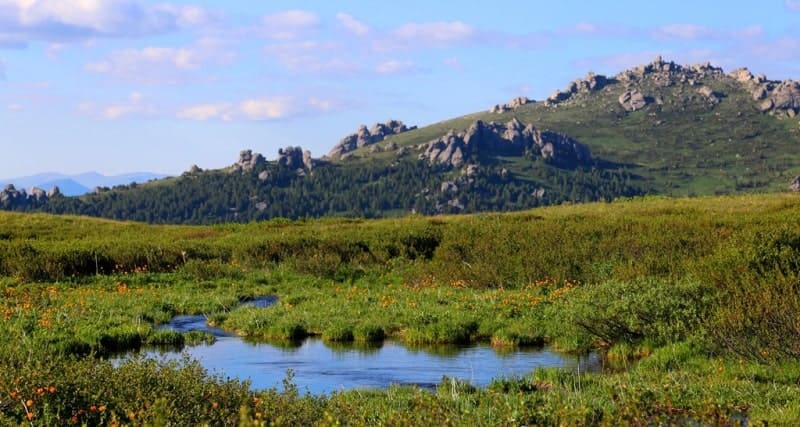
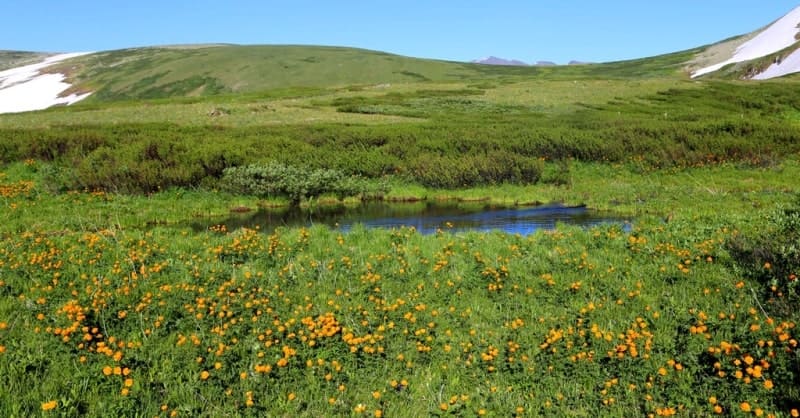
Here, the slopes are more gentle, and the surface is covered with thickets of dwarf birch, a characteristic element of the Altai highlands. The contrast between the steep, snow-covered southern slope and the softer, vegetated shores on the opposite side gives the lake a special character.
On one side, there is a harsh, rocky, snow-covered slope, preserving traces of the high-mountain climate; on the other, there is low-growing vegetation. Adapted to the short summer season, Third Beloubinskoye Lake is especially picturesque during the summer snowmelt.
Against the backdrop of dark water and green slopes, the white fields of snowfields that remain on the southern slopes stand out vividly.
Natural significance of Lake Third Beloubinskoye.
Lake Third Beloubinskoye is of significant interest for studying the high-mountain landscapes of Altai. Its location within the West Altai Nature Reserve allows the lake to be viewed within the context of a virtually undisturbed natural environment.
Its connection to the Belaya Uba River source system is particularly important. Water entering the lake from the snowfields then flows through the northwestern source into a cascade of small moraine lakes and then into the river system. Thus, what we see here is not simply an isolated high-mountain body of water, but part of a complex natural system formed by ancient glaciation and continuing to evolve under the influence of modern natural processes.
Third Beloubinskoye Lake is one of the most interesting features of the Beloubinskoye Lakes group. Its large surface area, compact shape, close proximity to Fourth Lake, the presence of a cascade of moraine reservoirs, and its connection to the source of the Belaya Uba River allow us to consider this area a unique natural laboratory, where the interaction between ancient glacial relief and modern hydrological processes is particularly clearly visible.
Hike to Third Beloubinskoye Lake.
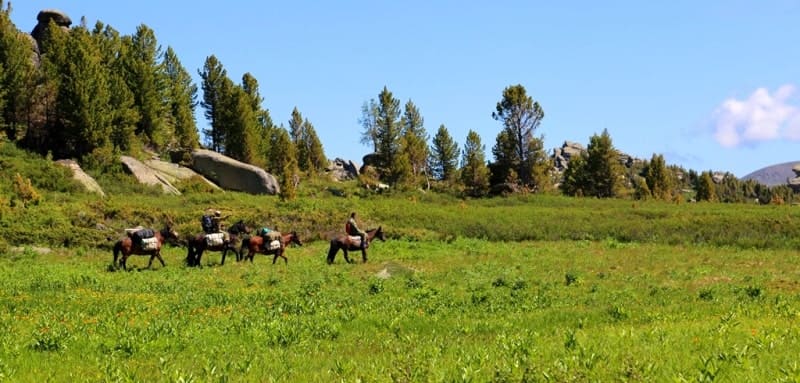
In July 2019, the author and friends hiked to Third Beloubinskoye Lake on horseback. The journey took place in the high-altitude natural environment of the West Altai Nature Reserve. The road to the lake allowed them to see one of the most beautiful corners of Altai, where harsh mountain landscapes combine with clear bodies of water, snowfields, and thickets of dwarf birch.
Upon reaching the lake, the travelers were able to fully appreciate its natural surroundings. Several hours were spent by the lake, amid the silence and virtually untouched nature of the protected area. The juxtaposition of the lake's considerable water surface with the surrounding high-mountain slopes is particularly impressive.
Against the backdrop of the snowfields on the southern slope, the lake takes on a particularly striking and memorable appearance. For travelers, Lake Third Beloubinskoye is of interest not only as the final destination of the route, but also as part of a larger natural complex.
Here, one can see several interconnected elements of the high-mountain landscape: ancient moraine landforms, a lake basin, snowfields, the source of a mountain stream, and a cascade of small moraine lakes.
Geographic coordinates of Third Beloubinskoye Lake are: N50°17'24 E84°09'31



Authority and photos:
Alexander Petrov.