




You are here
Ak-Serai mausoleum in Samarkand.
Monuments Temurids in Samarkand.
"By all accounts, this structure dates back to the time of Timur or the Timurids and is undoubtedly a mausoleum. However, the vagueness and paucity of historical data make it mysterious, and even the idea that Timur and his grandson Muhammad Sultan were originally buried here is now questioned."
V. L. Vyatkin. Ak-Saray. "Antiquities of Samarkand." 1930.
Excursion tours to Ak-Serai mausoleum.
On the opposite side, next to the Gur-Emir Mausoleum, stands the Ak-Saray Mausoleum, considered the burial place of the male representatives of the Timurid family from the second half of the XVth century. The dilapidated structure retains its compositional core - a cruciform hall above an octagonal crypt.
Despite its relatively modest appearance, the Ak Saray mausoleum is one of the most important burial mazars in Samarkand due to its connection with the Timurid dynasty. Its construction was initiated by the Timurid ruler Abu Said, who wished to expand the enormous nearby Gur-Emir mausoleum, the burial place of the male line of the dynasty.
Abu Said died during battles with the Turkmens in Azerbaijan in 1469, and construction of the mausoleum was completed in the 1470s. Although Ak Saray lacks the impressive dome of the earlier Rukhabad mausoleum, it is distinguished by a beautifully designed centralized structure with a richly decorated interior.
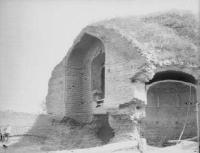
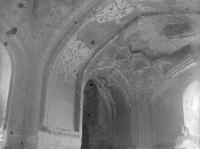
The mausoleum's architectural feature is a pointed arch (a vaulted hall with one end open, surrounded by walls on three sides) with standing figures that provide a sense of scale. Significant damage was clearly visible on the surfaces of the massive brick walls and vaults before restoration.
The mausoleum is renowned for its monumental interior paintings, which covered it entirely. These are among the finest examples of the organic fusion of structure and architectural sculpture of the dome, featuring intersecting arches and mesh-like pendentives.
The walls and ceilings were covered with gilded relief paintings called "kundal," featuring stylized ornamentation on a blue background. The interior of the hall was surrounded by a mosaic panel featuring an elegant design of flowerpots against a diagonal grid of blue and white tiles.
The crypt panel is faced with gray marble. Restoration work is underway to restore the mausoleum. Legend has it that a beheaded man is buried in a niche near its eastern wall. According to one version, this is the burial place of Ulugh Beg's son, Abdullatif, who was executed after his overthrow for the murder of his father.
Authority:
"Religious and Spiritual Monuments of Central Asia." Author: M. Khashimov. Saga Publishing House, 2001.
Ak-Serai temurids mausoleum.
The mausoleum of Ak-Serai is located to the southeast from Gur-Emir, deep in dwelling quarter of the old city. The majority of scholars agree that it is a male necropolis of the last Samarkand Temurids. The mausoleum dates from the 1470s, when dynastical necropolis Gur-Emir had exhausted its space for burying.
Another Temurid mausoleum - Ishrat-khana, probably, was constructed in the same years. The possible customer of the late mausoleums - Abu Sa’id (1451-1468-1469) from the Temurids, which in the mid-XV century, conquered Samarkand and Maverannahr with the help of nomadic Uzbeks, headed by Abulhayr-khan.
The closest adviser of Abu Sa’id was Khodja Akhrar, a chief of Central Asian Sufis "naqshbandiyyah". In 1457, Abu Sa’id conquered Khurasan and became the third, after Amir Temur and Shahruh, Temurid king, which succeeded in centralizing of Maverannahr and Khurasan. He transferred the capital to Heart.
In 1468-1469 Abu-Sa’id was killed in the battle with Turkmen Ak-Koyunli in Azerbaijan. Externally, Ak-Serai with its not-decorated walls and not finished external dome makes impression of simplicity. However, the building has a composite layout.
It includes the memorial hall (ziaratkhana), cross-shaped in plan, the corner cells and three-parted hall. From here, the passage is going down to the underground octahedral crypt, facing with marble. At its eastern wall, inside a special niche faced with marble, there is a tomb of some headless person.
According to one of existing versions, he is a son of Ulugbeg, Abdullatif (1449-1550), which lost his head after dethronement. The hall is covered by a dome on crossed arches and pendentives. The panel with remains of refined mosaics decorates the lower parts of walls.
The walls, pendentives and dome are covered with the ornamental paintings, done in technique of "kundal", richly gilded.
Authority:
Alexey Arapov. Samarkand. Masterpieces of Central Asia. Tashkent, San’at. 2004.