




You are here
Besshatyr burial mounds is burial place of Saka-Tigrakhauda kings.
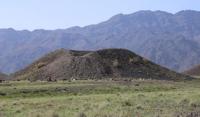
Besshatyr is necropolis of Saka nomadic elite.
"On the other side of the Gerras River (west of Molochnaya) are the so-called royal domains, where live the bravest and most numerous Scythians, who consider other Scythians their slaves. In the south, they extend to Taurica, in the east to the ditch dug by the descendants of the blind, and to the marketplace on Lake Meotia, called Kremny. Part of their domain extends to the Tanais River. To the east of the Scythian farmers, on the other side of the Panticapae River, live the nomadic Scythians, who neither sow nor plow. This entire country, with the exception of the gilei, is treeless. The nomads occupy the area to the east, a 14-day journey away, extending to the Gerros River. On the other side of the Gerros River are… the royal domains."
Herodotus of Halicarnassus. "History." § 19, 20. 430 BC
Photos of Central Asia.
Ili Valley is a unique natural corridor formed by the Trans-Ili Alatau mountain ranges in the south and the Malaisary, Sholaktau, Altyn-Emel, and Katutau ranges in the north. From west to east, the valley is open for 600-700 km, from the Balkhash sands to the city of Kuldzha.
Only in one place is this vast corridor partially blocked by the "last shield" - the always bluish, hazy Ayakkalkan Mountains. Strong, persistent northwesterly winds bring the hot breath of Betpak-Dala and Sary-Ishik-Otrau in summer, and in winter they blow the snow clean off the plain on the right bank of the river.
The Ili Valley's geographic location determined its significant historical role. It serves as a wide passage connecting Kazakhstan and Central Asia with East Turkestan and further on to China, which facilitated the early establishment of economic and political ties between the countries, the interpenetration and mixing of tribes, and the mutual influence of cultures.
The narrow strip of the right bank of the middle reaches of the Ili River, where the majestic burial mounds of Besshatyr are located, is bounded to the north by the Sholaktau Mountains and to the south by the river itself. The terrain is densely indented by large and small sais (river valleys) formed by rain and floodwaters flowing down from the mountains.
The vegetation is sparse, only in rainy years and early spring is the surrounding area covered with a vibrant carpet of wildflowers and ephemerals. The rest of the year, only thickets of reeds and shrubs, dzhida (sedge) and chingil (grass) are found on the low, flooded floodplains of the Ili River.
The Besshatyr burial ground is located at the foot of the Zhelshalgyr Mountains, at the entrance to the Shilbyr Gorge, 3 km from the riverbank and 100 km east of the village of Iliysk. The locals call the monument the Besshatyr Grave. From the elevated site, open on three sides, where the burial ground is located, the entire left bank of the river, right up to the spurs of the Zailiskiy Alatau, is clearly visible.
The first and only account of Besshatyr appears in the work of V.D. Gorodetsky. It merely mentions that there is a burial site on the right bank of the river. Or the Besshatyr burial mounds are located and that V. Parfentyev visited them in 1924.
The works of other researchers known to us, who studied Semirechye at various times, mention nothing about this site. The Besshatyr burial ground extends 2 km from north to south and 1 km from west to east. It consists of 31 burial mounds, 21 of which have stone coverings and 10 with a mound of rubble and earth.
There is no specific pattern in the arrangement of the mounds, but two more or less compact groups can be distinguished: northern and southern. The northern group consists of six stone mounds. It includes the three largest burial mounds: the Bolshoi, Second, and Third Besshatyr Mounds.
The southern group of mounds is located 0.5 km from the northern group and comprises four stone mounds, arranged in a chain in a meridional direction. Five small rubble mounds adjoin the chain on the northwestern side, while others are scattered throughout the burial ground.
By the size of their mounds, the mounds can be divided into large, medium, and small. Large mounds range in diameter from 45 to 105 meters, and their heights from 6 to 17 meters; medium mounds, respectively, are 25-38 meters and 5-6 meters, and small mounds are 6-18 meters and 0.8-2 meters.
Over four years (1957, 1959-1961), 18 mounds were excavated in the burial ground, three of which were large, and the rest were medium and small. In 1957, two small burial mounds (24 and 25) were uncovered, in 1959 - a large one - the Sixth Besshatyr burial mound and five small burial mounds (15, 26, 27, 29 and 30). The largest number of burial mounds were excavated in 1960. This year, the following were investigated: the Third Besshatyr burial mound, two medium-sized ones (8 and 14) and six small ones (17-22).
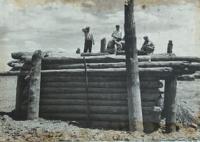
Unfortunately, all the burial mounds, with rare exceptions (25), were looted by people familiar with the structure of these Saka "pyramids." However, despite this, the Besshatyr burial mounds yielded not only excellent dating material (daggers, arrowheads) but also, most importantly, previously unknown types of monumental grave structures, which allowed for a new understanding of the culture of the Saka tribes of Semirechye, the level of their construction technology, and their use of wood, stone, and reed in the construction of residential and religious buildings.
Furthermore, a thorough study of the log structure yielded data on the woodworking methods and primary carpentry tools of the ancient inhabitants of these areas. Their external surface structures, complex embankment structure, and monumental burial structures suggest that the Besshatyr burial mounds are not simply grave mounds, but outstanding monuments of Saka architecture.
Note:
1 V. D. Gorodetsky. “Antiquities of the Semirechensk (Dzhetysu) region.” Archive of the Institute of Atomic Energy of the Kazakh SSR Academy of Sciences. Manuscript fund, inv. No. 37, p. 16.
Authority:
K. A. Akishev, G. A. Kushabaev. "The ancient culture of the Sakas and Usuns of the Ili River Valley." Academy of Sciences of the Kazakh SSR. Institute of History, Archeology and Ethnography named after. Ch. Ch. Valikhanova. Publishing house of the Academy of Sciences of the Kazakh SSR. Alma-Ata. 1963.